My portfolio review for Q1 2015

Each quarter I review the UKVI model portfolio to make sure it's doing what it's supposed to be doing, or to give an explanation if it isn't.
But before I get into the gritty details of whether the portfolio is up or down I'd like to draw your attention to some other things that matter just as much as raw performance numbers.
Investment goals
To hit a target you first must have a target, so the first thing to review is the investment goals by which I define success. There are four basic investment goals for this model portfolio:
- High yield – Higher than the FTSE All-Share at all times
- High relative return – Higher total return than the FTSE All-Share over any 5-year period
- High absolute return – Total returns of more than 5% after inflation over any 5-year period
- Low risk – Lower than the FTSE All-Share (measured using volatility and drawdown)
Investment strategy
That's where I want to portfolio to go, and here's a quick overview of the investment strategy I'm using to take it there:
- Buy a diversified group:
- Of good companies:
- At attractive valuations:
- Hold for the long-term:
- Target an average holding period of 5 years
- But sell occasionally to reduce risk and lock in capital gains:
There is a bit more to it than that of course, but that's the basic picture.
Performance review
As you probably know, 2015 started with a bang. After 2014, where the UK large-cap market more or less went nowhere, 2015 has seen the FTSE All-Share increase by more than 6% in just the first quarter.
The more familiar FTSE 100 has gone from 6,500 at the start of the year to 7,100 today, blasting through both new highs and the seemingly insurmountable 7,000 barrier along the way.
However, I don't have any short-term return goals so I don't generally think about performance over such a short period of time. Instead I prefer to concentrate on how the model portfolio had done over the past few years relative to its FTSE All-Share benchmark.
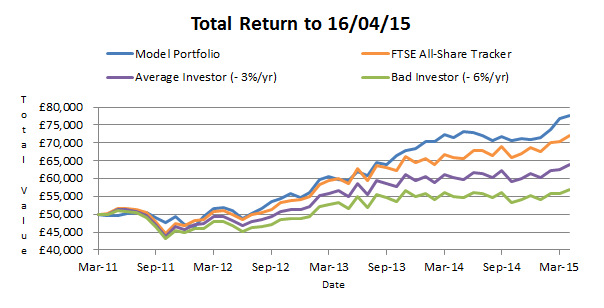
Today the model portfolio stands at £77,760, some £5,500 ahead of its FTSE All-Share benchmark, which now has a value of £72,060. Note that these results include the negative impact of broker fees and stamp duty.
So how has the portfolio done in terms of its investment goals?
- High yield – Its historic dividend yield is currently 3.6% compared to 3.8% for the FTSE All-Share
- High relative return – From inception the portfolio's rate of return has been 11.4% a year compared to 9.4% for the FTSE All-Share
- High absolute return – CPI inflation has run at 2.3% since March 2011, so my absolute rate of return goal is 7.3% a year. The portfolio's actual rate of return is 11.4% a year
- Low risk – The portfolio's monthly volatility has been 19% less than the FTSE All-Share's. The largest peak-to-trough decline for the portfolio is 8% compared to 13.5% for the FTSE All-Share
Overall then the portfolio met its high return and low risk goals, but failed to meet its high yield goal this quarter.
Looking at the details of that failure, there is no reason to panic just yet. The FTSE All-Share investment trust benchmark currently has a relatively high historic dividend yield because of the massive one-off payment from Vodafone last year. You can see how this has skewed things in the chart of reinvested dividends below:
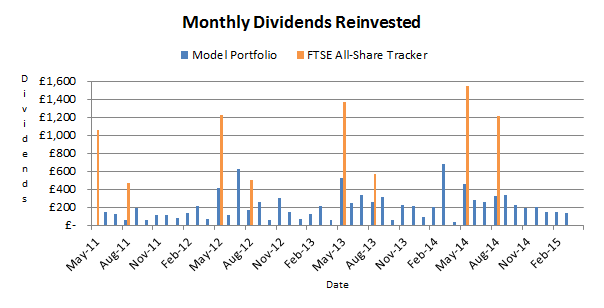
The orange bars are the twice yearly dividends paid out by the FTSE All-Share investment trust, with a large final payment and a much smaller interim payment. However, in 2014 the interim payment was almost as large as the previous final payment.
The model portfolio holds Vodafone and so it also benefited from that company's massive special dividend (which shows up as large blue dividend in March 2014), but that dividend has now dropped out of the trailing 12-month dividend figure and no longer forms part of the portfolio's 3.6% historic yield.
The FTSE All-Share on the other hand delays dividend payments and so its Vodafone dividend was paid several months after the payment to direct shareholders (in August rather than March), and so that dividend still makes up part of the All-Share's 3.8% historic yield.
I expect that once the Vodafone payments drop completely out of the picture the model portfolio will once again have the higher yield, but only time will tell.
Biggest winners and loser during the quarter
Although not strictly necessary for a review, I always find it interesting and educational to look at just how volatile individual shares can be. It reminds me of the importance of diversification and why I hold 30 companies from a wide range of geographies and industries.
- JD Sport up 48% – JD Sport has been a big success for the portfolio over a long period of time. It has been a holding since the beginning in March 2011 and has returned 131% so far.
- Serco down 64% - Much like Balfour Beatty, Serco was an unsuccessful step into the world of businesses that must repeatedly replace large, complex contracts.
If I focused on each individual company then I would be riding a very dangerous emotional roller coaster, with elation in one minute as JD Sport increases profits by 25% and desolation the next as Serco suspends its dividends.
But I don't focus on each company; I focus instead on the overall value of the portfolio which has, on average, gone up by almost 1% per month over the past four years (and up by 9% over the last quarter). That makes the investment process much less stressful than it would be if I focused on individual companies.
Stocks bought and sold during the quarter
As I mentioned above, part of my strategy is to make one trade each month; either one buy or one sell decision, alternating between the two.
Since the start of the year I've made the following trades:
- January - Bought a FTSE 100 pharmaceutical company
- February – Sold ICAP, the FTSE 250-listed inter-dealer broker
- March – Bought a small cap media company (but not that small as its market cap is almost £500m)
- April (not technically Q1) – Sold Balfour Beatty after an eventful but ultimately fruitless three years
Having sold Balfour in April I am now looking forward to reinvesting the proceeds into something else at the start of May.
Disclaimer
This is not financial advice. Our content is intended to be used and must be used for information and education purposes only. Please read our disclaimer and terms and conditions to understand our obligations.
No comments yet
No one has commented here yet! Why not be the first one?