NRW Holdings: overcoming the challenges

Mining services companies can be risky ventures. Over the last few years quite a few have met an untimely demise. RCR Tomlinson’s 100 year history came to a sorry end in 2018. Others that no longer grace the ASX boards include Titan Energy Services and Forge Group. One that flirted with disaster in 2015 but has since gone from strength to strength is NRW Holdings (ASX:NWH).
In 2015 NRW recorded a loss of $230 million. This was due to a major slowdown across the resources sector along with one particularly ill-fated project. Samsung C&T had sub-contracted NRW to work on the Roy Hill Rail project, part of Gina Reinhart’s Roy Hill iron ore project in the Pilbara, WA. This was Samsung C&T’s first mining construction project and they ended up losing about $1 billion on it. Many of the sub-contractors also suffered large losses, including NRW who booked an impairment charge of $157m. By February 2016 the share price had fallen as low as 5 cents, with the market capitalisation having plummeted from over $1 billion four years prior to about $14 million.
Those who had great foresight and a strong stomach in early 2016 would now be sitting on gains of about 50 times.
The company rebounded to profitability in 2016 and those profits grew every year until 2021. 2021 was a tough year for NRW with the pandemic induced border closures leading to chronic shortages of staff, making it very difficult for NRW to fulfil their contract obligations. Profits rebounded to a good level in 2022 and are forecast to continue growing for at least the next two years. In 2022 profits reached almost 100 million, more than six times the entire market capitalisation six years prior.
NWR have now expanded from focusing purely on mining services to also include infrastructure and urban construction in their portfolio. The nature of most of their revenue is project based. The risk with projects is that they are usually costed on fairly tight margins. NRW generally operates on single digit margins. As many projects run for multiple years a lot of unforeseen things can occur. It does not take a lot for costs to blow out and for the project to suddenly be operating at a loss.
These risks were highlighted again in 2019 as they had to write-off costs on the Gascoyne Gold project when Gascoyne Resources went into administration. This resulted in their Earnings before interest and tax (EBIT) being reduced by about one third.
With that introduction you would have to wonder why anyone would contemplate investing in a mining services company?
There is an old adage that the people who make the most money from mining are the ones selling the picks and shovels rather than the miners themselves. Whilst mining is a very cyclical business, subject to the market driven pricing of commodities, for as long as the global economy consumes mineral resources there will always be demand for companies that supply products and services to the miners.
Looking specifically at NRW, they have been around since 1994 and listed since 2007. Throughout that time they have ridden booms and busts and have managed to grow their revenue from $278 million in 2007 to $2.4 billion in 2022
NRW generates strong cash flow. Over the last five years they have generated a cumulative $826 million in operating cash flow. $641 million has been reinvested in the business, including some material acquisitions of other businesses. $115 million was paid out as dividends leaving a further $64m to pay down debt and add to the bank balance. Their Bankruptcy Risk is in the Safe zone.
| 2018 | 2019 | 2020 | 2021 | 2022 | 5 yr total | |
|---|---|---|---|---|---|---|
| Cashflow from Operations | 75 | 100 | 216 | 147 | 288 | 826 |
| Cashflow from investing | -115 | -86 | -193 | -122 | -125 | -641 |
| Cash flow after investing | -40 | 14 | 23 | 25 | 163 | 185 |
| Cash Dividends paid | -15 | -18 | -35 | -47 | -115 | |
| Other financing cash flows | -1 | -5 | -6 | |||
| Funding Surplus (Gap) | -41 | -1 | 0 | -10 | 116 | 64 |
Having a strong balance sheet allowed them to capitalise on an opportunity when RCR Tomlinson went under. They purchased the RCR Mining Technologies business for $10 million from the liquidators who were looking to sell off the assets. In the 2019 accounts this acquisition was valued up by $5.1 million as the fair value of the assets exceeded what they had paid.
Average shares on issue have increased at a CAGR of 7% over the last five years. A considerable portion of the increase in revenue has come from acquisitions as they have added complimentary businesses to their portfolio. This has been partially funded by the issue of new shares. They are reasonably disciplined in the execution of their acquisitions and last year pulled out of the race to acquire mining services group MACA as the price was bid up.
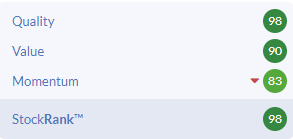
Despite the fairly tight profit margins, NWR consistently produces double digit return on equity with the most recent figure being 15%. This, combined with a good F-score and strong cash flow lead to a high Quality score of 98.
From a valuation perspective NRW does not look expensive. The price has retracted 26% from its peak in January which is making the valuation metrics look more attractive. It is trading on a 12 month Forecast rolling PE ratio of 9.2 and a forecast dividend yield of 6.8%. Dividend payments for the next few years are expected to be unfranked as they utilise the ATO’s temporary full expensing allowance.
It is also important to note that NWR, and indeed most mining services businesses, tend to trade on low PE ratios. This reflects the low margins and chequered history as outlined above.
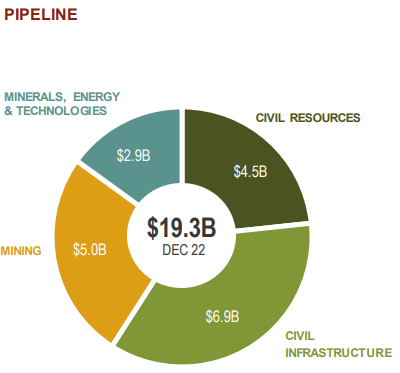
NRW is now a much larger business with a more diversified revenue base. They have positioned the business to reap rewards during the boom times and shored up the defences to ride through the troughs. Recent results were impacted by high rainfall levels in Queensland. They are often impacted by different external events, but that is partially mitigated by having a portfolio of projects well diversified across different sectors and geographies.
In what can be a challenging industry, NWR have steadily built themselves into a significant player. Their high StockRank of 98 supports this.
Important Information: Stockopedia Ltd ABN 39 757 874 670 UK business registration number 0637267 (“Stockopedia”) is an Authorised Representative of Daylight Financial Group Pty Ltd ABN 77 633 984 773 (“DFGPL”) which is the holder of an Australian Financial Services Licence (AFS Licence No. 521404).
Information in this commentary is current as at date prepared unless otherwise stated. However, please bear in mind that investments can go up or down in value, and that past performance is not a reliable indicator of future performance. For more Important Information please refer to the Disclaimer section of this website.
This communication may contain general financial product advice. It has been prepared without taking into account your personal circumstances, and you should therefore consider its appropriateness in light of your objectives, financial circumstances and needs before acting on it.
If our advice relates to the acquisition or possible acquisition of a particular financial product, you should obtain a copy of and consider the Product Disclosure Statement (PDS) before making any decision.
Disclaimer
This is not financial advice. Our content is intended to be used and must be used for information and education purposes only. Please read our disclaimer and terms and conditions to understand our obligations.
2 comments
Nice write-up Chris.
I wonder about how to determine cyclical nature of a co, how this might be taken into account in stockopedia. Ie if a recession could unfold in the next 18mths. I suppose that would be a macro/global liquidity factor, not covered.
Hi Jonner,
Macro factors are not covered directly in Stockopedia, however you can use analysts forecasts to get an indication of what type of macro conditions they may be expecting. For example you can look at forecasts for revenue over the next two years. In the case of NWH they are forecast to keep growing, whereas for some other companies they are forecast to decline. This suggests that if analysts are expecting a recession in the next two years they do not expect it to have a significant impact on NWH.