One key rule for volatile markets

Hi everyone, I'm Gareth, a new member of the Stockopedia content bureau! I'll be providing short and long-form pieces on prevalent investing themes, complementing the amazing analysis from Graham and the team.
This article follows on from our recent webinar, 10 Results Seasons Opportunities, which analysed the strongest themes and shares in the current market. Didn’t catch it live? You can watch the full replay here.
When markets get choppy, it’s easy to get fixated on the direction of the headwinds.
Which companies are at risk? Which positions should I unwind?
But that’s first-order thinking. Derisking can be wise, but it also leaves us easily wrong-footed by capricious politicians and agenda-led reporters.
Take the current crisis. A quick sentiment analysis shows that since the Iran conflict erupted on Feb. 28, there have been eight significant ‘mood swings’ in the global news media about the prospects of a deal.
Both sides optimistic > Claim contradicted > A partial deal is announced… the market has turned on each flip and flop.
So try this rule instead
Instead of thinking about who wins and who loses, why not ask ‘who gets paid either way?’
Lots of companies benefit from volatility itself. Take brokers. Investors tend to trade furiously in choppy times, looking for short-term price movements. And brokers don't need markets to go up or down, they just need them to move. The more uncertain the world becomes, the more activity they can profit from.
The current climate throws up several specific examples.
- The interdealer brokers that match buyers and sellers of complex instruments.
- The transport and logistics firms that get paid on rerouted journeys.
- The insolvency and restructuring advisors for whom distress is a business model.
The choppier the world gets, the more indispensable each of these business becomes.
A case study: spread-betting companies
Spread betting is arguably the clearest example of an industry that benefits on volatility.
Spread betting companies make their revenue from spreads, commissions and financing fees. Volume is everything. And volatility drives volume.

Let’s consider three UK stocks in this space.
- IG Group (LON: IGG)
- CMC Markets (LON: CMCX).
- Plus500 (LON: PLUS).
The scale of these companies is very different. IG’s market cap is nearly five times that of CMC Markets. And their operating models are different too.
IG tends to hedge all client positions for a more predictable earnings profile. Plus 500 hedges far less and relies more heavily on client losses exceeding gains. CMC is somewhere in the middle.
But their current fortunes follow a similar trajectory.
- IG’s total revenue hit a record £1.12 billion in 2025, with net trading up 10%. Q1 revenue is up 7% on the prior year.
- Plus500 delivered revenue of approximately $792 million (£586 million) in 2025, ahead of market expectations. Q1 revenue rose 18% Y/Y to $242.1 million.
- CMC’s dividend for the full year rose 37%. In November, the company said it expects its fiscal year 2026 net operating income to be about 10% ahead of current market estimates of £353.9 million.
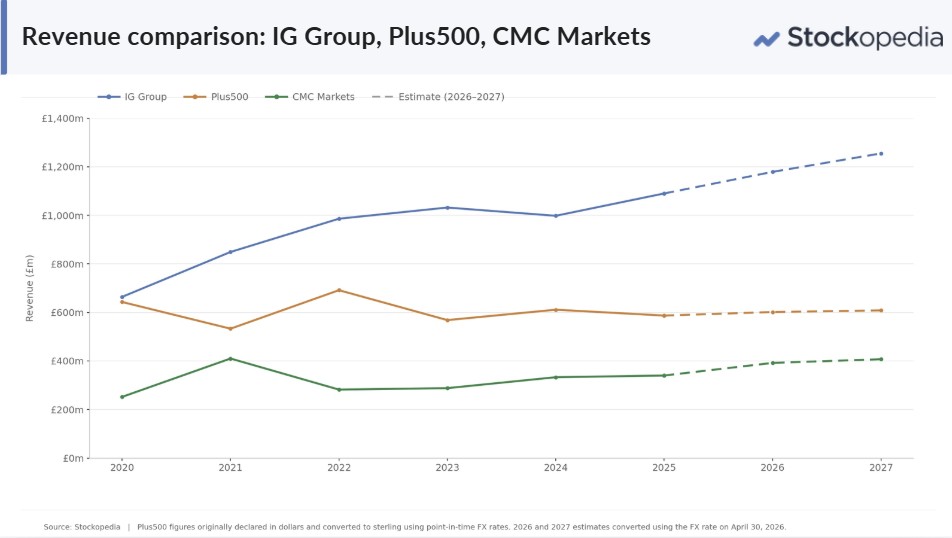
The companies themselves freely recognise their dependence on turbulence. Announcing IG’s Q1 2026 results, CEO Breon Corcoran identified “heightened market volatility” as a key driver. CNC’s half-year results talk of “periods of healthy market volatility” fuelling performance.
But these companies aren’t just ‘fear plays’
It would be easy to write these off as cyclical flash-in-the-pans. Businesses you buy when panic spikes and sell when the world cools down.
But the numbers? They tell a more interesting story.
All three carry StockRanks in excess of 85 on Stockopedia, with IG and CMC in the mid-90s.
None offers compelling value against their book value or sales. They are not cheap stocks by conventional measures.
But in this case, it’s the quality metrics that stand out.
- All three generate exceptional returns on equity, carry strong operating margins, and are highly cash-generative.
- This combination - structural leverage to market activity, plus durable profitability - is what separates them from simple momentum trades.
On a bearish note, if markets were to take a significant tumble, OTC and spread betting volumes could decline and lead to falling revenues for these companies.
However, all three are genuinely excellent businesses that happen to make more money when the world gets noisier.
Our analyst team have recently written up deep dives into both IG Group (by Graham Neary) and CMC Markets (Mark Simpson). Do read up to learn more.
The same principle applies elsewhere
You might think that Clarkson (LON: CKN), the world's largest shipbroker, would be decimated by the current crisis in Iraq. But look a bit closer.
Geopolitical disruption - Red Sea diversions, sanctions, tariff wars - adds complexity and distance to shipping routes, driving demand for both brokerage services and data. Clarkson’s Research division, which provides intelligence in precisely the conditions where intelligence is most valued, now generates 92% recurring revenue.
TP ICAP (LON: TCAP), a ‘broker of brokers’, is another fascinating case. As an intermediary in wholesale financial markets - rates, credit, FX, energy - market stress isn’t a headwind for this business. It’s the business model.
Both Clarkson and TP ICAP are robust businesses, with excellent returns on capital and equity.
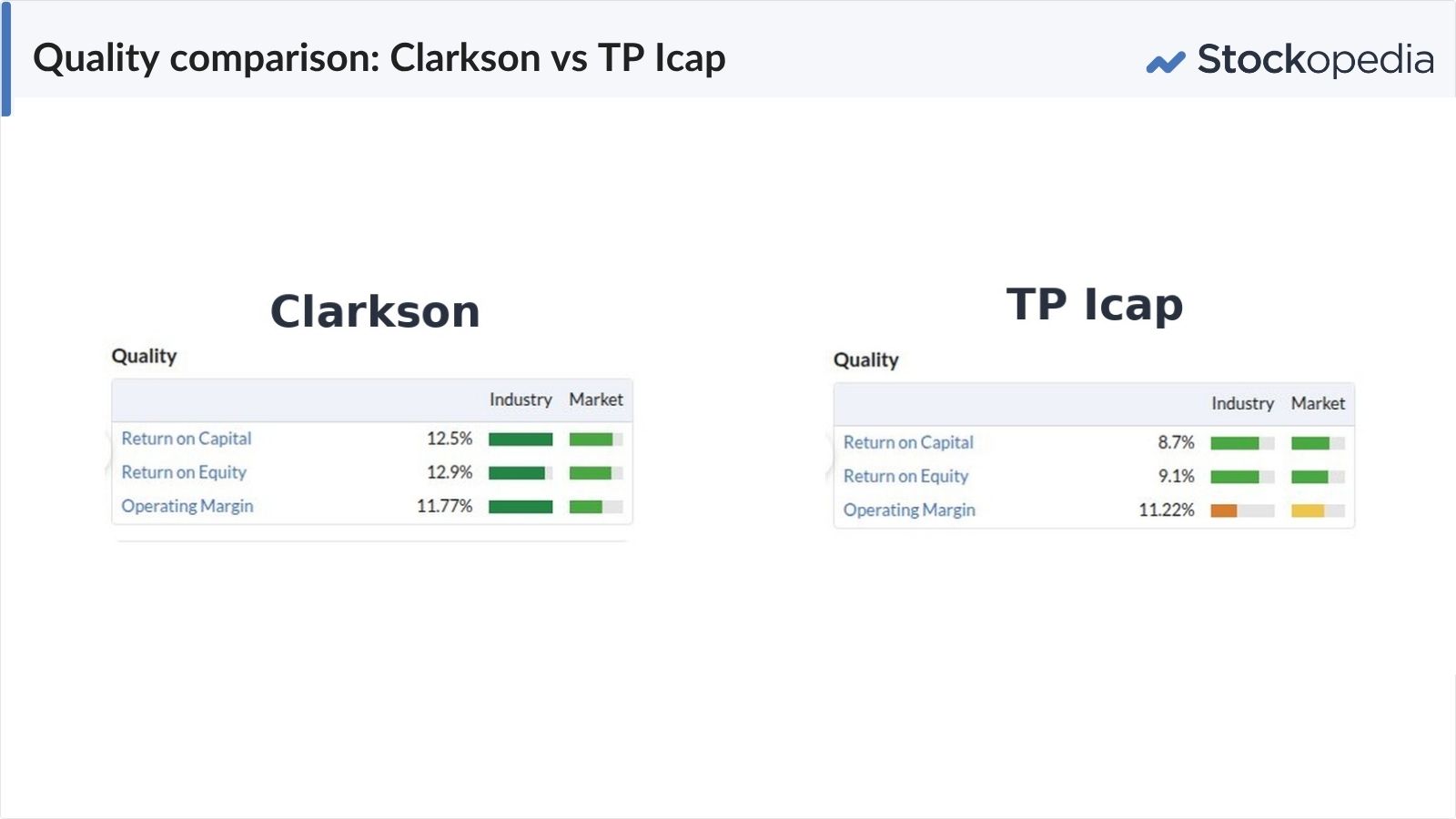
However, their relationship with volatility is clear: both generate more activity precisely when clients are most uncertain.
So the next time you’re weighing up a stock, ask yourself: Does this company get paid on outcomes, or on activity?
If their revenue is driven by the act of markets moving rather than the direction they move in, they become resolute plays when the world gets choppy.
As we get deeper into 2026, the headwinds are sure to change direction. We may see a cessation of hostilities in Iran. The ‘AI-pocalpyse’ panic may infect a whole new set of industries. An entirely new theme might enter the fray.
But as these global narratives play out, keep asking the same question: who gets paid?
Reminder: if you still haven’t seen our webinar on 10 Results Season Opportunities, it’s worth checking. We’ve got a section on volatility (including profiles of the three featured spread-betting companies) as well as dedicated segments on the bifurcation of consumer companies and the emerging phenomenon of HaLo stocks.
Check it out here.
Disclaimer
This is not financial advice. Our content is intended to be used and must be used for information and education purposes only. Please read our disclaimer and terms and conditions to understand our obligations.
7 comments
Useful ideas thank you, but if I may say calling Clarkson and TP ICap table figures excellent roe and roc is a stretch . In line with magic formula excellent would be north of 20%.
Fantastic article, great to keep up looking at the wood when distracted by the trees. Thanks and welcome Gareth
CME and Interactive broker are of interest for those who seek the US equivalent.
Absolutely excellent article. If for not other reason that it reinforces my current strategy!!! I have IG group (LON:IGG) , TP Icap (LON:TCAP) and Viel et Compagnie SA (EPA:VIL) as a core part of my financials holdings.
I've been looking to compile a list of articles on strategies for when markets are falling or volatile. This will be added to it. Thanks.
Perfect Thank you
Welcome Gareth and a great first article. Some thought provoking points.