One Way to Become an ISA Millionaire

Despite their popularity, long history and the potential offered for compounding returns tax-efficiently it is surprising that according to anecdotal evidence there are only around 100 ISA millionaires in the UK out of a total of 24.3 million people who hold ISAs.
A staggering £442.8 billion was held in Cash and Stocks and Shares ISAs at September 2013 with the average value of a Stocks and Shares ISA worth £25.9k in April 2011 (all data from HMRC Individual Savings Account (ISA) Statistics, September 20131).
It seems odd that this hugely successful scheme to encourage savings and investments should have been the subject of a debate by policy wonks at the Treasury on placing a cap on the value of an individual ISA, in a manner similar to the lifetime allowance in an approved pension scheme. This might have been prompted by concerns over a few investors doing very well but given the estimated annual tax cost to the Exchequer of ISAs in 2012-13 was just £1¾ billion1,2, or 0.4% of the value of total assets held, the average tax cost per ISA holder to the Exchequer is just £71.85 per annum.
A better discussion might have been had around how to encourage the public to become more astute in their savings and investment decisions, even more relevant now following the banning of commissions for the provision of financial advice to retail customers at the end of 2012. This should start by explaining why Stocks and Shares ISAs generally perform better than Cash ISAs. The average Cash only ISA was worth just £7.35k in 2011 despite securing nearly 70% of investors’ annual contributions. Lower contribution limits, low interest rates and regular withdrawals are all to be blamed. The power of compounding is not being given a chance to work.
In a Stocks and Shares ISA, particularly a self-directed one, compounding has greater scope to produce its magic. Someone making the maximum contribution each year to a Stocks and Shares ISA since the savings wrapper was launched in 1987 (initially as a Personal Equity Plan or PEP which were merged with ISAs in 2008) could have amassed tax-free savings worth around £649,325 had he or she only matched the performance of the FTSE 100 (on a total returns basis), around 7.66% p.a. A married couple making the maximum contribution and achieving the same annual return would be worth £1,298,6493. The maximum contributions would have totalled £212,280 for an individual or £425,560 for a couple over the 27 year period.
But of course things are not so simple. Few people are able to save regularly and save significant amounts each year. People with young families and/or those trying to buy a home have competing demands on their resources. I know I had this problem when I opened Personal Equity Plans for my spouse and I back in 1993. In fact, until 2006, my spouse and I had contributed just £59,459 to our ISAs/PEPs (net of £14,575 withdrawn in the late 1990s and early 2000s), representing just 22.1% of the amount we could have contributed since 1993 or 16.2% of the total we could have contributed had we started saving in 1987.
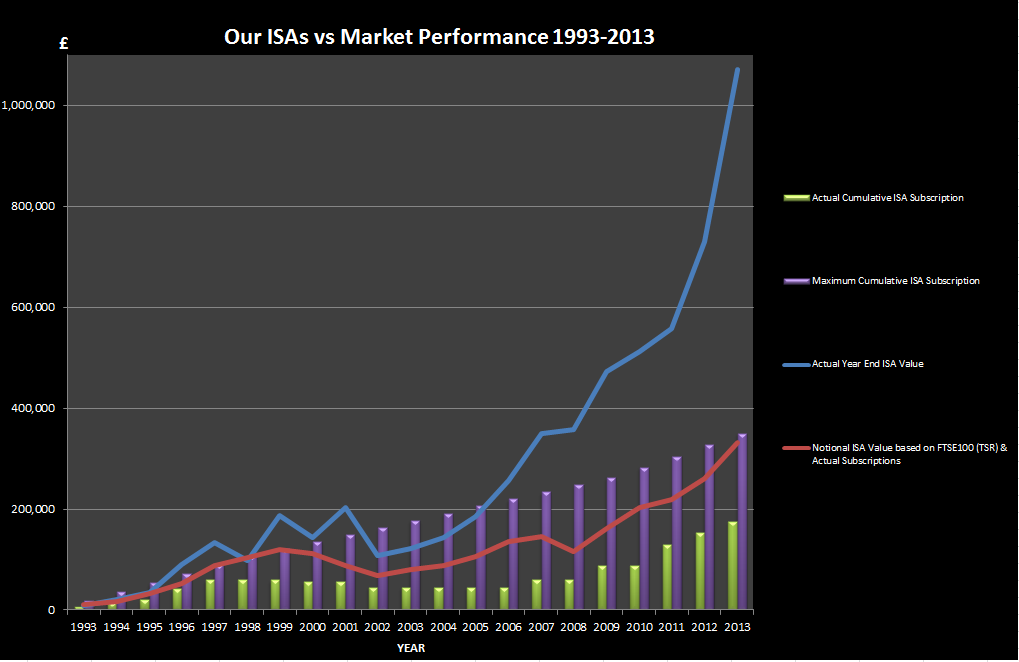
Despite the paucity of our contributions, by the end of 2006, our Stocks and Shares ISAs/PEPs were worth £256,800. Today, that figure has reached just over £1 million4. True, we have been utilising our annual contributions in full in recent years but even now our total contributions only make up just over 50% of the amount we could have saved since 1993 and 41.4% of the total we could have contributed had we started saving in 1987.
The money we invested back in 1993 has increased 40.04 times, representing an annual return of 19.45%. The FTSE 100 on an estimated total return basis has increased 4.34 times over the same period, an annual return of just 7.33%. Our internal rate of return, which factors in the timing of subsequent contributions and withdrawals, is running at around 16.3% per annum. We have beaten the FTSE 100 on a total shareholder return basis 13 times out of 21 on an annual basis, 16 times out of 17 on a five year rolling basis and over all 12 ten year rolling periods. Performance in recent years has been particularly strong, 26.5% up in 2012 and 42.8% up in 2013.
What lessons have been learnt along the way to becoming an ISA Millionaire?
Start as young as you can to give the law of compounding the longest time to work. If you have children under 18 years old you can subscribe up to £3,720 p.a. on their behalf to a Junior ISA. It is a great way of getting them used to thinking about finance and is good experience if they plan to work in the City where it is all about using “other peoples’ money”!
Use a quantitative led approach to filter the investment universe. It is too big, you do not have the time to understand it all and a quantitative led approach affords you some protection from promoters of “good stories.”
Run a concentrated portfolio when you are young. Typically, at this stage of your life, your portfolio value will be modest, you will have limited time for research and you still have the chance to "rebuy" in the event of a major loss on a share out of your future earnings. Investing in your best ideas makes sense as it gives you the chance to outperform. Holding between five and ten stocks is perfect but this should grow as time goes by and the value of your portfolio increases. We currently hold only 17 stocks in our ISA and about 35 overall if you include my SIPP and our general trading accounts.
Cut losses and run profits. Everyone should know about this rule but few private investors have the discipline to apply it (including me from time to time!). Remember, when you sell a losing investment you are no worse off than you were immediately beforehand. In fact, there are big psychological benefits to be had from ridding yourself of a losing position. Since 1993 only around 64% of my ISA investments have been profitable. An embarrassingly large 36%, were losing trades but critically only a quarter of these involved losses of more than 20%. Furthermore, I did not suffer a single 100% loss despite owning at least four companies over the years which subsequently went bankrupt after I sold them.
Running profits can be difficult especially when a single share becomes dominant in your portfolio but it is consistent with the buy and hold approach used by successful investors like Warren Buffett. A single multi- bagging share can pay for many small mistakes. Four of our ISA investments have generated in excess of £100,000 each in profits/dividends. All involved a patient buy and hold strategy. These were Autonomy, Capita, Beazley and more recently Lloyds Banking Group. A buy and hold approach keeps transaction costs to the minimum and forces you to think carefully about the kind of stocks you want to own.
Try to avoid blue sky stocks and leveraged products. Focus instead on value and quality. With the exception of Autonomy all my blue sky investments have produced losses. I lost particularly heavily on Torotrak and Easynet in the late 1990s and early noughties when I started flirting with story stocks. Almost a decade later, I started playing around with leveraged ETF funds focussed on movements in stock market indices and commodities with damaging consequences for my portfolio and ego! Almost 90% of my trades in this area lost money but the maximum drawdown on any one bet was only 19%. In contrast 70% of my Value and GARP (Growth at a Reasonable Price) investments have been profitable over the two decades and almost 90% of my quality orientated investments have paid off.
Focus on Quality at a Reasonable Price ("QARP"). I like companies that generate high rates of return on capital/assets bought at reasonable prices. Such companies generally outperform over time as they require relatively modest amounts of capital to preserve their business franchise. They typically generate strong free cash flow, which can be reinvested in the business at high rates of return and be used to grow earnings through acquisition without the need for significant additional equity or debt. Surplus cash can also be used to support a progressive dividend and fund special dividends and share buybacks. I also like companies that are able to generate high gross and operating profit margins, as this will often indicate the presence of a strong business franchise.
I do not like to pay more than 12 to 13 times earnings for a quality stock. This equates to an initial earnings yield of 7.7% to 8.3%, which if earnings broadly equate to Free Cashflow represents an excellent cash return on investment. Any above inflation growth in earnings is a bonus. I might be tempted to pay more for a fast growing quality company so long as I am comfortable with its medium and long term prospects and cashflow characteristics. Shares in our ISAs which currently meet (or have met) my QARP criteria include Bioventix (BVXP), Dragon Oil (DGO), Euromoney Institutional Investor (ERM), Judges Scientific (JDG) and IG Group (IGG).
Bioventix plc: A Classic QARP Stock
- Listed on ISDX with a market cap of £21m;
- Specialises in the development of monoclonal sheep antibodies for use in clinical diagnostics for a range of conditions, including heart disease, Vitamin D deficiency and cancer;
- Annuity style royalty revenues on existing antibodies should guarantee growth of 15% to 20% p.a. to 2020;
- Most of the team now working on new anti-bodies for 2020 and beyond;
- EBIT £1.8m on sales of £2.7m (an EBIT margin of 67%);
- Sales have quintupled over 6 years;
- Return on Tangible Assets 40% (94% if you exclude the £2.6m of net cash);
- Operating cash flow typically 90% + of operating profits;
- Prospective P/E of 12.5 & dividend yield around 4.0% (based on an offer price of 450p)
I have written more extensively on Bioventix see here.
Own Individual Shares. Sadly, of the £442.8bn invested in ISAs only £26.4bn or 8% is invested directly in stocks, shares and other securities1. The vast majority is held in cash or invested in unit trusts, OEICs and other collective investment schemes. Achieving ISA millionaire status investing solely in collective investment schemes can be done if you have the time and savings capacity but otherwise the journey will be long and slow.
I believe it should be possible for a private investor to significantly outperform both the market and most fund managers. Although fund managers are typically very bright and have a huge reservoir of knowledge, experience and resources to draw on there are a number of reasons why it is hard for them to outperform on a consistent basis. First, most fund managers are focussed on their careers which means the objective is to achieve relative out performance rather than absolute returns. Making a big call on the market runs the risk of damaging a manager’s career if he or she gets it wrong.
For instance, I sold almost all my investments in March 2008 and did not re-enter the market for a full twelve months. In 2008, our ISAs actually increased in value by 2.5%, whilst the market was down over 30%. I was prepared to look stupid if I got it wrong because it was more important to me to protect the absolute value of our ISAs. A long only fund manager would have been happy running up a loss of less than 30% in 2008.
Second, assets under management drive fund managers’ fees so the incentive is to grow big. It gets harder to beat the market when running a large fund. A large diversified portfolio effectively removes the non-market or specific risk associated with individual investments, thereby linking performance closely to market returns.
Third, fund managers don’t have much of a reverse gear. This is particularly true when a fund takes a big position in a relatively illiquid stock. If they get it wrong it can be very hard for them to unwind the position. Private investors can be far more nimble. They can exit a poor investment more easily. The corollary is that if you know you can get out quickly you might be tempted to rush in having done too little research. Be warned!
Finally, fund managers charge fees. A typical annual total expense ratio of 1.5% represents around 20% of the annual return achieved by UK equities since 1993.
Never forget the importance of liquidity and knowledge. I prefer to invest across the spectrum of micro/mega cap balancing the liquidity benefit this brings with the knowledge edge available in the smaller cap arena.
Meet the managers (in some cases this can mean meeting the Fockers!). In recent years I have had the opportunity of meeting hundreds of management teams. Organisations like ShareSoc, Equity Development, Mello, Blackthorn Focus and Proactive Investors arrange meetings with company management for private investors. Usually held in the early evening these events are essential for those looking for an edge in the market but they should come with a “wealth warning”. Top managers are usually great salesman and wonderful story tellers. You will need to be an excellent judge of character to avoid traps but if you keep a firm eye on the financials and valuation you should be protected from making too many mistakes. These events also provide an excellent opportunity to meet other private investors and discuss ideas. The standard is generally very high. I thought I was a pretty good private investor until I met some of the others.
Conclusion
Placing a cap on the value of investments that can be held in an ISA - as Treasury officials have been contemplating - only puts a ceiling on the aspirations of savers and investors and adds some of the complexities which have done so much damage to pensions. It would deter people from committing the time and trouble it takes to better understand their own finances and in turn those of companies and governments. It would also come at the very time we need to encourage people to be more financially self-reliant and less dependent on an indebted state.
Before Treasury officials rush to place a cap on the value of ISAs they should perhaps consider what kind of pension a million pound ISA would buy. If used to buy an annuity offering comparable benefits to a “gold plated” public sector pension (i.e. inflation indexed and partly transferable to a spouse on death) it would produce a pension of only around £30,000 per annum, less than many senior civil servants and public sector managers.
Warren Buffett in his 2012 letter to Berkshire Hathaway shareholders said “investing is forgoing consumption now in order to have the ability to consume more at a later date.” I would not like to have these words inscribed on my tombstone! You have to get the balance right.
Had my wife and I subscribed the full amount to our ISAs each year they would today be worth around £3m but in doing so we would have had to make sacrifices in the way we lived and we would have been unable invest in our children’s future.
What the future has in store for our own finances I cannot say. I hope our ISAs will continue to grow in value but I would be a fool to think there will be no setbacks along the way.
Appendices
1 http://www.hmrc.gov.uk/statistics/isas/statistics.pdf
2 http://www.hmrc.gov.uk/statistics/expenditures/table1-5.xls
3 This omits the possibility of an approx. £9,000 additional contribution from investing in a TESSA, converted to a TOISA and subsequently transferred into an ISA.
4 Valued at £1,071,494 as at the end of December 2013
A version of this article appeared in the Sharesoc monthly newsletter, The Informer in December 2013.
Disclaimer
This is not financial advice. Our content is intended to be used and must be used for information and education purposes only. Please read our disclaimer and terms and conditions to understand our obligations.
32 comments
hi Leon - I'm interested if you or other successful ISA investors ever considered ratcheting or slicing some profits from fast growers into 'decent' global growth funds, in a type of barbell strategy. In a way you could take 10-20% of the headache away and rely on a fund manager such as Terry Smith etc. Also to hedge against GBP with off-share funds, Asia & North America etc. rgds Phil.
Excellent and well-written article. Thanks. And a great thread, so thanks also to everyone who contributed.
Great article that still holds true today. Thanks
I find it totally perverse that the Treasury is considering capping investments that can held in an ISA when it's so obvious that long-term saving needs to be encouraged. And congratulations on meeting that seven figure ISA mark - right now it's something that I'm aspiring too, even if I'm still in five figures!
Thanks for sharing. I started off with a managed fund from Fidelity (https://www.fidelity.co.uk/investor/isa.page) and as I've learned more and become more confident I've opened ISAs that have let me have more control over the stocks picked, hoping that this is more likely to bring me closer to my goal.
To be fair I think your right.
It is however a worthy ambition.
Last year I only managed a 22% rate of return, so not even hitting target in my first year ;)
Great article, I agree with all the points raised.
I did a wee spreadsheet recently to estimate my portfolio value over 15 years assuming I continued to invest only 6k per year and averaging a 25% yearly return......this gave fund value of 900k, aggressive I know! but I hope is achievable......
Among 2979 pro-funds on trustnet, 5 did more than 25% annualised over the past 5 years (a very favourable period for equity) and they're not all run by imbeciles. For 15 years the numbers are not available but it would probably be zero as it's much easier to do 25% for 5 years than it is to do it for 15 years. Our host did 16%, which is extremely good, 25% is considerably harder (it's not a linear scale). So yes it's achievable, but in the way that winning Wimbledon, several times, is achievable if you play tennis. :-)
Wonder what you think about Aberdeen Aset Mgmt -Ive jist started buying them yesterday -seem to be cheap and with very good potential for earnings increases with the SWIP acquisition. analysts seem to be targeting upto 33% higher .
Ps going to stay in AAZ to see Gosha working and the tailings plant running flat out .The warning signs are there -high expectations always missed ,lots of new debt ,falling sales price ....
Well done Valueman, a fine investment record. AAZ is also not one of my better ideas. I've been selling down from around 33p and sold more today after the profits warning. I am now holding just a quarter of my original holding. I just wish I had been stricter with my 20% stop loss (down about 60% on the tranche sold today). I'll need a 2.5 bagger elsewhere to get my money back, significantly more difficult than the 25% gain I which would have required had I cut my losses at 20%! Anyway, it has been a very good couple of years generally so I should not be too disappointed about the odd mistake.
Boros
Interesting article . I agree with your strategy .Its no good buying great stocks at very high prices because it is likely you will become frustrated with share price under-performance in the short term and sell them .
to grow strongly you need to focus on few good companies ,get to know them well and hold on.
i grew my Isa to £1m last year and my wife's to £740k (she has only invested since 95 )
ps I met you at AAZ agm-luckily its not in my Isa.
Hi Boros
Very much enjoyed your article and comments. Your views of what may lie ahead are particularly timely for me because my portfolio is overweight with small growth stocks. Done very well in 2013 but I need to take a more sober look looking ahead. By coincidence today's Shares magazine majors in sector analysis and sector rotation views of the FTSE 100 companies. A lot to ponder upon.
Thanks again. Ram
Boros,what a fantastic article , thank you for sharing it with us all. This clearly shows how compound interest wins with time "The money we invested back in 1993 has increased 40.04 times, representing a return of 19.45%" This sure beats the FTSE 100 estimated return increase of 4.34 times with a return of 7.33%. I was quite surprised this was done with only 17 shares. I am currently running with 23. Perhaps room for some improvement.
Love the poem Kate.
Cheers from Lightningtiger
I would like to say my decision to sell in March 2008 was because I fully appreciated what was happening with sub-prime debt and CDO's in the US. I had an understanding but like many I gained a much better understanding after the event. What I was aware of was a growing credit fuelled bubble in the UK retail and property markets which was brought "home" to me when I was offered a mortgage facility by HBOS equal to 10x the annual profits of my business!
I also thought the markets were being very complacent and were repeatedly brushing aside bad news. No one wanted the party to finish! It was the first and only time in my "investing career" that I have moved so decisively into cash. I found it incredibly difficult to do so - but so it should be. The best decisions are often the hardest ones to make.
As regards where we are today, I am concerned about valuations especially certain growth stocks and many FTSE 250 and Small Cap stocks. However, I don't feel the stocks I hold in my ISA are particularly overvalued. The weighted average P/E ratio of my ISA is currently 12.57 and the dividend yield is 3.01%.
A respected private investing friend wrote to me today saying, "I don't believe in market timing in the short term but I do subscribe to the Howard Marks concept of being aware of where we are roughly in the cycle and I think UK small caps are heading rapidly towards the euphoria end of the spectrum. Cash is looking increasingly attractive."
The pendulum is certainly beyond the mid-point as it swings from despair to euphoria but I feel it may have further to go. Discretionary fund managers I know talk of a constant flow of new money coming into the market as investors search for yield and (some) protection from anticipated inflation. Respected fund manager Gervais Williams, CEO of Miton, believes valuations of small caps will go well beyond fair value as money chases companies capable of growing earnings in an otherwise slow growth degreared economy. Listen to his thinking.
I am certainly not in a position to call the market (one correct call in 21 years is about all I can manage!). All I would say is keep an eye on what is going on in the markets and the economy generally but more importantly keep a track of the valuations of the businesses you own.
Hi Leon,
Thank you for your wonderful post, and for sharing your experiences of being a private investor on the way to the magic £1,000,000 ISA.
Your market timing was amazing!
I wish that I had had the courage and foresight to have gone to cash before the summer of 2008.
Please could you let us know what your current cash percentage is with regard to a very possible small cap market correction looming over us.
With very best wishes from
Neville
Really good article with lots of sage advice - thanks Boros
Would really be interested to know of your reason for selling in March 2008 ?
Lots of good advice but beware of survivorship bias. Such success stories often involve successful market timing and concentrated small cap portfolios, which are strategies that naturally produce outliers and are not easily emulated, and we don't hear as often the "I could be an ISA millionaire if I had not tried to market time and had diversified a bit more" stories.
Fabulous article and a real inspiration. Agree with everything written.
Rgds,
Bill Ward
Many thanks for the article and for sharing facts and knowledge......( not just opinions). Good food for thought. Here's a little ditty I wrote about the ISA millionaire possibility!
Would you like to win the lottery
And receive a load of cash ?
Oh no, not me, too random
And perhaps a little brash.
I prefer investing
In British companies,
And you see
Profits and potential losses,
Are attributable to me.
But I never really had
A proper strategy,
Now with the tools of Stockopedia
I've learned that
Strategy, is key.
I've honed my skills at Stockopedia
And my returns are getting higher,
And running the screens and stock reports
Of this I'll never tire.
And now I've got a mission
That's acheivable 'cos you see
An ISA millionaire
Is what I aim to be.
Great poem Kate. It made me smile.
Hi Boros10,
Many thanks for sharing your investment history and insights.
I was particularly impressed in your actually 'cashing out' in 2008 - a flexibility that all PI's have but is rarely exploited - and wonder (faced as we are with not dissimilar uncertainties) - what your current thoughts on appropriate cash levels are ?
ATB
Thanks you for all the positive feedback.
sharroncostley. My QARP approach evolved over time and is very influenced by Warren Buffett and the likes of Joel Greenblatt (The Magic Formula), Professor Novy Marx, Howard Marks (Oaktree Capital), Nick Train (Lindsell Train) and Antony Cross (Liontrust). Fundsmith, launched by Terry Smith, in 2010 adopts a very similar approach but with a greater focus on big cap and overseas stocks. My wider portfolio is just over 31% in QARP stocks - I find it is increasingly difficult to find the R bit! I don't currently own any collective funds - past experience has not been good - but if I did not have the time to do my own thing I would happily invest in any fund run by one of the above. I also rate Gervais Williams at Miton but his style is slightly different to mine. I accept that owning funds can give you exposure to markets which it might be hard to access (e.g. Russia or a specialist Biotech fund) but I think it is best to invest in what you know (and can best monitor) even if you end up being overweight UK plc.
I agree with your comments about pensions. It might sound a bit arrogant but if I can't get my head around all the rules & regulations what chance has the average man or women in the street?
peterg. I suspect you are correct when you say there are likely to be more than 100 ISA millionaires. I based my figure on various articles I have read but there are a host of reasons why this might understate the actual total. Even if the true figure is 500 or a 1,000 it is still on the low side given the number of ISAs in issue and the maturity of the scheme.
intuitive6191. Given the state of public finances in the UK with the annual deficit at around 30% of expenditure (the average has been around 20% since 1962!) I suspect you are correct when you suggest the taxation of ISAs will change for the worse at some point.
jjis. I agree, if a limit of £100k were placed on the value of stocks/cash that could be held in an ISA - the last thing I would do is invest the balance in an annuity.
I was trying to draw a contrast between the small number of people with substantial ISAs and the large number of public sector employees in final salary schemes with very large pension pots.
I've found this article positioned well and motivational - I just wondered how long it took to develop the method of filtering ie "QARP" - I'm currently at the stage of trying to work out my screening methodology.
On the comments re fund managers - I am still invested in some investment trusts mainly to more easily access overseas stocks (& I guess have implicitly signed up to the belief that active management maybe better than ETFs etc) - I'd be interested in how others invest overseas.
Just thought I'd mention that in addition to my ISA investments I'm also managing a SIPP having consolidated a number of my money contribution scheme pensions - I really hate the opaque and expensive world of pension management.
I use both investment trusts and ETFs for overseas but prefer Investment trusts as I reckon with a bit of research you can usually find a good manager who can outperform his/her respective Index. currently hold Baillie Gifford Japan and Baillie Gifford Shin Nippon. Have held Templeton Emerging Markets, Schroder Japan, BlackRock Latin American, Aberdeen Asian Smaller Companies and F&C US Smaller Companies in the last couple of years.
I also like Investment trusts for themes where you need real expertise; currently own Biotech Growth Trust and WorldwideHealtcare Trust
I also use Investment Trusts & ETF's for overseas exposure but with an emphasis on income, see my post here today for an example.
Alternatively there are some good cheap international Global Growth Trusts which can be a one stop shop such as Scottish Mortgage Investment Trust (LON:SMT) (Baillie Gifford, growth manager, good record but close to NAV) and Alliance Trust Closed Fund (LON:ATST) (Self Managed, cheap, slightly stodgy performance but comes at a discount of around 11% to NAV. Good luck with your investing.
it is surprising that according to anecdotal evidence there are only around 100 ISA millionaires in the UK out of a total of 24.3 million people who hold ISAs.
I'd be surprised if it isn't more than that. Any evidence is going to be hard to come by as there are no appropriate records. I'd very much doubt that many investors with pots that big use a single broker, so there will be many with more than £1m but with less than that in any single account, so how can anyone know?
This country is slowly moving towards greater taxation of assets in addition to income tax. ISAs are well out of step with this and no doubt (sadly) their days in their current form are numbered. Also the government is keen to get us spending again buying stuff we dont really need to boost the economy. It probably thinks that we would spend this money that we are no longer able to keep in a tax free environment.
13/4 billion is quite a reasonable sum. I am sure that politicians would welcome the opportunity to squander this on some grand project.
I would also agree with the other comments about this article, thanks for sharing it here. Lets hope the treasury see sense and don't apply restrictions on ISA's as they are a great add on / alternative to Pensions. Talking of which you mention what annuity a £1m ISA could buy, but personally I won't do that as I can generate a larger, growing tax free income off of it and keep the assets or use them as I see fit. Though certainly the government will still take their cut from Inheritance tax - ah death and taxes the only certainties in life - which is why PEP's and ISA were such a godsend when they were introduced. Consequently I always thought they would be too good to last so have always tried to use my full allowance - long may they continue.
Superb article, Leon, which I originally enjoyed reading over the winter break in the Sharesoc Informer newsletter. (Please excuse the unashamed plug for ShareSoc which also now offers paying members a discounted subscription to Stockopedia: http://www.sharesoc.org/membership.html )
I too like your focus on keeping a concentrated portfolio and cutting losses. A nice antidote to the 'diversification is everything' and 'trading (tinkering) is for losers' brigade who police certain bulletin boards with such evangelical zest.
Steve
Couldn't agree more with the sentiments you express so well. I always encourage people to use their ISAs when investing. You never know where it will take you eventually but the aim must be to end up with a decent sum within.
Very good posting and should be an inspiration to all. Most impressed with the way you preserved value during 2008. Most important point to me was about cutting losses quickly. Also like your concentration on 17 stocks. I sometimes think I have too many holdings with 27!
Yes - excellent piece. I hope to reply at length when I have more time.....but I certainly endorse the points about investing in individual stocks and running winners.
Wow! What an absolutely brilliant article Leon. Seriously good stuff. Fascinating to see the real nuts & bolts of how an ISA millionaire got there - many thanks for sharing.
Regards, Paul.