Online platforms - network effect moats or profits at risk?

Ever notice how some people become successful because they’re really good at knowing people? The bigger his or her network grows, the more popular and valuable that social butterfly becomes.
The ‘network effect’ in business works in the same way. It is one of the five or so types of economic moat - a structural competitive advantage - you might hope to find in a company. With the network effect the value of the product or service increases as the number of users goes up, attracting more users, which further boosts value.
It’s a virtuous circle. In fact, research from Morningstar analysts indicates that this is both the rarest and most lucrative type of moat to be found… Not only that, but the best networks are very defendable for wide-moat industry leaders such as Google and Facebook.
You’ll find that quite a lot of companies with this network effect are digital or online. That’s because it is most often found in businesses based on sharing information or connecting users together.
Very few businesses actually have this characteristic. It’s not the straight line growth of, say, selling more barrels of oil per day. This is an exponential increase in value; a curved line arching ever upwards as the nodes and connections proliferate until, ultimately, there is no other network worth visiting.
Towards the end of this post I’ve identified some online platform companies - they all typically generate high returns, but whether they benefit from network effects is another matter. And even if they do have network effects, that does not mean they are safe from competition...
I’d welcome a discussion on the subject - both in terms of the stocks listed in this article and those that might have been missed out.
The networks that do succeed tend to consolidate - the economies of scale seen in networks are just too compelling. These businesses create natural monopolies and oligopolies. As the economist and academic, Brian Arthur, once put it: ‘Of networks, there will be few.’
As if to illustrate this consolidation point, one of the UK-listed companies with a valuable network finds itself at the centre of a bidding war, after years of hoovering up similar, smaller platforms…
Just Eat snapped up?
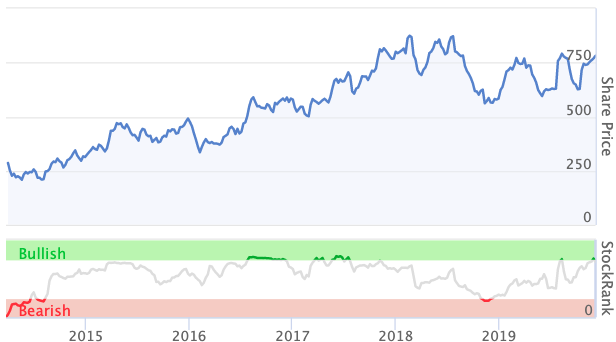
Just Eat (LON:JE.) is the online food delivery platform that has revolutionised the way we drunkenly eat curries. The group listed in 2014 and its shares have marched resolutely upwards ever since. Today, Just Eat has a market cap of £5.33bn and is in the middle of a bidding war between Dutch peer Takeaway.com and Amsterdam-listed Prosus.
Just Eat is a good example of a negative working capital platform, like Rightmove and Auto Trader below (the group’s balance sheet shows FY18 working capital of -£68m).
With very little accounts receivable compared to accounts payable, it is essentially self-funding. Money comes in immediately as food orders are processed and money to providers goes out later. Its rate of growth has been impressive.
FY13 | FY14 | FY15 | FY16 | FY17 | FY18 | CAGR | |
Revenue (£m) | 96.8 | 157 | 248 | 376 | 546 | 780 | 52% |
Op profit (£m) | 6.8 | 19 | 38.5 | 91.2 | -73.6 | 110 | 74% |
Op margin (%) | 7% | 12% | 16% | 24% | -13% | 14% | 15% |
As Just Eat is currently ‘in play’ I won’t spend too much time on it.
From the examples below though, I’m looking to find companies worth looking at in more detail. Some of them might benefit from network effects, others might not, but they are all online platforms and most of them are proving extremely profitable...
Rightmove
After Zoopla was acquired in 2018 by tech-focused private equity firm Silver Lake for £2.2bn, there are two property portal platforms listed in the UK: Rightmove (LON:RMV) and Onthemarket (LON:OTMP). Going back to the point about scale benefits and consolidation, however, I’m not overly enthusiastic about Onthemarket’s prospects…
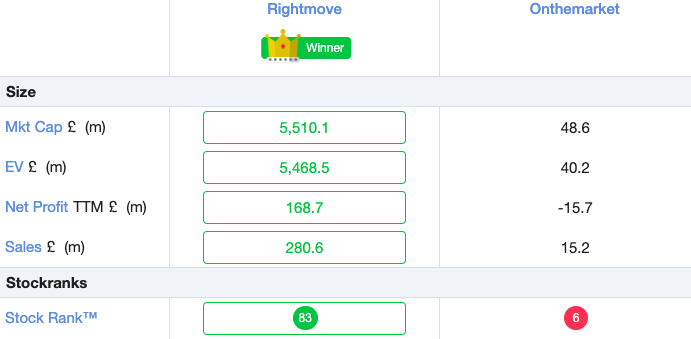
Its position is reminiscent of a story in Pat Dorsey’s The Little Book that builds Wealth:
‘I once asked a candidate applying for an analyst job at Morningstar what he would do if I played venture capitalist, gave him huge amounts of financial backing, and told him to go beat eBay at its own game in the United States. He thought for a minute and then replied, “I’d return the money.” Good answer.’
Network effects? Rightmove clearly benefits from the platform network effect. In terms of the return on capital it generates, it is pretty much peerless. There is probably a moat here.
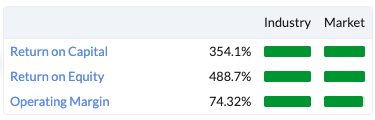
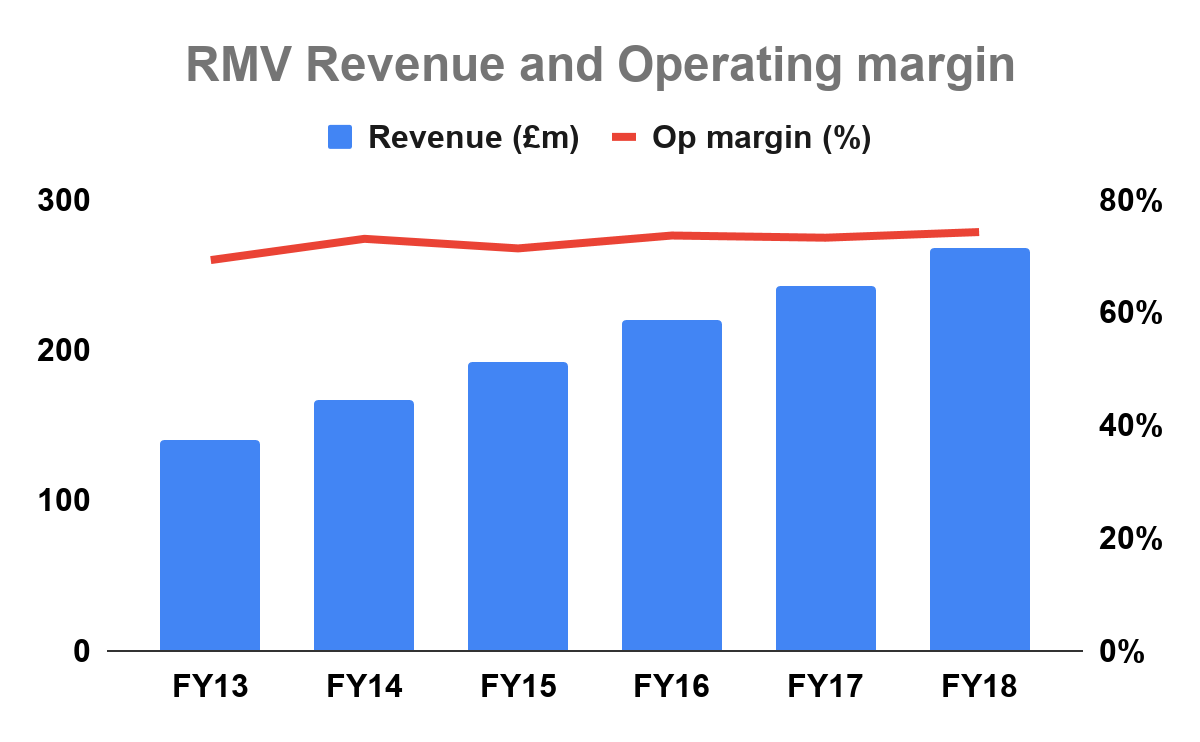
But with an already sky high operating margin and solid if unspectacular revenue and profit growth rates, have investors missed the boat?
RMV | FY13 | FY14 | FY15 | FY16 | FY17 | FY18 | CAGR |
Revenue (£m) | 140 | 167 | 192 | 220 | 243 | 268 | 14% |
Op profit (£m) | 97 | 122 | 137 | 162 | 178 | 199 | 15% |
Op margin (%) | 69% | 73% | 71% | 74% | 73% | 74% | 1% |
Since listing in 2006, the Rightmove share price has grown at a compound annual rate of about 22%. As a c£5bn company, you might think it would struggle to match this historic rate of growth.
However, given that the best examples of network effect companies routinely reach market caps in the hundreds of billions of dollars and continue to grow strongly, perhaps that would be underestimating its growth prospects?
Auto Trader
One of the key advantages that Auto Trader (LON:AUTO) has is its network and reach. Over the past five years or so, it has been a great example of how this kind of online marketplace can drive both revenue growth and margin expansion.
AUTO | FY14 | FY15 | FY16 | FY17 | FY18 | FY19 | CAGR |
Revenue (£m) | 238 | 256 | 282 | 311 | 330 | 355 | 8% |
Op profit (£m) | 87.9 | 104 | 170 | 203 | 221 | 252 | 23% |
Op margin (%) | 37% | 41% | 60% | 65% | 67% | 71% | 14% |
This is a truly transformative combination. From FY15 to FY19, Auto Trader’s net profit has increased from £10.4m to £198m.
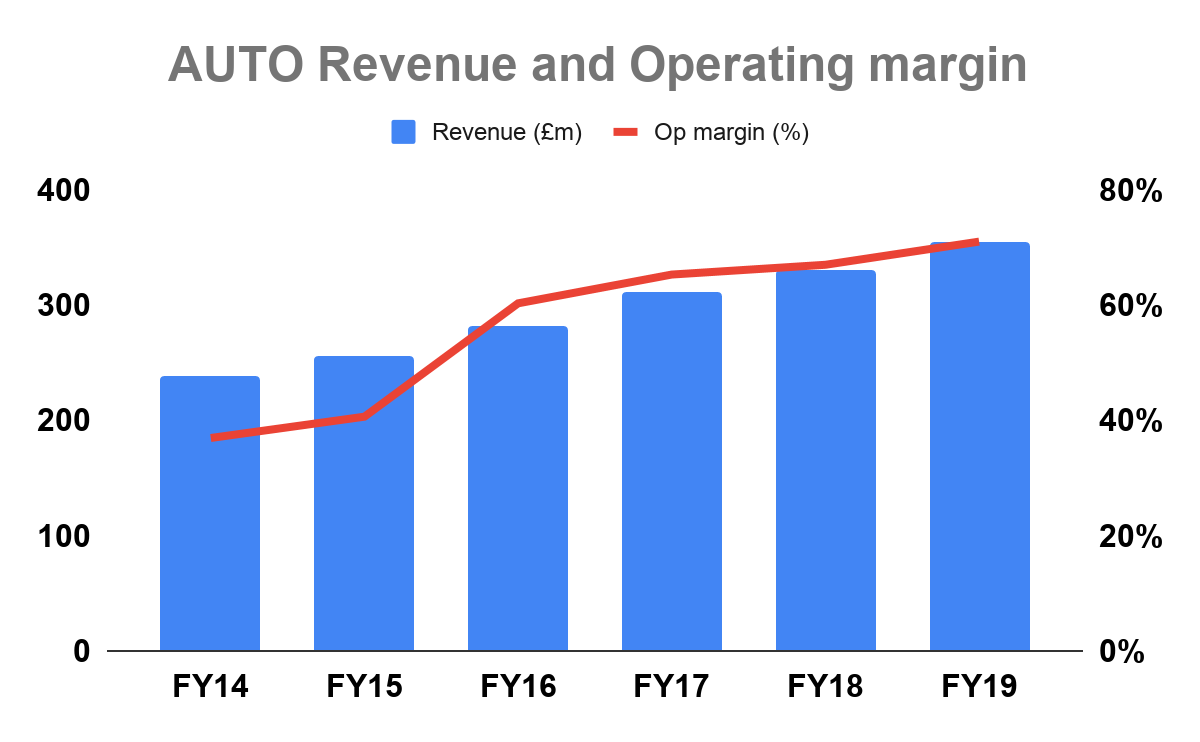
Network effect? As with Rightmove, there is evidence of network effects in play here. The more car sellers and prospective buyers join the marketplace, the more valuable it becomes.
Other platform candidates
Whether or not the following collection of online travel agencies, marketplaces, and price comparison websites have network effects is up for debate.
If you know these companies I’d like to hear any thoughts on them and whether they do in fact qualify or are just very profitable platforms at risk of competition. Hopefully one or two of them are worth exploring in more detail.
Name | Mkt Cap £m | Revenue (£m) | Operating margin (%) | Return on capital | Quality Rank |
5,340 | 886 | 14 | 8.1 | 96 | |
5,440 | 281 | 74 | 354.1 | 97 | |
5,110 | 365 | 72 | 61.1 | 74 | |
1,740 | 381 | 30 | 55.0 | 96 | |
416 | 153 | 25 | 71.4 | 56 | |
112.58 | 78.3 | 8 | 3.1 | 76 | |
590.19 | 140 | 14 | 14.2 | 94 | |
44.51 | 125 | n/a | 1.6 | 22 |
Price comparison companies such as Moneysupermarket.com (LON:MONY) and Goco (LON:GOCO) probably don’t have network effects. They are clearly highly profitable business models for now, but can they defend their positions in the same way as Rightmove and Auto Trader?
Go Compare is smaller than Moneysupermarket but also appears to be growing more slowly. This makes me wonder how hard it is having to fight for growth. Its return on capital figure does show the attractiveness of this business model but again, can it defend against rivals?
I am also concerned about the ability of Hostelworld (LON:HSW) to compete against much larger rivals such as Trivago and Expedia. Is the fact that it specialises in hostels enough of a niche? And how big is that market?
On The Beach (LON:OTB) looks like a fair candidate to look at more closely, with growing revenue and, up until FY19, expanding margins. You can see from the group’s operating margin below that this business has to spend a lot more than listing companies Rightmove and Auto Trader, though.
OTB | FY14 | FY15 | FY16 | FY17 | FY18 | FY19 | CAGR |
Revenue (£m) | 45.8 | 63.1 | 71.3 | 83.6 | 104 | 140 | 25% |
Op profit (£m) | 3.75 | 6.98 | 16.8 | 21.1 | 26.2 | 19.2 | 39% |
Op margin (%) | 8% | 11% | 24% | 25% | 25% | 14% | 11% |
Meanwhile, Gear4music Holdings (LON:G4M) has yet to properly convince the market that it can translate revenue growth into profit. You can see from the Cashflow section of its Financial Summary that the group is still very much in a heavy investment phase.

Its shares are in the doldrums now but revenue growth has been encouraging and management is focused on becoming a more profitable operation. Perceptions in the market can change quickly.
Conclusion
Rounding up this ramshackle group of companies has been a thought-provoking exercise. Some of these companies are worth looking at in more depth. Possibly all of them.
As for genuine network effects, I would welcome a discussion on the subject. If there are networks here, how safe are they? Could those networks open up to other participants? I think this might be a risk for most of these companies, with the exception of the larger, more established Rightmove and Auto Trader.
There are other types of moats, of course, and those companies that don’t display evidence of network effects might still be worth researching more closely.
I’d be interested to hear any thoughts. If you hold any of these stocks, what has been your experience?
Disclaimer
This is not financial advice. Our content is intended to be used and must be used for information and education purposes only. Please read our disclaimer and terms and conditions to understand our obligations.
9 comments
Having personal insider knowledge of Auto Trader (LON:AUTO) ,albeit from many years ago, I always assumed that they would be unstoppable. Each year new products were introduced, revenues rose, margins were fantastic and the competition couldn't touch them, even the websites who offered car dealerships a free portal on which to advertise their car stock.
I was similarly sure that its USA namesake and the #1 player in the USA market - autotrader.com - would also have a completely dominant position. However, in the last few years, the rise of cargurus.com has put that position at risk.From 2015 to 2019 (e) carguru's revenues have risen from c$100m to c.$600m (with nearly 100% of this being USA revenue).
From memory Autotrader USA had revenues of around $1b, with quite pedestrian growth. So if the trend for cargurus.com continues, then it won't be long before they overtake Autotrader USA as the number 1 player in the US market.
For this reason, I've never been inclined to buy into Auto Trader (LON:AUTO) despite it's apparent moat-like properties.
Cheers
A
I analyse Auto Trader (LON:AUTO) a while ago. I found that it had a lot of good traits as a potential investment. But what put me off buying it was the advent of driver-less cars and taxi like services such as Uber. For a lot of people it would be cheaper & easier to hail a driver-less cab, than to own a car. One reason for this is that there is no need to pay any driver wages when there is no driver. So it should make them cheaper than traditional taxis. I know this situation is "a long way down the road" (Ha ha), but I didn't consider it to be a good idea to buy the shares of a company which is currently on a pretty high multiple, when the long term future of the company isn't looking too bright.
Varaiants of social media such as dating apps have network effetcs.
Online games have been shown to have network effects.
Wikipedia has a network effect that is not monetised.
All technology platofrms and ecosystems offer some degree of network effect. The wider the adoption, the greater the utility to the next buyer in several ways e.g. compatible products, availability of support and likelihood of longevity.
Clubs (e.g. golf, bridge, reading groups ...) have network effects with limited scope. There is a finite size for these things after which the value degrades. Stocko's SCVR may be another example. The value is enhanced by having a variety of informed invesors commenting, but after a certain point the value would degrade. That point hasn't been reached yet!
I’d go so far to say none of these are really platform companies where users return regularly and interact, Facebook obvious but businesses that have users subscribe & do something useful for individuals or businesses on a continual basis, really have platforms. These to me are all market places, great as they maybe I’d not say they are platforms.
i was about to say the same. I'd also say they are more ditches than moats. Google or Facebook could easily crush any of them if they were interested. Why? They have the true networks. Facebook already do local adverts. Not difficult to tweak to match what the above offer. If/when they do I doubt the above will be able to compete.
Perhaps but there is also something to be said for brand power and specialisation... Twenty years from now, will Facebook be the one stop shop for all of the services listed above? For the larger examples like Rightmove (LON:RMV) and Auto Trader (LON:AUTO), both of which have a c£5bn market cap, Facebook might have to spend a lot of money taking share there. It might decide its capital is better deployed elsewhere.
IIRC people said Amazon would crush Ocado (LON:OCDO) for years but it hasn't happened yet (I'm straying from the idea of 'network effects' here though).
I don't have the answer. It will be interesting to see how it all plays out though!
For the smaller ones, I agree that the big risk is someone with lots of money will just come along and start doing it better.
I don't claim to know many of the companies mentioned. But I am not sure that any of them have the network effect in the way that Facebook does. No one would go to another chat site, because all their friends are probably on facebook. It therefore attracts more and more people, with little need to advertise, and become more attractive the more people are on it.
Rightmove and Autotrader might be examples of the effect.
But aren't G4M just an online music shop. It might have a good future, through economies of scale, if it become the 'go to' site for musical instruments which a fragmented competition of small shops can't compete with. But is that really an example of the 'network effect'? I'm not sure.
I appreciate the article, it has got me thinking, and therefore hopefully learning.
I'm minded to agree - Rightmove and Auto Trader are the most promising examples of a potentially long-term network effect. The rest perhaps don't have it but are nevertheless interesting companies, some of which are highly profitable...
I feel that marketplaces can have a network effect in that the more customers use it, the more useful it is to vendors and vice versa, therefore increasing the value of the marketplace. It might not be as pure or textbook an example as Facebook, but I think some marketplaces fit this description.
Another point: as I interpret it, you can build a network that stands to benefit from these effects but that has low barriers to entry and attracts competition. It is not a panacea and is not, in itself, an automatic moat. If we take the network effect to mean something like: 'increased numbers of participants improve the value of the good or service, thereby attracting more users' then actually quite a lot of failed companies in the past have had this attribute but they just haven't reached the scale to become dominant for one reason or another.
In order to be defended, perhaps networks need to offer complimentary services that make their product more 'sticky', whether that be some sort of insurance or vetting of participants?
Good points made. On reflection I think we are looking at different things, both valid. I stretched it to how resilient are the networks, whereas I think the conversation is really about network effects. In which case I totally agree about Rightmove and Autotrader. I use both as my go to sites for cars/houses. My concern is it wouldn't take much for a bigger network to offer free (and possibly inferior) service and suddenly the network effects are gone. Hence not really moats.
Anyone remember the next great things in network effects - MySpace, Yahoo, AOL..... users go, network effects collapse and value gone.
I think Ocado is a good example of a moat and why Amazon struggled to complete. Local food logistics.
However to argue against myself, eBay and Gumtree do cars (and cheaper) but I still go back to Autotrader!