Part 2 - Simon Denison-Smith - Insights from London Value Investor Conference, 9 May 2013

This is the second part in a short series of articles about speeches I listened to at the London Value Investor Conference on 9 May 2013. To read Part 1, please click here.
As in the previous article, I have skipped over a lot of detail, but have put key insights in bold.
Simon Denison-Smith of Metropolis Capital

Denison-Smith works with Jonathan Mills at Metropolis Capital, and they are interesting in that they have come from a business background, and moved into fund management after successful careers building & buying businesses in the real world. To my mind that makes them far more valuable than pure money managers who have never actually run a proper business themselves!
As an aside, I had a personal experience of both Simon and Jonathan when the acrimonious takeover by management of FDM Group occurred a few years ago. Management effectively held a gun to shareholders heads, and tried to "steal" the business at about half what it was really worth. I kicked up a stink, and co-operated with Metropolis, and between us we forced up the offer price from 120p to 150p. It was still a lousy deal, but I was very impressed with these guys - firstly because they had built up a stake in a woefully undervalued growth company, secondly because they were prepared to roll up their sleeves and get activist when out of control management were taking the proverbial, and thirdly that they were happy to talk to other shareholders to secure the best outcome.
Investing approach
Simon's speech is interesting mainly because it explains their rigorous approach to stock selection, using the value investing principles of Ben Graham & Warren Buffett.
In overview, he looks for companies which generate good cashflows, at a low price multiple.
They buy when a share is significantly below its intrinsic value, and sell when it reaches intrinsic value.
They place great importance on capable and intelligent management, who have displayed high integrity.
Interestingly, again they take a concentrated approach, typically only holding 12 stocks. (Edit: Metropolis tell me that their target is to hold 10-20 stocks, with the portfolio currently holding 13). This is becoming a consistent theme with value investors, and is one I wholeheartedly agree with - after all, if you want to out-perform the market, you need to concentrate funds into your best investment ideas, not diversify away the future gains. However, clearly this should only be done once you have a proven track record of successfully picking the right stocks! It would be a potentially disastrous approach for inexperienced investors.
Buying unloved stocks is a simple concept, but difficult to execute consistently, because it takes conviction to hold when the market is screaming at you to sell.
Value investing requires periods of inactivity.
Stock selection process at Metropolis
Stage 1: Using their proprietary screening model to filter the whole market down to a "long list".
Stage 2: Reduce the long list down to a short list by ruling out certain sectors, size of pension deficit, unfavourable ownership structure, etc.
Stage 3: "Forensic" analysis of shortlist, by analysing multiple years' accounts, broker notes, web-based qualitative research, considering risks, etc.
Stage 4: Due Diligence - interact with management, more deeply test the investment hypothesis, risks, etc. This may also include talking to customers, competitors, former employees, etc.
However, the most interesting point which is not in this list, but which was explained in the speech, is that Metropolis always start by articulating the bear case. So they want to read negative reports first, and think about them before considering the bull case in more detail.
I can think of many bulletin board loonies from another site who would have done well to have listened to this advice, instead of shouting down the bears, one should carefully listen to & consider what they have to say.
Metropolis only buy a share once they are satisfied with their Due Diligence, and the market gives them an opportunity to buy the shares at a 25-50% discount to intrinsic value (depending on business quality, and liquidity).
The deeper discount they can buy at (i.e. the greater the margin of safety), then the larger position size they will take.
Unusual features of Metropolis
It is note-worthy that Metropolis is highly unusual in that the biggest investors in the fund are actually the managers themselves. So it's no wonder they work harder, and look into far more detail than conventional fund managers. Also it is interesting to note that their decision-making is not constrained by career risk (something that badly infects the rest of the fund management area, but more on that in a later article), but only constrained by the risk of permanent capital loss of their own money, so they consider the downside risks more carefully.
Also, as mentioned earlier, Simon & Jonathan come from a background of being successful entrepreneurs and venture capitalists (they've done 25 transactions before).
Because of that, I would feel a lot more comfortable leaving money with these guys than with a conventional fund manager, who doesn't have much (if any) skin in the game.
Cisco
Next, Simon went into considerable detail about why he thinks Cisco is significantly under-valued, and that is their favourite current stock pick. So we can refer back in future, the price of NASDAQ:CSCO is currently $21.10. He believes it is not cyclical, and that strong growth in cashflows will continue. Also it has a dominant market position, and customers won't mix products from different suppliers. It has a 3% dividend yield, and 2-4% p.a. is returned via buybacks.
(Edit: Metropolis have clarified that they, "would be happy to own Cisco even if it was not growing, at an EV to post tax free cashflow of 7x, it's cheap for a company with stable & predictable earnings, and very cheap if it continues to grow").
J. Smart
I was surprised at his small cap pick, which is an obscure micro cap Scottish builder & property company called J Smart & Co (Contractors) (LON:SMJ). The bull case is that it's trading at less than half NTAV, has a 4% dividend yield, and further hidden balance sheet value.
The family own 50%, which Metropolis are comfortable with, as they've met them & trust them. It doesn't float my boat at all, I have to say, but there we go. However, knowing the level of detail Metropolis go into, and their shrewd track record, maybe we should have another look at J. Smart?
Importance of networking
Finally, during the Q&A Simon mentioned that besides using their stock screening approach, Metropolis also get a lot of their investing ideas from networking with other like-minded investors.
I thought this was encouraging, as it's how most of us also work - i.e. running our own stock screens using filters on Stockopedia & other sites, to research our own ideas. Then sharing those ideas with other investors (usually after picking up a few shares ourselves of course!). So the networking effect is very valuable to us all, and builds a good community of investors who help each other. I'm a great believer in the idea that two minds are usually better than one, so a group of shrewd investors researching a company usually arrives a better decision than when I look at something on my own. The more people that look, the more likelihood the pitfalls will be found.
So it's encouraging to see that a top fund manager also works using the same approach!
Edit: I've also noticed that Metropolis have some useful research material collated on their website here.
Disclaimer
This is not financial advice. Our content is intended to be used and must be used for information and education purposes only. Please read our disclaimer and terms and conditions to understand our obligations.
6 comments
He quotes 20 - 30 stocks for his Magic Formula in the Little Book That Beats the Market.
Think his quant funds are based on fundamental indexing, not the Magic Formula.
Hi,
Interesting feedback, thanks!
Just as a post-script, Simon Denison-Smith's top tip, Cisco, which was $21.10 at the time of my report just a few days ago, is now $24.23, up 14.8% after a positive earnings announcement this week. He must be feeling pretty pleased, certainly great timing, am kicking myself for not buying any, as I almost did after his very convincing talk about why the shares are great value long term.
Cheers, Paul.
On the other side though, it takes less stocks to achieve a decent level of diversification than most people expect. Obviously 4 is silly unless you're a Buffett, but around 20 is a lot better than many would guess at. However you need to be careful with being over-exposed to specific risks (i.e. not owning 10 miners out of your 20, etc):
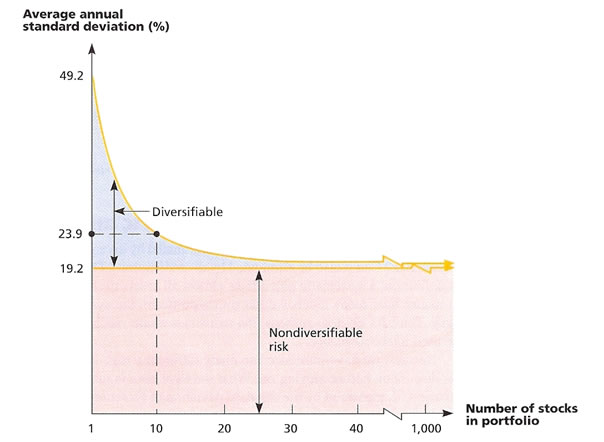
Hi Paul,
Thanks for your excellent report.
It is worth noting that taking such a concentrated approach is not simply a question of experience. It also requires a very focussed approach to risk. Note the vital role of "forensic analysis" and due diligence in Metropolis' approach. Very few private investors have access to the level of information - and the forensic ability - to make a proper risk assessment (that certainly includes me).
In my experience far too many investors run away with the idea that they can make outsize returns by running a concentrated portfolio, without having conducted the necessary level of due diligence. Many have little idea of what that actually means, and presume that a cursory glance at recent accounts and metrics is sufficient. Some get lucky, when it turns out that their simplistic thesis was right. Far more, however, make heavy losses when it turns out that there was some crucial factor that they hadn't appreciated which explains why a company's shares trade at an apparently big discount to intrinsic value.
Cheers,
Mark
Here's a piece I wrote on diversification a while back . http://www.stockopedia.com/content/the-5-ways-diversification-can-kill-your-portfolio-returns-63448/
A study of 60,000 private investors showed they only own 4 stocks on average and underperform by 4% per year. Also those 4 stocks tend to be in the same sector.
The points you raise Mark are v. v. v. important for people to understand - too few do.
Greenblatt stated that IF you are an investor who can do the due dil, 6-8 stocks should be enough - if you aren't then just go for a more systematic 25 stock approach.
Greenblatt recommending 25?! He's widely reported to be buying(/selling) the top 300 for his current quant fund(s).