Photo-Me International: In a supermarket near you

There are some brands that are ubiquitous; cleaning companies perhaps or white-label bakeries. They're everywhere and yet no one notices them. Photo-Me International is just such a company with its 27,600 photo-booths sited worldwide together with those children's rides you see in shopping malls and a number of fully automated laundromats.
All in all the company operates more than 47,300 vending locations in 18 countries (primarily the UK, France and Japan) and is the world's leading operator of photo-booths; although that's something of a poisoned chalice given the meteoric ascent of digital photography since the turn of the century. This, I think, is just one of the reasons why the shares have lagged since 2000 despite having been fully listed since 1962 and presumably profitable over most of this half-century.
That said this article from 2000 suggests that the company managed to create its own problems too with accounting irregularities leading to a shock profit warning at the time. Then, in 2007, another profit warning arrived courtesy of a deal going sour and the board being in disarray; issues which led to a hefty fine from the FSA. Looking back it seems that this was just the latest in a sequence of problems for the company.
So with all of that in mind what's the attraction here? I must admit that I'm starting to wonder with the latest misstep being reported in June 2016 with the Japanese roll-out of identity cards failing to be as smooth as expected. Nevertheless this is a business that dominates its niche, generates excellent cash-flow and directs this to develop new markets (as well as pay shareholders a decent dividend). The current management appear to be making sensible decisions and the CEO, Serge Crasnianski, has a lot to lose by virtue of owning over 20% of the company.
How do the numbers look?
The key question that I want to answer is whether Photo-Me is a value trap. Qualitatively I know that it's operating in a challenging, if not actively shrinking, market and that new sources of revenue are needed; however I wonder if a quantitative analysis backs up this assessment? Much like Empresaria, another recent holding of mine, turnover has gone nowhere for years and is only now rebounding from a recent decline:
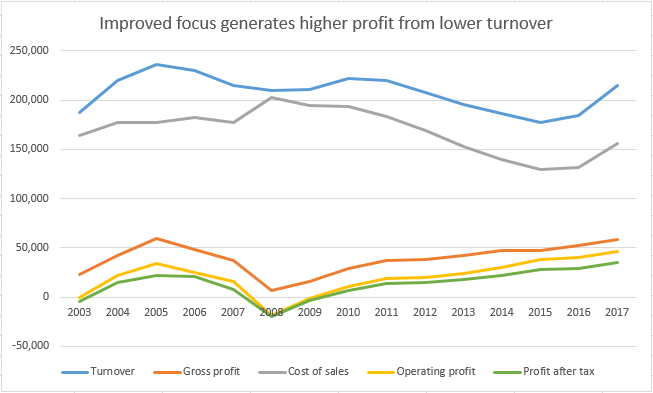
Still profits have very steadily rebounded from the 2008 debacle and, with a CAGR of 7% over the last 13 years, are over 50% higher than they were a decade ago. This improvement is reflected in the way in which margins at all points have improved towards a level more representative of a healthy business while the cost of generating these profits has been slowly whittled away:
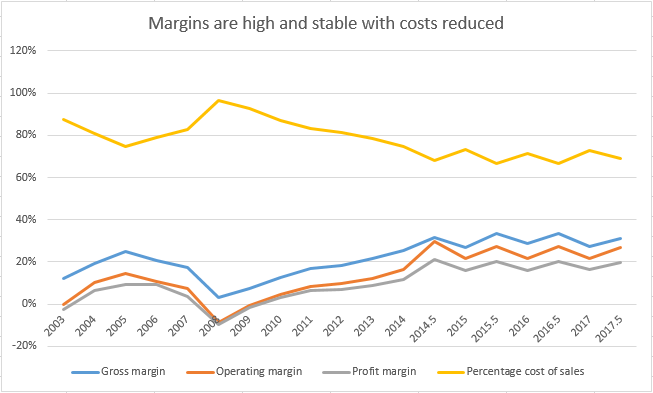
Something that I notice in this graph is just how much of a first-half bias there is to the results - this is why there are peaks at the half-year mark where I've included the interim results for comparison. Roughly 60-70% of the annual profits are generated in this happy period and the margin on this business is much higher, at around 20%, than the full-year margin of 16%. Actually staying with the issue of margins it's remarkable just how much better these are in Europe as compared to either the UK/ROI or Asia:
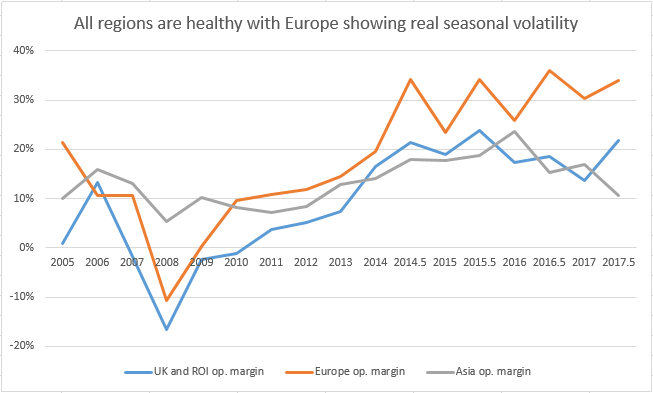
Clearly the Photo-Me business is just much more profitable in Europe (perhaps it's the laundrettes?) but that isn't the aspect that I like here; instead I'm happy to see such an improvement in the UK/ROI margin, as this looks to have been a real dog for years, and I just hope that all regions continue on this track (although Asia is showing signs of becoming the problem child). Still the fact the Europe is both the most profitable region and also the one generating more than 50% of all revenue is an arrangement that works well:
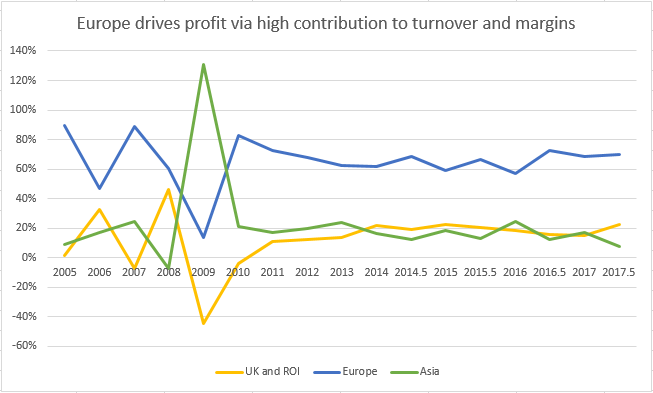
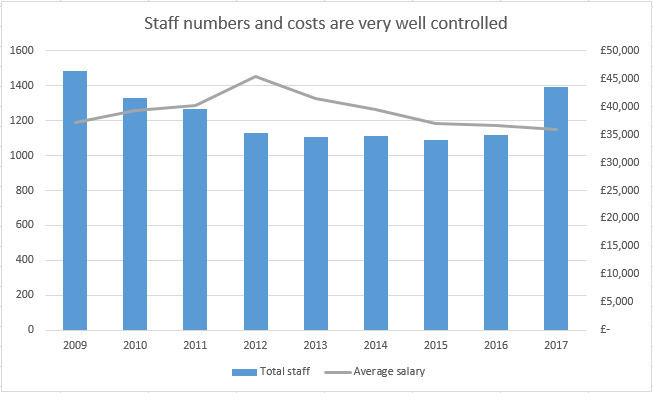
Part of this margin improvement is no doubt down to management concentrating on more profitable lines of business, while cutting back on the laggards, but they've also focused on reducing fixed costs. This makes a lot of sense as the board are rightly proud of their trained field engineers, who are apparently versatile enough to turn their hand to most things, but there's a big fixed cost base to deal with here when the market goes sour. In any event the head-count has reduced sharply in recent years without any impact on the average salary of employees (with the jump last year probably down to the Asda estate acquisition):
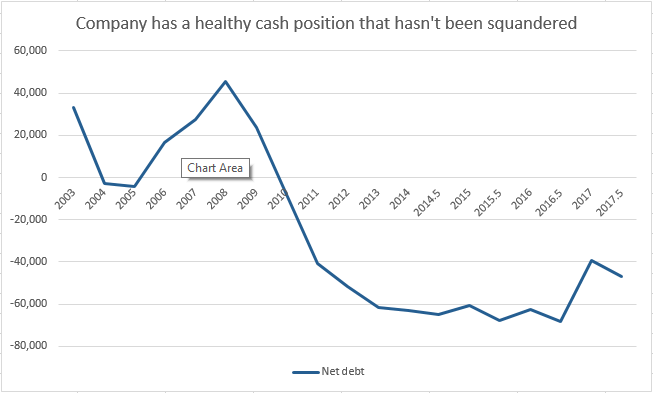
Looked at from a different angle I find it hard to invest in companies that don't convert their profits into cash and this is where Photo-Me's legacy of heavy investment in previous years is paying off (though it didn't at the time) through a high depreciation charge ensuring that profits are suppressed relative to the underlying cash generation. The consequence of this is that, following the last corporate meltdown, the balance sheet has moved from a net debt position of £45M to having over £47M in cash available (and that's after paying a special dividend):
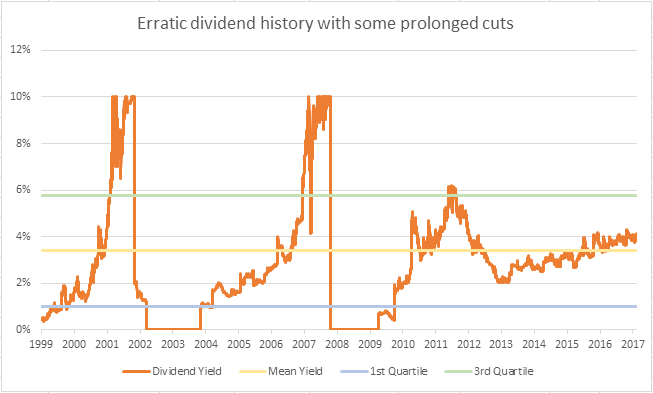
A nice side-effect of this balance sheet strength (and a show of confidence by management) is that the board have committed themselves to returning any net cash in excess of £50M to shareholders as a special dividend. In addition for the next two years, at least, the ordinary dividend will be raised by 20% and that implies a pretty decent yield of around 5% in a year or two (at the present share price). That said this is a share with a patchy payout record (two total cuts so far this century) and I won't be relying on it to pay my pension! I just hope that the directors aren't over-stretching the finances of the company by setting such a public goal:
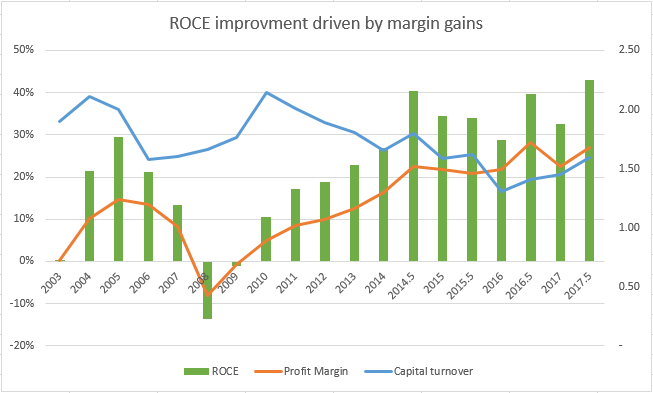
A final area that I want to examine is whether the company is managing to make a decent return on its assets; something that can be tricky when 10% of the market cap is sitting in the bank earning a derisory return. In the past this has been a real problem, and the ROCE has thrashed around as wildly as the share price, but in recent years it seems that some measure of stability has set in:
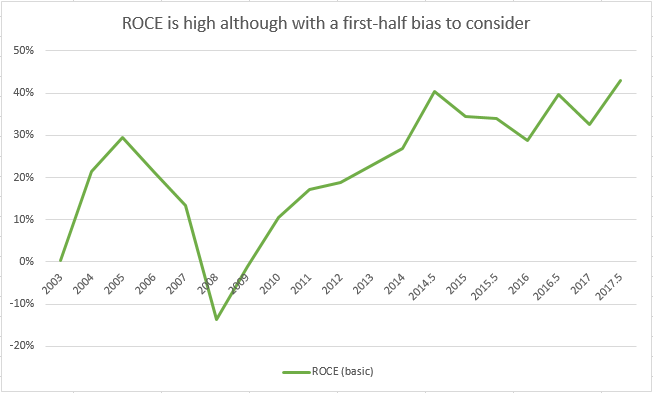
If we then perform a DuPont analysis it's possible to see what's driving this improving return; is it that profit margins are increasing or that capital is being used more effectively? Well it turns out that it's all about the margins with growth here being a function of cost control combined with a move into more profitable types of business. Personally I think that margins have gone as far as they can, at around 20%, but this is just fine when it leads to a ROCE north of 30%:
Conclusions
Having worked through the numbers I don't believe that Photo-Me is a value trap; instead it's using operational cash-flow to reinvent itself through the medium of laundrettes. Equally I don't believe that it's fundamentally a quality business even though its reliance on many, small transactions is typical of defensive sector firms such as Unilever (and it very much has a moat in its large estate of machines).
What it does have is a clear goal that makes sense: "Our stated strategy is to use the significant cash flow generated from our long-established photobooth business to develop new and complementary products which will drive our future growth. Alongside this, we are keen to penetrate new geographic markets, which offer the potential of long-term growth. It is also part of our strategy to be financially independent as far as we can be, and to concentrate on increasing our returns to shareholders."
To help myself decide on how convincing this statement is I've tried to distill the pros and cons of this business into a short list:
Strong Points:
- Very cash generative with high cash balance providing stability and security
- Committed to returning excess cash and paying an improving dividend
- Succeeding with the laundrette business and researching new areas
- Managing decline in photo-booth industry with technical improvements
- Manned retail outlets are being closed which will cut costs and improve margins
- Serge will want to retire wealthy and has recently been buying in size
- Recent confident statement suggests that business is on a roll
- Sterling depreciation is helpful even if just a one-off boost and prone to reversal
Weak Points:
- Photo-booths are in secular decline and seem obsolete in the medium term
- Reliant on Revolution laundry to drive top and bottom-line growth
- Chequered history shows reliance on Serge and he's no spring chicken
- Regions outside Europe aren't pulling their weight in terms of margins and profits
- Other directors don't have much skin in the game and are maybe overshadowed?
- Japanese issues with My Number are looking structural with margin under pressure
- Government requirements drive the photobooth industry and they are fickle
Such an even split very much reflects my inner thoughts on Photo-Me and of at least one other blogger: the board are doing just as much as they can with what they have to hand but perhaps it still won't be enough? Serge Crasnianski is clearly convinced enough to spend £7.5M on buying more shares just a year ago, taking his stake to 22.48% of the company or about £130M, and that's no chump change. On the other hand his base salary is £540K and for every year since re-joining in 2010 he's received a 100% bonus which leads to a total annual payout around the £1M mark (suggesting that the performance hurdles are nowhere near tough enough!).
Still with the recent article on selfies being allowed by the Passport Office, and anecdotal evidence that this is a pretty slick process, I do wonder if the board are underestimating the threat from this quarter? Of course this isn't new news but perception is all in some ways. I tend to agree that this move by the authorities isn't terminal (with Europe accounting for >70% of profits and their focus on security via directly-linked 3D booths) but neither can it be lightly dismissed. The world is changing and Photo-Me is being priced, with a P/E near 20, on the expectation that it'll be able to change pretty nimbly without much scope for error. Good luck with that!
Disclaimer: The author holds shares in this company
Disclaimer
This is not financial advice. Our content is intended to be used and must be used for information and education purposes only. Please read our disclaimer and terms and conditions to understand our obligations.
11 comments
I cannot seem to work out based on the last interims under
Property, plant & equipment they have £81.2 million .How much if any is freehold property ?
My guess is none as not mentioned
Thanks
I think that most of this is photo-booths, launderettes and the like. In the last annual report the only freehold that I can find relates to an investment property:
"The investment property is freehold and is stated at cost.
The property was valued by an independent professional valuer in October 2010, with a value of €12.2m based on a market
value for similar properties, and on a rental stream valuation of €12.6m.
Since this valuation was performed, the Group has sold the rights to the future rental stream on the property for the period up to
April 2019. Funds received in the year ended 30 April 2011 on the original rental stream sale amounted to €9.2m (£8.2m).
The Board believes at 30 April 2017; the property continues to be worth more than its £662,000 net book value. The
valuations for future years are expected to increase due to the passage of time and the unwinding of the related deferred rental
income creditor.
Rental income from the investment property was £1,038,000 (2016: £903,000) (note 4) and finance costs were £21,000
(2016: £32,000)."
Thanks Damian
I've held (LON:PHTM) for a month short of 2 years now. Capital gains-wise, it's been unimpressive in that time.
Re:
"...Still with the recent article on selfies being allowed by the Passport Office, and anecdotal evidence that this is a pretty slick process, I do wonder if the board are underestimating the threat from this quarter?..."
- When the media revisited the selfies-for-passports story last year it knocked the SP for six. Then, in time, it recovered.
For purely personal, cognitive bias reasons you might say, I'm coming down on the side of passport-selfies presenting limited damage.
Young travellers may well go down the selfie route, but when you've experienced all the mishaps in life that go wrong when they shouldn't, I will always get the photo-booth photo for my pasport. Imagine by sheer chance your travelling through a foergin country known to suffer from drug smugglers/ and or other undesirables and unmentionables.
You present your passport to the authorities and some suspicious official in a military-style cap wearing ultra black, aviator-style, 1970's Medallion-Man sunglasses (and a moustache :) notices that your passport photo is cut unevenly around the edges and obviously "home-made" - then a full anal security check might be the least of your worries, as you're suddenly surrounded by automatic weapon carrying, guards - pointing them at you to comply.
Nah, passport-selfies by the younger traveller; yes - can't see the seasoned, older traveller, having anything less than a defacto photo-booth photo. Also there's the lazy factor. For instance, Ready Meals in all supermarkets and corner shops abound in plenty. DIY photos? That's akin to actual real cooking - and the ubiquitous, supermarket ready meals show we have better things to do than time-poor consumers handing it over to cooking - every single day..
The laziness factor ie., time saving convenience, still rules! :)
Is anyone aware what margins the laundry business is achieving for Photo-Me International (LON:PHTM)
Thanks
Great analysis Damian, I keep tripping over this company but find myself unable to judge the technology risk & the rate of change thereof in the photo booth business, the laundry business therefore has a hole of unknown size / timing to fill in the future P+L. Add in the Serge age / succession factors & I’m happy on the sidelines.
I fully understand rhomboid1. The photobooth business is definitely in secular decline (how could it be otherwise) but I am always surprised at just how well Photo-Me International (LON:PHTM) are managing this change. Part of this is that some of the vending estate provides physical printing (which benefits from the growth in smartphones) while elsewhere the company keep innovating with more efficient machines that offer digitally secure photos for ID purposes and potentially some banking services.
So the team aren't just sitting around letting themselves become obsolete. Instead they're actively managing the estate and getting rid of loss making operations. That said I think that they were sold a pup with the ASDA acquisition and taking a hit as a consequence - really they should have been paid to take this business on board!
Anyway this is definitely a company which polarises opinions...
"... I think that they were sold a pup with the ASDA acquisition and taking a hit as a consequence - really they should have been paid to take this business on board!..."
- I agree. They were taken to the cleaners by Asda on that one. (Pun intended :)
Looking back at the acquisition details Photo-Me International (LON:PHTM) paid £3.35m for 191 photo centres and 172 self-service kiosks with another £2m or so for stock. At the time these operations made a loss of £3.4m on sales of £19.3m but Serge reckoned that they could turn this around. I guess not.
Hi, good analysis, for me the laundrette business is the one to watch, something like €15-17k of revenue from each * 6000, thats a lot of cash being created.
Thanks John. The launderette business is working very well for Photo-Me International (LON:PHTM) and they're on-track to have those 6000 units deployed by the end of 2020. Right now they've got 2332 in the field, a 47% increase year-on-year, so I see this target being achieved. Also while the average takings are €1508 per month this is a 7.7% increase on H1 2017.
Which is all to say that I agree with you; more machines which are improving their takings are really going to push up turnover here in a material way. i.e. total FY turnover for 2016 was £215m and an estate of 6000 launderettes at current sales levels would generate almost £90m at good margins.
When you put it like that, and consider that this expansion is all self-funded from cash flows, the company starts to look pretty tasty!