Revisiting Judges Scientific and SDI: acquisitions, special dividends, strong trading and share price gains

Given the prevailing macro conditions of quantitative easing and low to negative interest rates, it’s reasonable to assume the past decade has seen more than its fair share of poor capital allocation. When the cost of borrowing is pushed down, projects that would not be economically feasible under “normal” conditions can all of a sudden be given the green light.
Warren Buffett once said: you only find out who is swimming naked when the tide goes out. I think there’s probably more than a couple of skinny dippers out there right now.
For all its bargepole companies and financial scandals, the AIM market is actually a particularly healthy index for small caps. On a market-weighted basis, around three-quarters of its companies are profitable and cash generative and about two-thirds are dividend-paying. Because of this quality, AIM could prove to be quite resilient in the years ahead. It’s a good pond to fish in.
Two of the most promising prospects on AIM are top Quality-Momentum stocks Judges Scientific (LON:JDG) and Sdi (LON:SDI), although some have concerns over their premium valuations. The two companies are similar “buy and build” operators consolidating high margin companies in long term growth markets. They look expensive right now, but they also looked expensive when we wrote about them last October. Since then the Judges share price has increased by 30% (40% at one point earlier in January) and the SDI share price has risen by 55% to 92p.
There has been news flow to power these performances (as well as generally strong market conditions). Both have released news in the intervening weeks and months, so I thought I would revisit them.
(please note: I have small positions in both of these companies)
Judges Scientific: market beats and ‘mini-mes’
Forecast PE ratio: 25.6
Market cap: £343.54m
QM Rank: 99
One of the most attractive aspects of Judges Scientific is its shareholder-friendly culture. An example of this came in late November when the group decided that, “in order to prioritise the interests of its shareholders”, it would pay out a one-off special dividend of 200p per share. This is equivalent to about 3.7% of today’s share price.
Following this payment, the Group will have returned to shareholders four and a half times the IPO price. You can see that it dwarfs previous payments to shareholders:
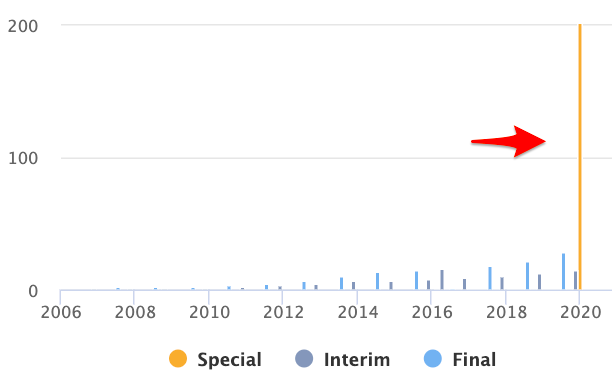
As of HY19, Judges reported £20.8m of cash on its balance sheet. This special dividend is for £12.4m.
What can we take from this?
Interpreting the special dividend: a lack of growth opportunities?
One of the central counter-arguments to investing in Judges - especially given its current premium valuation - is the idea that it is running out of road. The narrative goes that Judges is a victim of its own success. For acquisitions to move the dial these days, it needs to fish in more competitive waters where private equity bids up prices and returns on investment are consequently reduced.
On the face of it, paying out £12.4m in special dividends does little to dispel these concerns. This is more than half of the company’s cash. However, Judges explains that “the special dividend will absorb a modest proportion of the resources available… and the Board is therefore confident that this special dividend will not interfere with the execution of Judges' unchanged buy-and-build strategy.”
On the one hand, a buy-and-build operator paying out more than half of its cash balances to shareholders does raise questions as to the amount of potential deals management is currently seeing. When you look at Judges’ balance sheet over the years though, you realise that it accumulates cash at quite a clip.
Whatever it pays out, it can build back up again quickly. That £20.8m of cash as of HY19 represented a 44% increase year-on-year, with much of that increase coming in the preceding six months.
The fact that the cash distribution comes in the form of a special dividend rather than a share buyback does beg the question of whether or not management believes Judges’ shares are good value at these levels. Then again, they just prefer distributing via dividends - Judges has had ample opportunity to buy back shares in the past at lower prices yet it has never done so.
Quorum: the first Judges Scientific “Mini-Me”?
One company I feel Judges holds in high regards is Berkshire Hathaway. I don’t want to force comparisons between two, but I do find it interesting to note the similarities in their actions and tone.
Berkshire - which has recently been criticised for conservatism and a lack of M&A activity - has managed to grow its way to a market cap of more than £400bn. Despite restless shareholders, the group retains a premium valuation with a forecast PE ratio of 21.4 times. I wonder if concerns over Judges’ ability to grow profitably in future have been overstated. As ever, I’m happy to hear any opposing views.
In Warren Buffett’s notes to shareholders, the great investor and capital allocator has noted that various of Berkshire’s subsidiaries end up making their own acquisitions. In doing so, they become “mini-Berkshires”. Berkshire Hathaway can then grow not just by making large acquisitions at the top level, but by making many more smaller acquisitions at the subsidiary level.
Interesting, then, that Quorum (a subsidiary of Judges) announced its acquisition of Moorfield (“an excellent company with quality products”) towards the end of last year.
I stress that this is not a strategy I have heard Judges suggest an increasing amount of subsidiary acquisitions is on the cards. It is just one possible roadmap for future growth I can think of and the Moorfield acquisition illustrates this.
If Judges could end up even a hundredth of the size of Berkshire, that would still be ten times larger than it is today. Of course, the team will need to have a couple of cards up its sleeve if it is to make that happen. With shares trading at nearly 26 times forecast earnings, it’s fair to say the market is expecting quite a few years of good growth.
A closer look at Moorfield Nanotechnology
Price paid: £2.3m
Revenue: £2.5m
Net income: £0.6 m
Profit margin: 24%
Net cash: £1.5m
Moorfield was established in 1989 by Jonathan and Vivienne Whitehead. It specialises in the design and manufacture of physical and chemical vapour deposition instruments used to cover materials with thin films. These systems are used for academic and industrial research.
Jonathan Edgeworth, the Managing Director, will continue to lead Moorfield as an autonomous business in close cooperation with Quorum.
Rummaging through the abridged balance sheet statements you can find on Companies House, it appears to be a typically high quality, profitable, cash generative, growing company. The business has rapidly accumulated cash reserves, net assets, and retained earnings over the past few years.
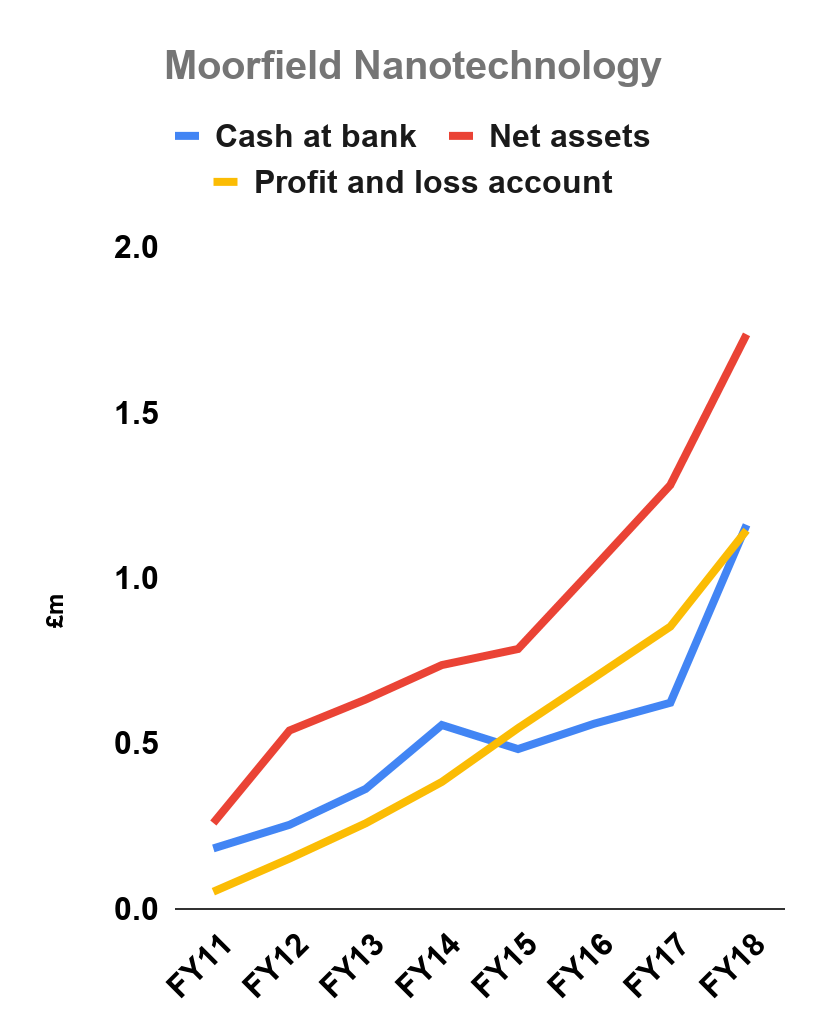
Quorum paid £2.3m, which includes an earn-out based on Moorfield's adjusted EBIT in the year to 30 June 2019, capped at £0.7m. An additional payment will be made (out of Moorfield’s existing cash reserves) to reflect any excess cash balances over and above the ongoing requirements of the business.
Moorfield's accounts for the financial year to 30 June 2019 show revenues of £2.5m (3.2% of Judges’ FY18 revenue) and pre-tax profits of £0.6m (7% of Judges’ FY18 net income). It is a useful addition. The acquisition price amounts to 4.17 times adjusted operating profit - well within Judges desired range of 3-6 times EBITDA.
Another above-expectations update
The flurry of activity from Judges since was capped off with another above-expectations market update. Earnings per share for 2019 will be slightly ahead of market expectations (having already been upwardly revised in September 2019).
Year-on-year organic (meaning for companies purchased before the start of 2018) order intake progressed 3.3%, although trading was uneven. The group called its organic order book “stable” and “comfortable”, although it is down year-on-year, from 14.2 weeks to 13.2 weeks of budgeted sales.
You can interpret this statement either way - Judges FY19 trading is ahead of expectations, but its FY20 order book is behind… Given the company’s track record, I personally give it the benefit of the doubt.
The favourable post-Brexit exchange rate effect is also something to bear in mind with this group, especially given its premium valuation.
SDI Group: rapid growth and another acquisition
Forecast PE ratio: 22.3
Market cap: £89.14m
QM Rank: 94
SDI, meanwhile, has also made an acquisition (this one more significant, relatively speaking) along with an above-expectations trading update.
A closer look at Chell Instruments
Price paid: £4.3m (plus additional cash payment)
Revenue: £4.7m
Net income: £0.78m
Profit margin: 16.6%
Net cash: c£600k
On the 2nd of December, SDI bought Chell Instruments for a consideration of £4.3m plus an additional cash payment for net assets at completion. Chell specialises in the design, manufacture and calibration of pressure, vacuum and gas flow measurement instruments for a variety of sectors including aerospace, vehicle aerodynamics, gas and steam turbine testing and power generation industries.
As with Moorfield Nanotechnology, the statements you can find on Companies House indicate that this is indeed a growing, profitable company with increasing cash reserves and retained earnings.
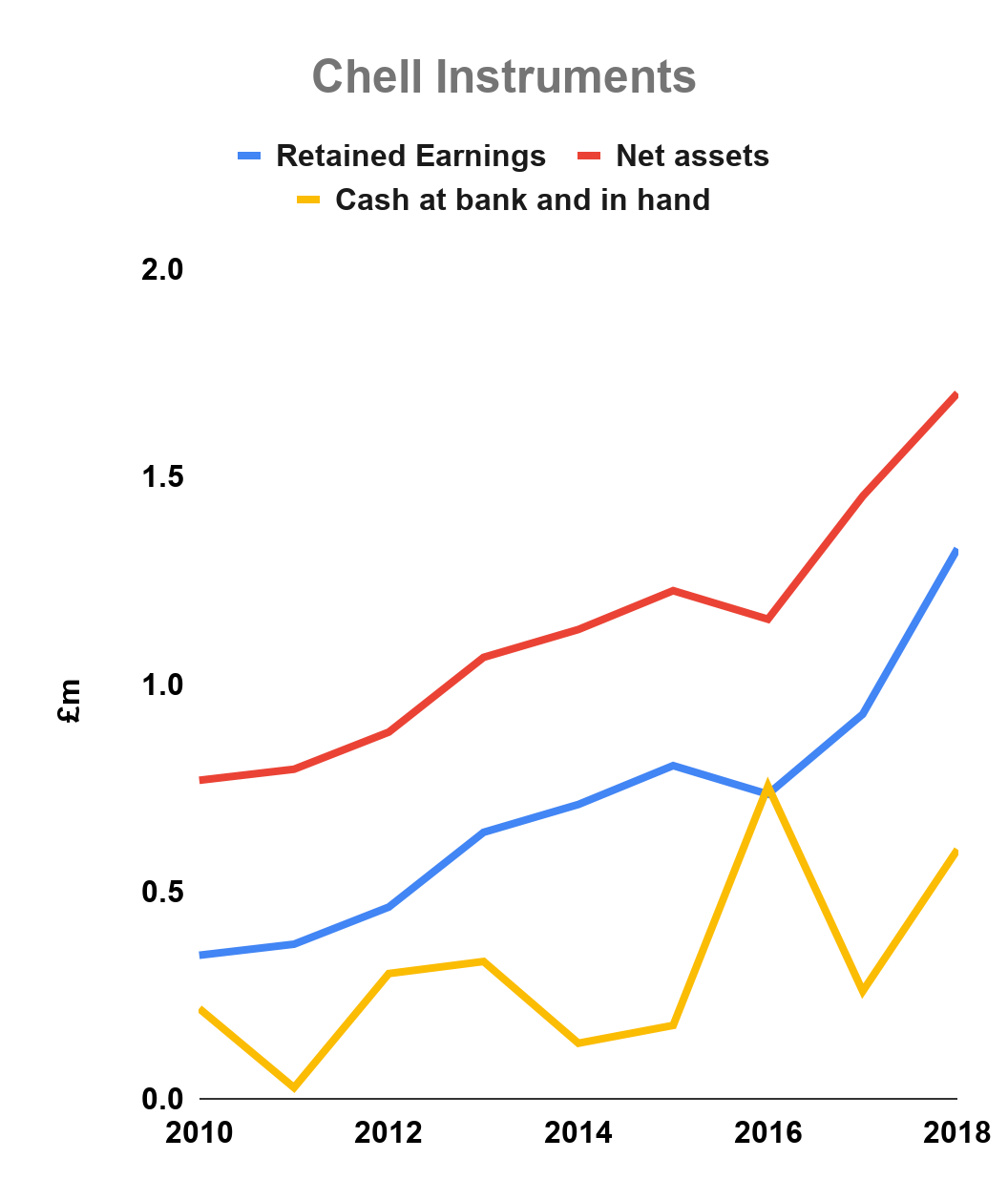
For the year ended 31 December 2018, Chell achieved revenue of £4.7m, gross profit of £2.5m and profit before tax of £0.78m. So SDI’s purchase price valued the company at 5.5 times net income. The acquisition is expected to be earnings enhancing in its first full year of ownership
This fits in with the picture I am forming concerning these two companies: Judges with the longer track record, larger scale and with a greater sense of financial prudence versus SDI’s higher growth potential, slightly more relaxed attitude and aggressive approach to acquisitions.
I think both strategies can be successful.
Trading update
To recap briefly: on 17th December, SDI reported on six months of “solid progress” across its businesses. The group is once more “actively seeking to acquire further companies to add to its portfolio”.
The numbers are encouraging:
- Revenue up 42% to £11.45m (6.4% organic growth, 35.8% from acquisitions)
- Adjusted operating profit +41% to £2.1m
- Adjusted diluted earnings per share up 28% to 1.70p
- Cash from operations +34% to £2.05m
- Net debt down from £1.51m to £0.57m
Conclusion: back both?
I do find it curious that, despite its smaller base and more aggressive track record, SDI trades at a discount to Judges Scientific. It clearly has more growth potential.
That said, it is also possible that doubts regarding Judges’ ability to grow are overstated. I do believe the company’s strategy will have to evolve though if it is to step up in size and become a £1bn-plus market cap company.
We might in future see more subsidiary deals like Quorum’s acquisition of Moorfield Nanotechnology. If Judges can get its subsidiaries to think and act like mini-Judges, then this could be a way of sourcing high quality deals that continue to move the dial in aggregate.
With SDI, its growth path looks more certain: do what Judges did. Continue to find small, niche companies that can be acquired and unleash their growth potential with superior scale and financial firepower. The trick will be in making sure the wheels don’t fall off.
To this point, SDI does seem to have taken a more aggressive approach than Judges. If I had to pick one or the other, I would lean towards SDI in the short to medium term but Judges over the long term. What I’ve done in practice is buy a bit of both... So far, SDI is winning the race.
Disclaimer
This is not financial advice. Our content is intended to be used and must be used for information and education purposes only. Please read our disclaimer and terms and conditions to understand our obligations.

11 comments
Cracking piece Jack
As a holder of SDI I do wonder just how many suitable small imaging companies there are left to acquire? (the same applies to JDG I would assume??)
The recent name change from "Scientific Digital Imaging" to "SDI" lead me to think they may start looking at targets outside there are of competence/experience ... if this is true this brings risks and needs to be carefully managed but it would also signal exciting times ahead.
Thanks... I agree, at some point (and by the sounds of it soon for Judges Scientific (LON:JDG)) both management teams will have to evolve their strategies and widen their nets.
Hi, to date SDI has acquired very small companies with no obvious synergies between them. Only in the last results announcement did they indicate synergies such as shared facilities for a couple of the businesses. And it’s not obvious what the group brings to the acquired companies - the key group directors are all financial people.
The danger with operating lots of small companies is that they become difficult to manage, particularly if things go wrong - the CEO and FD spend their time firefighting. So it as good to see in the last announcement that the group was recruiting, although this doesn’t entirely address the issue of too many small subs.
I’m a holder of SDI which has done me well in SP terms, but I am still to be convinced by the strategy .
One of the central points both Sdi (LON:SDI) and Judges Scientific (LON:JDG) make is that they bring increased financial firepower to these businesses, so growth investment is more readily available and comes at a lower cost. If the underlying businesses have global growth potential then possibly being able to realise that with improved funding is more important than operational synergies?
We shall see... SDI has been going at a fair clip. I'd like to do some more detailed research into the subsidiary companies if possible so that we can take more of a view on the quality of acquisitions. Information can be quite scarce though
Hi Jack
Thanks for another great article.
To echo your point regarding digging into the subsidiary companies, I previously went through each of Judges Scientific (LON:JDG) 's subsidiary accounts for the last couple of years to see if they stacked up to the reported consolidated accounts.
For 2018:
Summation of Subsidiary revenues = £76.1m
Consolidated revenue = £77.9m
This looks the wrong way around and I was not sure why. After inter-company eliminations I would always expect consolidated revenue to be a lower figure (as it was when I performed the same exercise for the 2017 accounts).
I believe all the subsidiaries and group have the same financial year end, though it's been a while since I looked at this, so would need to re-confirm.
I figured that I must have been misunderstanding something and gave the company the benefit of the doubt owing to its excellent cash generation and positive history. It did, however, create some lingering doubts.
For clarity, I did hold Judges Scientific (LON:JDG) until the recent spike when I felt it had become fully valued and was happy to sell out.
Cheers
A
Thanks Abtan,
So you got subsidiary revenue data from Companies House, or somewhere else?
At some point I hope to do the same.
Yes, subsidiary revenues all came from companies house
thanks for this, great work. Following your last article on JDG I did a lot of research on them and decided that I couldnt pay the current multiple, despite really liking the business model and management. I was wrong then and im probably still wrong in thinking the same today but one day id love an attractive entry point into both of these companies
Hi Jack
I think if Judges grew by a factor of 10, it would still only be one hundredth of the size of Berkshire Hathaway (not one tenth)
Even better! Will update
Thanks Jack, as a holder of both I have found this really useful and thanks for putting the work in to produce it. I don't think I can add anything. Thanks.