RM: Back from the brink?

“We have delivered another good half year of results and are on track with our journey back to growth”. That was the opening line from RM’s CEO David Brooks in the company’s most recent interim statement. It was a stark contrast to 2011 when the company’s share price fell by more than 66% and the company was forced to cut its dividend by 54%. The last few years have been tough for RM who provide schools with education and data resources, but the latest figures suggest that RM could be on the road to recovery. The stock’s improving StockRank has encouraged us take a closer look...
Back from the brink?
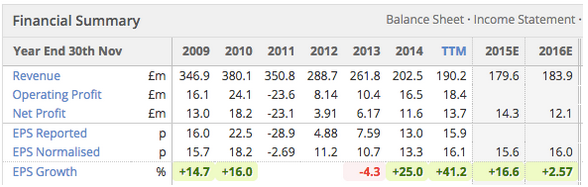
Most of RM’s business is funded from UK government sources. The tightening of public sector budgets helped drive earnings into negative territory from 18.2p per share (2010) to -2.69p per share (2011). Revenues dropped from £380m to £351m in the same timeframe and have gone on to decline each year since then. However, RM’s recent interim results revealed that the company expects revenue growth in 2016. The interim dividend has also increased by 25% to 1.20p.
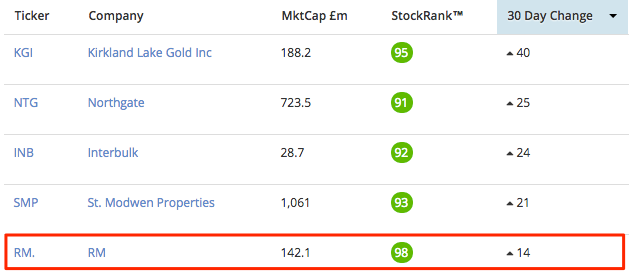
Since RM released its interim results on 6 July, the company’s StockRank has risen from 84 to 98 - as you can see from the StockRank Movers page below. To assess whether a company is a recovery play, Peter Lynch, the author of What works on Wall Street, asks three important questions:
- How is the company supposed to be turning around?
- Are costs being cut?
- Is the business coming back?
Let’s take a look at these questions in more detail.
“How is the company supposed to be turning around?”
After earnings crashed in 2010, RM undertook a strategic review which concluded that the company would concentrate on its core UK education market, restructure into four operating divisions, dispose of a number of business operations, and integrate the remaining activities more fully. With a view to dispose of operations that were either ‘loss-making or of marginal profitability’, RM disposed of its US hardware business and Australian operations. Furthermore, RM Education ceased selling personal computing devices in December 2013 and stopped manufacturing hardware devices in June 2014.
The company has also taken steps to reduce costs. In 2011, RM implemented a redundancy programme which streamlined the company’s headcount down from 2,699 (September 2011) to 2,250 (November 2012). The headcount dropped further to 2,018 by the end of 2013, and 1,778 by November 2014.
“Is the business coming back?”
The Piotroski F-Score is perhaps one of the best tools to judge whether or not a company is turning a corner. The Score seeks to identify companies that are profit-making, have improving margins, don’t employ any accounting tricks and have strengthening balance sheets. RM has a high Piotroski Score (7 out of a possible 9). In particular, the company is more profitable than it was last year and its capacity to service both long and short-term debt is getting better. The company’s profit margins have widened, perhaps reflecting the success of RM’s cost reduction programme. Furthermore, the Financial Summary below shows that after a drop in 2013, earnings have grown by 41% over the last twelve months.
“Where will RM go next?”
The market seems to be warming to RM’s story as illustrated by strong share price relative strength. The company’s share price has appreciated by almost 10% over the last six months while the FTSE 100 has dropped by nearly 4%. Furthermore, brokers are becoming increasingly optimistic. EPS estimates have risen from 13.6p to 15.5p over the last year. RM has an overall MomentumRank of 90 and an overall QualityRank of 97, suggesting that the company could be exposed to factors which have historically driven share price returns.
So the momentum picture is beginning to look brighter for RM. After a few years in the doldrums, the company is growing earnings and the market has started to drive the firm’s share price up. Nevertheless, the company is still relatively cheap, with a low P/E ratio (10.7) compared to the market average (19). Why so cheap?
There are two major worries. Firstly, public spending cuts may be on some investors’ minds. Indeed, RM’s ‘Risks and Uncertainties’ section warns that ‘UK government funding in the education sector is constrained by fiscal policy…Changes in political administration, or changes in policy priorities, might result in a reduction in education spending.’ Secondly, our own Paul Scott has highlighted several problems around the company’s pension deficit. Last year, Paul revealed that the company had a £53.5m deficit for funding purposes, which required £3.6m p.a. recovery payments. The pension deficit has now increased (see here).
So perhaps the risk is there, but many believe that value investors get paid a premium as compensation for the risk of underperformance. Indeed, Ben Graham used to buy the kinds of stocks that you wouldn’t even wish on your mother in law. Individually these looked like bombed out companies, but the idea was that if you diversify across a wide range of stocks, there would be enough recoveries, re-ratings and perhaps buy-outs to offset the losses and generate strong returns. It is impossible to judge where RM will go next, but do please feel free to leave your own opinions below.
Disclaimer
This is not financial advice. Our content is intended to be used and must be used for information and education purposes only. Please read our disclaimer and terms and conditions to understand our obligations.
5 comments
Hi PeterRussell,
Thanks for this. You may want to check out our StockRank Movers page, here: http://www.stockopedia.com/stockranks/
...or our stock sceening tool which can be found here:
http://www.stockopedia.com/screens/create/
Also see our webinar on the StockRank Portal, here:
https://www.youtube.com/watch?v=VtHgyW18dP0
I hope this helps?
Best,
Alex
Excellent, it is on my seriously consider list.
please how did you pick out this stock. I dont find Stokopedia good for trawling stocks or am I missing something ?
Using Sharescope it is easy to trawl all stocks with PEG say < 1
How can I use Stockopedia to trawl stocks on a regular basis ?
Peter Russell
With the screening tool, you can create your own screens
Thanks! Thought provoking.
Question: why is the RoCE so high?
Stockpedia reports c. 45%. This seems very high, compared to (for instance) Pearson which struggles to get above 4% RoCE.
I had a quick look at the RM balance sheet. Aside from the pension deficit, there is also £15m of intangible assets, versus net assets of £16m. That would be my other concern.
Any thoughts Alex?
I don't think anyone answered to the question about the RoCE.
I was puzzled as to why the RoCE could be so high compared to the RoA, given that RM has essentially no long-term debt... The answer is about the current liabilities, which are very high for RM (83.3/117.3 = 71%). This is what magnifies the RoCE, as stockopedia calculates it as EBIT/(TA-CL).
The bulk of the current liabilities is a category 'others'. I tried to download the reports from RM's website to learn more about it, but their website gives me an error page! That does not fill me with a lot of confidence in this company, which is suppose to sell ICT solutions!