Royal Mail (LON:RMG) could offer a 9% dividend yield

At the start of 2022, Royal Mail (LON:RMG) was flying high. The company had reported near-record profits for the two years of the pandemic and appeared to have recovered both its profitability and its mojo following a boardroom shake up.
Unfortunately, events this year have suggested that Royal Mail’s postal business still has the same problems with modernisation, workforce relations, and declining letter volumes that dogged it before the pandemic.
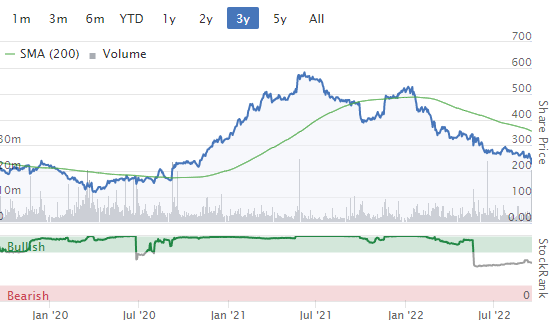
Royal Mail Group shares are now back at pre-pandemic levels:
Recent trading: The group’s first-quarter trading update revealed that revenue fell by 11.5% year-on-year in the Royal Mail postal division, leading to a Q1 operating loss of £92m. The postal operator hopes to break even at an adjusted operating profit level over the full year.
This was a notable contrast with RMG’s other division, international parcel operator GLS, which owns Parcelforce. GLS reported a 3% fall in volumes but said that revenue rose by 7.8% during the quarter, including acquisitions.
Inflationary pressures are putting last year’s 8% operating margin under pressure at GLS, but management still expects this business to generate an operating profit of €370m-€410m this year.
Royal Mail Group chairman, Keith Williams, says that the problem at Royal Mail is that efficiency improvements have stalled and the postal workers’ union won’t accept changes to working practices. He’s planning to end cross-subsidy between GLS and Royal Mail and has threatened to consider splitting the two businesses if no solution can be found.
I can’t predict how all the human and political elements of this situation will turn out. But I can see some reasons to believe that the shares offer value at current levels, however the situation evolves.
Stockopedia’s algorithms appear to share this view. Royal Mail is badged as a contrarian stock at the moment.

That suggests a mix of good value and quality, but poor momentum. In other words, the shares could be cheap if earnings stabilise:

Let’s take a closer look.
Great value?
Royal Mail is often talked of as a value stock due to its large property portfolio, cash generation and apparently modest valuation.
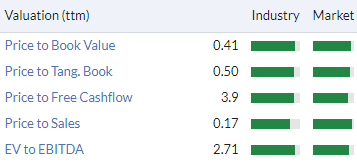
Book value: Royal Mail does indeed have plenty of fixed assets. The group’s property, plant and equipment (PP&E) was valued at £3.6bn on the most recent balance sheet. Debt is still low.
However, the price/book ratio above is distorted by a more unusual balance sheet entry. Unlike many large employers, Royal Mail’s pension scheme is fully funded. In fact, it’s in surplus – to the tune of £2.7bn. This is shown as a non-current asset.

Management warns that this surplus is an accounting entry only and “could not be recovered by the group”. So when considering the equity value available to shareholders, we need to discount this surplus.
Stripping out this pension surplus gives me a net asset value of £2,611m or 274p per share for Royal Mail Group. That means the last-seen share price of 230p represents around 0.85x book value. That’s still attractive, I think, but not such a large discount as suggested by the headline figures.
A P/E of 3 and a 9% yield? RMG shares look extremely cheap relative to last year’s earnings and dividends:
- P/E: 3.3
- Dividend yield: 8.7%
- Earnings yield (EBIT/EV): 20%
The problem here is obvious enough. The group earned exceptional profits over the last two years, but these are expected to moderate going forward:.

It looks like GLS profits will help to offset a possible net loss for Royal Mail this year, leading to a positive but much-reduced group result.
However, I think what’s most interesting here is the possibility that the dividend will be maintained. Royal Mail’s dividend policy is for a progressive payout that keeps net cash broadly at zero.
Last year’s ordinary dividend of 20p is unlikely to be covered by group earnings this year. But Royal Mail reported net cash excluding lease liabilities of £307m at the end of March. That would be enough to cover last year’s ordinary dividend of 20p 1.5 times.
Maintaining this payout for FY23 would give the stock a forward yield of 8.7%. Any increase could push the yield to 9%.
If the company can ride out one bad year and return to a more sustainable level of profitability in FY24, then I think Royal Mail shares could offer attractive value at current levels.
Quality: a mixed picture
Why doesn’t Royal Mail have any debt? Such prudence is unusual in large companies. But there is a good reason, which the company answers in its own results:
Given the high operational leverage in our business, we will continue to keep low levels of financial leverage.
Operational leverage refers to the effect a small change in revenue has on a company’s profits.
Royal Mail’s claim of high operational leverage reflects the very high fixed cost base of this business. The vast majority of its daily operations are fixed, regardless of whether mail volumes rise or fall.
What this means is that when volumes rise, as they did during the pandemic, profits can rise very quickly. Unfortunately, we’re now seeing the opposite effect.
In my experience, it’s quite rare for a company to explicitly flag up this risk. It suggests that profits could always be uncertain and volatile, based on factors outside management control. It’s certainly something I’d want to consider when reviewing Royal Mail’s quality metrics.
At first glance, these seem acceptable, if rather average:

However, I think it’s worth bearing in mind that these ratings are based on near-record results. Looking back over the last few years, what strikes me is how volatile Royal Mail’s margins have been:

One of the factors the QualityRank looks for is consistent profitability. This isn’t present here.
However, I think that the results we saw during the pandemic suggest that Royal Mail has the potential to deliver attractive profitability, if it can modernise its operations and introduce a little more flexibility into its cost base.
Dire momentum could turn positive
Despite the current deadlock with the CWU, City analysts remain more positive about the medium-term outlook for Royal Mail Group. They’re forecasting a sizeable bump in earnings next year:

If this materialises, RMG shares could be trading on just 6.5x FY24 forecast earnings, with a covered 9% dividend yield. Given the group’s general record of cash generation and low leverage, I can see some attractions here.
However, I think it’s prudent to consider the known unknowns in this situation.
We don’t know how the current dispute over pay and working conditions will be resolved, or how long it will take. Positive news could trigger an upwards re-rating – but a protracted deadlock with ongoing strikes could have the opposite effect, while also hitting profit expectations.
In addition, we don’t know how cost inflation and economic activity might change over the coming year. Although Royal Mail hedges most of its commodity-related costs, GLS doesn’t. High costs plus a broader economic slowdown could hit parcel volumes and cause profit expectations to be revised.
Finally, I think it’s worth remembering that the technical trend here is still very weak:

From a technical perspective, the only glimmer of hope I can see here is that volumes have risen over the last two weeks, relative to the three-month average. I guess it’s too soon to say whether this marks the start of a rally, but it might be worth watching.
My view: Royal Mail Group’s MomentumRank of 2 is dire by any standard. In my experience, investing in stocks with such poor momentum requires patience and can be an expensive mistake.
Conclusion
Leaving aside Royal Mail’s problematic industrial relations, I think that a key question is whether Royal Mail Group’s financial position has worsened during the first half of the year. This might provide some clues as to whether a dividend cut will be needed.
There’s also the question of whether strikes could cause havoc over the key Christmas trading period.
RMG’s accounts for the six months to 30 September are due in November. Until then – at least – I suspect the shares will remain volatile and apparently cheap.
I dislike investing in situations where there’s so much political and regulatory risk. But on balance, I think there’s a good chance the shares do offer value at current levels. If I was a died-in-the-wool value investor, I’d certainly do some more detailed research into RMG.
Disclaimer
This is not financial advice. Our content is intended to be used and must be used for information and education purposes only. Please read our disclaimer and terms and conditions to understand our obligations.

16 comments
What are peoples thoughts on what’s going to happen with this company? The value parcel business and the property portfolio is significant.
I hold and the way I see this is through three possible scenarios.
Scenario 1
The business and union come to an agreement within the coming week.
IDS loses circa £400m this year, reduced to circa £100m next year as change is implemented and then returns to profit in 2025, reaching circa £300m. A reduced divvy is paid over this year and next.
The shares get up to around £4 by 2025, with a circa 4% divvy.
Scenario 2
The business and union do not reach any agreement, further strike action is called.
IDS losses mount up and the business calls for administration. Courts would have to agree to this in order for the business to forgo its USO commitment.
The interesting thing here is part of the group is profitable (GLS) and the UK arm could be if the industrial action is halfway resolved, so how can a company claim it needs to go into administration in such circumstances?
This could be a nightmare for government, especially approaching an election year. Postal service perceived as going bankrupt, worsening levels of service. Any suggestion of GLS being split off could lead to claims of asset striping a UK infrastructure company. GLS built off the back of UK assets, so stripping that out and leaving the UK postal service in a mess could be a political problem.
I think government would not allow this and “suggest” the business lowers its change agenda to get union agreement and plod on, possibly conceding a review of USO to lower the required days to 5 or less ( as in other EU countries).
Scenario 3
VESA continues to build its stake to 30%, makes an offer at around £3 per share, and takes it all private. Next few years sees GLS continue to be built up whilst the UK arm is asset stripped with operational site rationalisation (already confirmed as in scope) and property sold off to keep the lights on and flow cash out of the business.
In four or five years time, they sell what’s left of the UK arm off for a nominal sum.
I think these are the most likely outcomes. I’d prefer the government and Ofcom agree to a USO review, lower the requirement to 5 days (1 in 6 staff reduction - and the volunteers are there to meet this) and the business comes to some agreement with its main union, even if not as far reaching in its scope. I do think this would be a catalyst to get the share price up towards the £5 mark in time.
Thanks for the response interesting points. Especially vesa taking private. I’ve been a long term holder, think in the next few months something will happen to this business. With vesa buying more , the unions not budging and there’s a lot of assets in this buiness.
With Labour likely to form the next government you have to take the political angle into consideration
https://www.theguardian.com/po...
These shares have been a roller coaster. Think they floated at c£3.30 had a huge covid windfall that’s now unwinding. Costs have increased turnover remained stable. think medium term utility costs will drop even the oil price must affect rmg a lot with its large fleet of vechlices.
But feel the future for parcel deliveries and for letters / post to level out at some stage is strong it’s just how rmg adjust, will determine their future.
We certainly aren’t used to seeing pensions in surplus, which is a great position to be in. As it is such a huge surplus, would it be likely to continue growing and if so, at what point <could> it become a company asset? Or would it be a payout to employees?
Thanks Roland, a very good read.
The value guru John Neff stockscreen has Deutsche Post on it
I hold and am sitting on a big loss and therefore I am not objective.
The key potential catalyst would be a spin-off of GLS. I think it is not too much of a stretch to say that GLS alone is worth more than the group market cap.
Management has tried to present the two businesses as separate and prevent the need to cross-subsidise Royal Mail by GLS. The CWU and Unite are clearly opposed although in theory it would make no difference to Royal Mail (just take away the crutch).
With no Group CEO - just separate CEOs of Royal Mail and GLS - a spin-off would presumably be technically doable. If it is what management really want to do, or just leave it as an option to wield over the unions’ heads remains to be seen.
If I worked for GLS, I would see no merit in being part of the Royal Mail Group and all the distractions and bad headlines that must cause.
Hi Wimbledonsprinter - I agree that for GLS, a spin-off could be attractive. However, there's a political element here and I'm not totally convinced the government would let the split go ahead.
Royal Mail's universal service obligation means that it's not a regular business that can be horse traded like any other (in my opinion). Separating the two would create the risk that Royal Mail might need a bailout or might even be reprivatised...
On balance, I'm inclined to see threats of a split as part of RMG's negotiation strategy. But I could be wrong...
Roland
I think you make very valuable points. Working in the PE industry I think the whole of Royal Mail is vulnerable to a takeover - Royal Mail has a huge property portfolio which is itching for a sale and leaseback transaction to release a huge amount of cash alongside the restructuring it desperately needs to do to make it a competitive and profitable company again.
GLS would be a great spin-off which will make shareholders more cash.
I think it is a matter of when or as Roland rightly says if the government lets it go ahead...
I can't imagine any potential suitor going anywhere near Royal Mail (LON:RMG) whilst it is being run into the ground by the TU's and their anti-change agenda.
If that could be resolved then it may become attractive, but that type of culture will take years & years to resolve - if it's even possible?
It didn't take very long for Maggie Thatcher to get rid of the miners union. I think the only remnants of that union is Scargill, still milking the last remaining cash left for his own gain.
Look at the London Underground. They held London to ransom for years, and now it's being bailed out at a 1bn a year, with falling passenger numbers.
When the public fight back, It's very subdued. I think RMG will change and the unions after today's RNS will find that they don't run the company.
Down 8% today, against a yield of 9%? What kind of deal is that, and likely to get worse.
I always rate Roland, and he is generally right whereas I am quite often wrong on shares he is reviewing, so there may be things I am missing. However, rising inflation, economic recession, and a work force against all the things the board want to do, and prepared to stand out for as long as it takes are a toxic mix. The last comment I read from the CEO was very blunt. They were losing £1m a day and no change in the the pay and conditions offer was going to be forthcoming unless substantial change to working practices were accepted.
Not for me.
Agree - completely uninvestable in my view, no matter how optically cheap.
Hi ridavies,
Thanks for your comment! The political element and the current negotiating deadlock certainly add up to an uncertain picture. But the situation will move one way or the other at some point.
In a sensible world, I would have thought that £RMG should be possible to build a profitable postal business from a company with a near-50% share of the UK parcel market.
In the world we're in right now, I'm not sure. I guess that the current valuation reflects this contradictory situation. It's not for me either, but my gut instinct is that there should be some value here.
Roland