Sabre Insurance: a big yield with a growth twist (and the risks to watch)

Insurance stocks can generate attractive returns and reliable cash flows – just ask Warren Buffett. But these specialist financials aren’t without risk, so in my experience it’s wise to focus on companies with proven financial strength and underwriting discipline.
In this Stock Pitch I’m going to take a look at niche motor insurer Sabre Insurance (LON:SBRE) and explain why I think this company offers an attractive mix of strength, discipline and growth potential.
Share price at the time of publication: 165p
Market cap: £408m
Disclosure: at the time of publication, Roland has no position in SBRE.

Source: Sabre Insurance website June 2026
The Pitch
Motor insurance is a ruthlessly competitive sector that’s exposed to macroeconomic pressures. Investors were reminded of this when even UK sector leader Admiral saw its profits halve in 2022. Others fared much worse.
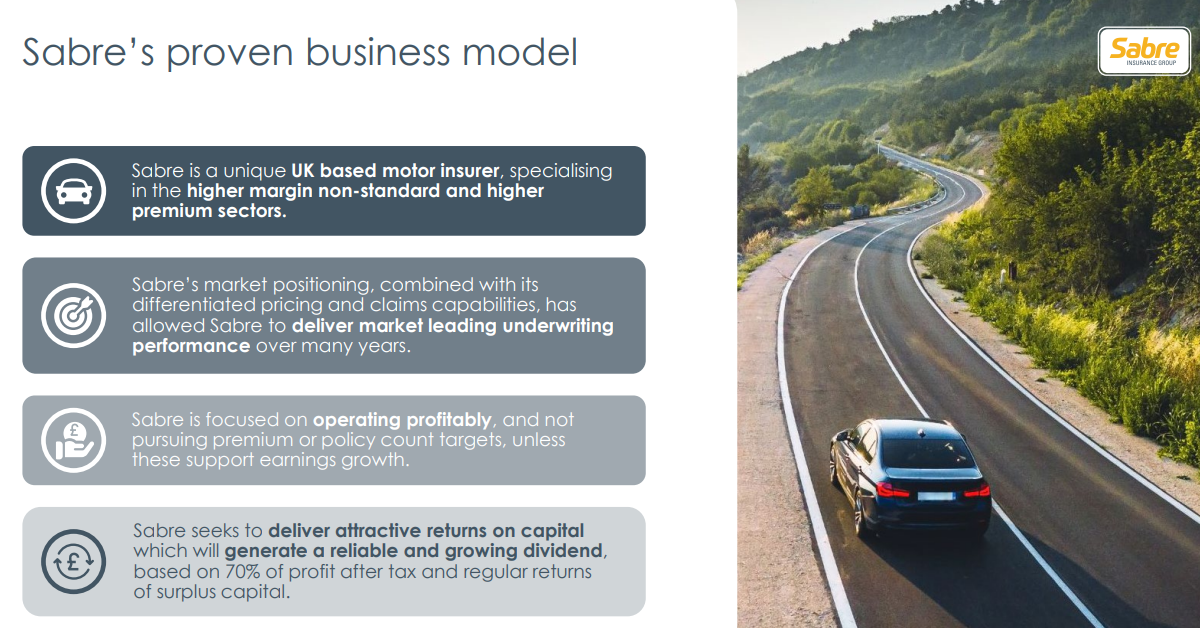
Sabre sidesteps the bear pit of competing solely on price by focusing on more profitable and less competitive sub-segments within the overall motor market. These include “high-premium, high-margin policies” for riskier car drivers, plus coverage for taxis and motorcycles.
The business sells policies through brokers and directly through its own brands, which include Insure2Drive, GoGirl and Sabre Direct.
Despite its small size, Sabre has established a reputation for skilled and disciplined underwriting – management aren’t afraid to turn down volumes to protect margin.
Source: Sabre Insurance Capital Markets Update 2024
The company has now embarked on an expansion plan targeting pre-tax profit of “at least" £80 million in 2030. That’s equivalent to an annualised growth rate of around 9% per year from the 2024 figure of £48.6m.
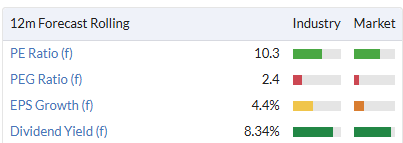
If the company can hit this target without any mishaps, my number crunching suggests that the shares could enjoy a material re-rating from current levels. In the meantime, Sabre offers a forecast dividend yield of 8% – potentially tempting.
The Big Picture
Sabre has a solid track record of profitable underwriting in its core markets of higher-risk car drivers, taxis and motorcycles. As broker Panmure Liberum commented in March, the company’s “previous strategy of focusing on profitability over volume has worked well, ensuring positive earnings throughout, unlike peers” (my emphasis).
The company’s new growth strategy is aimed at realising the holy grail for insurers: strong profitability and consistent growth through the cycle. If successful, I think it’s fair to say this approach could make Sabre a much larger business in the future.
Here’s how Sabre CEO Geoff Carter believes this will work:
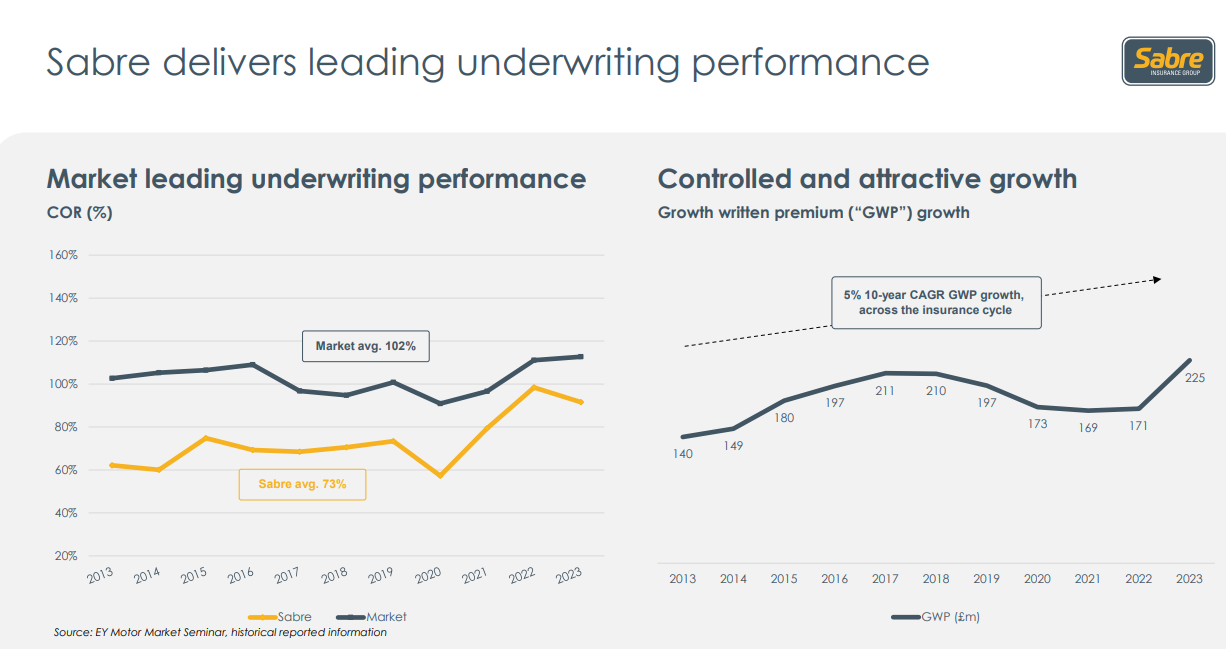
Strong foundations: Sabre has an excellent track record of profitable underwriting throughout the cycle. This is highlighted in the chart below. The flipside to this is that the company has to endure periods where its premium income and policy volumes decline, in order to protect its margins (right-hand chart). Although this might seem unappealing, it’s a valid approach that has historically allowed Sabre to be consistently profitable and pay generous dividends, without risking its financial strength (unlike Direct Line in recent years, for example):
Source: Sabre Insurance Capital Markets Update 2024
Cheap valuation: a forecast dividend yield of more than 8% suggests the market is pricing in an extended period of flat profits or declining profit margins. That seems harsh, in my view, given that the group achieved a 15% return on equity and 20% operating margin last year (in relatively soft conditions).
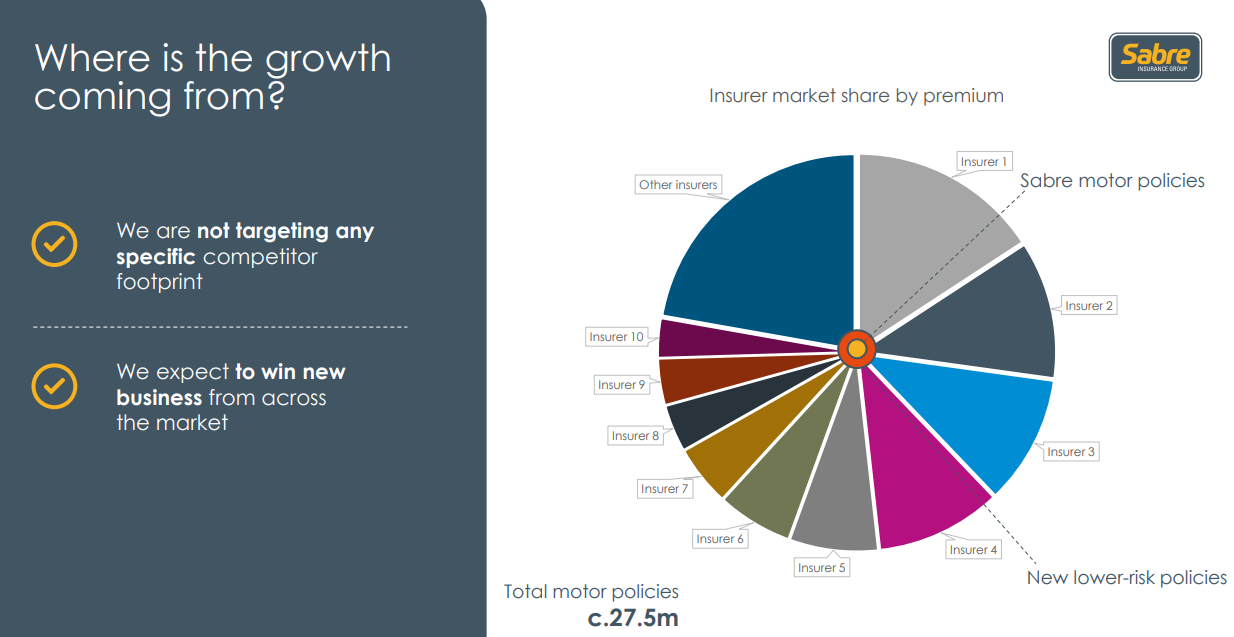
Growth ambition - taking crumbs from a much larger cake: the final piece of the jigsaw is an opportunity for the business to expand at lower risk. Sabre’s Ambition 2030 strategy sees the company expanding into the much larger market for lower risk motor insurance. If the company gets this right, it could support a step change in size over time; Sabre’s existing market share of 1% means that even small gains could translate into significant volume growth.
Source: Sabre Insurance Capital Markets Update 2024
Going Deeper
While Sabre’s growth strategy isn’t without risk (I’ll return to this shortly), I can see several reasons to be optimistic about the outlook and valuation here:
Consistent focus on sustainable dividends: Sabre has paid more than 100p per share in dividends since its IPO, while consistently maintaining a healthy balance sheet. Shareholders have enjoyed an average income of nearly 5% per year, based on the 2017 IPO price of c.250p. The de-rating of the shares over the last couple of years means this yield is now much higher, at over 8%. I don’t think risk has increased this much, though.
Experienced management: CEO Geoff Carter joined Sabre in 2015 and has been CEO since 2017. He was previously CEO of Tesco Underwriting and has more than 25 years of experience of managing insurance operations. Of the other executive directors, the Claims Director and Chief Actuary have both been with the business for at least 12 years. This means they are responsible for the group’s track record of profitable underwriting. I would like to think all three men will be careful to protect this record as they seek to expand Sabre’s market share.
Fair value estimates: I must caveat this section by emphasising that projections about the future are inherently uncertain and require predictions that may prove to be inaccurate. With that said, my number crunching suggests that if the company's growth plan is successful, Sabre shares could have a fair value of 200-250p per share, using a fairly standard set of assumptions. That’s significantly above the 165p share price at the time of writing.
What The Brokers Say
Five brokers are listed as covering Sabre Insurance. We can see from the chart below that overall sentiment is quite positive:
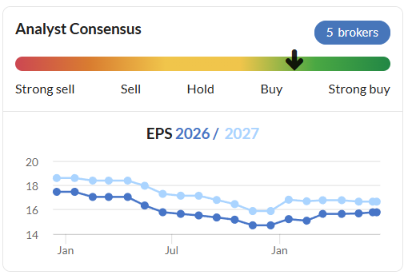
Unfortunately we only have access to detailed forecasts from one of these brokers, Panmure Liberum, which is kind enough to make its coverage available on Research Tree.
Panmure has a price target of 200p. Its analysts upgraded their forecasts following Sabre’s full-year results in March and then left their estimates unchanged following May’s Q1 trading update:
2026E EPS: 15.3p
2027E EPS: 17.4p
2028E EPS: 19.0p
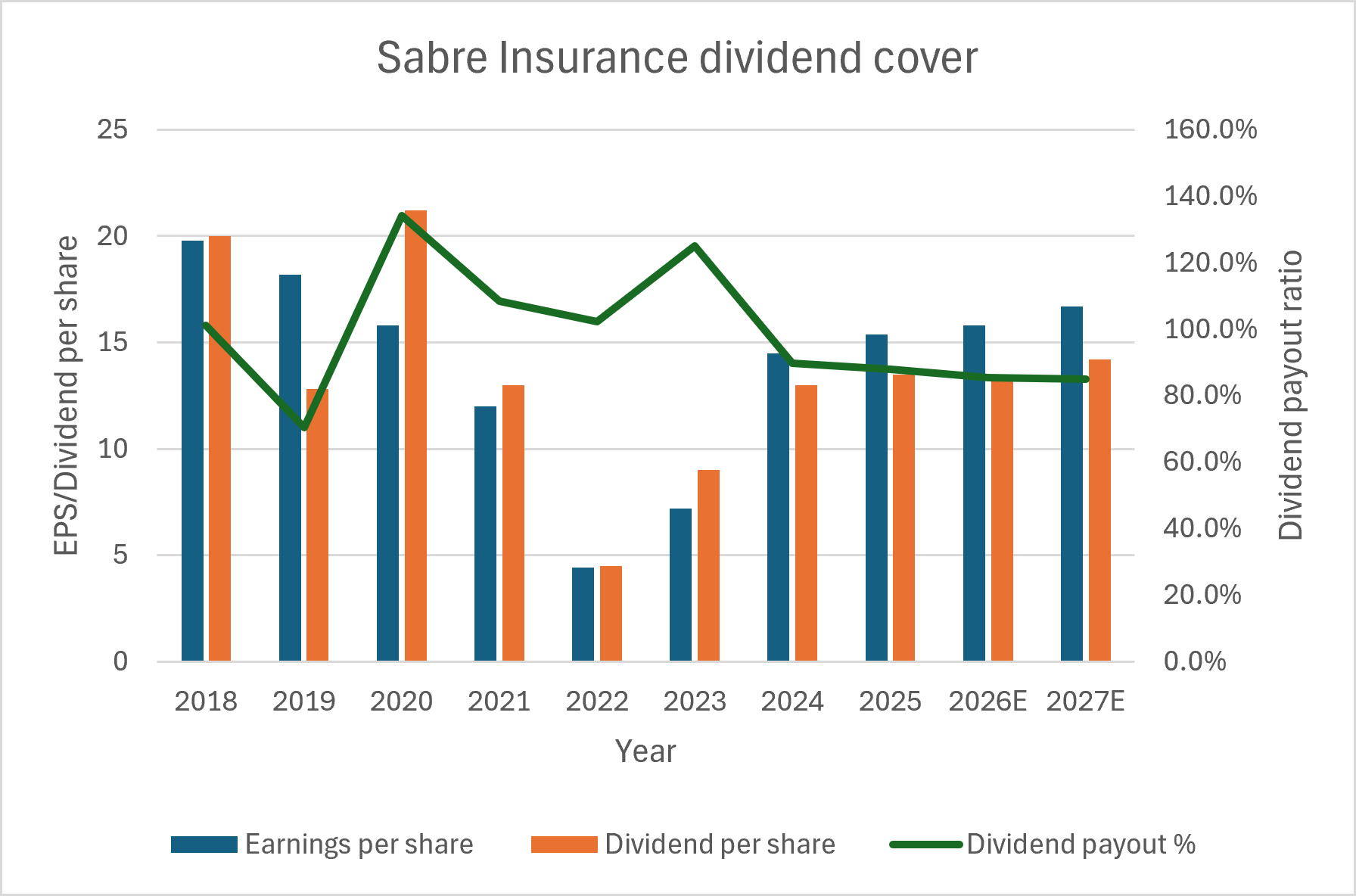
These numbers price the stock on a 2026E P/E of 10.8, falling to a P/E of 8.7x in 2028. Panmure expects the dividend payout ratio to remain around 85%, with the projected payout reaching 16.3p in 2028.
The Bear Case
There’s no doubt in my mind that the big risk here is the company’s decision to modify its business model. Here are my top three concerns, from an investment perspective:
Change of strategy: the expansion into lower margin, more competitive work needs skilled management, technical innovation and financial discipline. Getting it wrong could sacrifice the very qualities and differentiation that make Sabre attractive. Any signs that the company is succumbing to a growth-before-margin mentality and risking its financial resilience would be a warning flag for me.
Difficult to understand: the detailed mechanics of an insurers’ pricing, claims reserving and investment portfolios are difficult to understand and model. To a greater extent that with some other sectors, private investors are reliant on company guidance and broker forecasts. If things go awry, there may not be any advance warning. This is probably particularly true for a small cap like Sabre.
The insurance cycle may continue to soften: broker forecasts suggest 2026 earnings will be largely flat. Unless market conditions improve to support firmer pricing, it may be difficult for Sabre to increase volumes in either its core markets or in the lower-risk (and more competitive markets) where it hopes to expand. In such a scenario, the shares could remain rangebound at current levels (or lower!).
The Bottom Line
I see Sabre Insurance as a well-run niche insurer with above-average profitability, experienced management and a strong record of shareholder returns.
The company’s ambition to expand its market share could lead to a step change in the fair value of the business, while continuing to support generous dividends. While this strategy is not without risk, it could also prove to be well timed if UK motor insurance conditions stabilise as expected after a difficult few years.
The 8% dividend yield offers the potential for an attractive, rising income, with capital gains over time. As with all niche financials, unexpected problems will always be a risk and positions should be sized accordingly. But I think this business could be worthy of further research for investors with an interest in this sector.
Disclaimer
This is not financial advice. Our content is intended to be used and must be used for information and education purposes only. Please read our disclaimer and terms and conditions to understand our obligations.

5 comments
Great article on Sabre Insurance (LON:SBRE) Roland. Thank you. I'm up 9% on SBRE after a modest £1500 investment and there's still no sign of a reversal. Thanks for that. I normally detest insurers but in this case I'll make an exception.
I don’t much like insurance as a sector but I bought some of these at 141p and another lot at 155p as I’m trying to get better sector diversification and I thought this was the best choice in the smaller insurers. I hope you analysis holds true but my target price is 176p at which point I will review and perhaps decide if I want to stay in or get out.
Carey, what did you decide!
Chris
Great work again Roland. Interesting to me, especially as I have just opened up a conceptualised "Insurance Barbell" with both Sabre Insurance (LON:SBRE) and Conduit Holdings (LON:CRE). By holding both I am trying to balance two fundamentally different risk profiles that share a common DNA of high yield and disciplined underwriting - with Conduit Holdings (LON:CRE) on the aggressive side and Sabre Insurance (LON:SBRE) on the defensive. Also a bit of currency hedge here on this huge yields as CRE pays in $. Not sure how committed I will stay on these, but great to read your analysis of the Sabre side.
Another in-depth disertation Roland, thank you. One tactic would be to buy now and double-down on the dips, one that I used in my Sabre Insurance (LON:SBRE) investment currently returning a 14% dividend in my ISA. Having a holding works to keep the eye on the company and with nothing ventured, nothing is gained.