Screening for sustainable dividend growth

This week I’m looking at a topic close to my heart – finding companies that can provide a sustainable, growing, dividend income.
A portfolio of such shares has the potential to provide a reliable passive income, with minimal trading. Over long periods, sustainable dividend growth tends to reflect underlying business growth, and should also lead to share price growth.
This means that with dividends reinvested, a dividend growth strategy can also be a good way to generate long-term compound gains.
In pursuit of a systematic approach to finding sustainable income, I’ve built a new screen to try and capture what I believe are the essential qualities of a good dividend.
I should point out straight away that this screen will probably exclude some suitable stocks and include some unsuitable choices. That’s okay with me. Indeed, I think it’s to be expected.
As with the StockRanks, the purpose of a screen isn’t to achieve a 100% success rate. That’s not realistic. Instead, we want to swing the odds in our favour by selecting a statistically favourable group of shares. I think I’ve been able to do that here, as I’ll explain.
Sustainable income screen criteria
In this section, I’ve split up the rules I’ve created into different categories and tried to explain why I think they’re important.
I’ve linked to my sustainable dividend income screen here.
Which companies?
To start with, I created three simple rules to filter out stocks that are statistically unlikely to offer the kind of qualities I’m looking for.
First of all, I don’t want any micro caps or foreign shares. These may sometimes have attractive income qualities. But they can be riskier and will require too much in-depth research for this strategy.
I’ve also specified a minimum StockRank in order to exclude shares that are statistically less likely to perform well. This might exclude some good businesses, but as a group, we know that companies with low StockRanks have underperformed over the last decade.
Rule #1: Market cap > £50m
Rule #2: Primary listing ==1
Rule #3: StockRank > 50
Here’s how this looks in the screener:

Dividend metrics
Sustainable income is about company culture as well as financial performance. What I want, ideally, is to buy shares in businesses where there’s a strong dividend culture and the dividend is well supported financially.
In quantitative terms, this means that I look for a sustainable payout ratio, a consistent dividend policy, and a decent track record of payouts.
For this initial filter, I’ve opted for relatively relaxed rules in order to avoid ruling out too many potential options.
Rule #4: Trailing 12-month dividend yield > 2.8%
I’d want a higher yield than this from an income portfolio, but I’m happy to have a mix of high yield/low growth and low yield/high growth stocks. In my experience, this can be a good way to generate a growing income from a diversified portfolio.
Rule #5: Annual dividend streak > 5 years
This rule excludes stocks which suspended their dividends during the pandemic. That is perhaps overly harsh - some good companies suspended their payouts but have since reinstated them.
Rule #6: Dividend per share CAGR 5y > 0%
I’m looking for companies whose dividend-paying capability has not been seriously impaired by the events of the last few years. This rule ensures that the current dividend is higher than it was five years ago.
Rule #7: Dividend per share Growth forecast 1y > -5%
I’ve opted for -5% to allow some wiggle room. In my experience, consensus forecasts sometimes suggest a small fall is expected when in fact a flat payout is more likely. Remember, a screen is only an initial sift, subject to further research.
Rule #8: Dividend Cover TTM > 1.1x
I would generally look for a higher level of earnings cover than this. But in some sectors, such as finance and utilities, low levels of dividend cover are more typical. Again, I don’t want the screen to be too restrictive.
Rule #9: Dividend per share TTM < Free cash flow per share TTM
The best quality dividends are normally covered by a company’s surplus cash flow, as well as by earnings. This rule is intended to test for dividend cover by free cash flow. For this, I’ve used the advanced rule capability in Stocko’s screener to compare two metrics:

Valuation & Quality
One challenge when systematically screening for quality and valuation is that different figures may be appropriate for different types of business.
In this case, I’ve opted for a fairly light-touch approach. My aim is merely to make sure that the companies I’m considering are profitable, cash generative, and do not have crazy valuations.
Rule #10: Return on Equity 5y Avg > 10%
As a rule of thumb I assume that companies that consistently generate a return on equity of less than 10% may not be covering their cost of capital. This isn’t true in all cases, but I find it a useful baseline. I’ve opted for the five-year average to smooth out short-term dips.
Rule #11: Piotroski F-Score TTM > 4
The F-Score is a good general measure of financial health and positive momentum. A very low score could be a worry, but once again I don't want to be too restrictive.
Rule #12: Earnings yield TTM ⩾ 4%
This ratio compares a company’s operating profit with its enterprise value (market cap plus net debt). I prefer it to the P/E because it provides a whole-business view of valuation, rather than focusing on equity alone. A yield of 4% is equivalent to a multiple of 25x.
Debt
Excessive leverage can be a big risk for income investors. When faced with a choice between keeping lenders happy and paying dividends, companies have no choice but to cut the dividend to maintain debt service.
I like to invest in companies which don’t use or need too much debt. However, the exact level of gearing I find acceptable varies widely between companies and sectors. Factors I’ll consider include size, profitability, cash generation, and industry group.
For this reason, I’ve included a fairly simple and unrestrictive rule on debt that’s only intended to exclude massively-indebted businesses from consideration. For me, this makes a good starting point for further checks, if the business looks attractive otherwise.
Rule #13: Net debt less than 5 times net profit
I like to use this ratio to give me a rough idea of a company’s ability to repay its debt. Once again, I’ve used an advanced rule for this test:

Screen results
Here are the results of my sustainable income screen at the time of writing. You can see (and copy) the screen here.
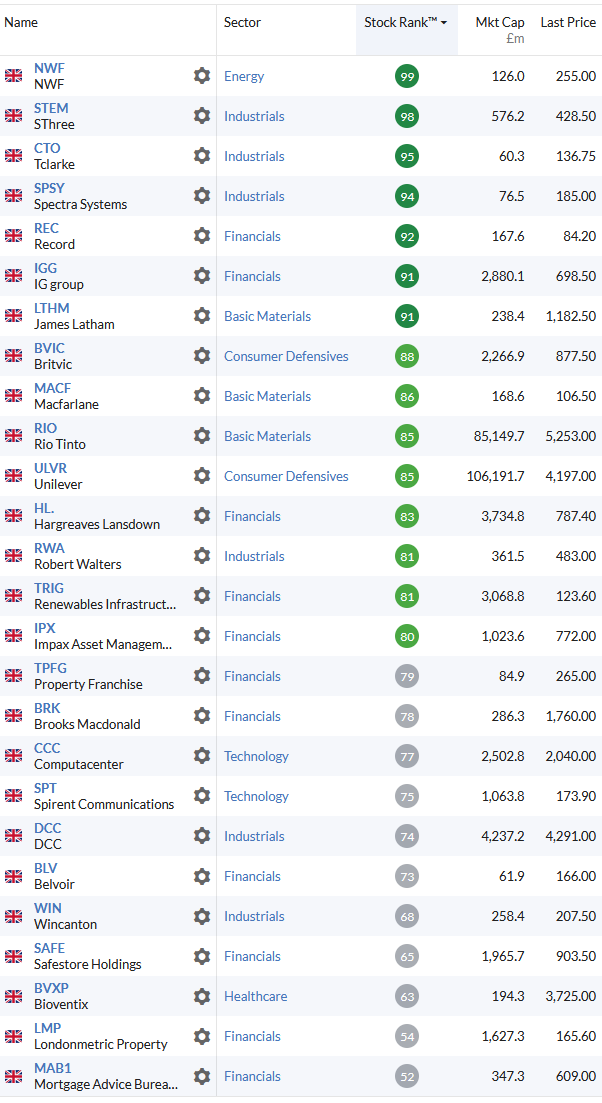
Interestingly, this screen includes two stocks that I recently reviewed from the results of my recent Warren Buffett screen, Computacenter (LON:CCC) and James Latham (LON:LTHM).
Conclusions
The challenge when creating a screen is to make it sufficiently selective, but not too restrictive. The reality is that while good quality stocks share many characteristics, they can also be quite different.
The screening criteria I’ve chosen could quite easily be tweaked in a number of ways. One possible choice would be to specify a higher minimum yield.
Another choice that would be easily justified would be to exclude the requirement for free cash flow cover for the most recent dividend. Free cash flow can be lumpy and the events of last year did have a temporary adverse impact on many companies’ cash flow.
On balance, though, I’m very encouraged by the output of this screen. It contains a good number of stocks that are on my watch list and a few that I already own.
Although I may be suffering from confirmation bias, I’m confident this list includes some good potential opportunities for long-term income investors. In a future piece, I’ll take a look at one or two of these businesses to examine their attractions in more depth.
In the meantime, please feel free to share your views on my income criteria and the opportunities (or not!) for dividend investors in today’s markets.
Disclaimer
This is not financial advice. Our content is intended to be used and must be used for information and education purposes only. Please read our disclaimer and terms and conditions to understand our obligations.

15 comments
It’s a very good screen. I guess my own deviation would be to use industry medians rather than absolute thresholds but I respect the core principles used. The right shares are coming up. It covers all the themes contained in the income screens (mantrua etc).
Thanks for providing an this excellent screen. This is exactly what I am looking for. I know I have an unbalanced portfolio of higher yielding and yet more risky shares. So I now realise I need to rebalance by adding shares with a lower and hopefully growing yield.
Only brought up three three stocks on Asx
Very useful starting point Roland so thanks for doing that. I have thus far avoided too much complexity in making my own screens so this is a great one to copy and play around with. Should help a lot going forward for a relatively new investor such as moi.
Great article Roland and plenty to mull over. A really useful screen and one which I will come back to regularly.
All the best. K
Thank you Roland. I always enjoy reading your articles. See that you have not included any Banks and I assume this is because they suspended paying a dividend during Covid, although of course they were given no choice by the BoE . Would you not consider , for example, HSBC and Standard Chartered otherwise?
Caper4,
I might indeed consider HSBC Holdings (LON:HSBA) and Standard Chartered (LON:STAN) (I hold), but it's worth noting that the dividend suspension isn't the only reason they don't qualify.
None of the big FTSE 100 banks meet my criteria for a 5-year average return on equity of 10%, either. Although their profitability did improve last year.
Roland
An excellent article. Thank you Roland.
Hello Roland, thanks for this article. I see Rio Tinto (LON:RIO) is on your list, it announced last month it was cutting it's dividend by around 50%, so this would now fail your screen?
It is worth double checking dividends, I have found quite a few on Stockopedia, to be inaccurate, over the past 2 years.
Quite a few excluded from your screen because of reduced or no dividends because of Covid, is that fair? I think Oil and Insurance stocks probably more reliable than commodities at the moment. Recruiters could also be hit by a recession.
The screen looks sensible and there are a couple of constraints I really ought to look at (the ones on dividend growth rates > 0 historic and forecast). Thanks.
But it highlights the fact that we cannot see something that is very important :-
how well does this screen work in a back-test
That is a question for Stocko, not Roland. It is clear the machinery is in place as we can see historic performance of the guru screens.
(I would also like to know it the screen will work going forwards, but that may be asking too much :)
Thank you, most useful, but please could you tell us which companies would have made the cut if they hadn't cut their dividend during the pandemic?
copy the screen and delete rule 5 and compare the two screens
Hi Anne,
You can make a copy of the screen and then make changes to the rules yourself to test the effect of single changes. I often find this very useful in understanding which factors are having a big impact on my results:
Then you can activate/deactivate individual rules or edit them:
Hope this helps.
Regards,
Roland
Excellent and timely article Roland. I was looking to create a watchlist for my next year ISA. You made my search much easier. As you said , lots of banks, insurance and financials are excluded because of not paying dividend during Covid. Not fair because many were forced to stop. Energy is excluded for the similar reasons. Not sure why BAE is not in the list.
Fancy seeing Hargreaves in this list. In fact I have been a buyer recently and has dropped more today. I own many in the list already. If I am going to choose only one from your list, it is going to be IGG.
Thank you again.
Hi Lucky dip,
BAE Systems (LON:BA.) misses out on a technicality - the stock's increased valuation means that its dividend yield has fallen below my cut off (slightly):
This kind of thing is always a factor with screens. I often find it sometimes pays to mess around by adjusting the rules slightly to see what changes in the results.
You can make a duplicate of the screen and edit the rules yourself, if it's of interest.
Regards,
Roland