SIF August review: Should gold star Capital stay after 50% gain? (CAPD, HAT)

Gold remains a popular topical subject in the investment world, not least because Warren Buffett recently bought a $500m stake in miner Barrick Gold. Paul discussed this deal here.
As we’re approaching the end of the month and next Monday is a bank holiday in the UK, I’m carrying out my usual month-end review for August this week. There are two stocks in the SIF portfolio which have been in place for more than nine months and thus are due for review. Coincidentally, the two companies concerned are those which provide the portfolio’s gold exposure:
If these stocks no longer pass all of my screening tests, then I’ll have no choice but to divest both, stripping SIF of its exposure to the yellow metal.
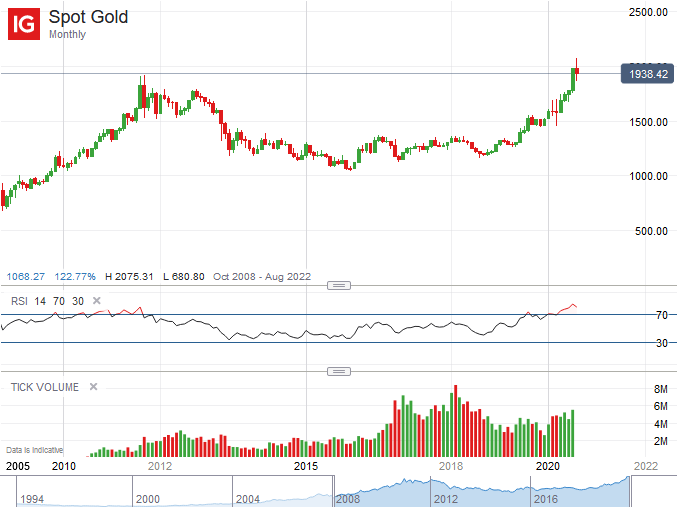
What’s gold been doing since last month? Here’s an updated version of the chart I used in my July review:
Source: IG Index
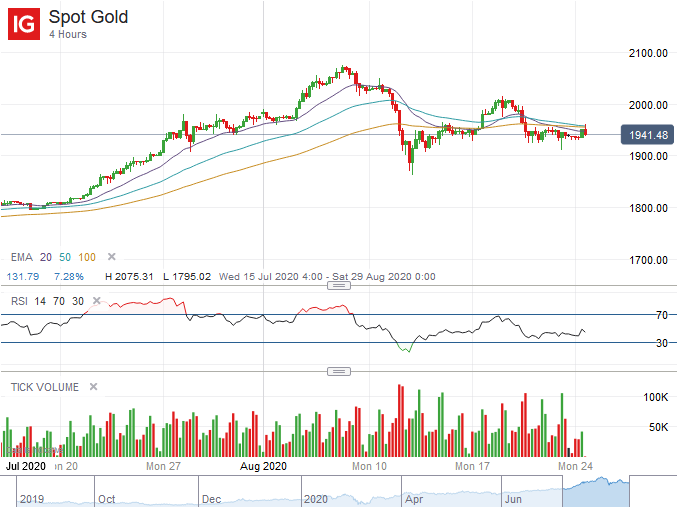
This long-term monthly chart doesn’t tell us all that much about recent movements, but we can see that gold’s ascent has paused over the last month. Here’s how the last six weeks look on a four-hour chart:
Source: IG Index
I’m not a chartist, but I would guess that this chart suggests a consolidation that could break out higher or lower in due course.
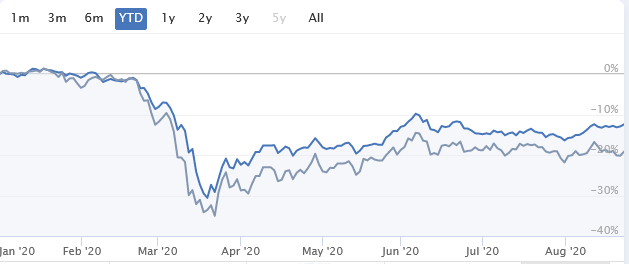
I don’t really have a strong view on which direction gold might move next. I prefer to focus on the performance and fundamentals of the stocks in the SIF folio. Here’s how the portfolio has performed over the year to date (the blue line is SIF, grey is the FTSE All-Share):
And here’s a stock-by-stock breakdown of the current positions in SIF:
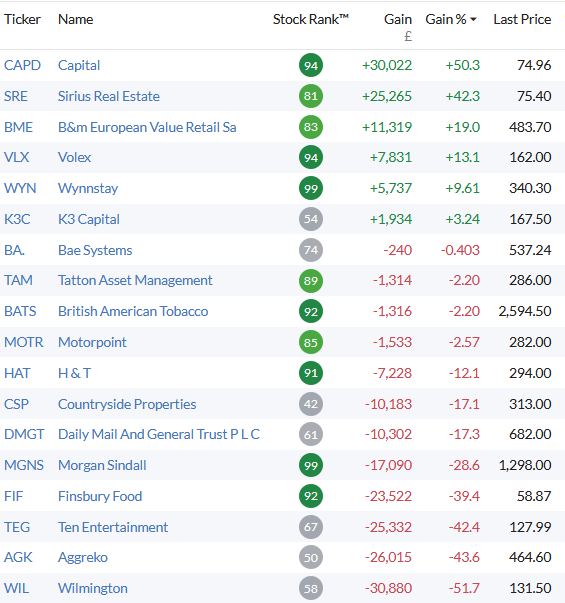
Capital is the biggest riser currently in the portfolio. H&T has languished. The impact of the lockdown closure of its shops has been greater than the benefit it might have enjoyed from gold’s rise.
Let’s take a closer look at each company.
Capital (LON: CAPD)
(Original coverage: 02-Jul-2019)
Capital’s half-year results were published last week. As you’d hope, the headline numbers were pretty strong:
- Revenue up by 19% to $65.1m
- Operating profit up by 21.5% to $9.6m
- Operating margin stable at c.14.5%
- After-tax profit up by 166% to $13.6m
I’ll stop there, as these numbers need some explanation. Why has after-tax profit risen so much more than operating profit?
The answer lies in Capital’s business model, which includes taking equity stakes in “exploration and mining companies”. The value of these rose sharply during the first half of this year, generating a non-cash fair value investment gain of $9.9m.
Executive chairman Jamie Boynton says that Capital uses equity investments as “a business development tool”. Mr Boynton says that this policy of direct investment has helped the company secure preferred contractor status with “multiple companies” in recent years and generated equity returns.
That was certainly true during the first half of this year, but I note that the 2018 and 2019 accounts show fair value losses on equity investments of $0.8m and $1.1m respectively.
One consequence of this policy of equity investment is that Capital’s profits are more heavily geared to the price of gold than you might expect from a mining contractor.
Shareholders must also trust Capital’s managers to back winning horses. Whereas a services contract should payout even if a mining project flops, equity investments such as these may be total losses in some cases.
Capital appears to allocate fairly substantial amounts of cash to its investments:
- 2018: $2.7m
- 2019: $9.7m
- H1 2020: $1m
Taking into account the fair value gains in equity investments, Capital reported half-year earnings of 10 cents per share. However, despite a confident operating outlook for the second half of the year, analysts’ consensus forecasts are for full-year earnings per share of 10 cents. Forecasts for 2021 are also notably flat:
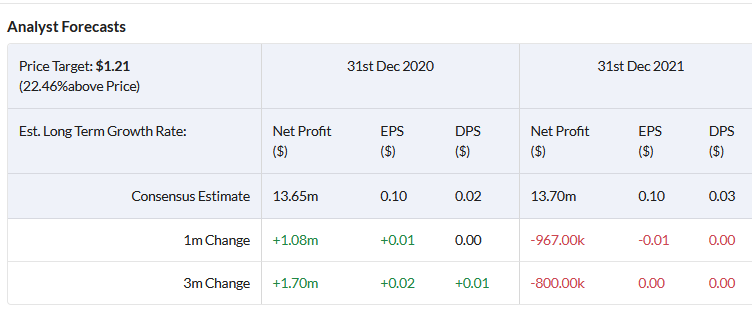
I can see two ways of interpreting this. One is that brokers are stripping out the effect of Capital’s equity investments. The other is that they expect some of the H1 investment gains to reverse in H2. In that scenario, non-cash losses on equity investments would cancel out operating profits.
The outlook for 2021 is relatively cautious, too:
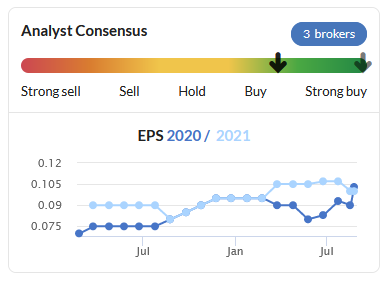
My verdict: I’m not sure how to call the outlook for Capital. I think it’s a decent business, but its policy of making material equity investments in potential clients certainly adds risk and volatility. On balance, the firm’s H1 figures support my view that the company might be more fully valued than it first appears.
A lack of forecast earnings growth means Capital’s rolling PEG ratio has now risen to 1.5, according to Stockopedia:
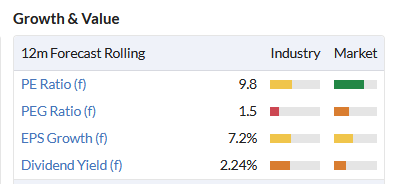
As a result, this stock no longer satisfies my screening requirement for a rolling forecast PEG ratio of less than 1.2. Consequently, I will be selling this position from the SIF virtual fund this month, and from my own real-money portfolio.
I may be leaving some money on the table, but this business has paid some nice dividends during my 13-month holding period and generated a capital gain of 50%. I think the downside risks are growing, so I’m not too sad to see Capital go.
Total return: 53.5%
Verdict: Sell
H&T Group (LON: HAT)
(Original coverage: 16-Jul-2019)
Pawnbroking, gold and personal loan firm H&T Group has also issued a solid set of half-year results this month. Jack covered these in the SCVR on 11 August, so I won’t retread old ground here.
Instead, I’ll cut to the chase. H&T’s pre-tax profit fell by 26.5% during the first half of the year. Retail profits and lending fell by nearly 50% due to the closure of the group’s stores during the lockdown period. Payment deferrals and a pawnbroking interest freeze also contributed to the decline in earnings.
Although stores are open again, the company says it “still has some way to go” to reach pre-lockdown levels of trading. H&T’s balance sheet looks safe enough to me, but analysts expect profitability in both 2020 and 2021 to be substantially below 2019 levels:
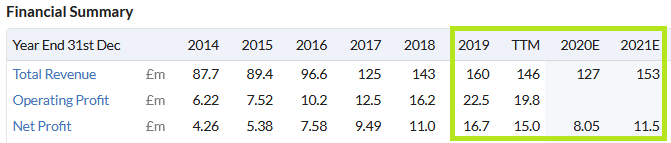
As a result of this downbeat outlook and H&T’s depressed share price, this stock now fails a number of my screening tests:
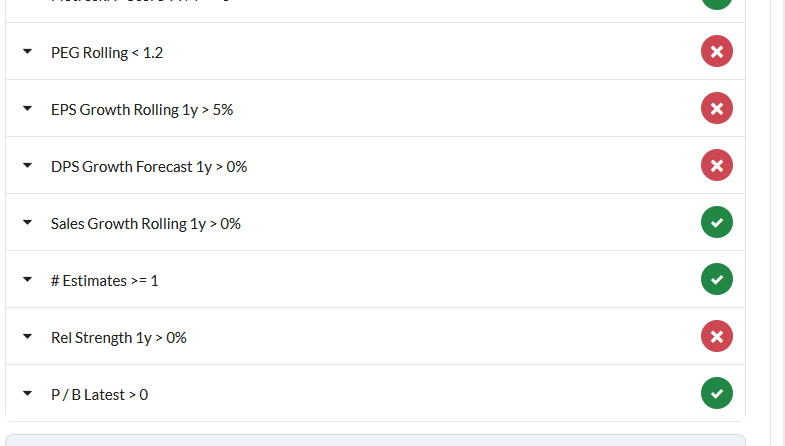
I have no choice but to sell H&T shares from SIF and my own holdings this week. This trade will generate a modest loss, although the 12% capital loss on the shares will be partially offset by dividend returns of 3.5% received during the holding period.
Total return: -8.5%
Verdict: Sell
As always, I will make the trades mentioned in this piece after it has been published.
What’s next?
In July I commented that it was hard to hold onto stocks with gold exposure when gold was hitting record highs. Now I’m having the opposite experience - deciding to sell the same shares triggers fears that I may be missing out.
But that’s the beauty (and devil) of rules-based investing. Decisions aren’t subjective or based on emotion.
In any case, I suspect that I may soon follow Warren Buffett’s example and add more direct gold exposure to SIF. As I write, two reputable mid-cap gold miners qualify for the SIF stock screen -- Centamin and Highland Gold Mining.
While I won’t be buying HGM, which is currently subject to a takeover offer,I might be persuaded to buy Centamin. I’ve followed this Egypt-based FTSE 250 group for years and rate it quite highly.
I’ll return to this subject next week. Until then, I’d love to hear what you’re doing with gold in your portfolios: are you heavily weighted to the yellow metal - and do you expect further gains?
Disclosure: At the time of publication, Roland owned shares in Capital and H&T Group.
Disclaimer
This is not financial advice. Our content is intended to be used and must be used for information and education purposes only. Please read our disclaimer and terms and conditions to understand our obligations.

6 comments
Hi Roland. Just to let you know if you don't already that the older historical comments on here are priceless. The old retrospective knowledge.
Got burnt with Centamin (one mine miner) but got out of Highland just before the bid. Mining in the small/mid caps area looks like too much Mr Market control and not chartists or fundamentalists.
Great to follow current 'hot' or 'fashionable' trends so will always hold a folio watchlist. H & T (LON:HAT) keeping an eye on for sure, if it doesn't go broke in the meantime.
Whilst H+T has underperformed and its failure to meet your criteria supports your disposal of this holding, I do not think it reflects the direction Gold is going to go, either in the coming months or years.
The US /Fed's willingness to increase borrowings to support the US economy, has and will, continue to lead to a decline in the value of the US dollar and this in turn will lead to much higher gold prices and that of other precious metals. In round numbers the Global total value of gold is about USD 12 trillion, this year alone US borrowing is likely to increase by over USD7trillion. Added to the US dollar losing value the Fed has made it very clear it will not be raising Interest rates anytime soon (to support the dollar) and that inflation will be allowed to move above 2% in the US and it will be more viewed on an average basis.
Gold I understand has and is likely to be a great hedge against rising inflation.
For what worth, my own expectations are for Gold to rise to 2,200 by mid to late January 2021 and potentially, significantly higher in the 18 months to 2 years after that. Clearly, under the scenario I have outlined, the GBP should rise further against the dollar but the failure of a UK Trade deal with Europe could impact that.
I run portfolios in both GBP and USD and am long via USD dollar investments in Gold, notably GLD and Sprott Junior Gold miners (SGDJ). Silver is also likely to rise and by a greater percentage compared to Gold.
I also hold H&T but feel the risk should from current low levels be more to he upside than further weakness.
Re: Capital (LON:CAPD) - I think it pays to dive into the details rather than just the headline number. In this case, the figures from Tamesis include the revaluation of the equity portfolio which has provided a one-off gain for 2019 hence the higher PEG.
Looking at EBITDA, forecast growth is a more reasonable 24%. And Tamesis appear to be quite conservative in their assumptions vs how the company describe their outlook in the recent results call.
I think the idea of selling based on an assumption that growth is stalling when the company themselves say the are facing "an absolute wall of demand for Q4 and 2021" may miss something.
Hi dangersimpson,
Thank you for your comment and for providing some extra 'colour' on the investment gains at £CAPD.
To some extent I agree with you - the operational outlook appears strong. Now might not be the right time to sell. But I'm bound by the rules of the SIF folio in situations such as these, so I'll have to watch from the sidelines and see how things pan out.
Best,
Roland
Artemis' disposal of a large portion of H & T (LON:HAT) shares does not help!
What does fundamentals of economics tell you.Longterm gold and Property are the two things that can be used to hedge against inflation.I think it should go up a little bit more .So hold on to it. However if you think deflation will set in because of negative interest rate.Then you should sell.No other use of Gold but to hedge against inflation and Jewellery.