SIF February review: After strong gains, should I sell Ashmore and Michelmersh?

Market news is being dominated by the coronavirus outbreak at the moment. Monday saw the FTSE 100 close down more than 3%, after Italy reported the largest outbreak outside Asia.
Obviously the human impact of this outbreak is everyone’s top concern. But as investors we’re obliged to consider the economic impact too. I see this as a temporary disruption, but there’s no way of knowing how long or how severe the impact will be. However, my general philosophy is to stay invested at all times. So I don’t plan to make any changes to my personal portfolio or to the SIF fund in response to this outbreak.
Before I start this month’s review of Ashmore and Michelmersh, I’d like to take a look at a domestic story where I do have a strong view. I’m probably a bit late to this, but I’ve noticed worrying signs of ‘innovation’ in the mortgage market. I wonder if this is a sign that housing affordability is finally about to hit the buffers.
Too clever by half?
A recent piece in the FT (paywall) examined the growing trend for “doing the splits”. This means splitting a mortgage into two or three loans with different characteristics. One example given was splitting a loan between interest-only and capital repayment so as to stay below the LTV limit on interest-only mortgages. Various other combinations are described, but from what I can see the underlying motivation is usually to stretch what the borrower can afford.
At the same time, the FCA tells us that 41% of mortgages are now for more than 25 years, up from just 2.5% in 2005. For first-time buyers, 66% of mortgages are for more than 25 years. Most lenders will now offer up to 40 years. That’s a lot of extra compound interest in return for a lower upfront monthly payment.
These mortgage trends suggest a mix of complacency and worsening affordability. It doesn’t seem like a good mix to me in a market that’s been kept high by the intoxicating combination of ultra-cheap debt and Help to Buy.
Demand for affordable housing in major cities may be insatiable. But affordability will only stretch so far. I wonder if we’re nearing that limit.
SIF folio monthly review
As it’s the last week of February, it’s time to take a look at the SIF folio and review stocks that have been in the portfolio for at least nine months. This month there are two stocks to consider, brickmaker Michelmersh Brick Holdings and emerging markets debt specialist Ashmore Group.
Here’s how the SIF portfolio looks at the at the time of writing (you can view this fantasy fund here if you’re using the old Stockopedia website):
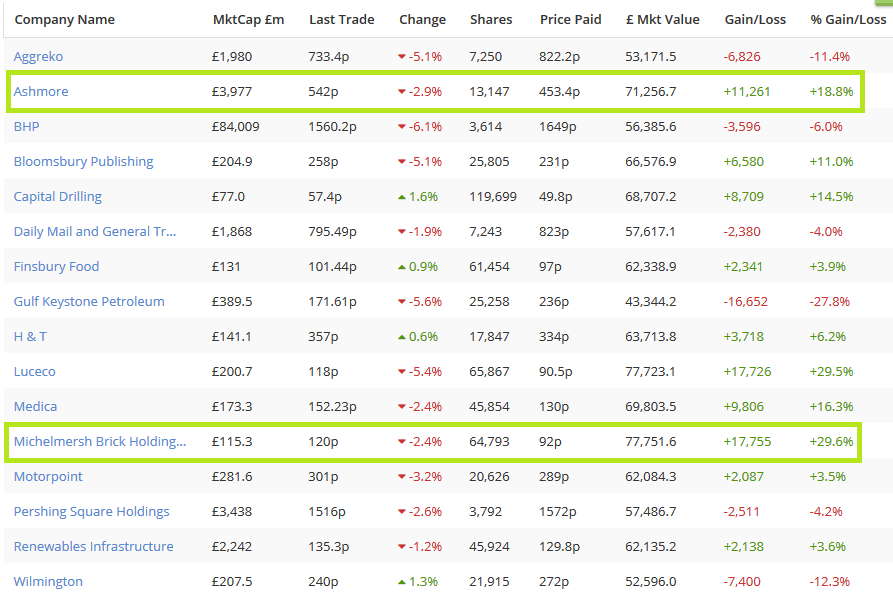
Ashmore and Michelmersh have both performed well during their time in the portfolio, despite the recent market weakness (this screenshot was taken on Monday 24 Feb).
However, as I discussed two weeks ago, my policy is to sell after nine months if stocks no longer pass all of my screening tests. Let’s take a look.
Ashmore Group (LON:ASHM)
(Original coverage: 14/05/2019)
I’m a fan of this FTSE 250 asset manager, which specialises in emerging market debt. In my view it’s a sector that’s likely to see structural growth for many years yet. It’s also a fairly specialist area, which I think should make it hard for passive funds to compete.
Trading is inevitably linked to emerging market conditions. But Ashmore reported strong growth during the final six months of 2019, with assets under management (AuM) up by 7% over the period to $98.4bn. This comprised net inflows of $5.7bn and investment gains of $0.9bn.
The company says that 75% of its AuM have outperformed benchmarks over the last three years, with 98% over five years. Although only 24% have outperformed over the last year, I’d suggest this reflects short-term volatility and opportunistic buying by Ashmore. I don’t think it’s likely to be reflective of future performance.
Incidentally, I wouldn’t worry about the recent £55m share sale by founder and CEO Mark Coombs. Mr Coombs has been under investor pressure to sell down his holding to avoid the risk that buybacks could inadvertently give him control of the company (his stake was 39%).
He’s planning to sell 4% of his stake each year for a period, and has so far reduced it to just under 36%, according to Stocko’s major shareholder listings. So Mr Coombs’ interests should still be closely aligned with those of his shareholders.
My verdict
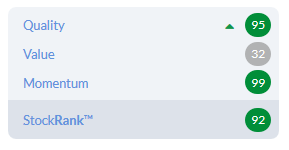
When I added Ashmore to the SIF folio in May last year, Stockopedia’s algorithms classed the stock as a High Flyer with a StockRank of 90. Little has changed today - Ashmore now has a StockRank of 92 and High Flyer status:
At current levels, the stock trade on about 18 times rolling forecast earnings, with a 3.4% dividend yield. For a company that’s consistently generated a return on equity of more than 20% in recent years, I would argue that this is fair value and not overly expensive.
However, despite my admiration for Ashmore, the shares no longer pass all of my screening tests. The stock’s rising valuation and slower forecast earnings growth mean there are two fails:
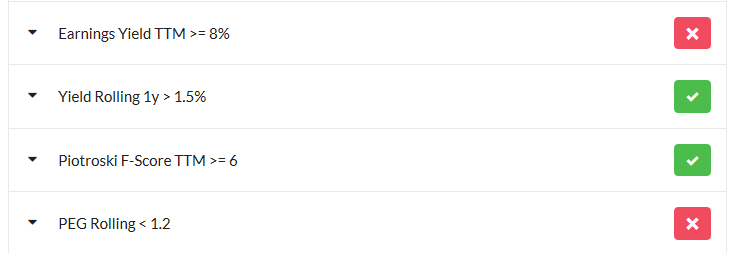
As a result, I will be selling Ashmore from the fund this week to crystallise a respectable 20% gain in nine months. I’ll also sell the shares from my own portfolio, after this article has been published.
Verdict: Sell
Total return: +20.3%
Michelmersh Brick Holdings (LON:MBH)
(Original coverage: 07/05/2019)
My comments on the mortgage market were made with this stock in mind. When I added AIM-listed small cap Michelmersh to the SIF folio last May, I chose it to gain exposure to housing without the political risk of housebuilders.
At the time, I was attracted by Michelmersh’s upmarket positioning and by reports suggesting the UK brick market was relying on imports to make up a substantial deficit. This suggested strong demand and perhaps some margin of safety if demand weakened.
Michelmersh’s performance during its time in the portfolio has been very impressive. Forecasts for 2019 earnings have risen from 7.4p to 7.8p per share over the period I’ve held the stock:
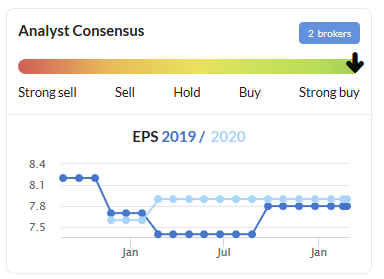
As yet, there have been no corresponding increases in 2020 forecasts. As a result, expectations for earnings growth this year have fallen to almost nothing. This isn’t to say the outlook won’t improve, but at present the consensus view on earnings growth is more cautious than last year.
Michelmersh has also become more expensive over the last nine months. In May 2019, the stock had a forecast P/E of about 12. Today, the equivalent figure is 15.6.
In fairness, the group’s free cash flow has remained very strong. But I think it’s worth remembering that this is an operationally-geared business with quite high fixed costs. Any softness in demand could hit profits significantly. And the shares are currently trading at levels only seen once before, in late 2007.
My verdict
This trade has worked out well, delivering a total return of more than 30% over the last nine months.
I still like Michelmersh, but the stock now fails my screening tests on several counts. These include rising debt, slowing earnings growth and a too-high valuation. So this holding will be sold from the SIF folio and my own portfolio this week.
Verdict: Sell
Total return: +33.2%
Disclosure: At the time of publication Roland owned shares of Ashmore Group, Michelmersh Brick Holdings and Finsbury Food.
Disclaimer
This is not financial advice. Our content is intended to be used and must be used for information and education purposes only. Please read our disclaimer and terms and conditions to understand our obligations.

4 comments
do you rebalance out your losing performers if their stock ranks have deteriorated after 9 months? or give them longer?
Hi Alexicek,
I don't buy and sell stocks based on their StockRanks, I use my own screening rules which you can find here:
https://www.stockopedia.com/screens/stock-in-focus-screen-113218/
After nine months, I check to see if a stock still qualifies for my screen. If it doesn't, it's sold.
Regards,
Roland
About 40-year mortgages, I wonder how many will run to full term. I'm a stick in the mud and I paid my 25-year mortgage off after 19 had passed while most people I know moved house two or three times over that period.
Hi Silver Moon,
That's a good point. I think the other question that's worth asking is how many people will remortgage onto a shorter term when they're able to afford it? Or will they simply keep remortgaging on 40yr terms to higher values?
Regards,
Roland