SIF Folio: A second slice of Finsbury Food?

Opinions seem to vary on the outlook for the market at the moment. I’ve seen some commentators suggesting a crash is overdue, with others saying that shares are now looking more reasonably priced to buy.
Personally, I expect to be a net buyer personally over the next few weeks. But one of the beauties of my SIF strategy is that I don’t have to make such difficult decisions. Instead, I simply follow the rules.
After several weeks of rather limited results, my main SIF buying screen is starting to offer a more diverse choice of stocks. The company I’m going to consider this week is Finsbury Food (LON:FIF). I held this cake and bread maker in SIF in 2020, but sold in October with woeful timing:
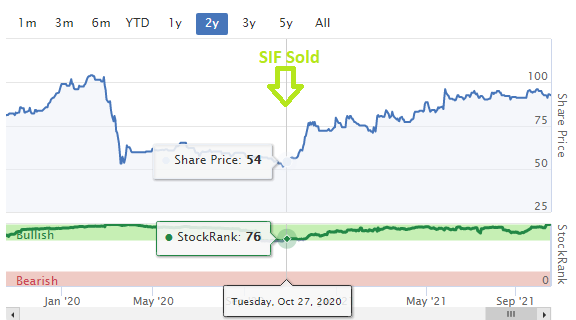
No one likes to see a chart like this, but it happens sometimes. What I think is important at this point is to neutralise the psychological bias that’s trying to tell me it’s too late to buy. This may be true, but there’s no reason why it must be true. The market has no memory. If a company’s performance is improving, it may still offer value at a higher share price.
Solid trading
In this case, I can see some reason for optimism. Finsbury shares are still below pre-pandemic levels, but the business seems to be performing pretty well.
The group - which supplies baked goods to supermarkets and the foodservice clients - said that revenue rose by 2.3% to £313m during the year to 26 June. Adjusted earnings for the year rose by 15% to 9.1p per share.
Net debt halved to £13.1m, while dividends were resumed at 2.4p per share for the full year. That’s 30% down on pre-Covid levels, but a useful payout all the same.
These results reflect strong demand from retailers over the last year and highlight Finsbury’s limited exposure to foodservice. This has proved fortunate.
Another positive is that the company was able to continue delivering new growth initiatives last year, despite disruption caused by Covid-19. Additions to the group’s manufacturing footprint included a new frozen dough ball facility in Manchester and a 50% capacity increase to artisan bread production.
Management say that ongoing innovations are “in line with consumer trends”, such as vegan and gluten-free cakes and breads.
I covered Finsbury’s results in more detail in the SCVR in September, so I won’t repeat too much here.
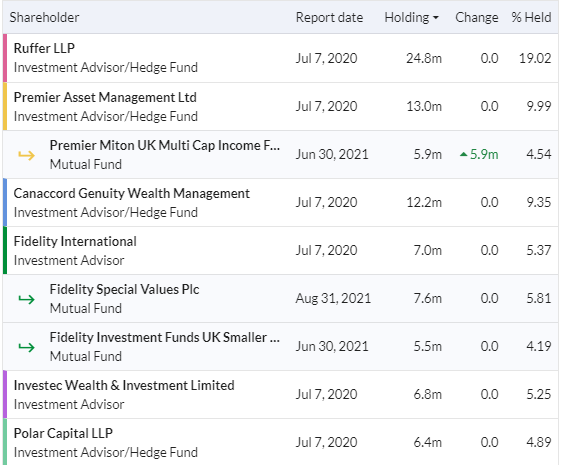
Instead, I’ll just conclude this section by noting that despite being a small cap, Finsbury has strong institutional backing. The group’s shareholder register includes several well-respected small cap fund managers:
Stockopedia’s algorithms rate this business highly too, awarding it a StockRank of 99 and Super Stock status:
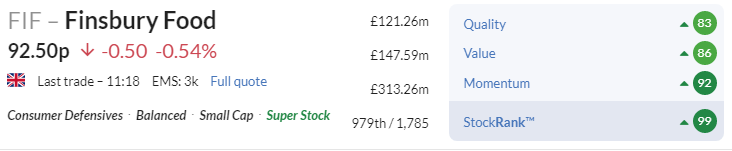
Finsbury also passes all of my screening tests, qualifying it as a potential buy for SIF.
On that note, let’s take a look at Finsbury’s QVM metrics in more detail. Should I add this stock to SIF for the second time?
Value: reasonable
When I look at a stock’s value metrics, I’m looking at valuation, but also at the company’s balance sheet. What does it own and what does it owe?
Finsbury’s ValueRank of 86 suggests few problems in this department, but there are a couple of things I’d like to highlight.
Valuation: The stock looks affordably valued to me on several key metrics:
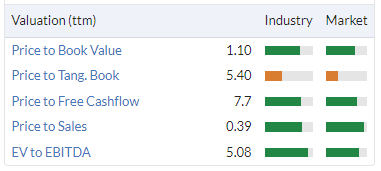
I’m encouraged by the low price to free cash flow ratio, but Finsbury benefited from a reduction in working capital last year which generated a £2.9m cash inflow. Now that trading has normalised, I don’t expect that to be repeated this year. Indeed, I suspect we could see cash performance worsen, due to cost pressures and supply chain disruption.
Other valuation measures also look favourable to me. Earnings yield is well above my 8% minimum:
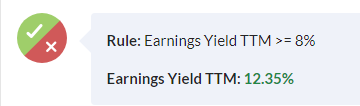
Finsbury’s trailing P/E of 11 and 2.6% dividend yield also look quite reasonable.
Balance sheet: Finsbury’s net debt halved to £13m last year, or £25.4m if you include IFRS 16 lease obligations. In either case, I think this level of debt should be quite comfortable for a business generating net profits of c.£12m per year.
My only caveat is that Finsbury appears to benefit from very generous credit terms with its suppliers. I discussed this in my SCVR report in September. My sums suggest the company takes more than 100 days to pay its bills, on average. This seems slow to me. It shouldn’t be a problem as long as the company doesn’t need to bring forward payments for any reason. Doing so could trigger substantial cash outflows.
Summary: Finsbury Food looks reasonably valued to me at the moment.
Quality: Improving?
Although Finsbury Food is a substantial producer in its market segments, it’s a small business compared to its supermarket clients. I can’t imagine that they’d allow the company to become too profitable.
Finsbury’s operating margins have certainly been fairly low historically, averaging 3.7% in the years before the pandemic.
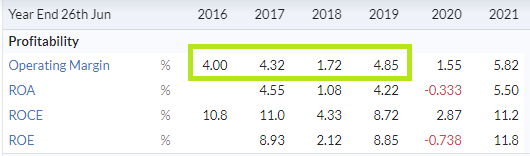
Last year’s operating margin of 5.8% represented a significant advance. I guess this was partly due to strong retail demand, but broker forecasts I’ve seen for the current year suggest this figure could remain above 5%.
If so, this could help to support the group’s return on capital employed. This rose to 11% last year, a level that’s been reached in the past too. I think this is quite respectable for a business of this kind.
Similarly, Finsbury’s operating cash flow also appears to be fairly healthy. In recent years much of this cash has been used to support elevated levels of capex. Spending now seems to be moderating, supporting stronger free cash flow:
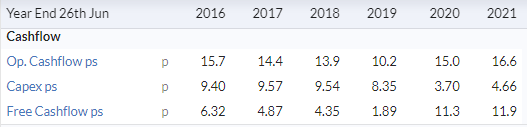
The stock’s Piotroski F-Score of 7/9 supports my view that Finsbury’s financial performance is generally improving.
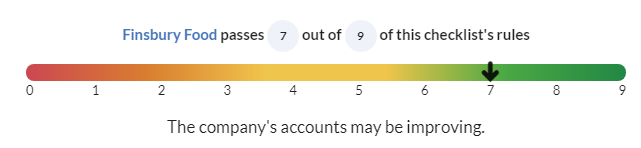
Summary: I don’t have any serious concerns about the quality of this business.
Momentum: Strong - for now
Finsbury’s MomentumRank of 92 is the stock’s highest factor score. Splitting the score into its two constituent elements does not seem to suggest any immediate problems.
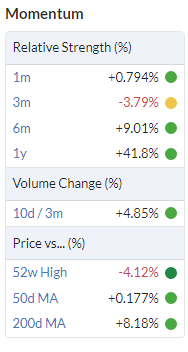
Price momentum: The stock’s Momentum graphic suggests that Finsbury shares could be trading in a well-established uptrend:
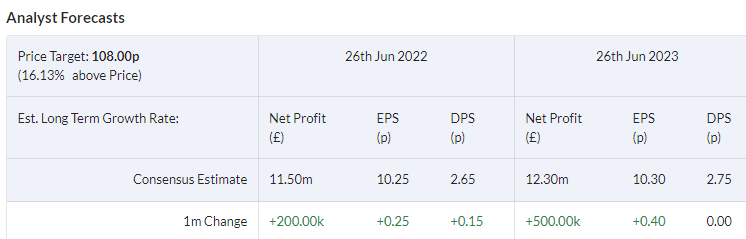
Similarly, broker earnings estimates are still showing positive momentum. Forecasts for FY22 and FY23 have been upgraded since September’s results were published:
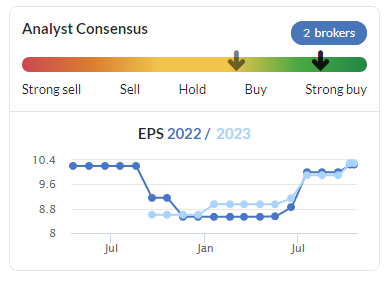
This is one of a series of upgrades we’ve seen since the start of this year:
In his outlook statement, chief executive John Duffy admitted that Finsbury was “likely to face persistent challenges” around inflation and labour shortages. These problems are well known. What’s not yet clear to me is how widely they will affect corporate results as we head into 2022.
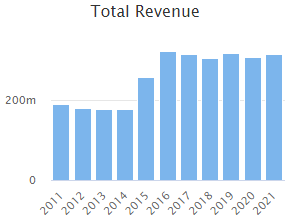
Finsbury shares are currently trading on nine times forecast earnings, with a forecast yield of 2.9%. This seems like a reasonable valuation to me, but earnings growth is expected to flatten out in 2022/23. I think it’s worth remembering that Finsbury is a low-margin business that’s been through lacklustre periods before:
Summary: Based on the facts available today, I think Finsbury has positive momentum and could be attractively valued.
My decision
CEO Duffy seems to have managed the business well through a difficult period, while maintaining a longer-term focus on growth.
In addition, Finsbury Food passes all of my screening tests and does not seem too expensive to me. The group’s valuation is supported by decent cash generation and comfortable levels of debt.
I’m comfortable with the idea of owning this stock. I’ll be adding Finsbury Food to SIF this week and to my own portfolio. As always, I’ll make these trades after this article has been published.
Please let me know what you think about Finsbury. Will defensive companies like this trade well through the current inflationary environment? Or are the risks not yet priced in? I’d love to hear your thoughts.
Disclaimer
This is not financial advice. Our content is intended to be used and must be used for information and education purposes only. Please read our disclaimer and terms and conditions to understand our obligations.

10 comments
Hi Roland, super useful - as are a couple of other comments. I've held FIF since Feb 2020 and with a purchase and a sale since have an in price of 78p (pre div).
I selected FIF as a test of the value of Stocko - buy a business that is onshore, that I understand, and where my money is relatively safe, that has a strong Q/V score. So far it has fitted the bill.
It wont be a multi-bagger IMO but a steady eddy that should be able to at least keep up with inflation and pay a dividend in the meantime.
Interesting comments about remuneration. I like to think the institutions will have an eye on this.
Hi Berksbee,
> Interesting comments about remuneration. I like to think the institutions will have an eye on this.
I'd like to think so too, but sadly I'm not sure in general that there's much evidence of fund managers taking a strong view on corporate remuneration.
I suppose a cynic might suggest that this is because the asset management sector is also highly remunerative...
Regards,
Roland
Apologies- just a couple more comments - I just looked at the remuneration report:
Messrs Boyd and Duffy have £nil priced options over 4.3m shares, in total (around 3% of the company).
For the 2021 year, none of the share options vested because because;
However, fear not!, they still received a bonus equivalent to 100% of their base salary because they did their job and achieved a 'stretching' EBITDA of £26.9m.( Coincidentally this EBITDA amount was roughly the equivalent EBITDA achieved during the previous 4 years).
I know there was a pandemic, but if anything people ate more during lockdown, not less.
The Directors' seem excessively greedy to me. I don't see what they have done which is 'special' in adding shareholder value, so I won't be investing!
I would be wary of investing in this type of company at the moment. It is low margin and costs have risen in various areas. Food prices, energy (Gas/electric), petrol/diesel, drivers shortage also pushing up wages. Then there maybe issues with supplies and deliveries due supply chain and driver shortages. What if these increases can't be passed on to their customers or not for a while. We have seen today a profit warning from Mcbride (LON:MCB), Paul warns about low margin businesses.
Do you know if they use gas or electric for baking?
Certainly had a chequered past, I remember it was quite a popular share around 5 years ago on the SCVR forum but shares are about -30% since then.
I agree with this comment. It's surely exactly the type of company that will get squeezed at the moment and very difficult to see how it wouldn't be affected negatively at all. The most recent outlook statement, coming 3 months into the new financial year, didn't really give anything away and if anything sounded a bit negative stating 'The environment in which we operate continues to face headwinds in relation to raw material prices, inflation, and skilled labour and driver shortages. Nevertheless, over the last 18 months the Group has shown its resilience and its ability to adapt, develop and strengthen no matter the circumstances.’
Better to wait until half year results at least I think.
(I held but sold at 95p for above reasons).
Hi Roland,
The 20% ROCE (if goodwill is excluded) is attractive!, however, you say:
"CEO Duffy seems to have managed the business well through a difficult period, while maintaining a longer-term focus on growth".
1. I'm a little confused where the growth has been over the past 5 years, or will come from in the future? i.e. year ending 2021 turnover is roughly equivalent to 2016 (as it was also in 2019 and 2020), and y-e 2023 expected profit to be the same as this year?
How is the CEO's strategy going to grow the business whilst margins are squeezed by the supermarkets? He states he wishes to grow the business organically in the 2021 annual report, but I can only see (since 2009 when he was appointed) that growth has been by acquisition rather than any organic growth?
2. If the only way to grow the business is through acquisition (as happened during 2014 and 2015), does the £7.5m written off, of intangible value (in the 2019 accounts, from it's 2018 Ultrapharm acquisition of £17m cash) , not concern you? (purchased whilst John Duffy was CEO)
Just playing devil's advocate.
Cheers,
Ben
Hi Ben,
I agree that Finsbury Food (LON:FIF) margins are always likely to be capped by the buying power of the supermarkets. This could constrain margin growth, but need not limit organic growth.
Equally, last year's strong performance may be hard to beat, given the one-off factors involved.
However, the forecasts you mention do show growth at an EBIT/PBT level over the next three years, with further deleveraging.
I do think there's scope for growth and positive shareholder returns from current levels. Of course, as with all stocks there's also the risk of disappointment.
The other aspect to my decision is that SIF is run using a systematic approach. I have to follow the rules. It's in the nature of running a systematic portfolio that I won't always feel strong conviction for every stock. Obviously this is my situation - not true for all investors.
Re. Ultrapharm - I agree and have commented on this before. It looks to me like Finsbury may have overpaid for a fashionable acquisition (gluten free).
Regards,
Roland
ok! Good luck, Roland. This company should throw off some cash, and it will be interesting to see what they do with it.
Hi Ben,
I agree that Finsbury Food (LON:FIF) margins are always likely to be capped by the buying power of the supermarkets. This could constrain margin growth, but need not limit organic growth.
Equally, last year's strong performance may be hard to beat, given the one-off factors involved.
However, the forecasts you mention do show growth at an EBIT/PBT level over the next three years, with further deleveraging.
I do think there's scope for growth and positive shareholder returns from current levels. Of course, as with all stocks there's also the risk of disappointment.
The other aspect to my decision is that SIF is run using a systematic approach. I have to follow the rules. It's in the nature of running a systematic portfolio that I won't always feel strong conviction for every stock. Obviously this is my situation - not true for all investors.
Re. Ultrapharm - I agree and have commented on this before. It looks to me like Finsbury may have overpaid for a fashionable acquisition (gluten free).
Regards,
Roland
Hi Roland the only thing that has put me off over the years has been the small profit margin. they have to run such a tight ship because if anything major happens it can set them right back.
the only rule I work on is an absolute minimum 10% mark up what ever they do