SIF Folio: BAE Systems is beating the market crash

As I write, the market is rising on early signs of hope that the coronavirus pandemic may have peaked. Of course, it’s too soon to be certain. And even if the outbreak has peaked, we don’t yet know how severe or long-lasting the damage will be to the global economy.
Against such an uncertain backdrop, I think it makes sense to focus on survivability when picking stocks. By this I mean stable revenue, strong balance sheets and decent cash generation.
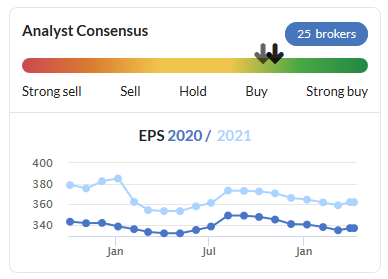
In this vein, I’ve already added British American Tobacco to the portfolio. This stock isn’t universally popular, as the comments on my recent piece highlighted. But I’m pretty sure it will survive COVID-19 relatively unscathed. Brokers also appear confident:
This week, the SIF stock screen has highlighted another stock which I think should score highly as a survivor. FTSE 100 defence giant BAE Systems (LON: BA) will raise ethical flags for some investors. But it’s beaten the market comfortably so far this year, falling by just 12% versus a 25%+ drop for the FTSE 100.
I rate BAE as a reliable long-term performer and I’m attracted to the diversity of its business, which encompasses, shipbuilding, aircraft, land-based equipment and electronics and cybersecurity systems.
Recent newsflow reassures me
In a recent update, BAE management says that Q1 trading was largely unaffected by coronavirus and that several new contract wins were secured during the period. Admittedly, the firm is now seeing “more significant disruptions”. But I’m hopeful that the long-term nature of the firm’s contracts and their government funding should mean the long-term outlook is largely unaffected.
I’m also encouraged by two other recent pieces of news from BAE.
Acquisitions: In January, the company announced the acquisition of a military GPS business from US firm Collins Aerospace for $1,925m. This technology is said to be in use on 280 different platforms, with more than 1.5m devices shipped. There was also a smaller electronics deal.
As far as I can see, both of the acquired businesses should be a good fit for BAE’s Electronic Systems division and should support longer-term growth in this important area.
Pension deficit: The group’s pension deficit reached £4.5bn at the end of 2019. But BAE has now agreed a new deficit reduction deal. Payments totalling £1.5bn over the next 12 months are expected to complete the group’s long-running attempt to reduce its deficit. The company was previously paying around £200m per year as part of a 12-year plan running until 2026.
These changes suggest that CEO Charles Woodburn is trying to position the firm for growth on a cleaner financial footing. Although I estimate that the acquisitions and pension deal will require about £3bn of new debt, BAE’s debt levels were previously very low. As I’ll explain, I’m comfortable with this situation.
Dividend: The coronavirus outbreak has ended one of the FTSE 100’s more impressive dividend streaks. Until last week, BAE had not cut its dividend for 27 years. On 3 April, the company decided to defer the decision on the final dividend for 2019. I guess shareholders may never see the full payout, but I’m hopeful that some kind of dividend will be possible later this year. Longer term, I’m confident this will remain a good income stock.
Do the numbers stack up?
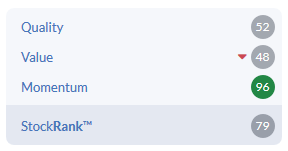
Stockopedia’s algorithms also have a broadly favourable view of BAE Systems, awarding this £16bn group a StockRank of 79 and a StockRank Style of Neutral.
In an update on 3 April, BAE followed the example of many other firms and withdrew its financial guidance for the current year. But the stability of the group’s share price suggests to me that the market doesn’t expect earnings to collapse.
Let’s take a look at each of the stock’s main factor scores.
Value: better than it looks?
BAE Systems’ ValueRank seems pretty low, at just 48/100. I suspect that this low score is caused by the stock’s high price-to-book valuation:
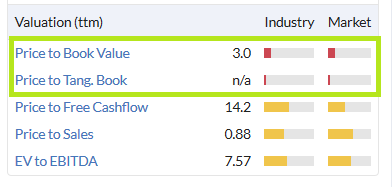
Price/book ratio: BAE’s price/book value ratio of 3 reflects the influence of the group’s pension deficit liability, which shows as £4.7bn on the 2019 balance sheet. Without this, I estimate the stock would be trading on around 1.6 times book value - a more typical ratio.
Price/tangible book ratio: This is shown as n/a because BAE’s tangible book value is negative. This is usually a sign that the balance sheet is dominated by intangibles, as we see here:
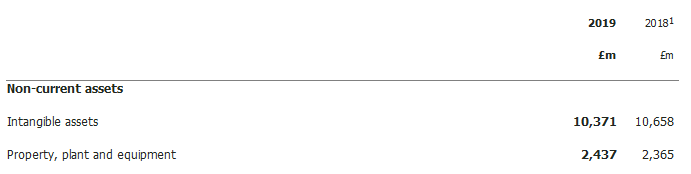
The latest annual report shows that these intangible assets are mostly goodwill, which totalled £9,984m at the end of 2019. I haven’t looked into the history of this figure, but I suspect it might relate to BAE’s long history of mergers and acquisitions.
Debt: Net debt (excluding leases) was just £743m at the end of last year. That’s just 0.5x 2019 net profit of £1,532m. For this reason, I’m comfortable with the group taking on extra debt to fund the US acquisitions and pension deficit reduction. I estimate that even after this new debt has been added, net debt should be less than 2.5x 2019 net profit.
Earnings yield: At current levels, my sums show that the stock has a historic earnings yield (EBIT/EV) of just over 10%. That’s an attractive figure, in my view. It’s also comfortably above SIF’s 8% minimum requirement.
Free cash flow: A valuation of 14x trailing free cash flow seems reasonable. BAE’s cash flows can be lumpy from year to year. But when averaged out over multiple years, the payout has covered the dividend comfortably over the last six years:
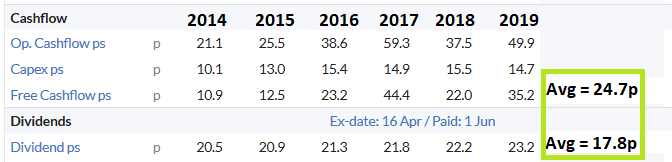
I think it’s fair to say that BAE is cash generative and reasonably valued.
Quality: profitability has improved
BAE’s QualityRank of 52 isn’t particularly impressive either. But as with value, I think the underlying picture might be better than this score suggests.
It’s worth remembering that the Piotroski F-Score is heavily weighted in Stockopedia’s QualityRank algorithm. So let’s start there.
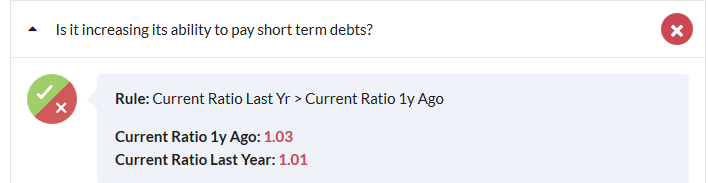
BAE’s F-Score of 6/9 is the minimum required to qualify for my screen. But when I look at the three failed tests, two of the failures are pretty marginal. For example:
Elsewhere, the quality picture isn’t too bad. Margins and ROCE have improved steadily over the last three years:
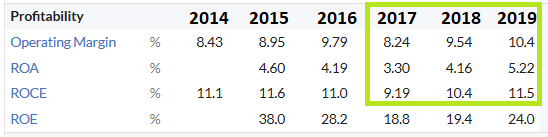
Given the group’s low debt levels, I’m fairly happy with this. (Although I’d note that the apparently high return on equity is boosted by the pension deficit. That’s not a good thing.)
Momentum: beating the market
BAE scores a surprising 96/100 for momentum. I think a large part of this is due to the apparent resilience of the group in the current market crash.
Price momentum: I’ve already mentioned that BAE’s share price has outperformed the market this year. Here’s how this looks:
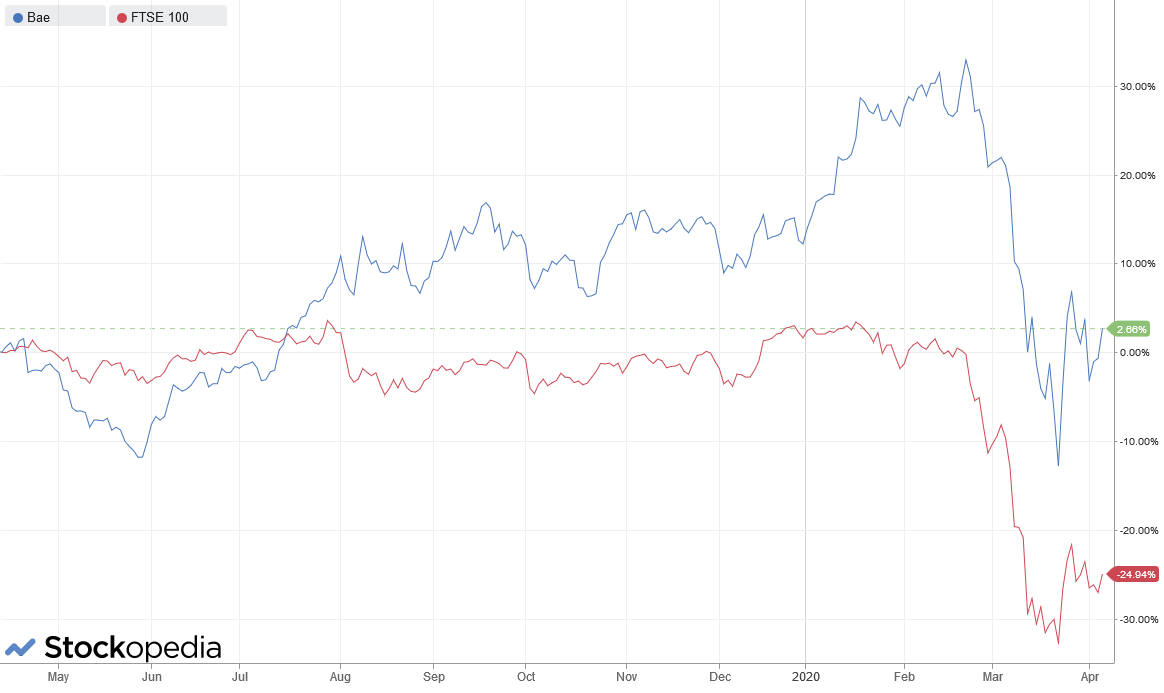
This outperformance is reflected in BAE’s strong relative strength scores. These are a key momentum factor:
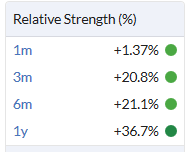
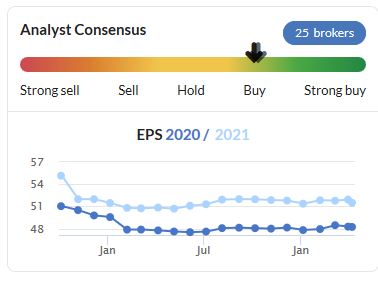
Earnings estimates: The other main element of momentum is earnings performance. Despite the firm withdrawing earnings guidance on 3 April, broker forecasts have only been modestly trimmed so far. Confidence appears to remain high, especially for 2021:
My decision
Unless the coronavirus outbreak results in a long-term shutdown of BAE’s facilities, I don’t think this business should be too badly affected by the pandemic.
The market crash has taken some of the heat out of the stock and left it trading on around 10 times 2021 forecast earnings. Given the group’s track record of cash generation and dividends, I see this as a good entry point.
I’m going to add BAE Systems to the SIF Folio and my own portfolio this week, after this article has been published.
As always, I’d love to hear your views on BAE or any other stocks which look well-positioned to ride out the storm.
Disclosure: Roland owns shares of British American Tobacco
Disclaimer
This is not financial advice. Our content is intended to be used and must be used for information and education purposes only. Please read our disclaimer and terms and conditions to understand our obligations.

4 comments
Like all defense contractors BAE is dependent on the public purse - whether that be in the UK, USA or export markets.
Given the financial impact of (i) coronavirus and (ii) recession what do you think the impact on the public purse will be?
Given that the public will have seen that fighter jets do not protect them from an epidemic or indeed a pandemic what do you think the public's view of defense expenditure will be looking forward? Do you think it will be business as usual for defense contractors in America? Do you think that there is any political risk in an election year in USA that might impact upon BAE's business in USA? And if all USA based defense contractors are impacted in their home market do you think competition in export markets will rise?
More positively, most defense contractors have a significant order backlog to process - in some cases 2+ years. And defense contracts once signed are seldom cancelled. Moreover, most governments react to a recession by maintaining public expenditure as a Keynsian response to a slow down (excepting the Cameron and Osborne austerity 'experiment').
No more than a mean reversion play in my estimation.
Hi Macro,
Thanks for your comments, sorry for missing this earlier. I think we agree on some points - big defence companies who tend to be primary contractors (like £BA ) enjoy sizeable order backlogs and a decent level of contract security. The near-term outlook seems safe enough to me.
Looking further ahead, we can safely assume that public finances will be left in poor shape as a result of the COVID-19 pandemic. You rightly point out that spending priorities could become an election issue.
However, my perception is that governments in BAE's key markets - UK, USA and Saudi Arabia - tend to ring fence defence spending quite strongly. Public attitude towards the armed forces of the UK/US also seems to have been very supportive in recent years, probably due to their protracted involvement in conflicts in the Middle East. So unless this changes, I don't see much public protest either.
Although my personal view is that some defence funding could be better spent elsewhere, I'm not convinced this will happen. Objectively, I expect companies like BAE Systems to continue to win new contracts.
Re. mean reversion: I agree, there is an element of mean reversion in my positive view on BAE. But I don't see anything wrong with this - in my view, value investing is (partly) about targeting mean reversion opportunities.
Regards,
Roland
Disclosure: I hold BAE Systems
I guess being a Stockopedia article you have to mention the numbers, ranks etc. but as these are inevitably backward looking indicators do they actually mean anything at the moment?
I have some BAE in my income portfolio, I agree on their long term prospects. But I am not putting to much faith in the numbers (other than debt levels) at the moment. Would love to hear what other numbers others think are still worth looking at
Hi Ben1,
Thanks for your comment, you make an interesting point. I'm going to explain my thoughts on this in more detail in my next SIF article.
Cheers,
Roland