SIF Folio: Devro could be poised for a return to growth

Defensive food and drink companies are often reliable performers, but they’ve been in vogue with investors over the last few years. As a result, these expensive defensives have rarely met the valuation criteria I use when screening stocks for my Stock In Focus (SIF) portfolio.
However, a strong set of recent results from sausage skin maker Devro mean that this small cap dividend stock has now appeared in the results of my SIF stock-buying screen.
Devro’s star has been in decline in recent years, but the outlook now seems to be improving.
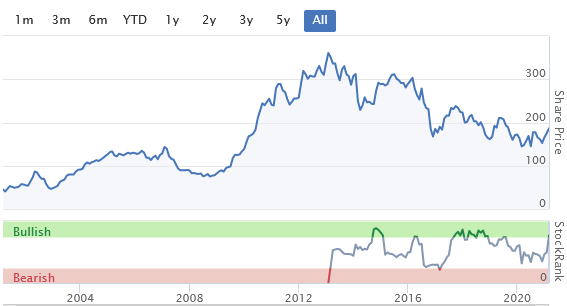
I’m interested to find out more, so this £315m stock will be my subject this week.
Devro (LON:DVO)
Glasgow-based Devro produces sausage casings from edible collagen, which the company describes as a naturally-occurring polymer. My understanding is that collagen mostly comes from animal bone, skin and tissue.
The group’s history stretches back to the 1950s, when it pioneered the development of edible collagen casing as part of Johnson & Johnson. Devro was spun out from J&J in 1991 through a management buyout and listed on the LSE in 1993.
Devro’s current product range includes edible casing, non-edible casing, films and plastics. These are used for different types of sausage and meat snacks. The group has manufacturing sites in the USA, UK, Netherlands, China, Czech Republic and Australia. These support customer operations in more than 100 countries.
Devro says it has a leading share of the market in “many countries” and expects global market growth of 2%-4% per year. Growth factors include urbanisation, higher living standards and the trend for increasing protein consumption.
However, Devro’s financial performance in recent years has been inconsistent:
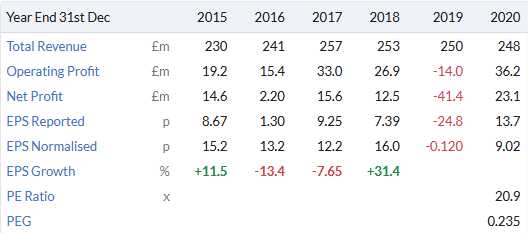
The firm appears to be keen to blame this on former management. The investment case published on its website boasts of a “refreshed” management team. Five out of seven of the executive management team have joined since 2016. This includes CEO Rutger Helbing, who was appointed as CFO in 2016 and promoted to CEO in 2018.
Devro’s 2020 results do appear to show signs of stabilisation and improvement. The company delivered a very stable performance during the pandemic year. Profits and margins rose slightly on broadly flat sales:
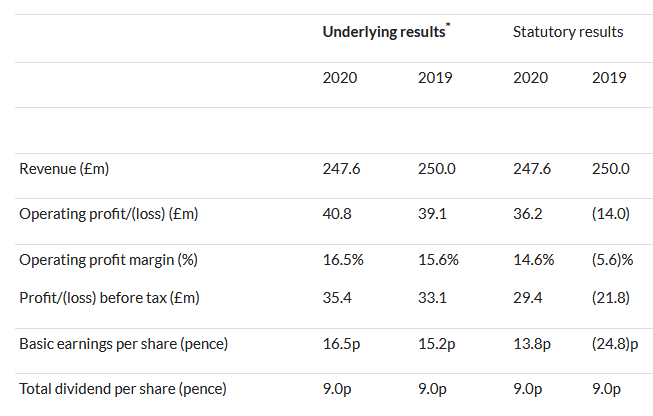
According to the firm, sales in emerging markets (Latin America, Russia and S.E. Asia) rose by 13%. This helped to offset a 5% fall in mature markets, which was triggered by widespread closure of restaurants and cafes in Europe.
Overall, the negative impact of Covid-19 on sales in 2020 is estimated at 2%. Not a big concern, I’d suggest.
Margins were lifted by cost savings, while strong free cash flow helped to reduce net debt to £109.5m (2019: £123.8m). This gives a net debt to EBITDA ratio of 1.8x (2019: 1.9x).
I prefer to see this leverage multiple stay below 2x, but for screening purposes I measure net debt relative to net profit, not EBITDA. I’ll come back to this in a moment.
Is Devro a buy for the SIF folio? Early signs seem promising. Let’s take a look at the stock’s factor scores.
Value: some big liabilities
I’ve kept an eye on Devro over the years, but I’ve never felt the stock looked especially cheap. That situation may now be improving. A ValueRank of 69 suggests the shares could be reasonably priced.
Stockopedia’s value metrics are based on trailing twelve month (TTM) figures. Using the group’s 2020 results, I see Devro stock trading on 11.5 times underlying earnings, with a 4.8% dividend yield.
Stockopedia calculates free cash flow at 14.2p per share for last year, which is very close to my own calculation. That gives a comfortable level of cover for the 9p dividend and means that 86% of underlying earnings converted to free cash flow. This gives me confidence in the credibility of the group’s underlying earnings calculation.
However, I can see a couple of potential concerns. The first is net debt. The company says that covenant net debt is £109.5m, excluding the (minimal) impact of IFRS 16. My preferred method of calculating leverage is to compare it to trailing net profit.
My screen’s limit for net debt is 4x net profit. Due to the variable impact of IFRS 16 on different businesses, I now allow some flexibility in this area. But even allowing for this, I calculate that Devro’s net debt of £109.5m is 4.7 times TTM net profit. That’s significantly above my limit, which s a concern.
I might be more lenient were it not for a second substantial liability on Devro’s books. The group also has a pension deficit of £55.2m (2019: £64.1m) on its final salary schemes. These are a legacy of its long history as a manufacturing employer.
This shortfall is roughly equivalent to two years’ profits, which I see a substantial liability. Deficit reduction payments are currently running at £7.4m, which equates to more than 10% of operating cash flow. If any further increases become necessary in the future, I would think that these payments could impact the affordability of the dividend.
Pension deficits are a grey area which some investors ignore, and some treat seriously. My view is somewhere in the middle. At this stage, I wouldn’t rule out Devro because of its pension deficit.
Devro’s ValueRank of 69 seems reasonable to me. But the firm’s debt levels breach my leverage limit and the pension deficit is an additional concern, in my view.
Quality: a solid score
A QualityRank of 88 suggests that things may be looking up. Although performance has been inconsistent in recent years, Devro generated double-digit margins and return on capital last year. As we’ve seen already, cash generation was also strong.
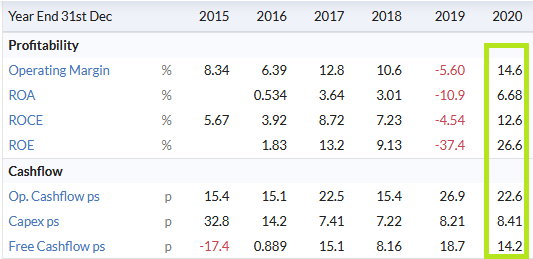
These factors combine to support a health Piotroski F-Score of 7/9:
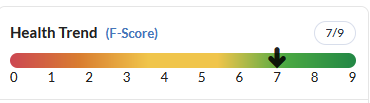
I see this fundamental health score as a useful snapshot and often refer to it. If you’re not familiar with it, I’d recommend clicking through on the blue link to see the components which make up the F-score.
The minimum F-Score required to buy a stock from my screen is 6/9, so Devro passes. On balance, I’m happy with the stock’s quality metrics.
Momentum: Middling
A MomentumRank of 56 suggests a rather middling performance in this department. I think Devro’s share price chart for the 15 months probably supports this view.
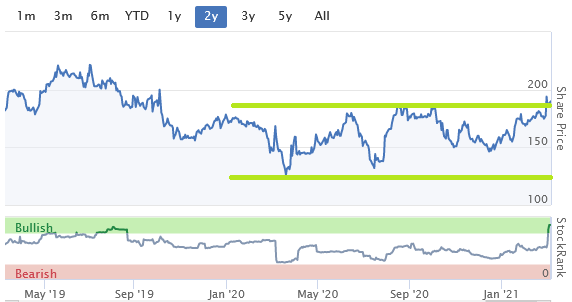
However, I can see some signs that the stock (and the business) may be breaking out of this range.
Price momentum: Demand for Devro shares appears to have improved recently.
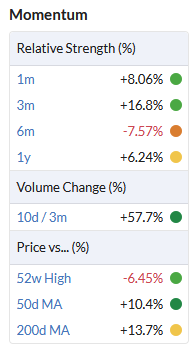
The 10d/3m momentum indicator shows that trading volumes have surged well ahead of average since last week’s results.
Positive 1y relative strength shows that Devro shares have outperformed the wider market over the last year.
Earnings estimates: The other element of momentum is earnings estimates. What I’m looking for here are upgrades to consensus earnings forecasts and expectations for year-on-year growth.
Stockopedia’s brilliant consensus trend chart provides all this information in a single view. Here’s how it looks for Devro:
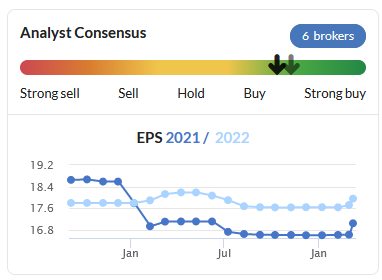
The latest estimates are dated 7 March. This suggests that last week’s results (2 March) triggered a round of upgrades. Good news.
The latest consensus forecasts price the stock on 10.9 times forecast earnings, with a dividend yield of 4.9%.
My view: Devro’s momentum seems to be improving and I can see potential upside on a technical and fundamental level.
My decision
Devro’s performance appears to have stabilised under new management and the shares look reasonably valued to me.
That said, I can also see some reasons to be more cautious. This company is already a large player in a market the company expects to grow by 2%-4% per year. Can Devro grow its earnings faster than the market? I don’t know.
A second concern is that the company’s leverage is still relatively high, especially when paired with its pension deficit. This is reflected in the Stocko leverage chart:
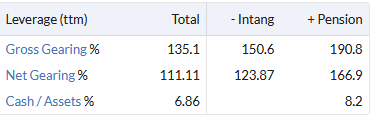
Although net debt and the pension deficit both fell last year, I’d still be cautious about assigning a high valuation to a business with substantial liabilities and - perhaps - limited growth potential.
I won’t be buying Devro shares for SIF because they breach my screen’s leverage limits. But if debt levels were lower, I probably would. On balance, I think this stock could be a nice income-growth play at current levels.
Disclaimer
This is not financial advice. Our content is intended to be used and must be used for information and education purposes only. Please read our disclaimer and terms and conditions to understand our obligations.

4 comments
I'm keeping a close eye out on companies with huge pension liabilities, as there's opportunity here "if" long-dated Treasury/Gilts rates keep rising. That should unwind quite a bit of any current deficits in those schemes, and therefore stop them sucking in free cash flow and maybe even reverse - go into surplus and give money back!
Devro (LON:DVO) could be a good share if this happens, re-rating higher, especially if they also sustain higher Op Margins and manage to eke out some top-line growth too.
Interesting to see a former employer reviewed in such detail. Not sure if it helps your analysis but the final salary schemes were closed to new employees from around 2004 onwards.
Hi Forbsy, thanks for clarifying the closure of the final salary schemes. I knew they had closed, but didn't know when - a relatively long time ago versus some companies, I think.
Roland
Really valuable analysis Roland. Helps me with my decision making. I hold.
Thanks