SIF Folio: I'm struggling with Alumasc

Next week will mark the fifth anniversary of the SIF portfolio. It’s fair to say that when I started out in April 2016, I didn’t foresee Brexit, Trump or Covid-19. Despite these challenges - or perhaps because of the market opportunities they created - SIF is currently trading at all-time highs.
I’ll look at the performance numbers next week and discuss the lessons I’ve learned so far.
This week I’m going to look at a possible addition to the portfolio, building products manufacturer Alumasc (LON:ALU).
Alumasc has been in business in various forms since the mid-20th century. In the 1980s and 90s the group made aluminium beer barrels and precision engineering components. The focus then shifted to aluminium rainwater and drainage products.Today, Alumasc produces three main lines of building products, sold under a number of different brands:
Water management: rainwater drainage and floor drainage systems for industrial, commercial and residential applications
Building envelope: roofing, balconies and solar shading
Housebuilding products: Sold under the timloc brand, these include a range of technical products with a focus on ventilation and insulation. For example, air bricks, roofline vents and cavity wall closers.
As far as I can tell, Alumasc has some decent products and brands. The company says that almost 80% of sales are driven by architects and structural engineers. This is due to the performance characteristics of the firm’s products, which help meet modern building regulations.
Another factor which looks positive to me is that export sales are significant (13% of revenue) and growing (up 23% in H1). I’d tend to see this as evidence the firm’s products have some degree of competitive advantage, and are not simply commoditised building materials.
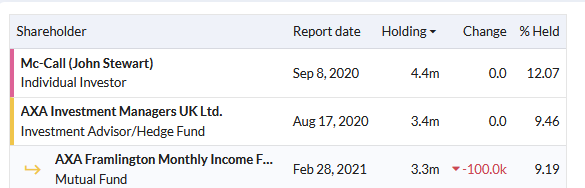
I’m also encouraged by insider ownership. Alumasc is still chaired by John McCall, who took the company private in 1984 and floated it in 1986. Mr McCall has a 12% shareholding, which should align his interests with those of shareholders.
A good time to buy?
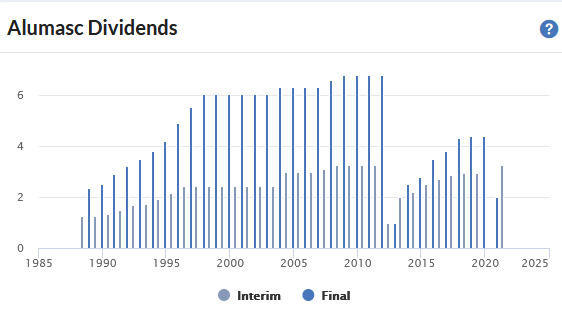
This £70m firm is a company I’ve followed on and off over the years, without ever owning. There are a couple of reasons for this. One is that Alumasc’s results haven’t always been consistent. The firm has been through some difficult patches over the last decade, as the dividend history suggests:
However, after a rough patch in 2019, performance seems to be improving. A tighter focus on costs and quality of sales seems to be rebuilding the group’s margins:

Profits are still lower than in 2017, but broker forecasts suggest the firm’s profits could hit new highs from 2021 onwards.
Alumasc’s recent interim results warn that changes to Help to Buy and the end of the Stamp Duty holiday could impact its performance. But CEO Paul Hooper says the firm is still “in a very strong position to move further forward”.
Stockopedia’s algorithms like Alumasc shares, too. The stock boasts a near-perfect StockRank of 98, with a style of Super Stock.
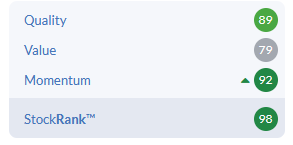
Is now the right time to buy? I’ve been taking a look at Alumasc’s factor scores to find out more.
Value: a fly in the ointment?
Alumasc’s ValueRank of 79 does not seem to suggest any serious problems. Indeed, most of the metrics used in the ValueRank look fairly attractive to me:
Earnings yield: 8.8%
Dividend yield: 2.7%
Price/earnings: 15.1
Price/free cash flow: 8.8
You may notice that all of these measures relate to earnings and cash flow. What about the balance sheet?
In terms of debt, I don’t have any concerns. Alumasc reported net debt of just £0.2m at the end of December, down from net debt of £4.3m six months previously.
However, the company trades on price/book multiple of 2.6x. This reflects the company’s final salary pension scheme deficit of £12.9m. Without this, the P/B multiple would be 1.8x.
As a reminder, a pension deficit is the difference between a scheme’s assets and liabilities (expected future payouts). Although the deficit looks manageable, the scheme itself is much larger. In fact, it’s bigger than the company:
Defined benefit scheme assets (FY20): £104m
Defined benefit scheme liabilities (FY20): £123m
Alumasc market cap: £71m
Future investment returns and perhaps interest rate rises might wipe out the deficit. Or they might not. Alumasc’s deficit has been volatile in recent years:
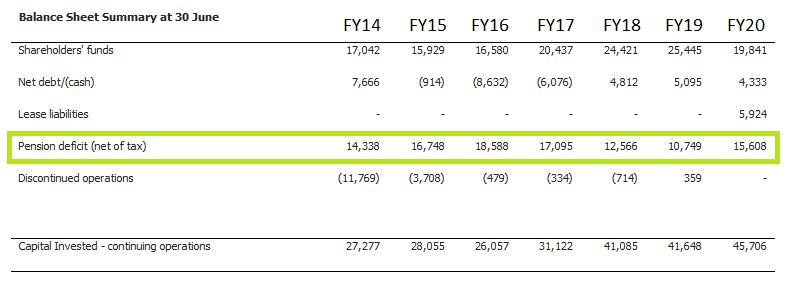
The deficit currently requires recovery payments of £2.3m per year. For context, the 2019 dividend payout cost about £2.7m.
Alumasc’s pension obligations means that shareholder returns could suffer if the deficit increases. I don’t know how likely this is, but I would argue that it justifies a more cautious valuation for this business.
Quality: better than it looks?
Pension concerns aside, Alumasc’s quality metrics look quite reasonable. The stock has a QualityRank of 89 and the stats suggest that both profitability and cash generation are improving:
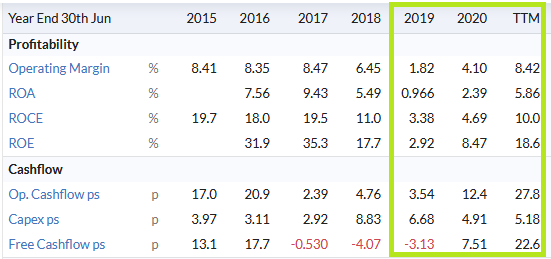
Alumasc’s operating margin for the first half of its current year was 12.9%. Profits seem to be weighted towards the first half of the year, but all the same I’d expect a full-year margin of at least 10% this year.
However, one possible risk is that not all parts of the business contribute equally to profits. Here is the segmental breakdown from the first half of this year. I’ve added in the divisional operating margins:
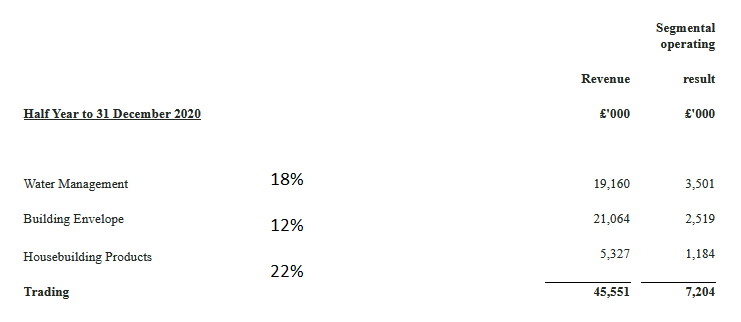
A slump in demand for water management or housebuilding products could hit profits disproportionately. I already have some exposure to the UK housing market through Persimmon. I’m not sure how much more I want.
However, on balance I think Alumasc shares score fairly well for quality. I have no major concerns.
Momentum: improving
Alumasc’s share price has risen by 155% in six months. The stock now trades 58% above its pre-pandemic peak:
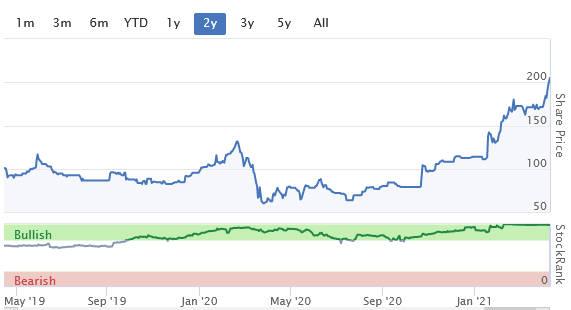
It looks like the firm is benefiting from more than just a post-pandemic recovery. Investor sentiment towards the business must have improved. Given this, I’m not surprised to see a strong MomentumRank of 92.
Let’s look at each element of momentum individually.
Earnings estimates: As we’ve already seen, the firm’s turnaround plan is delivering results despite the headwinds of the last year. Profits are expected to hit new highs over the coming year. Indeed, broker consensus forecasts are now higher than they were before the pandemic:
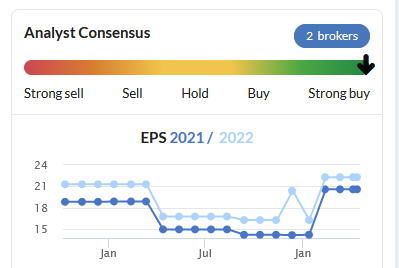
Seen in the context of improving performance, I reckon Alumasc’s forecast P/E of 9 and 4.4% dividend yield could offer value. The only point I’d note is that earnings growth is expected to slow markedly next year, to around 5%.
Price momentum: The technical picture is positive, too. Alumasc scores a full suite of green indicators in the Momentum snapshot:
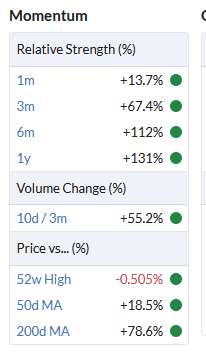
I can’t see anything to dislike in Alumasc’s momentum metrics. The outlook does seem to be improving.
Alumasc: my decision
I can’t get too excited about this business. Its cyclical exposure and hefty pension liabilities mean that I wouldn’t want to pay a high multiple for the shares.
In terms of adding the stock to SIF, I also have some reservations about increasing the portfolio’s existing exposure to the UK housing market.
Although Alumasc passes all of my screening tests, I’m not going to add the shares to the SIF portfolio this week. Am I being too cautious and shortsighted? Let me know what you think in the comments below.
Disclosure: At the time of publication, Roland owned shares in Persimmon.
Disclaimer
This is not financial advice. Our content is intended to be used and must be used for information and education purposes only. Please read our disclaimer and terms and conditions to understand our obligations.

10 comments
Thanks for this detailed overview Roland, it's very interesting (and helpful) to see another person's take on a research process I've also gone through with this company.
I've held since mid February, so have benefitted from the latest price movement up to 200. There's a lot of positives about the business, that hit my assessment criteria at the time which I think still stand.
roland i think your right. i have been the same over the years i just looked at it again i would wait until a new person with ambitious drive takes the helm then thats the time to take a chance
Alumasc brand in the industry is a strong one. Often the first name on a specification or a challenger to Genuit (LON:GEN) (ex-Polypipe)
I looked at this company last week. The big pension deficit & illiquid shares put me off. I sort of sat on the fence for a bit with it. But in the end it would have been a low conviction buy, and I decided not to go ahead with it.
I did ask you about it, some weeks ago, when it was on your scene, I feel you have rather missed the boat and probably right not to buy now. The spread is around 500bps so does not pass all your rules?
Another one to consider is Tyman (LON:TYMN) passes all your rules, apart from earnings but is close at 6.39%. Much tighter spread as well.
Hi herbie47,
The spread changes from day-to-day, but I agree - Alumasc (LON:ALU) isn't the most liquid stock and sometimes the spread is over my limit. When I wrote about the shares, it wasn't.
Tyman (LON:TYMN) has drifted in and out of my screen on a number of occasions. I've never managed to cover it but may do so if another opportunity arises.
Roland
Although I missed last week's rise, I recently sold out at a good % profit on the basis that I couldn't see why the share price would/should keep rising as the current financials are just getting back to where they were in 2015.
Good to see a detailed analysis to support my decision!
Another great write up Roland out of interest when it comes to price to book what is the maximum figure you feel comfortable with before the red flag alert kicks in ?
Thanks Andy
Andy,
I wouldn't necessarily say the price/book ratio was a red flag at £ALU. It was more just a warning that I should look at the balance sheet more closely and understand the different moving parts.
I don't have a hard limit on P/B, as what's appropriate can vary widely between businesses.
For example, companies with lots of fixed assets and few acquisitions will tend to have a low P/B. Property is the obvious example.
In contrast, companies that have developed valuable brands may have very high P/B ratios. For example, Unilever (LON:ULVR) (I hold) trades at 8x book value, but I wouldn't say it was outrageously expensive.
The reason for this is that the value of brands developed in house isn't reflected on the balance sheet. (Brands that have been acquired show up as goodwill/intangibles).
Understanding a company's balance sheet is always important, in my view, but it needs to be viewed in context.
Regards,
Roland
Thanks Roland