SIF Folio: Morgan Sindall promises H2 recovery

We’re now approaching the end of the half-year results season. In the past, I’ve not covered results from companies in my rules-based SIF portfolio. In keeping with my hands-off approach, I’ve usually avoided any review of a stock’s performance until the end of its nine-month holding period.
However, I’m considering providing additional coverage of the performance of shares while they are still in the portfolio. There are a couple of reasons for this.
The first is that many companies have faced unprecedented challenges and headwinds this year. There’s a real sense of uncertainty about how many businesses are performing, something that’s not always true.
The second reason is that my approach is becoming somewhat more active than in the past. For example, I’ve recently introduced a stop-loss rule and also have a policy of selling after a profit warning.
I know that many of you follow company news quite closely, so I’d be interested to hear your views on this - should I provide more consistent coverage of news from stocks in SIF?
This week I’m going to trial this new format by taking a look at last week’s half-year results from construction group Morgan Sindall. This FTSE 250 stock fell by more than 50% in February and March, as investors feared the worst. Four months later, most parts of the business are back in operation. I think it’s a good time to take a fresh look.
Morgan Sindall (LON:MGNS): still a sector winner?
(Original buy report: 03/03/2020)
I’ve been following this construction and regeneration group since I held the shares in SIF in 2017, when it delivered a total return of 59% in nine months. I don’t expect a repeat performance this time round - Morgan Sindall’s share price has fallen by nearly 30% since I bought the shares for the portfolio in early March.
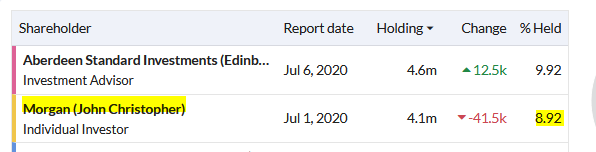
However, I remain of the view that this firm is one of the best operators in this sector. I’m in no doubt that one reason for this is the presence of owner-management -- founder John Morgan remains in the hot seat and controls 9% of the stock.
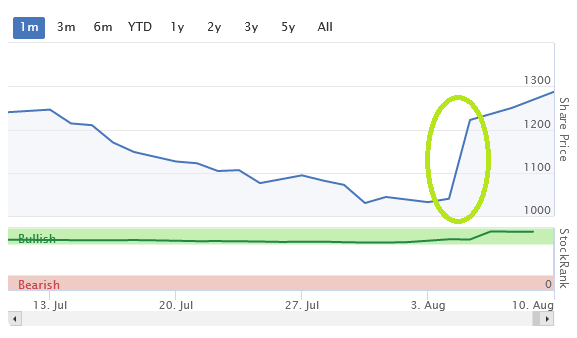
Last week’s half-year results received a warm reception, lifting the stock 17.5% in one day and boosting the firm’s StockRank to 94:
Half-year review
As expected, revenue and profits for the period fell sharply due to the impact of lockdown and supply chain challenges on construction sites:
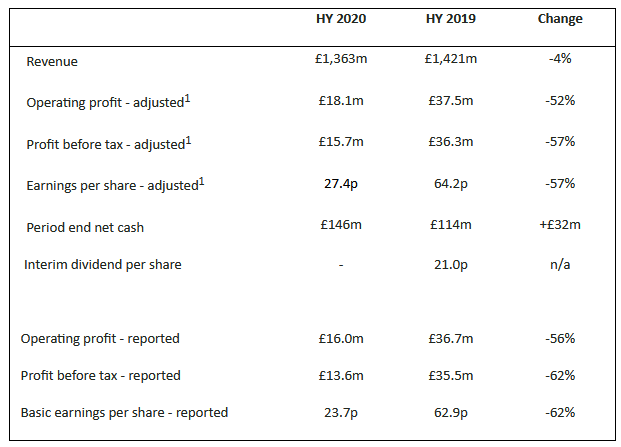
Reassuringly, we’re told that revenue rose by 17% during the first quarter before falling 23% in Q2. So trading was strong before lockdown.
Another positive was that period end net cash rose to a healthy £146m during the period. Of course, many firms massage their cash flow to deliver strong period end figures. But I think the quality of Morgan Sindall’s cash position can be gauged by comparing it to average daily net cash of £153m - almost identical.
The company admits that this figure was increased by £22m as a result of various tax and related deferrals during the first half. These will all have to be paid, so perhaps we should say that average daily net cash was £131m. That compares to a figure of £123m for the same period last year. Not a bad result.
Outlook: Many companies are still using the pandemic as an excuse to withhold guidance for the year. Increasingly, I’m not sure this is justified. Fortunately Morgan Sindall’s management do have a clear view on the likely outturn for the current year.
Revised guidance is for pre-tax profit of £50m-£60m this year. Taking the midpoint, this implies an H2 pre-tax profit of £39m. The comparable figures for 2019 were £90m (FY) and £54m (H2). If the firm can hit this guidance, then I think that will be a solid result in the circumstances given ongoing disruption and cost inflation.
Taking a slightly longer view, one of my main concerns earlier this year was that Morgan Sindall’s order book might start to deteriorate. Although it’s too soon to be sure, there’s no sign of this happening so far. The company says that its secured workload actually rose by 5% to £7,962m during the first half.
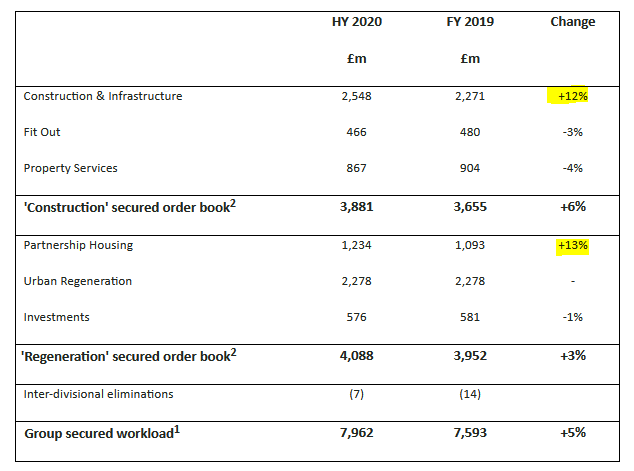
As you can see, the new work came from two divisions, Construction & Infrastructure and Partnership Housing. I’d expect these sectors to be relatively resilient in a recession, given the government’s commitment to invest in infrastructure and the need to support affordable rental housing.
There’s no dividend as yet, but I suspect that if this guidance is delivered, the board will declare a reduced final dividend for 2020. Analysts have pencilled in a payout of 25.4p for this year, giving a forecast yield of 2%.
My view: Morgan Sindall has always had a good track record of cash generation and a relatively strong balance sheet. But I don’t think the company has any special advantage in terms of profitability. The group’s operating margin has averaged 1.8% since 2014, according to Stocko stats.
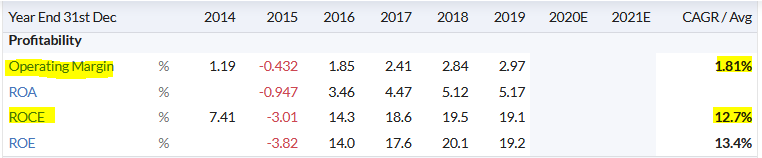
Instead, I think the firm’s performance is the result of very good management - tight control of working capital, well-structured contracts and good operational execution. These support a respectable level of returns on capital employed.
My guess this performance stems at least partly from the company’s founder-led culture. This suggests that when John Morgan does eventually retire (he’s 64), shareholders could face an element of key-person risk. Fortunately, there’s no sign of this happening just yet.
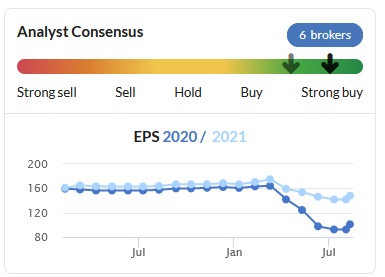
My view of this business remains very positive. This is supported by the latest broker forecasts, which suggest a solid recovery in earnings next year:
I’m interested to note that the stock also qualifies for Richard Beddard’s Nifty Thrifty Screen, which has returned 116% since its inception at the start of 2012.
Stockopedia’s algorithms continue to rate Morgan Sindall highly, with a StockRank of 94 and a Super Stock style. My SIF screen also likes this stock, which is currently one of just five shares qualifying for the screen.
These algorithmic results match my own subjective view on this stock, so I remain very happy to continue holding.
Disclosure: Roland owns shares of Morgan Sindall.
Disclaimer
This is not financial advice. Our content is intended to be used and must be used for information and education purposes only. Please read our disclaimer and terms and conditions to understand our obligations.

12 comments
Been interested in MGNS for a while. Are you not concerned by its poor liquidity? (quick ratio of 0.69 on Stocko)
Hi WealthRoad,
Re. Morgan Sindall (LON:MGNS) quick ratio - as you say, the quick ratio is below zero. This tells us that current liabilities (mainly payables) are greater than the firm's cash and receivables. This does imply some measure of risk if customer billings (receivables) are interrupted.
However, this isn't a new situation for MGNS and the broader current ratio, which includes inventories and contract assets, is >1. This suggests to me that Morgan Sindall is able to convert work in progress and inventories into billings quickly enough to provide the cash flow needed to fund its payables.
Looked at another way, my sums show that in 2019, the firm received payment for its invoices in an average of 32 days. Payables (payments to suppliers) took an average of 45 days. So suppliers are in effect providing some free credit. As long as the wheels keep turning, this shouldn't be a problem - it's standard for businesses such as supermarkets, for example.
Obviously there is some risk here - especially as this is a sector notoriously prone to problems (e.g. Costain (LON:COST) in the SCVR on Monday).
I'm willing to accept the risks in this case, as I rate this business quite highly and it passes all my screening tests.
Please DYOR, as always!
Roland
Disclosure: I hold MGNS
Thank you, that makes sense...their good business management clearly encompasses tight cashflow management and I did wonder about historical quick-ratios for MGNS (not automatically provided by Stocko, which only gives the latest value), so reassuring if this is BAU for them. Will do more research as it has appealed for some time.
Just to be clear, management is in effect guiding for an underlying pre-tax H2 profit of £44m-£54m, which will be a pretty remarkable achievement if they can pull it off.
H1’s profit was flattered by £9.3m of furlough cash received from the government’s CJRS, but the MGNS board has decided that it would be in the best long-term interests of the company to repay all furlough claims (which makes sense when you consider their client base). The £9.3m will therefore be charged as central costs in H2 even though they relate to H1.
This H1/H2 profit split was confirmed by FD Steve Crummett in response to an analyst’s question during the results presentation last week [at 43:02].
Hi Luthrin,
I take your point re. the impact of the decision to repay the CJRS funds in H2. It does look as though underlying H2 profit will rebound very strongly, which is impressive and encouraging for the near-term future.
I didn't mention this in the article as my focus was more on the full-year outlook. Obviously over the one-year period, the impact of CJRS is neutral, if we assume Morgan Sindall (LON:MGNS) would have paid its staff directly otherwise.
I don't tend to focus too heavily on sub-1yr periods of performance, as they can often be distorted by timing factors and other 'noise'. But given the situation this year, I agree that it might make sense to look at H2 in isolation.
Regards,Roland
Hi Luthrin, Yes, good point. The FD does indeed point to a very decent run-rate profit.
One general question: do you know why Morgan Sindall (LON:MGNS) or any other company would elect to hand back furlough money. £9.3m is a lot of dosh. So, there must have been some benefit or obligation. You would think it would be a simple and obvious reason, but I dont know what it is!
If there was any obligation to repay then all the £bns of furlough money would be a contingent financial claim on the UK corporate sector and that can't be surely?
I wondered if repaying would give them the flexibility to pay dividends?
Tks for any thoughts on this point.
Hi Colin,
John Morgan addressed the issue of the furlough repayment at 41:21 in the results presentation when questioned on it:
You said in your earlier comment that you like the company’s business practices and ethics, and I think the decision to repay the furlough cash is a reflection of those standards (MGNS is under no obligation to do so). Yes, £9.3m is a lot of money, but the immediate hit to the bottom line may be a small price to pay for the longer-term reputational gains.
In the aftermath of Carillion’s meltdown and troubles at other peers (e.g. Kier), corporate governance and financial strength have become key considerations in contract selection. As a consequence, MGNS now looks to be very well placed for the coming post-pandemic bidding rounds.
Thanks. It is that simple then. They dont need it and dont think they should take it.
Hi Emboite,
At the risk of sounding cynical, I think the freedom to pay dividends is probably an important part of the decision by Morgan Sindall (LON:MGNS) and other companies to return CJRS payments.
Paying dividends to shareholders (and bonuses to execs) while in receipt of government cash which wasn't needed won't look good. The furlough scheme was meant to save jobs, not line shareholders' pockets.
I'm not sure if there are any fixed conditions attached to the furlough payments, but I can imagine the kind of negative publicity this would (rightly) create.
Far better to do the honourable thing and repay it asap. Then declare a dividend...
Regards,
Roland
Hiya, I am a fundamental holder of and believer in MGNS, so thanks for looking at it. One thought. You say: 'I don’t think the company has any special advantage in terms of profitability'. Pre-COVID the ROE and ROCE were 19%. Op margins are tiny in absolute terms as a contractor but were trending upwards till 2020. MGNS talk a lot about their supplier and sub-contractor network as a comparitve advantage. Maybe not a moat but certainly a decorative pond in their front garden. They seem to have helped this network work through COVID. I may be getting sentimental but I like this company's business practices and, big word, ethics. A growing share of the revenue is through longer term framework agreements and recurring service revenue. This gives some barriers to entry which may help price and planning and so profits. I am a holder though so I may just be talking my own book. Tks again and more comments and updates from you would be very welcome, though be careful not to 2nd guess your system if it works! Colin.
Hi Colin,
I agree that the high ROCE at Morgan Sindall (LON:MGNS) is an attraction. I've commented before that I think this must be down to very tight financial controls.
But I can see how the group's profitability could also be enhanced by a reliable and trusted network of sub-contractors and suppliers. This might help to minimise the cost overruns and other such problems that tend to plague this sector (which MGNS mostly seems to avoid).
Thanks for highlighting this.
Roland
Hi Roland, I think your more active approach makes sense, no point in my view just watching sinking ships, much better to do something.
I’m kicking myself mildly because I nearly bought in to MGNS before the recent announcement. What stopped me was a concern that the working from home concept will significantly impact on the construction sector. Now I’m thinking that is an issue for a future date, and companies stand no chance of having any clear visibility on that right now. So why be pessimistic in your outlook when you don’t know. And there could be another boom before a bust. Still sitting on the sidelines though.