SIF Folio: Swimming naked + why SSP Group could take off

I’ve always disliked hearing companies talk about maintaining an efficient balance sheet. As far as I can see, this is a euphemism for juicing up short-term shareholder returns using cheap debt.
The end result is a business with very little margin of safety. In recent years, this hasn’t seemed so important. By using cheap debt to return cash to shareholders, companies have been able to boost both earnings per share and metrics such as return on equity.
For a hired CEO with a five-year mental timeframe and a juicy incentive plan, efficient balance sheets have made sense. But as Warren Buffett said in 2008, “you only learn who has been swimming naked when the tide goes out”.
It turns out that efficient balance sheets are a bit like skinny dipping. A number of FTSE 350 stocks that were highly regarded by investors have already launched cash calls to repair their efficient balance sheets.
Unsurprisingly, the first wave of fundraisers have come from the hospitality and travel sectors. Last week I mentioned Compass Group and Whitbread. Two other notable examples are travel food specialist SSP Group and WH Smith, whose business also relies heavily on trade at travel outlets.
All four of these are businesses that - in general - I admire. But I think it’s fair to say that they might all have avoided having to go cap in hand to shareholders if they’d held onto more of their free cash flow over the last five years.
I’ve chosen to take a closer look at SSP Group this week, because it’s currently very close to qualifying for my Stock in Focus screen. Although a near-total halt to global air traffic has left SSP in a perilous position, I think this FTSE 250 firm could be a good recovery play following its recent fundraising.
Flying too close to the sun?
If you’ve travelled through any major UK airport or railway in recent years, you’ve probably walked past (or entered) at least one of SMEs eateries. The company operates around 2,800 units in 35 countries. In the UK alone, SSP runs 570 units at 130 airports and railway stations.
The group runs a mix of franchised and own-branded outlets, plus localised and bespoke units designed to have a tailored appeal to the local market. Franchised brands include M&S Food, Burger King and Starbucks. SSP’s owned brands in the UK include Upper Crust and Camden Food Co.
SSP floated on the London market in 2014 at around 240p per share. The stock hit a high of 743p, after which it drifted until crashing at the start of this year. As the chart shows, we can now buy SSP shares at little more than the 2014 IPO price:
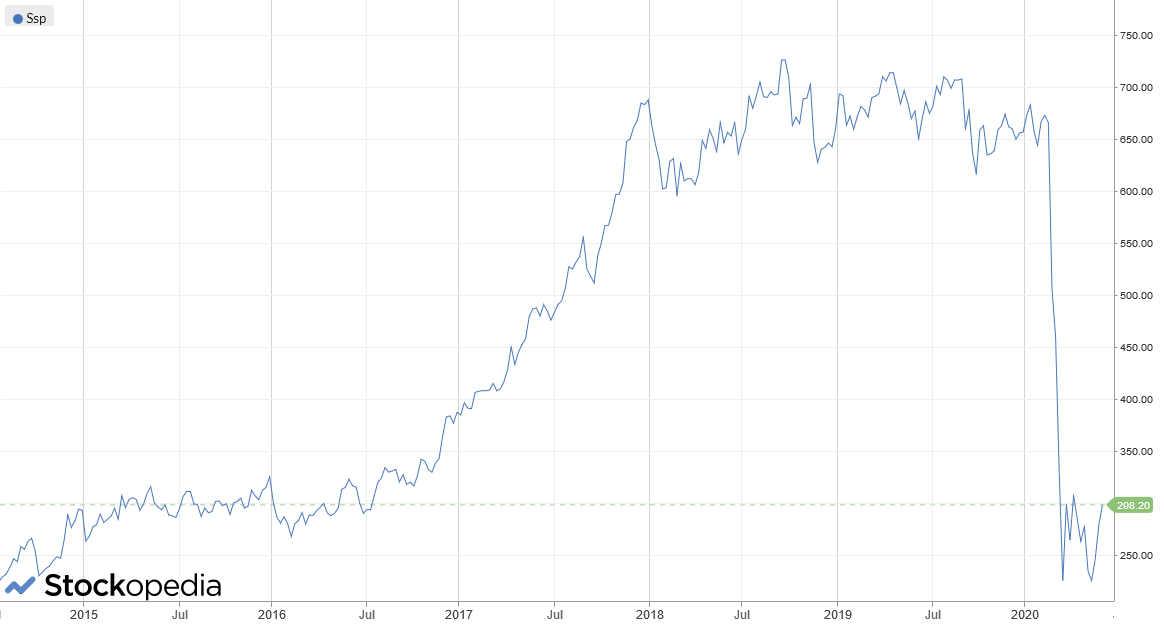
SSP’s share price refused to rise from 2018 onwards despite generous inducements for shareholders. In 2017, the company declared a £100m special dividend and share consolidation. In 2018, the firm repeated this trick with a £150m special dividend and share consolidation.
I’m not going to dwell on the company’s efforts to maintain an efficient balance sheet, except to note four interesting numbers:
Special returns to shareholders 2017-2019: £250m
Increase in net debt FY17-FY19: £221m
Amount raised in placing March 2020: £216m
Share price fall YTD: -55% (c.£1.5bn of shareholder value destruction)
Arguably, CEOs shouldn’t need to plan for the near-total shutdown of their businesses. But bad stuff happens. Perhaps we should expect companies to build in a higher level of financial resilience. I think so.
A quality business?
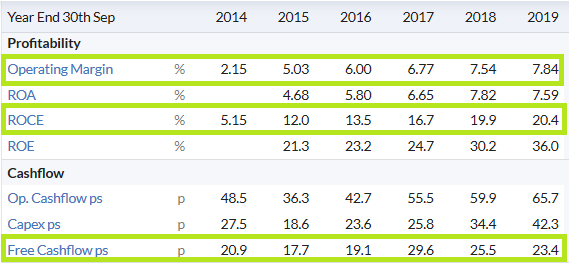
Despite my critical comments above, I think SSP is an attractive business. Margins compare well to rival restaurant and pub chains, and return on capital employed reached 20% last year. The group has also delivered consistent strong cash generation:
Stockopedia’s algorithms have a fairly positive view on SSP too, classifying the stock as a Contrarian play - high quality and value scores, but low momentum. I wouldn’t argue with that:
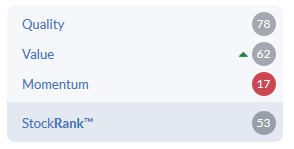
I think we can take it for granted that momentum will remain dire until there’s some positive news on earnings. I guess that will require a significant increase in air passenger numbers. I’d expect this to happen gradually over the next three-six months.
In the meantime, I think it’s worth looking at SSP’s value and quality scores.
Value: SSP is not an asset play, as all of its units are rented or leased in travel hubs. But this business does score reasonably high for value in other regards.
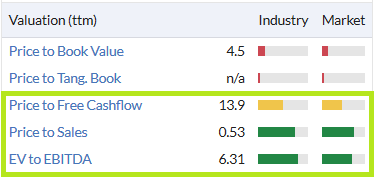
The business looks cheap to me, relative to last year’s earnings and free cash flow.
However, my preferred measure of valuation is earnings yield. This ratio compares operating profit with enterprise value (EV). Because EV includes debt and market cap, earnings yield gives us a measure of value and profitability that’s representative of what someone buying the whole business would see.
SSP’s earnings yield is currently just over 10%, according to Stocko stats. That’s comfortably above the 8% minimum demanded by my SIF screen. My sums suggest that at the current share price, operating profit could fall by 25% before SSP’s earnings yield would drop below 8%. That seems a plausible outlook to me for the 2021 financial year, so I’d see this as a significant value indicator.
Obviously this assumption rests on net debt remaining stable or falling. We should find out more about this when SSP publishes its half-year results on 3 June (this is being written on 1 June).
Quality: As I’ve mentioned, SSP has generated above-average returns on capital employed in recent years. Stockopedia’s stats show a five-year average ROCE of 14.6% and an average return on equity of 27%. These are attractive figures, in my view.
The stock’s QualityRank is also supported by a Piotroski F-Score of 7/9. This measure of fundamental health includes nine tests covering growth, profitability, leverage and cash generation. I think the F-Score provides a great snapshot of a company’s financial health. I’d recommend taking a look if you haven’t before - you can drill down into the F-Score for any stock by clicking on the F-Score link on the StockReport page:
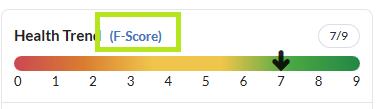
In this case, SSP’s F-Score is marked down because of its recent placing and its rising gearing over the last year. Fair criticisms, as we’ve already seen.
Why doesn’t SSP pass my screen?
SSP actually comes pretty close to passing my screening tests. There are only two areas where it fails:
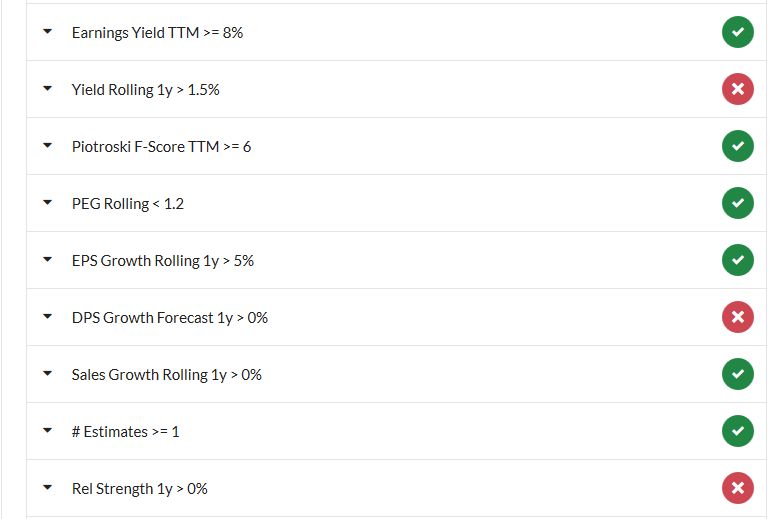
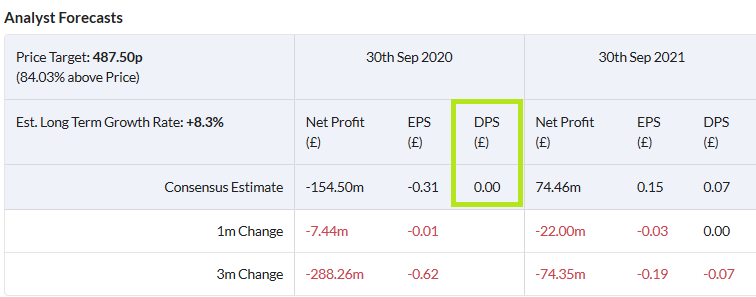
The first two failures relate to the suspension of the group’s dividend this year. This isn’t always reflected in companies’ broker forecasts, but in this case it is:
The only other rule SSP fails is the requirement for positive one-year relative strength. This momentum tests measures whether a stock has outperformed the market over the last year. SSP hasn’t:
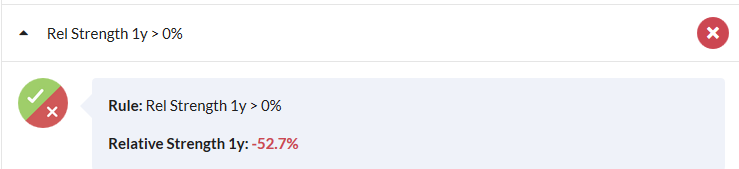
For value investors with an open timeframe, negative relative strength wouldn’t necessarily matter. The value opportunity lies in buying this stock at lockdown prices and waiting for its valuation to normalise. But if you’re holding stocks for a fixed period, as the SIF fund does, then negative momentum becomes a more serious risk.
My verdict
I’ve contemplated ditching relative strength during previous market corrections. As a value investor by nature, I’m always tempted by a bargain. I’m doubly tempted in this case, as I think SSP is a stock that could perform very strongly over the next year.
However, this outlook isn’t without risk. We don’t yet know how quickly traveller numbers will recover. And we don’t know how easily the companies that serve them will adapt to social distancing and other constraints. Profitability may be significantly lower for some time.
Personally, my view is more optimistic. But I’m going to hold fire on SSP for now - at least until I’ve had a chance to read through the firm’s half-year results, which are due later this week.
I’d be interested to know your views on momentum: is it still an important factor in these uncertain times? Or should we trust that former high performers will retain their historic earning power, and buy them while they’re cheap?
Disclaimer
This is not financial advice. Our content is intended to be used and must be used for information and education purposes only. Please read our disclaimer and terms and conditions to understand our obligations.

8 comments
SSP had been on my watchlist pre-COVID because I like its margins and business model - seems (or seemed) very stable with room to expand. I still think this it the case in some respects, they will normalise, and hence they are priced cheaply in my opinion. I also noticed their chart showing some 'cup + handle' patterns around the 325p mark so bought in yesterday and have been pleased to see a strong day today breaking this pattern on the positive. I hadn't read this article before buying, which a nice feeling to read something that backs up what you thought after buying rather than the other way around!
Hi Roland. You asked for our views on momentum. I think a lot depends on ones overall strategy and likely holding period. It's clear that a share that a share that has had good momentum for quite a period of time will not score well on value. So this is difficult because we want both value & momentum. My approach is that I will probably hold for about 6 months. I do want to have some positive momentum at the time of buying. So I generally have to make a bit of a sacrifice on the question of value. I look for growth & momentum at a reasonable price. However, one thing is quite clear. Never catch a falling knife!
I look at the direction of the momentum ranking so in that sense it's useful. It also gives me confidence even now to see momentum rising if it's the icing on the cake to other factors that meet my criteria. Equally falling momentum makes me wary and tells me to look at where sales are heading. This would be the case for me with SSP, the potential long term gain on their lowly share price looks really tempting but for hospitality businesses I worry about first them getting open, then factors they can't control, like how many people pass through the airline terminal, and then about their sales density, for example even if there is the demand they might only be able to seat or serve half the people they did before. Even a company that's good on cost control like SSP might struggle with that. I'm not sure every historic high performer will return to former glory.
Hi Andrew,
Thanks for your comment. I agree that lack of control for Ssp (LON:SSPG) is a significant risk. This firm is basically an outsourced service provider to airports/railway stations. Like caterer Compass (LON:CPG), it has been hit by events it has no control over.
This is certainly a factor I've started to think more about in all of my equity investments - is the company the master of its own destiny? External pressures always exist, but they aren't equal for all companies.
Perhaps the most extreme example that's come to light for me in this crisis is public transport operators. They have become unviable without intensive government support. Yet (rightly) they must operate in line with government dictates on service provision.
I'm taking a more wary view of such stocks than previously, and have sold the stock I did own in this sector.
Regards,Roland
Thanks for expanding Roland, I like the way you've phrased that: "Is this business master of its own destiny?" makes a great defensive question for anyone's checklist right now.
Re seating in airports, in my experience many people do "takeaways" and just sit in airport seats, so it may not be that big a problem.
Not keen on momentum investing. Much prefer finding cheap quality with the company reinvesting earnings.
Thanks Roland, a good insight. This is also on my watchlist.
ATB, NM