SIF Folio: Wynnstay looks like a defensive dividend buy

The ethical and governance issues faced by investors are making headlines at the moment, thanks to the scandal that’s embroiled Boohoo. The online fast fashion retailer is alleged to have contracted work to Leicester companies paying employees less than the minimum wage.
The ethical ins and outs of Boohoo stock were discussed at length in the comments to Monday’s SCVR. If nothing else, I think these events are a useful reminder of how difficult it is to define a widely acceptable set of criteria for ESG investing (Environmental, Social and Governance).
It’s food for thought. Fortunately, I don’t take a fixed stance on ESG issues in the SIF portfolio, which is run according to a set of financial rules. With that in mind, let’s move on to this week’s stock, agricultural supplier Wynnstay (LON:WYN).
A safe bet for ESG investors?
As a UK-based agricultural supply company that’s been supporting British farmers with things like feed and fertiliser for over 100 years, you’d probably expect Wynnstay to score well on ESG issues.
I wouldn’t necessarily disagree with this view. But I think it’s fair to say that many environmentalists would argue that the modern farming industry - especially meat and dairy - contributes heavily to problems such as river pollution, environmental damage, food inequality and excess carbon emissions. Maybe not so great in ESG terms?
That’s a debate for another day. What interests me now is that AIM-listed Wynnstay appears to tick all the boxes in my full-strength SIF screen. It even boasts a 4.6% dividend yield, recently confirmed!
Cheap, defensive and durable?
For a £60m firm in a rather dull and defensive line of business, Wynnstay has had a lot of coverage recently on Stockopedia
24 March 2020: Jack commented on Wynnstay in the SCVR, noting early signs of improving momentum and strong value metrics, despite low margins.
15 June 2020: Jack revisited Wynnstay in a feature looking at quality dividend stocks. An apparently solid dividend is a key attraction for me, too.
24 June 2020: Paul mentioned the firm’s half-year results in the SCVR. He commented that strong trading in a difficult period suggested Wynnstay might be worth a closer look.
I have to admit this stock has flown below the radar for me due to its small size. But my initial inspection suggests there’s a lot to like here. Let’s dig in.
A defensive super stock!
From a quantitative viewpoint, Stockopedia’s algorithms can find very little to fault with Wynnstay. The has a near-perfect score and is classified as an Adventurous Super Stock - a classification pairing that’s historically outperformed.
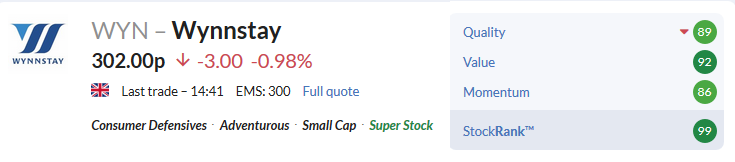
It’s a promising start. Before I look at Wynnstay’s factor scores in more detail, I’d just like to draw your attention to the shareholder register. For a company of this type, WYN appears to have a strong level of backing from credible institutional shareholders. I see this as a positive factor:
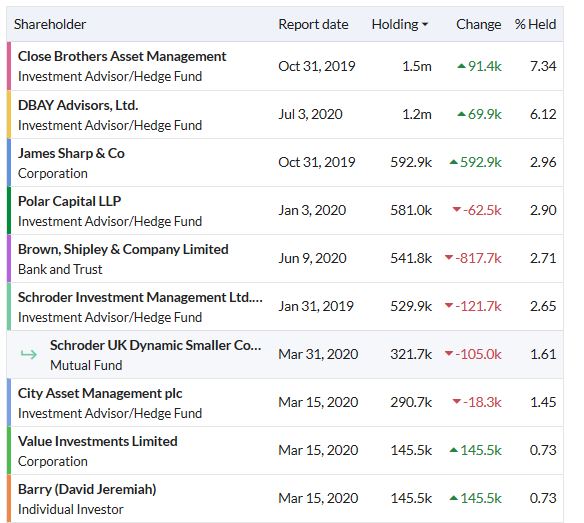
On a related note, I’m a little disappointed to see that the directors’ shareholdings appear to be relatively modest. However, this isn’t a dealbreaker for me.
Value: outstanding?
There’s more than one way to measure value. For example, we can value shares relative to their assets, cash flow, earnings or dividend yield. Few stocks manage to score well on all counts, but Wynnstay does appear to do this:
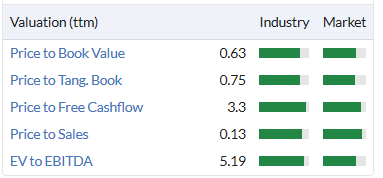
WYN’s recent half-year results confirmed that the interim dividend will be maintained, confirming shares’ above-average dividend yield of 4.6%.
I’ve taken a look at the latest accounts to understand a little more about what lies behind these attractive ratios.
Book value: The half-year accounts report a net asset value of £96.8m, or 487p per share. A fair chunk of this relates to £42m of inventories. These appear to be turned over every 40 days, which seems reasonable to me for a business of this kind.
Customers appear to take an average of about 55 days to pay Wynnstay’s invoices. That seems a little slow, but I don’t think it’s suspicious.
Free cash flow: The company has benefited from falling commodity prices over the last year. These have reduced working capital requirements, boosted cash flow and allowed the group to cut net debt from £14.7m to £2.5m at the half year end.
Although this one-off boost has been useful, history suggests that Wynnstay generally enjoys decent cash generation:

Earnings yield: One of the most important valuation metrics I use is earnings yield (EBIT/EV). I feel this provides a valuation metric that reflects a company’s profitability. Wynnstay scores highly on this metric, with an earnings yield of over 11%. That’s comfortably above the 8% minimum my screening rules require.
Overall, I can see a lot to like in terms of valuation. By nature this is a low-margin business, but as I’ll try and explain next, I don’t think we need to be too concerned by this.
Quality: look beyond the margin
Wynnstay’s QualityRank of 89 suggests that businesses don’t need very high margins to score well on quality. So how does this work?
The firm’s six-year average operating margin is just under 2%:
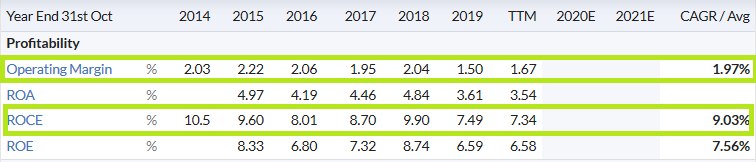
In most cases, I’d warn that this looked fragile and risky. Here, I’m not too concerned. One reason for this is that Wynnstay’s return on capital employed is okay, if not inspiring, at around 7.5%.
But the main reason why I’m comfortable with this low margin relates to Wynnstay’s business model.
My impression is that the company’s low operating margin is related to its bulk commodity business - animal feed and the like. This kind of bulk product is a bit like petrol or heating oil. It’s sold with a small markup which may simply be a fixed amount per unit of volume.
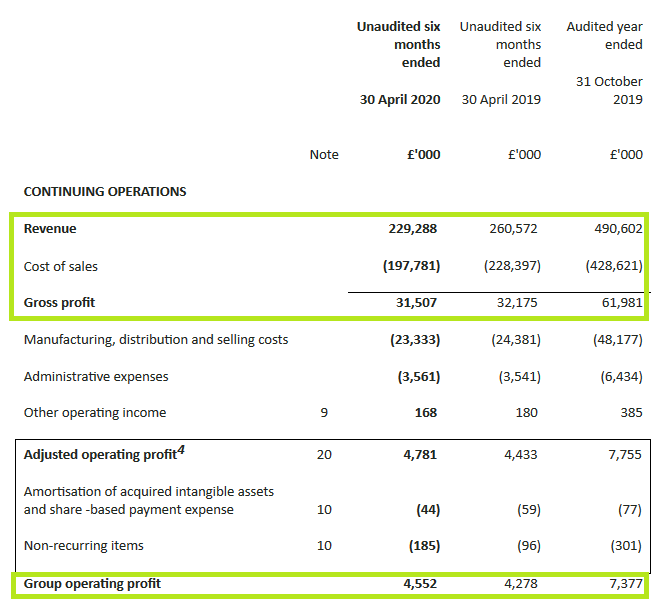
We can see from the income statement that cost of sales (inventory) accounts for more than 85% of revenue. The gross margin that’s left is about 12.5%, which is low by most standards.
However, the way I look at this is that Wynnstay’s gross profit is effectively a fee for the services it provides. This is an approximation, but I think it works here. If we then compare the group’s operating profit with its gross profit [fee income], we get a pseudo-operating margin of about 13%. That seems pretty healthy to me.
Piotroski F-Score: Wynnstay’s low margins would not be acceptable to me if cash generation was poor or if gearing was high. Fortunately, this isn’t the case. We’ve already seen that the company enjoys strong free cash flow and low debt levels. The stock’s Piotroski F-Score confirms this and provide a little more context.
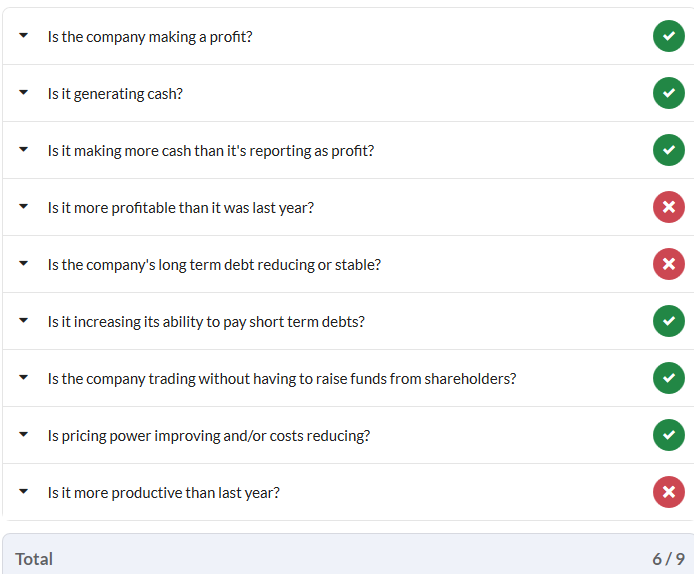
We can see that cash generation matches or exceeds accounting profits - always good news. We can also see that liquidity (ability to pay short-term debts) is good.
The F-score isn’t infallible, due to its rigid comparisons with prior-year figures. But I find it a very useful way to get a snapshot of a stock’s fundamental health. This metric is also heavily weighted in Stockopedia’s QualityRank calculation.
Market-beating momentum
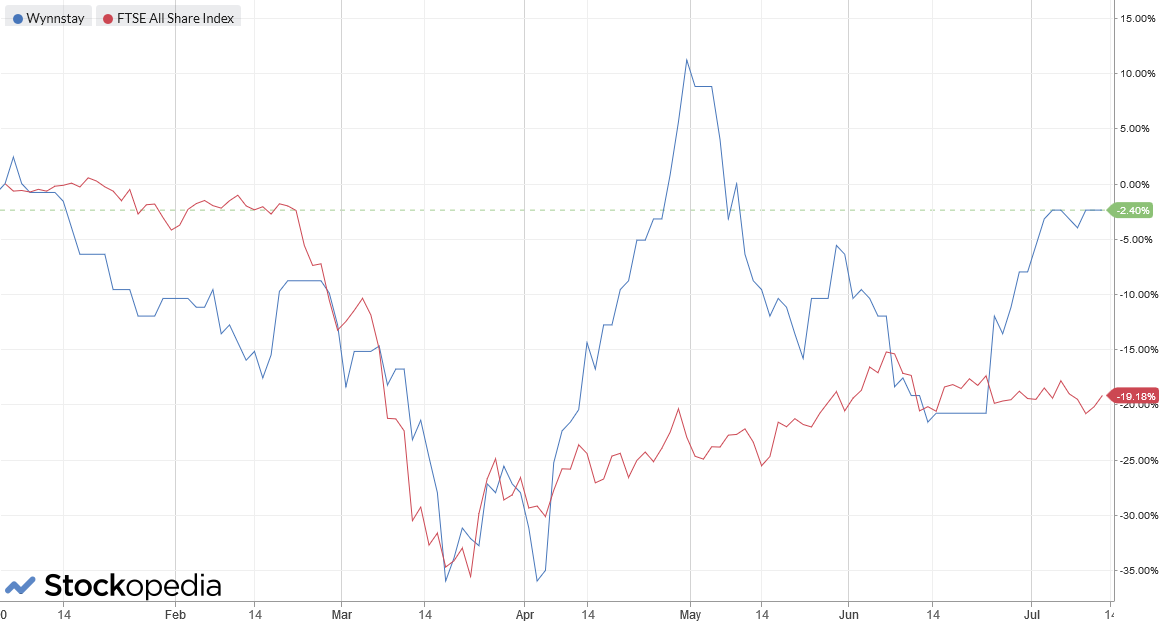
Wynnstay shares have hammered the market so far this year, delivering a broadly flat result during a period when the FTSE All-Share index has fallen by around 20%.
Progress hasn’t been in a straight line: the shares suffered during the market crash but have rebounded strongly since on trading results and a confident outlook:
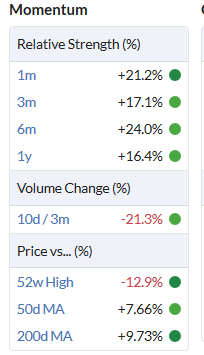
The stock’s MomentumRank is also very high, at 86. This score relates to two sets of factors.
The first is price momentum. This remains very strong, as we can see from the indicators at the top of the StockReport:
The second element of the momentum score relates to earnings momentum. The picture here is slightly more mixed. Earnings are expected to fall this year but be far more robust next year:
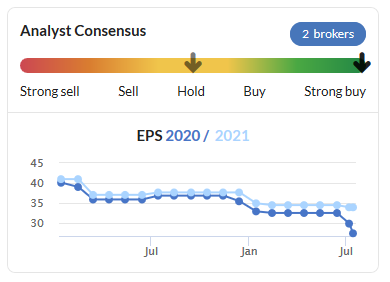
This is what I’d hope to see from a defensive business in a sector like agriculture. After all, demand for the foodstuffs produced by Wynnstay’s farming customers ought to be fairly stable, regardless of the economic cycle.
Putting these elements together gives us a stock that’s trading on a rolling forecast P/E of 9.5, with an expected dividend yield of 4.8%. Both the PEG ratio and earnings growth metrics suggest a positive outlook for profits over the next 12 months:
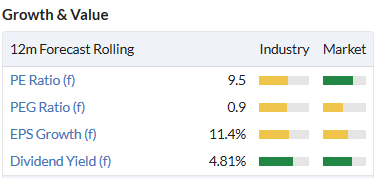
This stock appears to be enjoying strong momentum.
My verdict
I can’t find anything much to dislike about Wynnstay, other than its exposure to farm commodity prices. A sharp increase in feed prices could reverse the cash flow benefits we’ve seen over the last year. However, this is a regular part of this business and the group’s 100-year history and low gearing suggests to me that it should be manageable.
Wynnstay passes all of my screening rules. Although I’d imagine the stock’s 3% spread (at the time of writing) may require careful negotiation if you’re buying in size, it’s under my 4% limit.
Overall, I think the outlook is positive here. I’ve decided to add Wynnstay to the SIF folio and my own holdings this week. As always, I’ll buy the shares after this article has been published.
Disclaimer
This is not financial advice. Our content is intended to be used and must be used for information and education purposes only. Please read our disclaimer and terms and conditions to understand our obligations.

13 comments
I came across WYN from a different direction. I was doing background research into a private company in which I have invested. This is an international farm data aggregator for major food manufacturers and supermarkets, think for example of Sainsburys, Macs and Muller. Amongst their other clients was WYN.
The UK, probably due to CJD and Foot and Mouth is one of the world leaders in tracking and tracing farm data (live stock, crop planting, chemical use, animal welfare etc). The farmers have, by law, to provide much of the data generated to the Government and it is free to access but aggregation and interpretation is not so easy. They also collect data on behalf of accreditation schemes like Red Tractor. The clever bit is that the private company supplies relevant aggregated data back to the farmers for free. Farmers love free stuff!
The fact that WYN are clients of this cutting edge company looked like a positive indicator to me. Next I did some local research as my Godson is a farmer in the West Midlands where Wynn are based. The feedback here was not so positive in that he said the stock distribution to their Agricultural Merchanting division was not terribly efficient but overall was well disposed toward the business.
Ultimately, it seems that Wynnstay are very well in tune with the direction modern farming is going with ever greater importance of sustainability and tracing as this recent advisory confirms https://www.stockopedia.com/share-prices/wynnstay-LON:WYN/news/urn:newsml:reuters.com:20200713:nRSM7292Sa
Together with the stock ranks this seemed a good opportunity at around 270p and other than the price going up nothing has changed. I intend further add to my position when the market next dives.
Hi Roland,
Very useful. I do feel our paths keep crossing WYN is also one of my key holding in my "Blastig" Portfolio. I've held since mid Feb and topped up in June. I must confess to taking a small profit on one of my batches yesterday - more my rules rather than any concern about the company.
I have very little to add to your excellent analysis except to say that I've seen posts concerned about very low margins. WYN has its roots in the Farming Cooperatives, they used to , and I suspect still do, run a cost plus operation of basics for members. Result small margins but a guaranteed profit.
PS would be very interested in your views on Finsbury Food (LON:FIF) which I believe is also part of your SIF and had a recent market update. If fell on Covid and has remained flat - given its market (baking) I am somewhat surprised.
many thanks Roland . This is the second largest position in my portfolio and is a stock for the long haul. Very few of these around at the moment . My biggest ? Boo Hoo but probably not for the long haul :)
Great article thanks Roland. I came to the same conclusion and bought some in June.
Great analysis Roland. Bought this recently. Looks well run and been around for a long time. Happy to hold.
Hi Roland,
Really nice analysis, Looks like a very safe bet.
I like modeling out valuation from the past and into the future. (see the graph below). The current share price is hampered by BREXIT uncertainty. Hopefully, will be rerated after the post BREXIT settlement.
Note: 2017 dip in performance is due to Just for Pets Limited (formerly part of the Specialist Retail Division) was regrettably placed into administration on 10 October 2017
DYOR
BSV
Great dive into Wynnstay (LON:WYN) metrics; very pleased I picked up some shares a month ago, as my screen identified it as great defensive and dividend payer. A healthy company with continued potential, I'll be interested how it fairs during Brexit.
Hi
Great article (although slightly wary of confirmation bias) - I bought a few months back after it appeared on the "Top Screened Stocks on the Move" on the homepage. I was looking for something defensive and this seemed to fit the bill and had a very strong balance sheet.
There is also a bit of a read-across today from Carr's (LON:CARR) :-
"The Agriculture division is currently trading ahead of the Board's expectations. In the UK, farmers are maintaining normal livestock operations and a marginally higher demand for feeds, supplements and fuels has enhanced revenues. "
The company is wary of Brexit from my reading of past reports. My own view is that farmers will be looked after in the event of a no-deal Brexit if for no other reason that people were shocked about how little of our own food we grow.
Edit:- Looks like you may have caused a bit of a rise in the SP, which brings me to a bit of a downside - it can be illiquid and sometimes the spread is unpalatable.
This is great article. It feels like a solid stock that as you say perhaps 'flies under the radar' somewhat being not necessarily a 'glamour stock'. Have held for a couple of months now and the Stockopedia values led me to decide to invest. Thank-you again for the detailed writeup.
I bought and sold at a loss in June, but bought back in again and am currently up 23%. Much to like about WYN. Happy to let it run.
Hello Roland,
Thanks for your very detailed breakdown of this stock and your views that it's possible contender as a defensive stock.
Do you have any concerns that Brexit might effect the outlook of this company as a no deal could have major negatives on the farming sector?
Hello Martinus67,
I agree that Brexit is a bit of a wild card, but my feeling is that the government is unlikely to throw the agriculture sector under a bus, especially at this time.
Over time we could see the farming sector evolve, but as others have said I would hope that overall food production in the UK remains stable (at least).
For me, Brexit falls into the category of "unknowable". Rightly or wrongly, I've pretty much excluded it from my investment process. My thinking is that successful companies will (mostly) adapt, as they would to any other major regulatory change.
Regards,
Roland