SIF July review: Morses Club, TRIG & Anglo Pacific

Despite political uncertainty at home and dramatic events in the Strait of Hormuz, it’s been an inconclusive month for markets. In contrast to the sharp gains seen in June, the FTSE All-Share was up by about 1% in July at the time of writing.
Valued as a whole, the UK market looks reasonably priced to me. The FTSE All-Share is trading on a forecast P/E of 13.1 with a dividend yield of 4.1%, according to Stockopedia data. This is the index I use as a benchmark for my rules-based SIF Fund.
However, this middling valuation conceals a very wide range of underlying company valuations. Domestic stocks continue to look depressed, in many cases. More defensive firms are still enjoying premium valuations.
Canny stock pickers should be able to gain an edge. I’m not sure if that description will include me this year. The SIF folio’s lead over the market has shrunk in recent months, although it still remains ahead of the market by about 20% since its inception in April 2016.
As it’s the end of the month, it’s time to review the portfolio to see if any stocks must face the chop.
Stocks for the chop?
Three stocks are up for review this month, having been in the portfolio for at least nine months:
Morses Club (LON:MCL) - Shares in this sub-prime lender have slumped over the last few months. Is this a sign of problems to come or a buying opportunity?
Renewables Infrastructure Group (LON:TRIG) - this renewables investment trust has proved a surprising performer, delivering capital gains as well as a high yield. But it could be time to take profits.
Anglo Pacific (LON:APF) - this mining royalty group survived June’s portfolio review. Will it do the same again in July?
Here’s how these companies have performed during their time in the SIF folio:

Morses Club (LON:MCL)
(Original coverage 16/10/2018)
This sub-prime lender has a significant share of the home collect market. It’s also expanding its online business, through the Dot Dot Loans brand. Performance has been good since the 2016 IPO. Morses was also able to profit from the self-inflicted problems faced by larger rival Provident Financial in 2017/18.
However, the shares have come off the boil since March, falling by nearly 30% from an all-time high of 186p.
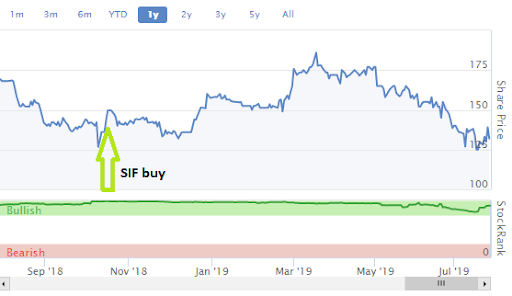
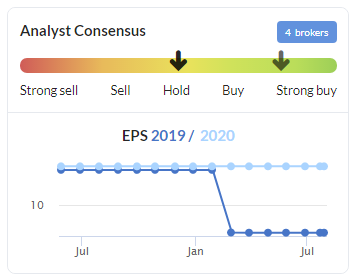
This fall has been mirrored by several broker downgrades. As you can see using the graphic from the new Stockopedia site, forecasts have been cut for both this year and next year:
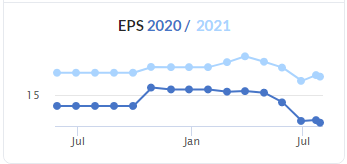
It seems that the City is becoming more cautious about the likely pace of growth at this firm. Although last year’s results were in line with forecasts, earnings forecasts for 2019/20 have been cut from 15.1p per share in May to 13.6p per share today.
Adjusted earnings last year were also 13.6p per share. So analysts now appear to be expecting a flat set of results this year, despite recent acquisitions.
Lower lending and digital deals: June’s AGM statement reported “challenging conditions” in the home collect credit market, with a slight reduction in new lending. To compensate for this, the company is investing more time and money in its digital operations, including several recent acquisitions.
It’s too soon to say how successful these will be, but perhaps some caution is prudent here. One of Morses larger digital deals was February’s purchase for £8.5m of the assets of online lender CURO Transatlantic (WageDayAdvance), which was in administration.
A commissioned broker note from Hardman & Co in June described CURO’s digital business as having lower costs but higher impairments than doorstep lending. Morses doesn’t expect this deal to add to earnings until FY21. At this stage, I think it’s fair to say visibility is limited on digital growth.
My verdict: Morses Club’s falling share price means the stock’s one-year relative strength reading has fallen below zero. As a result, the stock no longer passes all of my screening rules and must be sold from the portfolio.
I’m disappointed at the outcome, but I feel this is probably the right thing to do. Visibility on earnings and growth seems to be worsening. With dividends included, I’ve broken even on MCL. In the meantime, I still have exposure to this sector through SIF’s holding in H&T Group.
Total return: c.0%
Verdict: Sell
The Renewables Infrastructure Group (LON:TRIG)
(Original coverage 09/10/2018)
This investment company has a portfolio of 71 wind, solar and battery storage projects with a generating capacity of 1,509MW. The vast majority of assets and income relate to wind power. After recent acquisitions, 45% of TRIG’s assets are by value are now located outside the UK, in EU countries.
When I added this stock to the SIF folio, I noted that “this is a stock to buy for income, not capital gains.”
I’d stand by that view, but in the event TRIG has delivered a useful 13% capital gain alongside a holding period dividend yield of 4.4%.
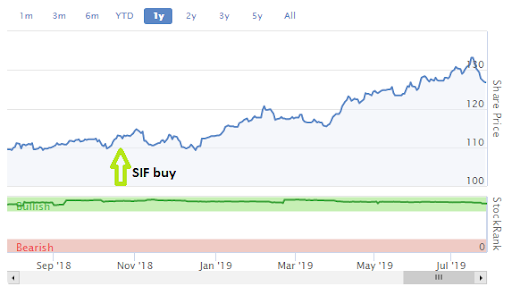
The shares now trade at a premium of about 14% to TRIG’s last-reported net asset value of 111.6p per share. Although this figure has probably changed due to recent acquisitions and an issue of new equity, I’d expect any change to be fairly small, given the group’s business model.
According to some recent analyst research, the average premium to NAV in this sector is 9%, so TRIG looks fully valued. This is also reflected in the forecast dividend yield, which has fallen to 5.2%. It was 5.8% when I added the stock to SIF.
It’s also worth noting that the improving broker forecast trend seen when I bought the stock has now reversed:
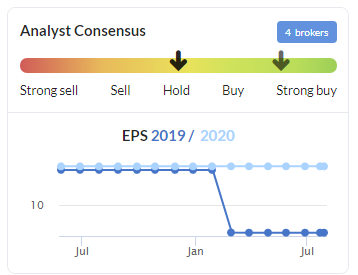
October 2018
July 2019
My verdict: In a long-term income portfolio, I’d keep holding this stock and top up on any dips. But the rising share price means that TRIG’s earnings yield has fallen below 8%, failing one of my screening rules. As a result, it will leave the portfolio this week.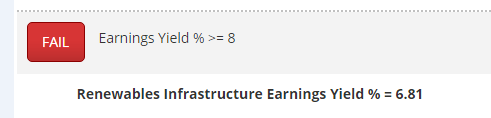
Total return: +17.5%
Verdict: Sell
Anglo Pacific (LON:APF)
Mining royalty group Anglo Pacific continues to qualify for the SIF screen, albeit with the same dividend data glitch I noted last month.
My verdict: This solid performer will stay in the SIF folio for at least one more month.
Total return to date: +37%
Verdict: Hold
As usual, I’ll sell the shares indicated (TRIG & MCL) from the SIF fantasy fund and my personal holdings after this article has been published.
Next week: I’ll be back next week, hopefully with news of a new stock for the SIF folio.
Disclosure: At the time of writing, Roland owned shares of Anglo Pacific, Morses Club and The Renewables Infrastructure Group.
Disclaimer
This is not financial advice. Our content is intended to be used and must be used for information and education purposes only. Please read our disclaimer and terms and conditions to understand our obligations.

6 comments
MCL 11 July 19 Woodford Holding now >5%
16 JUly 19 AIM Rule 26 now no mention of Woodford Holding.Hay Wain Group Ltd has 36.74% and indications are they are looking to exit slowly of course.
J O Hambro Asset Management have 6.93% another indication its viewed as a Special Situation.
At current levels 128/130 a buy
My reasons for holding are IHT planning
Whilst I agree with your analysis, might not the present share weakness in MCL be due in large part to the sale of a large volume of stock by Woodford? I am a holder at present for IHT reasons.
Rhubarbcrumble & krtpforever,
I agree that the Woodford sale may have been one factor causing weakness in the Morses Club (LON:MCL) share price. I should probably have mentioned this in the piece. However, I'm no longer convinced that Woodford selling is the only cause of the weakness we've seen. I think it's possible that growth will slow over the coming year.
Having said that, I still have a broadly positive view of this business and would be happy to hold the shares in a long-term portfolio, such as for IHT reasons.
Everyone's situation is different. My commentary here reflects my opinion and the approach I'm using for the SIF folio. This is based on a set of rules and built around a minimum nine-month holding period.
My decisions are not intended to be advice and won't necessarily be appropriate for other investors.
Regards,
Roland
I agree with the notion that TRIG is fully valued but the premium to NAV is largely down to the new projects coming online and the high margins which will be realised as they do. Under IFRS 15, these will only be recognized in their statements at that point.
Considering this, I think it is worth the premium as the future cashflows still look very attractive in a largely uncompetitive market.
The yield is still also good and management still expect the dividend to continue increasing.
Thornabien,
Thanks for flagging this up. I agree that cash flow and yield remain attractive, albeit less so than previously in the case of yield.
Cheers, Roland
As ever, great analysis concisely presented. I have been tempted by Morses Club and decision now is clear.
Many Thanks
James