SIF June review: Miners Anglo Pacific & Sylvania Platinum are up 40%

It’s almost the end of June, but this month I’m happy to report that I have two profitable positions to review! After recent calamities such as Staffline and Bilby, this makes a nice change. So without further ado, let’s see what’s been happening to the SIF folio’s miners.
Stocks for review
I added two companies to the SIF fund in September 2018. After nine months in SIF, both are now due for review:
Anglo Pacific (LON:APF) - a highly profitable mining royalty firm with a dependency on coal. Can APF diversify in time?
Sylvania Platinum (LON:SLP) - this South African tailings specialist has been cashing in as the price of palladium has roared ahead. Is it too good to last?
Here’s how these two companies have performed during their time in the portfolio:

Let’s take a closer look at the news that has driven these gains and find out whether each stock still passes my screening tests.
Anglo Pacific (LON:APF)
(Original coverage 04/09/2018)
Mining royalty group Anglo Pacific came through the 2015/16 mining downturn relatively unscathed, albeit with a dividend cut. But the balance sheet remained fairly strong and chief executive Julian Treger’s decision to maintain a dividend payout was vindicated.
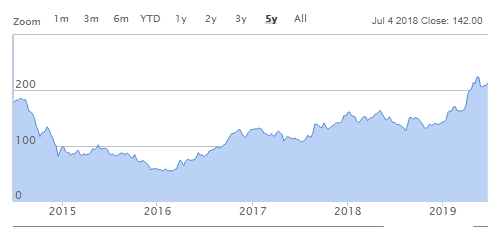
The shares have quadrupled from the lows seen in early 2016, as commodity prices have rocketed ahead once more. However, I think it’s fair to say that Anglo Pacific has benefited from a mix of good judgement and good luck here.
In the right place at the right time: The firm’s main cash-producing royalty asset is a stake in the Kestrel coal mine in Australia. This accounted for 70% of Anglo’s royalty-related revenue last year.
However, this interest only covers certain parts of the mine acreage, so royalty income is dependent on which areas the mine’s operator chooses to work. The proportion of Kestrel mining taking place in Anglo Pacific’s royalty lands has moved in the firm’s favour since 2015:
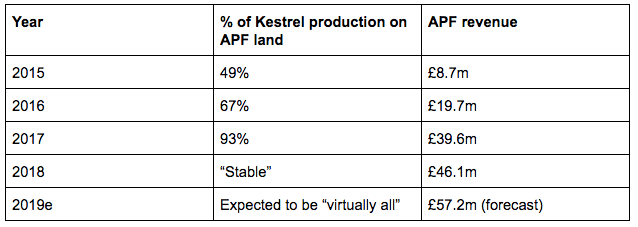
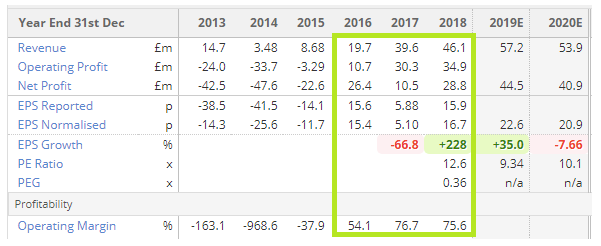
The combination of strong coal prices and a bigger share of Kestrel royalties has worked wonders for Anglo Pacific’s revenue, most of which falls through to the bottom line as profit:
Heading for a blow out?
A second change has taken place during this time that might have been harder to predict. The mine’s previous owner, FTSE 100 giant Rio Tinto, has sold all of its coal operations.
The consortium which bought Kestrel from Rio appears to be running the mine to maximise upfront cash generation. They intend to increase production from the mine by 40% in 2019, according to Anglo Pacific. Management expect virtually all of Kestrel’s production to remain within its royalty lands, providing a big boost in revenue.
Analysts’ forecasts reflect this. Anglo’s revenue is expected to rise by 24% this year. Adjusted net profit is expected to rise by 37% to £44.5m.
There is a downside here. APF admits that accelerating Kestrel production will bring forward the time at which the firm’s royalty interest is exhausted. Given its continued financial dependency on the mine, that’s a key risk.
In an effort to address this, Anglo has made a number of acquisitions and new investments over the last couple of years. The company now says that the proportion of its net asset value attributed to Kestrel has fallen from 72% to 48% over the last five years.
That’s fair enough, but some of these assets are at an early stage of development and not yet producing revenue. During the first quarter of 2019, Kestrel still accounted for 71% of the group’s revenue.
I’d hope that this mismatch between NAV and revenue will start to correct over the next couple of years. CEO Mr Treger certainly has a strong incentive to achieve this, as he owns 3.1% of the company. Other notable shareholders (in my opinion) include Schroders (7.2%) and Miton (4.7%).
In the meantime, bumper income from Kestrel is providing cash flow for new investments and generous dividends. So the situation isn’t all bad.
SIF screen review
Does Anglo-Pacific still pass all of my Stock in Focus screening rules? A quick check with the checklist tool suggests there’s a problem:

On closer inspection, this turns out to be a false alarm. For some reason, the StockReport page for APF shows a dividend of 9.6p per share for 2018, which is forecast to be cut to 8.3p in 2019:

A forecast dividend cut would break one of my rules. But the figure of 9.6p is incorrect. The total dividend for 2018 was 8p per share. Oddly enough, the data on the APF dividend history page reflects this correctly. So I’m not sure what’s going on.
The upshot is that Anglo Pacific still passes all of my screening tests and will remain in the portfolio for at least one more month.
I’m comfortable with this, in the short term at least. Although the stock is arguably fully priced, on 1.8x NAV, the outlook for the next 18 months is pretty strong. Mr Treger’s judgement has proved fairly reliable so far, so I’m happy to hold on a little longer.
Verdict: Hold
Total return to date: +40.2pc
Sylvania Platinum (LON:SLP)
(Original coverage 11/09/2018)
“It is a bubble…” -- not my words, but those of Anglo American chief executive Mark Cutifani, discussing the current market for palladium, one of the platinum group metals (PGM) produced by Sylvania Platinum.
In the interests of balance, I should also say that Mr Cutifani went on to say that he thought palladium prices would remain elevated for a while, as it would take time for automotive manufacturers to re-engineer their catalytic converters to use cheaper platinum.
Palladium prices have risen from about $140/oz at the start of 2009 to roughly $1,500/oz today (FT chart link). Since July 2016 alone, the price of palladium has risen by about 150%. Rhodium, another PGM, has also performed strongly.
This strong growth has provided a tailwind for Sylvania, which makes money by processing tailings (the waste from other mines), as well as mining on its own account. Profits rose by 29% during the first half of the current year, even though production was only 4.5% higher.
The stock closed about 6% higher on Monday after the company announced a 2.1m share buyback. After subtracting off the 1m shares which will be used for staff stock options, my sums suggest the net return to shareholders equates to a yield of about 0.4%.
Sell or hold? With a running gain of more than 40% on this position, I’m happy to lock in a profit at this point. History suggests that the price of palladium will correct at some point in the future. When this happens, the profits of small miners like Sylvania will be hit hard.
Although the outlook remains positive, a forecast P/E of 5.1, below my minimum P/E of 7. This suggests to me that the market sees some downside risk to earnings. I share this view.
This has been a successful trade for the SIF fund, with a share price gain of 41%. The company’s maiden dividend in October added a further 1.6% to the folio’s total return.
Verdict: Sell
Total return: +42.5pc
I will sell Sylvania Platinum from the SIF fund and my own holdings after this article has been published.
Next week, I have high hopes that my SIF stock screen will provide some new candidates for the portfolio.
Disclosure: At the time of publication, Roland owned shares in Anglo Pacific and Sylvania Platinum.
Disclaimer
This is not financial advice. Our content is intended to be used and must be used for information and education purposes only. Please read our disclaimer and terms and conditions to understand our obligations.

8 comments
Profits rose by 29% during the first half of the current year, even though production was only 4.5% higher.... Although the outlook remains positive, a forecast P/E of 5.1, below my minimum P/E of 7. This suggests to me that the market sees some downside risk to earnings. I share this view.
Rowland - Interesting that you are following your sell @ PE <7 rule, but rather than reflecting immediate downside market risk, isn't it more likely that the low PE is an example of PEAD (Post Earnings Announcement Drift) with a succession of new 52 Wk Highs, while the market attempts to catch up with Sylvania Platinum (LON:SLP) operational gearing and speciality metal pricing new news?
Still looks v.cheap to me despite the rise from circa 30p to 43p. Platinum, Palladium and Rhodium (now the main income generator) are rising to incredible levels. Expect 50p shortly!!
I'm holding on to £SLP. It's a high risk investment like all miners. But the share price is more likely I think to go up than down. It produces two of the four precious metals - platinum and palladium. The price of gold and silver has jumped over the last couple of months. Palladium went up around 4% yesterday. The price of platinum has gone up 10% over the last 3 days. Precious metals are likely to increase in value whilst there is fear of recession, and the fear of recession could last another couple of years or until the next recession actually hits us. There is no compelling reason for investors to sell now, although traders might want to take a quick profit.
My inclination is to continue holding Sylvania Platinum (LON:SLP) - like Robin Penfold I think the steadily rising price of Palladium is one good reason not to sell. Incidentally I've also invested in a physical palladium ETF IShares Physical Palladium ETC (LON:SPDM) since palladium is rising and the amount produced by Russia looks likely to fall ih the short term.
Hi Robin,
I agree that I may have sold Sylvania Platinum (LON:SLP) too soon, in terms of share price movement. Ultimately, my decision to sell was forced by my trading rules, as I've explained elsewhere.
I don't have any special insight into the outlook for the firm, other than that in my view the valuation is now likely to be very sensitive to any falls in PGM prices. Although unexpected operational disruption is always a risk with small miners, I believe commodity prices are the major risk for shareholders right now.
I can certainly see arguments in favour of continuing to hold. As always, it's a case of DYOR.
Good luck with your position, if you hold.
Regards,
Roland
Hi Roland,
Like John I understand your logic, especially after the gains you have made but I do believe you have sold too soon.
The greatest unknown for me is the reliability of the company's production forecasts both for Q4 and 2020.
If we assume that Q4 is in line with April guidance, then results to June (and beyond) should be outstanding, given PGM prices. Platinum is around 1% down on 12 months ago (and appears to have support at 780 to 800$ oz), Palladium is up 63% YOY, +20% over 6 months and +16% over30 days and near all time highs - currently $1547 Oz. Rhodium is at $3,150 oz up from $2,100 oz 12 months ago. My estimate is that Rhodium and Palladium now account for approximately 33% and 27% of Sylvania's revenues.
Given what should be very strong cash flow in Q4 (and currently 2020 FY commencing July 1st), a dividend likely over 3.5% and reducing cap.ex, I believe this share could rise between 20 and 40% post Q4 Operational report. I am sure I have missed the negatives - beyond production and price levels and would be grateful for views on what the other negatives are.
I’m not saying you’re wrong to sell Sylvania Platinum (LON:SLP) but it’s not a rule based decision is it?
Hi John,
Thanks for your comments.
I can see why you might say this, but I can confirm my decision to sell Sylvania Platinum (LON:SLP) is completely a rules-based decision (even though I agree with it).
The rule in question is that the stock's rolling forecast P/E of 5.5 is below my minimum of 7. Sorry I didn't make this clearer in the article, I've amended it now.
As a side note, until April, my minimum P/E was 5. I increased it following my annual review of the SIF folio in order to try and avoid stocks that were unusually cheap. In my experience, this can be a sign that the market is pricing in a cut to earnings.
I'm not necessarily suggesting that's the case here, but that's the rule I'm working too. As always, these articles only represent my views and are not advice. I may well have sold Sylvania too soon...
Regards,
Roland