SIF portfolio: 2017 in review & 3 new international stocks

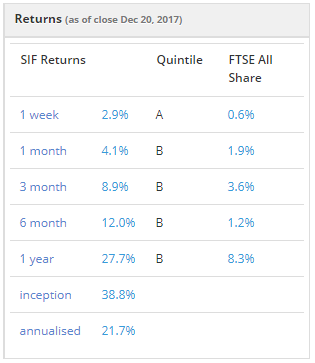
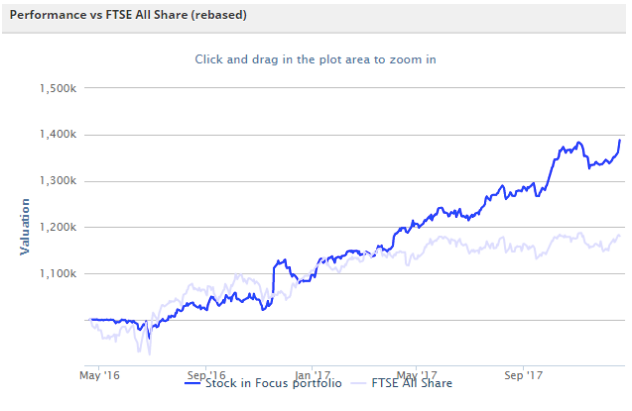
It’s been a good year for the SIF portfolio, which has delivered a one-year gain of almost 28%, beating the FTSE All-Share benchmark (+8%) by about 20%.
The portfolio now has an annualised gain (excluding dividends) of about 21% since its inception in April 2016. I’m quite happy with this.
Although many of you will have done better than this in 2017 (notably small cap editor Paul Scott), it’s worth remembering that the SIF portfolio is largely mechanical. It requires very little in the way of research or analysis, and could be easily managed in less than an hour each week.
Hits and misses from 2017
Highlights from the last year include several stocks which delivered total returns of around 50% in nine months or less:
January: Giftware group IG Design (+49.5%)
March: Audio-visual production firm Avesco was taken over (+132%)
May: Bangladeshi pharma group Beximco Pharmaceuticals (+69.7%)
July: Small-cap fund manager Miton Group (+46.3%)
October: Russian bank TCS Holding (+55%)
November: Construction and services firm Morgan Sindall (+59%)
December: Industrial thread manufacturer Coats Group (+53.5%)
There were also a few misses, but not as many as I expected. This is undoubtedly thanks in part to the bullish backdrop to the markets this year. I don’t expect to be able to maintain such a good record:
January: Car dealership group Cambria Automobiles (-4.1%)
February: Corporate travel services firm Hogg Robinson (-1%)
October: Russian electricity utility RusHydro Group (-16%)
At the end of the year, the portfolio will contain 17 stocks. At the time of writing five of these are showing losses, ranging from 1% to 16%. Positions in profit range from +4% to +28%.
Patience pays off
I’m pleased I decided to lengthen the minimum holding period from six to nine months this year.
The main benefit of this is that at least one set of accounts will be published for every stock while it’s in the portfolio. This means that a fresh set of numbers works through the market. This updates the data used in my screen, giving each stock a ‘fresh’ chance to stay in the portfolio.
I believe the longer holding period should also increase the effect of momentum and value factors on the share price.
International SIF portfolio
At the end of November, I introduced a new international version of the SIF portfolio. This is strictly a virtual portfolio and I won’t be buying these stocks unless I state otherwise.
What this does provide is a chance to invest completely by the rules, in companies and markets with which I have no familiarity. Can a pure rules-based portfolio of this kind be successful? That’s one of the things I hope to find out.
My policy is to add three new stocks each month, targeting a portfolio of 24 stocks. Here’s a reminder of the first three:

As it’s the end of another month, I’ve selected three more stocks from my international screen to add to this virtual portfolio. Here’s a quick summary of each one.
Sandfire Resources NL (ASX:SFR)
A mid-cap Australian mining company which operates the DeGrussa copper-gold mine in Western Australia. In my personal portfolio I’m invested in two of the big FTSE 100 miners, so I’m reasonably comfortable with valuations and the outlook for this sector at the moment.
Judging from the StockReport, this could be a really good quality company. Sandfire has a StockRank of 99, Super Stock status and qualifies for five guru screens.
The shares currently trade on 8 times trailing free cash flow and on a rolling forecast P/E of 9.3. Earnings forecasts were upgraded earlier this month, and earnings per share are expected to rise by 30% in FY18 and FY19.
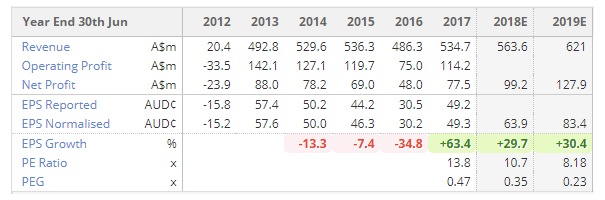
The group has net cash and has generated an average ROCE of 20% since 2012. As a finishing touch, Sandfire has a perfect Piotroski F-Score of 9.
Faurecia SA (EPA:EO)
A European stock at last! You may not have heard of French car parts manufacturer Faurecia, but there’s a good chance your car contains parts from its seating, interiors or exhaust systems divisions. This €8bn firm is a supplier to most major European car manufacturers.
Looking at the figures, Faurecia has a Piotroski fundamental health score of 9/9 and a trailing ROCE of 19%. Net debt appears to be fairly minimal, at less than one year’s earnings. Earnings per share are expected to have risen by 17% this year, with a similar performance pencilled in for next year.
To some extent this is already reflected in the shares, which trade on a 2017 forecast P/E of 14.7, falling to a P/E of 12.8 for 2018. Interestingly, while consensus forecasts have risen steadily all year, broker sentiment has weakened over the last three months:
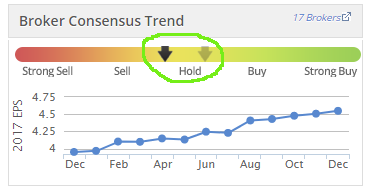
Stockopedia’s algorithms rate this as a Super Stock with a StockRank of 97. So it will be interesting to see if these quantitative advantages prove more predictive than broker ratings.
Konecranes Abp (HEL:KCR)
This Finnish crane firm has delivered a storming performance over the last year. Konecranes produces all sorts of lifting equipment, from four-wheeled cherry pickers right up to 1,000t+ heavy lifting cranes for shipyards. Its cranes are extensively used in container parts, and also in the mining, energy and manufacturing sectors.
In this sense Konecranes is a play on the health of the global economy. And with the shipping, energy and mining sectors all emerging from a major downturn, this may not be a bad bet. While comparable sales are expected to be flat this year, order intake was ahead of 2016 in both Q2 and Q3.
Investors certainly seem confident.The stock currently trades on a rolling forecast P/E of 19. Earnings per share are expected to have risen by more than 30% in 2017, and by 40% in 2018.
Some of this growth may be due to a major acquisition undertaken earlier this year, when Konecranes acquired US rival Terex’s Material Handling & Port Solutions business. I haven’t looked into the structure of this deal, but I’m guessing it’s the reason why net debt quadrupled from €125m to €533m during H1. However, that’s still only 2.5x trailing net profit, so I’m not too concerned.
Cash generation generally appears to be strong and I’d expect net debt to fall as cost savings take effect. The group said recently that it’s targeting €140m of annualised acquisition-related synergies by the end of 2019. (Incidentally, if you want to check a company’s newsflow without digging too deep, the Reuters news feed on each stock’s ‘News’ tab is a great source of information.)
Here’s to 2018!
That’s all from me for this year. All that remains is for me to thank you for reading and commenting so generously this year. Good luck in the markets in 2018.
Disclaimer
This is not financial advice. Our content is intended to be used and must be used for information and education purposes only. Please read our disclaimer and terms and conditions to understand our obligations.

4 comments
Hi Roland,
Just like to add my thanks to you for running this section in Stockopedia. Your success vs failure rate seems very good and during 2017 I've basically been adding your picks on a more or less conviction basis, so far no real let downs. I did recently baulk at Motorpoint mainly from a chart perspective, however I've been proved wrong on this one which kind of re-enforces your point about a purely mechanical system and not letting personal biases get in the way!
One of the things I like most about SIF though is your commitment to use real money of your own and tell us before you buy! I think that approach is rare not to say unique, most people are happy to tell you about their purchases AFTER the event, usually at a higher price!
Anyway keep up the good work in 2018 please! I shall monitor the international screen for a bit to see how that goes. By the way do you have any ideas/advice on how best to purchase non-uk listed companies? I suppose via a SB might be a good way ?
Regards
Jim
Hi Jim,
Thanks for your kind words. The practicalities of trading non-UK listed stocks is a topic that I may cover in more depth in an article this year.
I think the combination of extra costs, currency costs and additional complications such as dividend withholding taxes mean that it's not always as simple as it might seem.
My view so far is that the best way to buy international stocks probably depends on your requirements, for example dealing size and planned holding period. The number of different markets you wish to trade in will also be a factor, as less common markets are not available through all brokers.
Spread betting seems a good choice that removes some of the complexity of dealing in overseas shares, but there's no such thing as a free lunch -- so the impact of the spread and foreign exchange risks could still be significant.
Regards,
Roland
Roland congratulations on a cracking year for SIF
A couple of benchmarking related questions (it is after all that time of year to review performance)
In your article you have a neat Returns table and below it a performance graph. can these only be generated if you have a public portfolio?
I assume you benchmark SIF against the FTSE All share but don't include divis although you seem to refer to both above. Which is more important for you and which all in return benchmark measure do you use?
Thanks
Hi Ssearby,
Thanks for your comment. The returns table and performance graph I've used are only available for Fantasy Portfolios such as SIF.
Dividends aren't included (and cannot be added) to these public funds, so they aren't included in the portfolio figures I've shown.
However, as you point out I do refer to dividend returns when calculating the total return from each individual stock in the portfolio. That's because dividends often add on a few percentage points to the total -- money that real investors would have received.
Personally, I'm a big fan of dividends. In my own portfolio, I use total return (price + dividends -
costs) use this as the main measure of my own performance. On a side note, I also like to calculate annualised return for investments and for my portfolio, as I believe this is the most accurate way to measure long-term performance.
Regards,
Roland