SIF Portfolio: Alliance Pharma could be the defensive prescription I need

Two weeks ago, I decided to hold back from adding more cyclical stocks into the SIF Portfolio.
My hope was that a defensive stock would become available in my screen results. This would allow me to reduce the portfolio’s long-running imbalance between cyclical and defensive stocks. I’m pleased to say that’s what has happened this week.
AIM-listed Alliance Pharma has been propelled into the Stock in Focus Screen following a strong set of interim results last week. This isn’t a company I’m very familiar with, so despite Stockopedia’s focus on the numbers, I’ve taken a little time to get up to speed with the firm’s story.
No R&D, just sales
Alliance Pharma is a pharmaceutical firm which specialises in buying products from other manufacturers and then marketing them. It doesn’t develop its own products. The company started trading in 1998, when it acquired a portfolio of 16 specialty brands from Novartis. It now has annualised revenues of more than £100m.
The group’s focus is on maximising the commercial returns from the products it acquires. Activities such as manufacturing and logistics are outsourced. Company founder John Dawson remains in charge of the business, which has grown through a series of 28 acquisitions.
One of the most significant deals was the £127.5m acquisition of a portfolio of products from Sinclair Pharma at the end of 2015. This added 27 products to the Alliance portfolio and contributed more than £40m of annual revenue.
Alliance now has a portfolio of 90 products, with sales in more than 100 countries. The bulk of these are “established niche prescription products”, which presumably have little in the way of competition.
Margins are high and the company appears to generate plenty of cash. Last week’s interim results showed that revenue rose by 8% to £50.3m, while underlying pre-tax profit edged higher to £11.9m. Net debt fell by 17% to £63.4m, and shareholders were rewarded with a 10% hike to the interim dividend.
The share price has doubled over the last five years and risen by 10% so far this year.
Stockopedia likes the shares too. At the time of writing, Alliance is the second-highest ranked firm in the Pharmaceuticals sector, with a StockRank of 80 and a style of Super Stock.
Improving value
Alliance Pharma’s StockRanks aren’t actually that outstanding, but the trend is upwards:
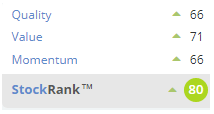
Last week’s interim results have clearly had a positive effect. The ValueRank of 71 is reassuring. When broken down it contains some attractive ratios, in my opinion:
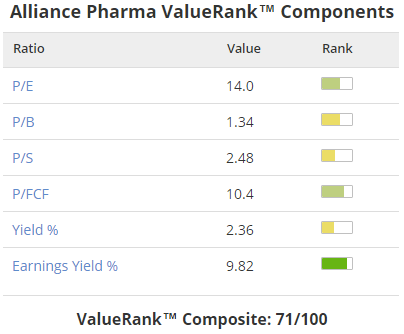
The highlights for me are the price/free cash flow ratio of 10.4 and the earnings yield of 9.8%. Let’s take a quick look at each.
Free cash flow: Trailing free cash flow shows up as 5.1p per share in Stockopedia, which is slightly above my own estimate of 4.5p per share. It’s worth noting that if you calculate values such as FCF yourself from companies’ published accounts, you’ll usually get a figure that’s slightly different to the Thomson Reuters data used by Stockopedia. The reason for this is simply that the Stockopedia financial data is processed and normalised by Thomson Reuters, so that it’s consistent across companies. Actual errors are fairly rare.
In this case, I’d be more comfortable assigning the stock a P/FCF of about 12, which is still attractive in my view.
Earnings yield (EBIT/EV): I like this metric because it combines valuation and profitability. So companies with differing levels of profitability and valuation can be meaningfully compared.
Alliance Pharma’s earnings yield of 9.8% implies that the company is only valued at around 10 times operating profit, including debt. That’s attractive, in my opinion.
Although the dividend yield of 2.4% is fairly low, the payout has grown by an average of 10% per year since 2011. At present, I’m happy to see free cash flow focused on debt reduction as well as dividends.
Acquisitions have hit quality
When Graham Neary reviewed this stock back in March, he raised a potential concern about debt levels. I agreed with his view that net debt of 2.8x EBITDA didn’t seem to leave much headroom below the group’s banking covenant of 3.0x.
However, the company’s confidence in its future cash flow seems to have been validated. Net debt to EBITDA has fallen to 2.4x during the first half of the year. In real numbers, this equates to a reduction of £12.7m in net debt to £63.4m.
That’s roughly 3.9 times forecast net profit for 2017. Although this is close to my screening limit of four times net profit, it is still acceptable, especially as management guidance is for net debt to fall “to around 2.0 times [EBITDA] by the end of the year”.
Looking elsewhere at the quality factors, there are no obvious problems. A Piotroski fundamental health score (F-Score) of 8/9 highlights profit growth and strong cash generation. The only fail is that the group’s profitability has fallen when measured using return on assets.
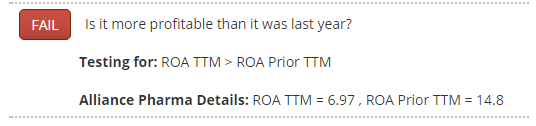
I suspect this is a glitch in the TTM calculations, resulting from the firm’s acquisition activity. Looking at the last eighteen months, the StockReport data shows an improvement in ROA following the interim results:
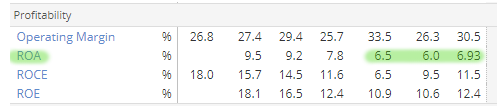
This table also provides a useful illustration of how a company’s margins can diverge from its return on capital employed (ROCE). Although Alliance’s operating margin has been stable at an average of 28% since 2011, ROCE has performed much more poorly.
This can be a characteristic of acquisitive groups. The price paid in an acquisition of this kind is meant to reflect the present value of future earnings. So balance sheet assets often increase much more quickly than profits following acquisitions.
Alliance Pharma’s total assets increased from £107.9m in 2014 to £282.6m in 2015 after the Sinclair acquisition. The ROCE generated by these assets should improve as profits rise and the assets are depreciated. ROCE has already returned to its pre-acquisition level of 11.5%, from a 2015 low of 6.5%.
Strong technical momentum
I’m comfortable with the value and quality offered by Alliance Pharma shares. But without a dose of momentum, the opportunity cost of tying up the portfolio’s cash might not be worthwhile.
Fortunately, the momentum picture looks broadly positive. Although the firm’s last results were apparently slightly below expectations, price momentum looks strong. A number of technical factors appear to support the case for further gains:
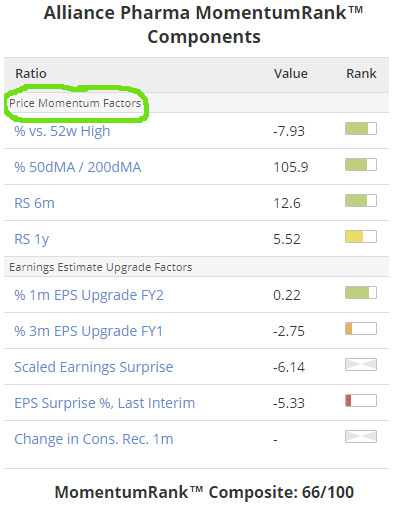
Overall, I’m comfortable with the outlook here. The group’s short-term profits may continue to fluctuate slightly due to acquisitions and other one-off costs. However, I think the firm’s focus on niche prescription medicines should mean that underlying revenue is very stable.
Financial quality is visibly improving as the Sinclair acquisition beds in, and the shares looks reasonable value to me, on a blended forecast P/E of 12.
I will be adding the stock to the SIF portfolio this week, but as always please let me know what you think.
Disclaimer
This is not financial advice. Our content is intended to be used and must be used for information and education purposes only. Please read our disclaimer and terms and conditions to understand our obligations.

10 comments
Roland
Thank you for the great write up as always. My real concern with alliance is that sales growth cannot really come from anywhere. I see it that they have 2 streams
1. The whole sale of medications to pharmacies which growth is limited
2. Their own portfolio of medications that they have bought.
Speaking to family members that write prescriptions they say that their portfolio is very 'niche' and they one the whole do not write up these medications it mainly people that are on them historically.
There is an issue where as there is limited competition from other generic manufactures they can essentially charge what they like. (See Pfizer selling phenytoin to Flynn pharm) though this generates good revenue I don't believe that it can be sustained in the face of mounting public pressure.
With wholesale they do have some lines that are only sold through them though a shift to AAH or waymade or another wholesaler could easily happen as the moat for this side of the business is not huge.
Though I am fully prepared to be proven wrong and do hope the price continues to rise
Hi fishmonkey,
Thanks for your comment. It's interesting to hear views on Alliance Pharma (LON:APH) from people who actually prescribe its products.
The flipside of 'niche' is 'limited growth', clearly that's a risk here. I suppose that explains the company's long-running focus on growth through acquisitions -- organic growth potential may be limited.
Having said that, the company does seem to have a few branded products with growth potential, based on comments in the interims. Although perhaps these only account for a minority of sales and/or profits. For example:
Sales of Kelo-cote, our scar reduction product, increased by 52% to reach £6.2m (H1 2016: £4.1m) across its markets. MacuShield, for age-related macular degeneration, also performed well, seeing a 67% increase in revenues to £3.4m (H1 2016: £2.0m). This has been driven by a combination of distribution gains in new territories and growth in the rates of sale in existing outlets, stimulated by our increased marketing investment.
It will be interesting to see how this one turns out. The firm's long experience and restricted focus gives me some confidence, but as you say, pressure seems to be building on companies that exploit monopoly positions to charge unreasonable prices.
Regards,
Roland
Just noticed that StockRank has dropped to 73 (mainly due to poorer momentum score) and no longer rated a SuperStock.
Hi finebone,
Thanks for pointing this out. Although it's been a week since the Alliance Pharma (LON:APH) interims were published, it often takes longer for new broker estimates to feed through for smaller stocks. That might be the reason for the drop.
I'm still comfortable with adding the stock to the SIF portfolio, though.
Regards, Roland
Great write up - many thanks.
One key aspect not mentioned here and pretty critical to smallcap investing is quality of the management. Although I have only met John Dawson once personally, I have seen him interviewed on a number of occasions and he always comes across exceedingly well. No hype and very balanced. Although he has sold some shares recently he remains a large shareholder and feel investors can sleep soundly under his stewardship.
Roland
I think it looks like a good selection. I'm definitely going to learn more about it.
Nice write up as always, many thanks.
Regards
Howard
Interesting, but do you have any concerns about the fact that Stockopedia reports the Earnings Manipulation Risk as "High"?
Hi finebone,
Thanks for flagging this up. With metrics such as the the Earnings Manipulation Risk, I think it's always worth digging down to see what's causing the low/high score.
In this case, there are three factors on which the M-Score test is failing:
- Is sales growth excessive?
- Is the rate of depreciation stable or increasing?
- Are sales, general and administrative expenses under control?
I'm fairly confident that the main factor behind these 'fails' is the acquisition of the Sinclair Pharma assets, which caused sales to double in 2016. This deal will also have triggered a corresponding increase in depreciation costs and SG&A expenses.
Because the risk scores are calculated by comparing the current TTM period with the prior TTM period, these increases are still being seen in the comparative figures, even though the acquisition took place in late 2015:
Current period: 1 July 2016 - 30 June 2017
Prior period: 1 July 2015 - 30 June 2016
If I'm right, the Earnings Manipulation Risk score should fall to low after the group's 2017 FY results are published.
Regards,
Roland
Hi Finebone
I am not too concerned about the earnings manipulation risk because the Free cash flow figure was very good on the latest TTM stage. It's a lot harder to manipulate cash figures than it is to manipulate profit figures.
Hi Roland. I agree with you and bought some following the recent results. One thing that I like about the company is that it is a bit more predictable than most drug companies because it is not spending on R & D, and we don't have to gamble on the unpredictable outcomes of clinical trials.