SIF Portfolio: Has breaking the rules cost me 24%?

My decision last week to venture into the Russian stock market triggered quite a lot of debate. You can check out that article here if you missed it.
It’s too early to say how things will turn out with last week’s stock, RusHydro. But what I can tell you about is the impact some of my previous decisions have had on returns from the Stock in Focus Portfolio.
I’ve been through my records and put together a list of stocks which have qualified for the SIF screen since last April, but which I’ve chosen not to buy or sold prematurely.
In other words, this is a list of companies where I’ve ignored my rules for stock selection and made a subjective choice. I’ve included my estimate of the share price gain or loss I have missed by not sticking strictly to my rules. The date is linked to the original article on each stock:
| Company | Date considered | What have I missed? |
| XLMedia* | 25 May 2016 | +31% |
| International Consolidated Airline Group | 22 June 2016 | -12% |
| Fulcrum Utility Services | 17 August 2016 | +67% |
| Plus500** | 7 December 2016 | +10% |
| Average per stock = +24% |
*I rejected XLMedia the first time, but have subsequently added it. 31% represents the difference between the profit I would have made, and the current running profit on my position.
**Plus500 was in the portfolio. I sold it ahead of schedule in December, when CFD shares crashed after the UK regulatory announced plans to limit leverage for retail customers. The shares have risen by 10% from my sale price.
These figures aren’t exact, but I think it’s pretty clear that the portfolio would be worth more if I’d obeyed my own rules blindly, rather than allowing an element of discretion.
This humbling set of figures is one of the reasons for my change of stance last week. Although the portfolio hasn’t been running long enough to be certain, the evidence so far seems to be in favour of a hands-off approach to stock selection.
So far, my manual interventions have cost the portfolio money!
The joker in the pack
There are a couple of stocks I haven’t mentioned so far. One of them is RusHydro, which I added to the portfolio last week. This stock qualified for the screen for a quite a while before I added it. During this time, the shares rose.
The stock I’m considering this week is a genuine dilemma. Russian banking group TCS Holding operates the Tinkoff online banking brand in Russia.

Outside Russia, Tinkoff and its colourful founder, chairman Oleg Tinkov, are probably best known for being the title sponsor (until last year) of a top professional cycling team.
Like RusHydro, TCS shares are listed as GDRs (Global Depositary Receipts) on the London Stock Exchange and priced in dollars. I’m not an expert on this, but my understanding is that stocks priced in foreign currencies can’t be held in ISAs. However, they can be held in most other types of UK share account. You can find out more about TCS Holding’s London listing on the LSE website.
TCS shares have risen by 345% over the last year and have a StockRank of 95. The group qualifies for my screen and would seem very attractive if it was a UK company.
What does concern me is that the diversification benefits aren’t as great as they were with RusHydro last week. I already have two financial stocks in the SIF Portfolio. Miton Group is a fund manager, while pawnbroking group H&T also offers loans.
Is TCS Holding -- which is registered in Cyprus and operates in Russia -- worth the risk?
What are the attractions?
The SIF Portfolio isn’t overweight with financial stocks, so I’m not going to rule out TCS straight away. Let’s take a closer look at the latest figures from the bank and its Stockopedia rankings.
The latest IFRS accounts available cover the first nine months of 2016. They are fairly dramatic:
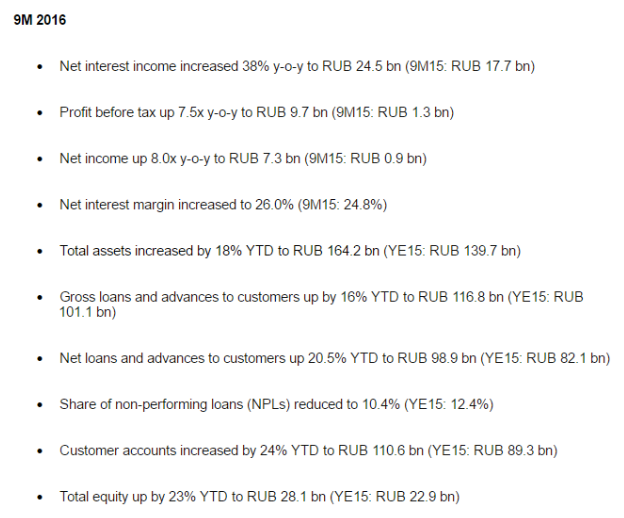
A net interest margin of 26% is impressive. By way of comparison, challenger bank OneSavings Bank has a net interest margin of 3.07%.
It’s clear from the rate of customer account and net lending growth that expansion is taking place very fast indeed. That’s a potential worry, but one explanation may be that the Russian domestic market for credit card lending and savings is much less mature than in Western Europe. This lack of maturity could explain both the rapid growth and the relatively high level of non-performing loans.
A further difference is that Russian interest rates are much higher than those in Western Europe or the USA. As I write, Tinkoff’s website appears to be offering a savings account with an 8% interest rate. It looks like the key rate set by the Russian Central Bank is currently 10%.
Beyond these fairly obvious points, I don’t have much insight into how or why TCS Holding’s pre-tax profits rose by 650% to RUB 9.7bn during the first half of last year. Adding this stock to the SIF portfolio really would be something of a leap in the dark.
What do the Ranks say?
As I write, TCS Holding is the top-ranked UK banking stock listed on Stockopedia, with a StockRank of 95.
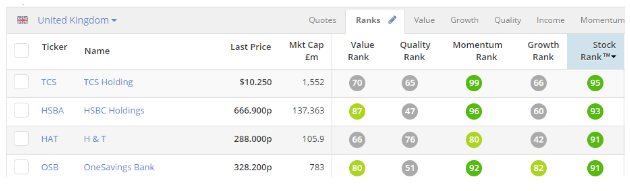
Looking at the Value and Quality ranks in more detail, I can’t see any major problems. You can do this for yourself by going to the sector page and then clicking on any of the rank numbers. This will bring up a breakdown of the components which make up that rank, such as this:
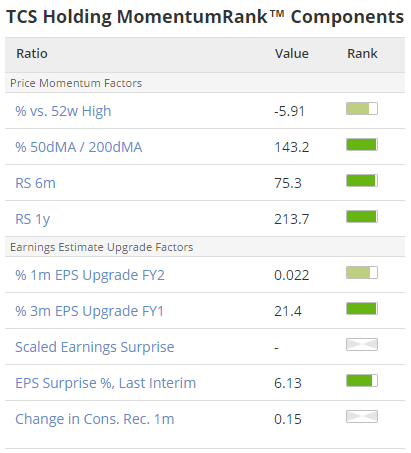
TCS Holding’s ValueRank (70) and QualityRank (65) are acceptable, but the group’s MomentumRank of 99 (above) is clearly the driving force behind the group’s high StockRank, and perhaps its share price.
TCS is covered by analysts from nine Russian banks, who have increased their 2016 earnings forecasts by 156% over the last twelve months:
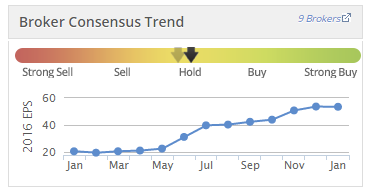
The stock currently trades on a 2016 forecast P/E of 11.5, falling to a P/E of 9.4 for 2017. The dividend yield for 2016 is expected to be 2.9%, rising to 3.3% in 2017.
It’s worth noting that unlike a conventional UK bank, asset backing is limited. TCS trades on a price/book ratio of 4.0, implying that the bank’s valuation is dependent on it maintaining a very high level of profitability.
Should I add TCS Holding to the SIF Portfolio?
The idea of buying this stock would make me uncomfortable. But the purpose of the SIF portfolio is to test what’s possible. From a rules-based perspective, I can’t see any reason not to buy. So I will add TCS to the portfolio this week.
I should add that I don’t expect to add any more Russian stocks to the portfolio for some time. I’ve no desire to skew the portfolio too far towards any geography or sector.
Disclaimer
This is not financial advice. Our content is intended to be used and must be used for information and education purposes only. Please read our disclaimer and terms and conditions to understand our obligations.

21 comments
Roland - to be clear, are you actually investing your own money like this?
With my own money, I would not invest in Russia until Sergei Magnitsky's killers have been put on trial, the FSB has been reformed and Bill Browder is warmly welcomed back. That's an ethical thing...but I think over the long term ethics make you money. Eg. look at the non conformists and Quakers.
My single largest holding is BGEO (LON:BGEO) so I'm not scared of places where they have funny handwriting. But there are some places where you can't trust the business culture, where fraud is deeply embedded in the society, where many criminals are actually in positions of authority in the Government.
Those countries are where stockopedia's algo's have a weakness, and some simple heuristics will do much better over the long term than blindly following the algos.
Hi Bruce,
Just to be clear: The SIF Portfolio is a virtual portfolio and does not reflect my personal stock holdings.
The goal of the SIF portfolio is to try and develop a rules-based approach to stock selection that delivers satisfactory returns (i.e. ahead of the wider market).
One of the areas I'm keen to understand better is how much weight to place on subjective concerns about corruption/earnings quality. I do share some of your concerns about investing in Russia. But I'm starting to wonder if it's no longer fair to tar all Russian stocks with the same brush, especially those that are keen to attract Western institutional investors.
Regards,
Roland
Roland
During your analysis did you examine the level of low interest foreign currency liabilities Tinkoff holds and the concentration of its loan / investment assets? Don't forget 1998!
To clarify on foreign stocks.
"stocks priced in foreign currencies can’t be held in ISAs."
The rules allow one to hold stocks listed on any recognized market in an ISA. I have at one time or another held European, US and Canadian stocks in my ISA which were not London listed. What you can hold is in practice determined by which markets your broker / ISA provider trades in. However as far as I know ISAs can only be held in sterling, so capita transactions, dividends and cash have to be exchanged into sterling.
Ardipithecus,
Thanks for the clarification.
Roland
Roland, all really interesting stuff.
Last year, I ran a fantasy portfolio of Stacks picked randomly across all sectors with a stockrank over 90. It performed as well (but no better) than my real self-run discretionary portfolio.
This year I have dipped a toe in the water by running a real portfolio where buying is discretionary but I am not allowed to buy a stock UNLESS its stockrank is 90 or more. I then hold for 6 months and thereafter until the stockrank falls below 90 - unless my original investment rationale changes.
In this way I am trying to inject a bit more discipline into my decisions.
Will let you know how I get on.
Roland
Once again, thank you for an extremely interesting article and particularly for the really interesting posts which your work has generated from the other readers (above).
I find your documented journey very informative and these post-mortems of particular value.
Regards
Howard
Hi Roland.
Interesting and thought provoking follow up. As others have commented, always good to be self critical and try and determine what a better outcome might have been and how to set about achieving it in the future.
While factor based lending does seem to offer superior returns over a widely spread portfolio, I can see why it is difficult to ignore subjective considerations when you have a relatively small portfolio and look to analyse beyond the headline traffic light ranking scores. This is especially true where the rankings appear to suggest the best shares to buy have some "hair" attached.
With a more diversified portfolio of say 200 stocks picked solely on the basis of their high rankings, I suspect it would be easier to bite the bullet and invest in apparently "dodgy" shares safe in the knowledge that even if one or two go bad, the severity of the individual loss is not too bad and the expectation that the home runs will more than compensate for this. Using tournesol's analogy in the above post of Russian Roulette, if the consequence of finding the chamber with the bullet in is a headache rather than termination, it becomes easier to play the percentages and go all in with a "warts and all" factor based approach.
The follow up question then would be how often is it necessary to re-balance the portfolio to adapt to changing rankings and how far do the associated transaction charges eat in to the expected superior returns?
Best,
Gus
Hi Roland,
You say you won't be adding any more Russian stocks to the portfolio. I'm not disagreeing, but do you have a rule that stops this or is this your judgement at work again?
When you next review your rules do you need to add one that defines the allowable split between say U.K., developed overseas markets and emerging markets?
For a rules based approach I think you need to work on improving the rules and not second guessing the outcomes. So you write the programming and execute the results. If you don't like the results then change the programme but don't inject your judgement on each result - otherwise it's not really rule based
Hi John,
Good point, I could see I was opening myself up to suggestions of inconsistency with that final remark!
The rules of the screen don't require me to add every single eligible stock. For example, I wouldn't add three banks. So any Russian stocks qualifying for the screen in the near future would have to really justify its selection in terms of diversification, for me to accept it.
Diversification is something that is quantifiable, so I'm hoping it won't be a question of judgement, but of numbers.
A second consideration is that the portfolio is mainly intended to focus on UK-listed companies. I think that GDRs for Russian-listed stocks are stretching that definition slightly.
Regards,
Roland
PS
I have had a number of experiences where I have invested without fully appreciating the risks and without realising the random nature of the outcomes. I can cite an uncomfortably large number of experiences where my investment "genius" led me to invest in amazingly successful companies which delivered life changing returns which I misattributed to good decision making on my part. In a painful number of these the life changing profits flipped into losses which took away all the gains and in some cases most or all of the original stake. I came to the uncomfortable realisation that both the gains and the losses resulted from poor decision making on my part. I could not take credit for the gains and offload blame for the losses. Both outcomes were down to me.
I resolved to place risk management at the centre of my investment activity rather than at its periphery. I can't say I've succeeded but I'm trying.
HI tournesol,
Honestly, I couldn't agree more. I believe we have possibly been reading the same books :) It's important to differentiate blind luck from skill. Lookng back, in the past 12 months it seemed a bit too easy to make money from stock market investments and I am wary lest I start believing I have suddenly turned into some kind of stock picking genius. I have not. These days I keep a copy of the James Montier book next to the bed and read the odd chapter on a regular basis.
All the best, Si
tournesol,
Absolutely. It's very easy to claim with hindsight that a speculative punt was a far-sighted investment. We've all done it, I suspect.
I'm also trying to gain a better understanding of risk in my investment activities this year, but it's tough to be sure that you're succeeding.
Regards,
Roland
Roland
Bravo. I really appreciate and value that you are reviewing your investment decisions with a dispassionate, critical and objective eye. Many (possibly most) of those who post comments on the internet or who publish blogs display a complete lack of critical thinking where their performance is concerned and big up their successes whilst forgetting their unsuccesses. If one is to improve in the field of investment or any other, it is always necessary to consider what could be improved. Well done. I will follow your blog in future.
That being said, it is, IMHO, not enough to look at the outcome which was achieved, one also needs to consider the risks. if someone offers you a million dollars to play Russian roulette with a revolver loaded with one bullet and five blanks, then the odds of success (ie not dying) are 5/6 and the odds of failing (and dying) are only 1/6. So we might expect to hear from many previous players that they succeeded and made a million. IT DOES NOT MEAN THAT THEY WERE RIGHT TO TAKE THE RISK. AND IT DOES NOT MEAN THAT WE SHOULD TAKE THE RISK OURSELVES.
It is relatively easy to analyse the risks involved in playing Russian roulette. It is much harder to get our heads around the risks of investing in company X. That does not mean to say that we should judge the success or failure of our decision only by looking at the investment outcome any more than we can judge the roulette player's decision by reference to the million dollars he makes by playing or the million dollars he loses by refusing to play. The magnitude of the risk exposure is the value of our investment - what we would lose if it blew up. That is different from the profit we made or did not make.
Thanks Roland, interesting to analyse the effects of your decisions as against running the rules blind.
I don't think the results are that humbling as its too early to tell whether your own decision making is definitely negative in terms of its impact on performance. If you looked again in a year's time the result might look very different.
It would also be interesting longer term to analyse the results of changing the portfolio as against not changing it - say from the point it is (was?) fully stocked for two or three years without changes, as compared to changing in accordance with the rules. If you have the stomach to run the experiment for that long ...!
I also have seen Carnival (LON:CCL) on your screen which was not added, not sure when it first appeared, so don't know how it would have performed. I think if you have a rules based system you should stick to it, otherwise there is no consistency. Did ED not write an article about rules based system outperforming human influenced ones? Some of your other sales have also gone up such as Go-Ahead (LON:GOG), Macfarlane (LON:MACF), Persimmon (LON:PSN) and Somero Enterprises Inc (LON:SOM). Those 4 stocks have not cost you 24% that is only on those 4, it's not over the whole portfolio. I think you need to look at is how have the ones you have bought to replace the sold ones performed. You will always have that situation, noone can time it perfectly all the time. My opinion is you are buying too late and selling too early. At the moment you fund is only the same as the FTSE All Share and thats even with the Avesco (LON:AVS) takeover.
Hi herbie47,
Carnival (LON:CCL) has been a close-run thing, but I've not written about it and rejected it on a specific date before. I don't have the facility to look at historic screen results so I'm not able to pinpoint a date where I considered the stock and then rejected it.
As for the issue of timing my entry and exit points, these are dictated by the screening rules and my six-month review period. In some cases so far you're right -- I've been too late and too early. But the portfolio has been running less than a year so far.
When I reach the anniversary date in April, I will consider whether to tweak the rules for both buying and selling, but I'm going to give it a full year before doing this.
Regards,
Roland
Hi Roland
I really enjoy your SIF column. I have not yet read the whole of this one but will do later. However there is an interesting post by Dan Egan of Betterment at
http://www.dpegan.com/better-decisions-through-blindness/
Entitled "Better Decisions through Blindness" and he is also on a recent Podcast with Patrick O'Shaunessy Invest like the Best.
Regards
Michael
Hi Michael,
Thanks for your comment. Selective blindness is an interesting idea. It's certainly relevant to investment, in my view.
For example, not knowing the running loss/profit on a stock holding might make it much easier to objectively decide whether to sell it or buy more.
Regards,
Roland
Roland this is an interesting discussion point - I am currently carrying out a similar exercise myself, examining my sale and purchase decisions discretely. However I have evaluated these decisions based on each asset's performance versus my chosen benchmark - i.e. would adding this stock to my portfolio at the time helped me or hindered me in beating my benchmark. For example investing in XLMedia in May instead of say the FTSE All share (if that was your chosen benchmark) is only a 16% out performance but you saved yourself 27% by avoiding IAG. What I have discovered in my own analysis is while on average the stocks I have sold have outperformed by 5% what they were reinvested into outperformed by significantly more.
ls2g08,
Thanks for your comment. In my case I haven't yet reached the point where the portfolio has ever been fully invested, so the argument about returns from reinvestment doesn't apply. But it's certainly valid and is a consideration I often face in my own portfolio.
Regards, Roland