SIF Portfolio: Jim Slater's tip expands my screen results

One of the comments on my article last week made me reconsider the merits of relaxing the screen during bull markets. Apparently this is something the late Jim Slater was known to do:

I really appreciate all of your comments each week. They always force me to double-check my arguments, which is invaluable.
John’s comment aligned with my own thinking that it might make sense to relax valuation criteria slightly during bull markets. The logic behind this change is fairly obvious. The returns from investing in quality stocks at a higher valuation might still be greater than those available from cash. By focusing on quality, downside risk should be mitigated.
I’ve not found a reference to this approach in my copy of The Zulu Principle, although I may have missed it. But I have found an exchange of letters on this topic between Jim Slater and Algy Hall, who writes about stock screening for Investors Chronicle.
You can find the letters here on Jim Slater’s official website, but these are the relevant highlights:
Jim Slater: “… The probable reason for this is that, in these difficult markets with very low interest rates and high valuations, it is necessary to stretch the price-earnings to growth (PEG) limit to about 1.3 and, in that way, avoid losing some of the best shares. …”
Algy Hall: “… rising market-wide valuations have caused you to adapt a method you have laid out in your excellent book, The Zulu Principle, by focusing more heavily on your ‘quality’ criteria and relaxing your ‘valuation’ requirement …”
The context to the discussion is that Hall’s IC screen is underperforming Slater’s Telegraph portfolio and contains a different selection of stocks. It turns out that Jim Slater has relaxed his valuation criteria, whereas Algy Hall has decided to relax the criteria for quality.
My own Stock in Focus screen is suffering from a record shortage of shares this week. Only three companies qualify at the time of writing, all of which are already in the SIF Portfolio. So I’ve decided to experiment. What choices would be available to me if I followed Jim Slater’s example and put quality ahead of value?
I wouldn’t change much
In last week’s article, I highlighted the four core factors which control my screen results:
- Earnings yield (EBIT/EV) = Value
- Piotroski F-Score = Quality
- Low PEG ratio = Affordable growth
- 1-year relative strength = Momentum
The first criteria I’d relax would be earnings yield. I consider this to be a pure valuation measure. It doesn’t reflect on the rate of earnings growth, quality, or momentum. It’s a representation of the pre-tax/capital-neutral yield available from the business (EBIT/EV). For a business owner, I see EBIT/EV as loosely equivalent to total return for an equity investor.
My screen specifies a minimum earnings yield of 8%. I chose this because it’s (roughly) the long-term average total return from the UK stock market before inflation.
The PEG ratio is also a valuation measure, but I see it more as a hybrid of growth and valuation. I wouldn’t want to relax this too much, but would increase it slightly in line with Jim Slater’s comments in the letter above.
Here’s what I’ll change:
- Earnings yield: reduce from 8% to 6%
- Rolling PEG ratio: increase from 1.2 to 1.3
Encouraging results
The changes above yield encouraging results. Three new stocks appear in the screen results:
- Severfield
- H&T
- Fulcrum Utility Services
What’s interesting is that two of these stocks are already known to us, as the police might say.
H&T
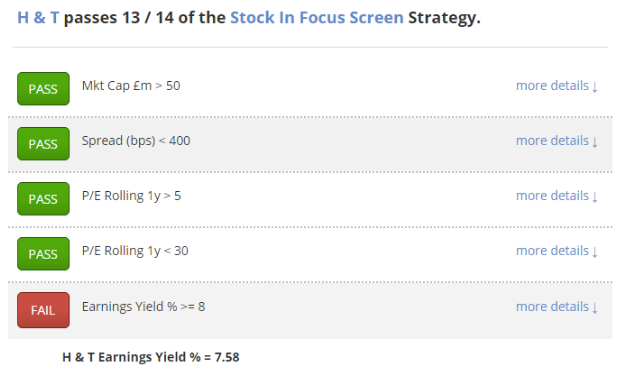
Pawnbroker and short-term loan firm H&T is already in the portfolio. It’s risen by 11.6% since joining the portfolio in September. Reassuringly the stock still qualifies for my original screen on all counts, except that its earnings yield has fallen to 7.6%.
Here’s a screenshot from Stockopedia’s excellent Checklist tool:
Fulcrum Utility Services
Utility services provider Fulcrum is one of my missed opportunities. I considered the stock on 17 August 2016 and decided not to add it to the portfolio. I wasn’t keen on the group’s focus on construction activities and was unsure about aspects of its balance sheet.
However, this display of independent thought has deprived the SIF portfolio of a 69% return to date. Ouch.
Like H&T, Fulcrum also still comes close to qualifying for the SIF screen, only falling short with an earnings yield of 6.4% and a rolling PEG ratio of 1.27.
Severfield
Structural steelwork group Severfield is the only one of these stocks that’s new to the SIF screen.
The firm has recovered strongly from a major slump in 2012/13 and is currently trading well. The shares have climbed 39% over the last year and Stockopedia also likes the stock, which has a StockRank of 95.
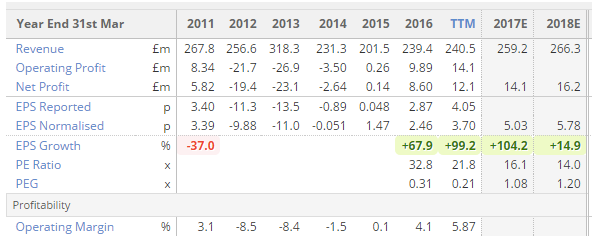
Severfield’s rolling PEG ratio of 0.8 is comfortably beneath my 1.2 maximum. It’s only the firm’s earnings yield of 6.5% that’s stopped it appearing in the screen. Should this be a concern?
The group’s net cash balance has risen from £6m in March 2015 to £24m at the end of September 2016. Severfield’s operating margin has also recovered strongly, rising to 4.1% in 2015/16 and reaching 7% during the first half of the firm’s current financial year.
I suspect only the strong performance of the group’s shares have stopped it making an appearance in the portfolio. My only concern is that most of the upside may now be in the price. However, management said in September that the firm had the “strongest order book for over six years”, with a “very good” outlook. Revenue, profits and return on capital are all expected to rise this year.
While this is obviously a cyclical business, I think I’d be happy to add Severfield to the portfolio of it did qualify for my screen.
My decision!
I’ve now been unable to add a new stock to the portfolio for three weeks. As the portfolio remains 37% in cash and below my target size of 15-20 holdings, I’m going to change the rules. I want to put more of the portfolio’s cash to work.
If the standard SIF screen doesn’t provide a suitable stock for the portfolio for four consecutive weeks, I’ll temporarily relax the rules as I’ve described above. If any additional stocks qualify for the screen, I’ll considering adding one of them to the portfolio in the usual way.
This won’t be a permanent relaxation. Any stocks which qualify for the full set of rules will always have priority. Although this is a reversal of my previous commitment to run the portfolio without changes for a year, I think it can be justified. I’m sure that like me, you want to find new stocks worth considering in the current market!
My tin hat is now on. I look forward to hearing what you think in the comments below.
Disclaimer
This is not financial advice. Our content is intended to be used and must be used for information and education purposes only. Please read our disclaimer and terms and conditions to understand our obligations.

9 comments
Hi Roland,
I hope you don't mind but I've just been playing with the SIF screen. It's surprising how some of my current holdings don't qualify based on one rule e.g. Walker Greenbank (LON:WGB) To get more companies through the screen IMHO it would be better to shorten the Relative Strength period to 3 or 6 months rather than compromise on quality or value. Just an idea, but having experimented it does throw up some credible SIF candidates.
All the best, Si
I agree with simoan - relative strength would be an obvious candidate to consider relaxing, particularly as a lot of relative strengths have been affected by a large external event of unknown outcome (Brexit) rather than the earning statements from the companies themselves. Go-Ahead (LON:GOG) comes to mind as one I think you ejected from the SIF portfolio due to the relative strength requirement just as I was buying it on the grounds it was now very good value.
Indeed, I'd really like to have kept Go-Ahead (LON:GOG) in the portfolio.
Although I have to beware of the temptation to change the rules to suit my own stock choices. That's not the point at all!
Hi Si,
Thanks for your comment -- by all means play with the screen, I'm sure it can be improved on!.
The RS rule has been frustrating at times over the last year, especially after the referendum when it prevented me adding a number of credible stocks to the portfolio (because their share prices had slumped).
A shorter RS period is one of the items on my review list for the end of the year.
Regards,
Roland
Hi Roland,
I certainly wasn't trying to improve it! But you asked the question about your criteria so thought I'd look in a bit more detail. I haven't been a big user of screens in the past, so I'm quite interested in what other people use them for and the SIF screen seems to be set up to find the type of GARP shares I normally invest in which makes it of particular interest.
I continued playing around with the rules last night and quite like the idea of using both 3 and 6 month RS as a measure of momentum i.e. RS 3m > 0 AND RS 6m > 0.
All the best, Si
Well done on tracking down the source of the comment I remembered! I read the correspondence in Algy Hall's column in the IC.
Algy himself noted that when he relaxed the quality criteria Globo qualified - a clear example as to why that change in approach was an error.
http://www.investorschronicle.co.uk/2015/12/17/sha...
Thanks for the suggestion John!
Intuitively it seems more attractive to relax on value than quality. We'll have to see whether the results back up this approach...
Roland
I'm horribly biased but Severfield (LON:SFR) is my 3rd largest holding as it is in a real sweet spot at the moment,
1 they're the market leader in their sector
2 they're growing margins fast, in part by increasing the "engineered" aspect of their steelwork
3 they're growing their order bank much faster than their turnover so storing up momentum
4 they've been accumulating cash fast
5 most competitors have weak balance sheets and mgrs. of big projects assess counterparty risk constantly
6 their end markets are buoyant for now..
So I'd say go for it !
Rhomboid
I like Severfield too. My Buy in notes for January:
Newish competent CEO spearheading efficiency drive and employee share scheme. Recovery stock with stretching 2020 target to double profit. Ahead of expectations and earnings beat. Order book (+17%) and margin increasing. Increased Divi. Recent broker upgrades. QM 95 and SR 95. 52 Week High. No net debt. Ironically uncertainty over Britexit and currency weakness could reduce European completion in UK and make it easier to export. On a roll.
I hold Fulcrum too for different reasons though than its PEG and H and T look like a reasonable punt. Please though DYOR Ian