SIF portfolio: Revisiting Fulcrum Utility Services one year on

Almost exactly one year ago, I decided against adding infrastructure services group Fulcrum Utility Services to the SIF portfolio.
Since then, I’ve learned a few lessons about letting my opinions take priority over the numbers. Most of the time, it’s cost the portfolio money. For example, anyone buying Fulcrum in August last year, when it qualified for my screen, would have made a 69% profit in six months.
This sort of thing has happened nearly every time I’ve decided to overrule my screening results and reject a stock that qualifies for the portfolio. So I’ve become much more reluctant to do this. I’m mentioning this today because after disappearing from my screen for most of the last year, Fulcrum is back!
The company seems to have performed well over the last 12 months, but the shares have pulled back from the 52-week high of 67p seen in February. The stock is now worth just 53p per share.
Today, I’m going to review Fulcrum’s financials and StockRank data. Should I grasp this new opportunity to add this stock to the portfolio?
Defensive or not?
Fulcrum’s attraction is that it trades in the Utilities sector, so it qualifies as a defensive business. The SIF portfolio has always been underweight defensive stocks, so I’m always keen to add one when I get an opportunity.
The catch is that Fulcrum isn’t defensive in the way that a normal utility might be. The firm installs gas and electric infrastructure for developers. For example, it might handle the connection to the grid and the build out of pipes and metering for a new development. This side of the business is clearly in the cyclical construction sector.
Where Fulcrum does start to look defensive is through its Fulcrum Pipelines business, which is a licensed gas transporter. This part of the group owns and operates many of the gas pipes and meter assets installed by Fulcrum, generating a recurring income. And although gas transportation only generated £695k of the group’s £5.8m operating profit last year, this revenue stream is high margin and is growing fast:
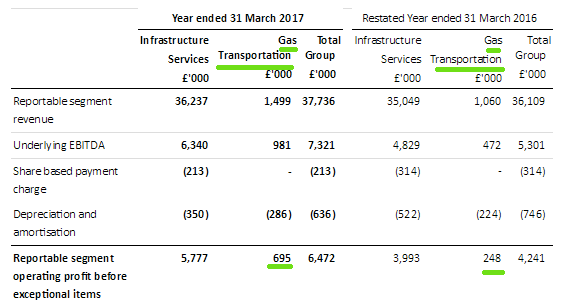
In 2015/16, gas transportation generated an operating profit of £248k at a margin of 23%.
In 2016/17, gas transportation generated £695k (+180%) of operating profit at a margin of 46%.
If Fulcrum can continue to lock in this kind of high margin recurring revenue, I believe it could become quite a valuable business.
What do the numbers say?
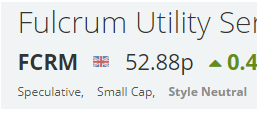
At the time of writing, Fulcrum Utility Services has a StockRank of 69. That’s not the lowest in the portfolio, but it’s below average.
However, it’s not low enough to suggest that Fulcrum could be one of the losing styles identified by the StockRank Styles algorithm. Stockopedia currently rates this share as a ‘Neutral’ stock, which is okay with me:
More importantly, Fulcrum passes all 14 of my stock screening rules, which use fundamental ratios to measure value, growth, financial strength and momentum. So I’m comfortable with a potential investment in this stock -- remember this year, I’m investing some of my own cash in all SIF portfolio picks.
Turning positive on value
A ValueRank of 53 isn’t very inspiring. But this stock scores quite highly in the areas on which my screen focuses (underlined in green):
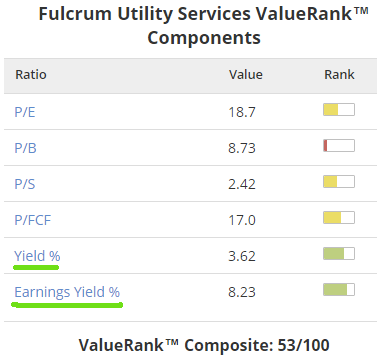
A trailing yield of 3.6% isn’t bad for a small cap. The earnings yield of 8.2% is above my threshold of 8% and suggests to me that the business is reasonably valued relative to its earning power.
One point worth noting is that net cash has risen from £1.2m in 2013, to £12.6m at the end of last year. That’s an encouraging trend, in my view, even though the average net cash/debt position during the year may be less favourable.
Similarly, although asset backing for the stock remains minimal, the price/book ratio has fallen from 10.1 in August 2016 to 8.7 today. Perhaps this trend reflects the growing asset base which generates the firm’s recurring revenues?
Last year, I said the picture was broadly neutral in terms of value. Today, I’d lean towards a slightly more positive view.
Improving quality
Fulcrum’s improving profitability is probably why the stock’s QualityRank has risen from 34 in August 2016 to a far more impressive score of 80 today. Comparing the two QualityRank breakdowns shows this quite clearly:
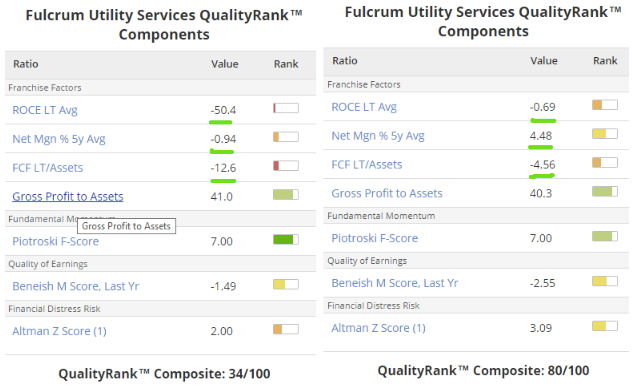
August 2016 (L) & August 2017 (R)
What’s really interesting about this, in my opinion, is that the franchise factors are still relatively weak. This is due to the company’s poor performances prior to 2015.
If we look at the turnaround period of 2015 - 2017, net margin has averaged about 12% and ROCE has averaged 54%. If this performance can be maintained, there seems to be scope for Fulcrum’s profitability and quality scores to increase further.
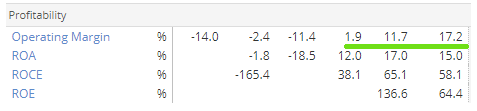
Indeed, it’s worth noting that the group’s operating margin has risen from 1.9% in 2015 to 17.2% last year:
What could go wrong?
The risk here is that almost 90% of Fulcrum’s operating profit still comes from infrastructure build projects. Although the recurring revenue from gas transportation is rising fast, it still only represented 10.7% of operating profit last year.
I hope to see the defensive pipeline side of the business account for a greater share of profits over the next couple of years. But we’re not there yet. A slowdown in the cyclical construction sector would be likely to cause revenue and profit to slump. I’d also expect it to cut short the supply of attractive new pipeline assets from which future recurring revenue might come.
A second point worth noting is that chief executive Martin Donnachie, who has led Fulcrum’s turnaround over the last four years, stood down on 31 July. He’s has handed over to Martin Harrison, the CFO, so there should be good continuity. But Mr Donnachie’s decision to leave might also signify that further progress is likely to be slower.
Rising momentum
As things stand, Fulcrum seems reasonably valued to me, with improving quality metrics. What’s needed for investors is further earnings momentum, and a favourable tailwind from the construction sector.
The stock’s MomentumRank has started to rise recently and is now at 53. Although this isn’t an outstanding score, I’m encouraged by earnings momentum shown by Stockopedia’s broker trend chart, which I find very useful:
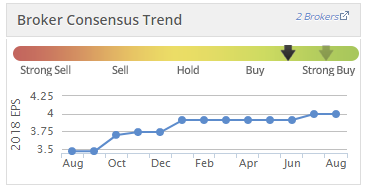
Fulcrum’s share price may have got ahead of itself earlier this year. But the underlying trend of broker forecasts looks supportive of a higher valuation to me.
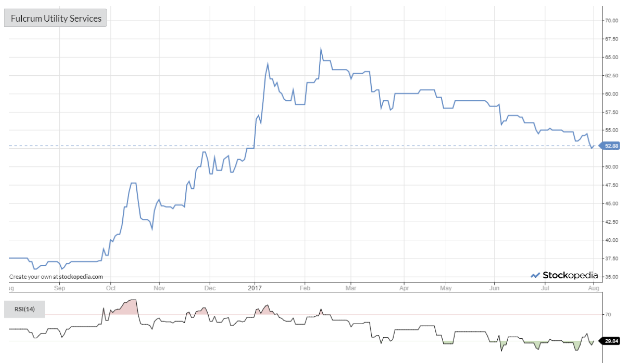
In my view, the decline seen since February could well be a consolidation pattern, rather than a retreat. An oversold RSI reading also seems to support the view that we could soon see a move higher:
My decision
I’m going to bite the bullet and add Fulcrum Utility Services to the SIF portfolio. As usual, I will buy the stock for my own portfolio after this article has been published.
Disclaimer
This is not financial advice. Our content is intended to be used and must be used for information and education purposes only. Please read our disclaimer and terms and conditions to understand our obligations.

14 comments
Sorry to bump up an old thread but I was wondering if anyone has looked at what EPS figure is best to use? I have done a bit of research into Fulcrum Utility Services (LON:FCRM) over the last 48 hours but I am not sure which EPS figure I should be relying on. For example, in its 2017 results it uses:
Basic earnings per share of 3.3p
Underlying earnings per share, before deferred tax 4.1p
Diluted earnings per ordinary share of 2.8p
Diluted earnings per share, before deferred tax 3.5p
I should probably ignore the deferred tax charge so am inclined to use the 3.5p figure, but does anyone know whether some kind of deferred tax charge occurs most years or should occur again in the future? From a quick skim of the 2017 results there wasn't a very clear explanation of why they had to pay it in the 2017 financial year as opposed to a previous one.
As I said I have only skimmed the surface of this company so apologies if the answer is fairly obvious and I have missed it.
Your SIF screen has been a terrific stock-finder Roland. Great job designing it.
As for "letting my opinions take priority over the numbers. Most of the time, it’s cost the portfolio money." Roughly how much better do you think SIF would have done without any human intervention?
Hi shine66,
I did attempt to calculate this back in January, but haven't done so more recently. Hope this is of interest:
http://www.stockopedia.com/content/sif-portfolio-has-breaking-the-rules-cost-me-24-167278/
Regards, Roland
Thanks for that, Roland.
Following the January review, both Plus500 and International did fantastically well, while Fulcrum saw a continued rise through till March before it faded somewhat. That SIF screen seems to know best!
Thanks for the article Roland. I have held Fulcrum for quite a few years so it has been a rollercoaster ride. I have just two points to make. When you discuss what could go wrong, I would specifically mention the potential loss of the British Gas contract (worth about £7.5M in annual revenues) which is due to be renewed at the end of 2017. The other thing that puzzles me is how Fulcrum manages to get such good margins from its pipeline ownership business. My admittedly superficial comparison to National Grid suggests that owning energy transmission assets is not a high profit margin activity and I guess this might be expected as prices are regulated in this area. I do like the fact that Fulcrum is progressing on a number of different fronts and I reckon that some of the technology driven upheavals in the energy sector which some are predicting may benefit Fulcrum as they may well require additional connections to the grid. I have therefore added a few more shares.
Hi Peter,
Interesting points. It's always worth considering a firm's dependency on major contracts.
I'm not sure how many direct rivals Fulcrum Utility Services (LON:FCRM) has in the pipeline ownership business -- if few, then perhaps this is the key to its margins. Or perhaps there's an element of risk or liability we haven't understood...
One other point - I'm not certain without checking, but I'd have thought that what Fulcrum does counts as gas distribution rather than transmission? It may not be regulated in quite the same way.
Regards,
Roland
Hello Roland,
Thanks for responding. I had a quick look at the Fulcrum web site and it appears that gas transportation is the correct term for describing the part of Fucrum's business which creates, owns and uses gas pipelines for transmitting gas. I did a quick bit of research to investigate other smaller company competitors with the gas transporter licences necessary to work in the same area. I only came across a handful and I noticed that these were all private companies which may be a good sign if this means that they do not need to raise much money.
Best regards,
John
Thanks for a good article Roland. I have purchased today at 53p. Here goes!
Fulcrum is one of the NAPS Portfolio picks this year too... it shot out of the blocks but has pulled right back. http://www.stockopedia.com/content/new-year-naps-top-stocks-for-2017-and-how-to-play-the-joker-164443/
Ah yes thanks. I read that report but I didn't join the dots.
Cheers Roland - Hadn't come across this before - Can't see much wrong there - In with a mental 45p Stop, circa 15% from Entry.
very helpful- i hold this stock
How did you get the QualityRank breakdown for August 2016?
Hi David,
I had the screenshot saved from when I wrote my original article on Fulcrum Utility Services (LON:FCRM) last year!
As far as I'm aware, there's no way to access this level of historic detail. But you can see historic StockReports (inc. Ranks) by clicking on the arrowhead next to the 'Print' button near the top of each StockReport page.
Regards,
Roland