SIF portfolio: Should I really buy another housebuilder?

The portfolio’s sale of housebuilder Redrow appears to have been well timed. This stock has fallen by 20% this year and by another 5% since I ditched it from the SIF fund and my own holdings on 25 June.
Stagnating house prices and rising wage and materials costs suggest to me that margins and perhaps profits may have peaked for most housebuilders. And as John Kingham highlighted recently in his excellent UK Value Investor blog, the house price to earnings ratio is now at an all time high of 7.8 in England and Wales. Theoretically, houses are less affordable than they’ve ever been.
Of course, this headline figure is skewed by sky-high prices in London and by the (crazy) Help to Buy Scheme. But the underlying reality seems to be that more and more people can’t afford to buy houses. Can housebuilding stocks still deliver attractive returns?
Profit from rental demand?
One possibility is that the growing demand for rental property will continue to support the market for new-build homes. The increased involvement of institutional investors in this sector could mean that big housebuilders can secure contracts to build large numbers of houses. Such work could provide predictable cash flows and margins.
One housebuilder that appears to be focusing heavily on this sector is Bovis Homes. Much of the company’s recent Capital Markets Day presentation focused on affordable housing and the group’s partnerships with “registered providers”. These appear to be housing associations and residential developers active in the social housing market.
According to the company, the attractions of this business include “repeat and early business” and “drive down cost; increase efficiencies”. Land earmarked for projects of this kind now accounts for 27% of the group’s owned land bank.
Could I really buy Bovis?
I’ve been away for the last couple of weeks. While I’ve been gone, the results of my SIF screen have dwindled to just 11 companies. To my surprise, the top-ranked stock that’s eligible for the portfolio is Bovis. So this week I’m going to take a closer look at the numbers and outlook for this firm.
One of the headline attractions for income investors is a forecast yield of 9%. This figure includes planned special dividends, so it’s probably best to assume that the total payout could fall at some point. But this doesn’t necessarily rule the shares out as a potential investment. We need to know more.
Stockopedia’s algorithms rate the shares highly, with a StockRank of 94. Bovis is now the third-highest ranked stock in the Homebuilding & Construction Supplies sector:
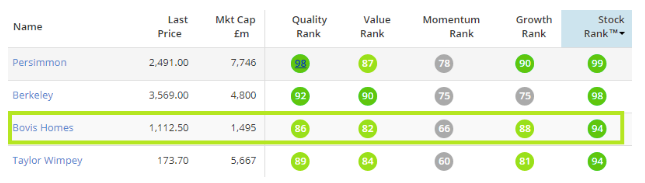
Persimmon and Berkeley fail my screening tests because earnings and/or the dividend are expected to fall. This is an obvious risk with all builders at present, in my view, but Bovis Homes’ situation is slightly different. It’s still in turnaround mode under newish boss Greg Fitzgerald. He confirmed last week that plans to improve margins and cash generation are delivering results.
Net cash was £40m at the end of June, compared to net debt of £32m last year. And Mr Fitzgerald expects measures such as part-exchange stock reduction and quicker turnaround of inventory to deliver a further £180m of cash into the business by the end of the year.
He remains confident that the firm is “making clear progress” towards a 2020 target of 25% return on capital employed. Given that ROCE was just 10% last year, it’s easy to see how improved profitability could drive the shares higher over the next couple of years, even if sales are flat.
Housing value?
A ValueRank of 82 seems a reasonable starting point for an investment.
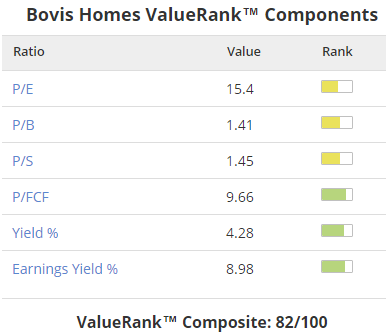
As this is a property stock, the price/book ratio is a key measure. A P/B of of 1.4 means that this isn’t a true value play on property. But these shares still trade at a much smaller premium to NAV than most others in this sector. Here are a few examples:
Persimmon: 2.4x
Countryside Properties: 2.1x
Cairn Homes: 1.9x
Taylor Wimpey: 1.8x
As things stand, Bovis’s lower valuation reflects its lower profitability. But if Mr Fitzgerald can improve margins while maintaining sales, a higher premium might be justified.
These historic figures also show attractive levels of cash generation. The price/free cash flow ratio of 9.7 is well into value territory, assuming it’s sustainable.
Based on the financial data alone, I think it’s fair to say that the valuation here looks reasonable.
Improving quality
Customer complaints were a problem when Mr Fitzgerald took over. But the customer satisfaction score is now trending “well above 80%”.
Like its building work, Bovis Homes’ financial quality also seems to be improving. The stock passes all of my screening tests and boasts a promising QualityRank of 86:
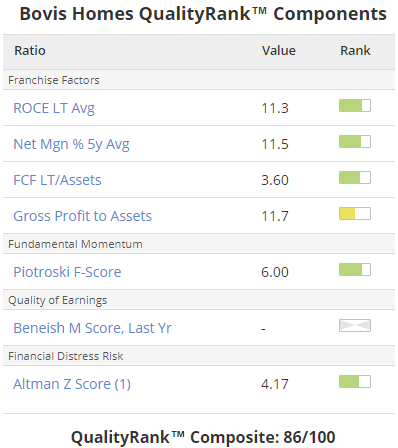
Although the long-term average ROCE of 11.3% and 5 year net margin of 11.5% are lower than some rivals, they’re not low enough to cause me too much concern.
I’m also reassured by the Piotroski F-Score of 6. Based on the firm’s plans for margin improvement and cash generation, I’d expect this to increase this year.
This could be a turning point for momentum
Value and quality scores of more than 80 give me confidence in the financial fundamentals. But the outlook for momentum is a little less certain:
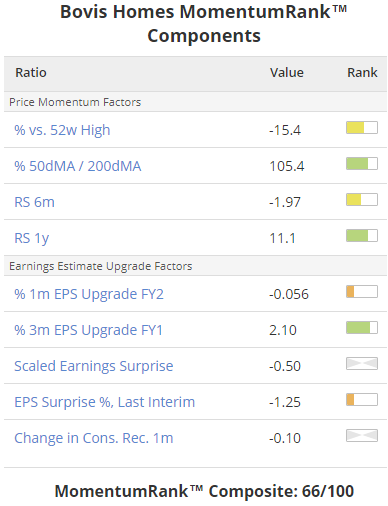
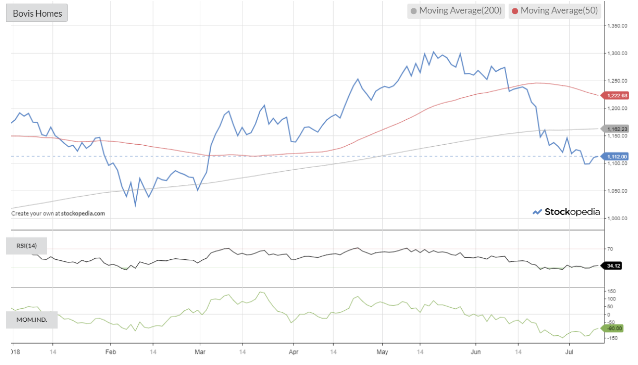
The metrics here suggest a mixed picture on price momentum. On the downside, the shares have fallen by 15% from May’s 52-week high of over £13. A negative 6m relative strength measure indicates that the share price has lagged the FTSE 250 index over the last six months.
However, relative strength is positive over the last year, and the stock’s 50-day moving average remains above the 200-day figure. These are generally seen as positive technical indicators. Looking at the chart, you could argue that the shares are oversold at current levels:
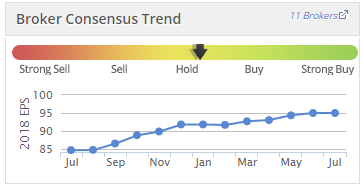
The picture on earnings upgrades is also mixed, but the broker consensus trend has been positive over the last year:
Recent changes have been pretty small in size:
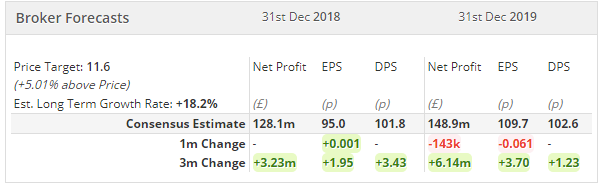
My reading of the momentum data is that this could be a potential turning point. I don’t see anything alarming, but the shares could still drift lower if market conditions get tougher.
My decision
If Bovis Homes operated in almost any other sector, its improving financial performance and valuation would make me an enthusiastic buyer.
As things stand, I’m not. But SIF is about rules-based investing, not top-down macro choices. This stock passes all of my rules and could continue to perform well. Despite feeling nervous, I’m going to add it to the portfolio this week.
I suspect this will be a controversial choice, so I’m looking forward to hearing your views on housebuilders in the comments...
International SIF update
In the meantime, I’m going to sign off with a quick summary of the three stocks I added to the International SIF last month.
HollyFrontier (NYQ:HFC) - A US petroleum refiner.
Gigabyte Technologies (TPE:2376) - A Taiwanese electronics manufacturer producing products such as computer motherboards and graphics cards.
Sonata Software (NSI:SONATSOFTW) - An Indian IT firm providing ecommerce software in sectors including travel, retail and distribution.
This virtual portfolio has now reached its target size of 24 stocks. So next month I’ll publish a more detailed review of performance so far and check whether any stocks are due to be sold.
Disclaimer
This is not financial advice. Our content is intended to be used and must be used for information and education purposes only. Please read our disclaimer and terms and conditions to understand our obligations.

4 comments
You could pick anything out of the house building sector and the quants look good.
The problem is the market hates this sector at the moment.
If you have any doubt about this, look what happened when the BoE increased the possibility of a .25% increase in the base rate in August a few weeks back - the entire sector went down 2-3%. What will happen if they go ahead and then (quite reasonably) suggest another one in 3 months time?
I personally think the market is wrong but I'll run out of money before the market.
Lots comment about the 9%+ yields in this sector - I simply fear you'll lose that in capital in the current environment.
Phil
Hi Phil,
Personally, I agree with all of your points. I'm a little nervous about putting money into housing stocks given the political and interest rate risks.
But SIF has always been an experiment in rules-based investing. By necessity I have to avoid making too many (any?) macro judgements as this would conflict with the quantitative metrics I used to select stocks.
Looking at the other side of the coin, I do think that it's possible to make the case for Bovis Homes (LON:BVS) still being in turnaround mode, and thus offering some upside. Growing institutional demand for rental properties could also sustain activity levels and support pricing for longer than expected.
Obviously the housing market will crash at some point. But when? I've long since given up trying to predict this...
Cheers,
Roland
Disclosure: I own shares of Bovis Homes Group.
Barratt Developments (LON:BDEV) (which I hold) had a trading update out today. Results were ahead of expectations. The sector as a whole is down over the last few months due to fears over margins going forwards. Barratt Developments (LON:BDEV) actually reported a Y-o-Y increase in margins and better than expected sales in London - so it looks like fears are overdone. I'm very happy to hold on current valuation and yield.
Hi Tristan,
What I thought was most interesting about the Barratt Developments (LON:BDEV) update was the emphasis on new product ranges (houses!) that are quicker and cheaper to build.
It seems as though these could support margin and profit growth even in a flat market environment.
I don't know whether these new designs are simply cheap and cheerful, or genuinely innovative. But I'd say that some innovation in housebuilding techniques is long overdue in the UK. Large builders that choose to invest in this area could perhaps gain an edge on rivals, at least for a few years.
Cheers,
Roland