SIF Portfolio: Turnaround plan should boost profits if GKN bid fails

GKN is “an overly complex and under-managed organisation without focus which needs a fundamental change of culture and leadership”. At least that’s the view of turnaround specialist Melrose Industries, which has the troubled FTSE 100 engineering group firmly on its acquisition radar.
In a presentation published on Monday targeting GKN shareholders, Melrose claimed that GKN has underperformed the FTSE 350 Total Shareholder Return (TSR) index by 26% since 2011. Despite spending £3.2bn on capex and acquisitions, it has “a history of missed margin targets since 2011”.
Melrose believes it can “re-energise and re-purpose GKN’s operations” to exceed the existing top-end trading margin target of 10%, from around 8% currently. My calculations suggest that if this was the case, H1 operating profit would have been roughly £521m, 20% higher than the £436m reported last July.
The other side of the story
In its response to the original bid approach, GKN’s said that the Melrose offer of 405p per share was “entirely opportunistic” and “fundamentally” undervalued the company.
--
Update 17/01/2018: Melrose is going hostile and has just made a firm offer for GKN worth 430p per share. https://www.investegate.co.uk/...
--
In fairness, I suspect the view held by GKN's board is correct. Melrose has turned £1 into £17.70 for its shareholders since its flotation in 2003. For GKN, the equivalent figure is £2.40 (plus dividends). If Melrose is prepared to pay 430p per share for GKN, I think it’s probably safe to assume that GKN could be worth significantly more.
Instead of pursuing a deal with Melrose, GKN’s board wants to realise this value by splitting the group into separate aerospace and automotive companies, a move that some shareholders have been calling for for some time. Like Melrose’s board, GKN’s new chief executive Anne Stevens sees a need for cultural change alongside operational and strategic changes.
The question for shareholders is which approach is likely to realise most value from GKN’s businesses. The track record of the group’s existing management is fairly uninspiring when compared to that of Melrose. But the decision to split GKN could tempt investors who want to retain the option of investing directly in its businesses.
All of this has become relevant to me this week because GKN is now the top-ranked qualifying stock in my SIF screen results. This means that I’m duty bound to take a closer look at the shares and consider them for inclusion in the SIF portfolio.
Better value than I expected
For me, the idea of buying a stock after it’s received a bid approach and risen by 32% is a little uncomfortable. But GKN still looks reasonably valued, based on my screen’s main valuation metrics:
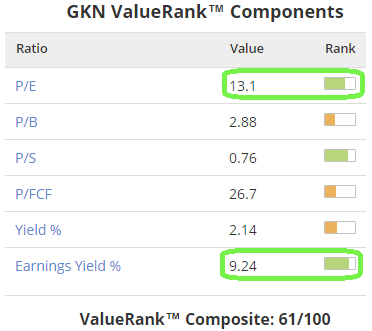
There are other good points too. The group’s net debt of £697m is only 1.5 times consensus forecast net profit for the current year. That’s well under my screening limit of 5x.
On the downside, free cash flow seems poor. And at 2.1%, the dividend yield is also below average for a relatively cheap, mature business.
Overall, I have to admit that while the shares aren’t an outright bargain, they don’t seem too expensive.
Quality score highlights potential gains
GKN scores rather better on quality, with a QualityRank of 73. Here’s how this score is composed (remember you can see these breakdowns by clicking the rank numbers on the sector pages):
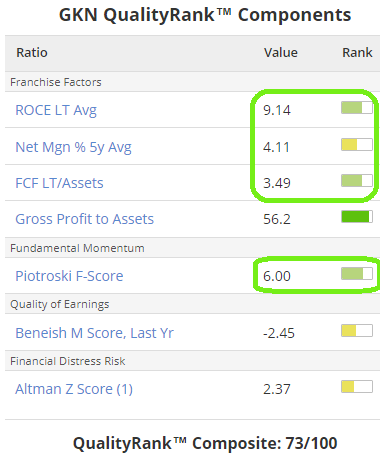
The scores I’ve circled are all pretty average, rather than very good. But there don’t seem to be any particular issues. These figures seem to provide support for claims that a well-executed turnaround plan could solve GKN’s problems and squeeze out some extra margin.
Interestingly, Melrose views the engineering group’s main businesses as number 1 or 2 by market share globally:
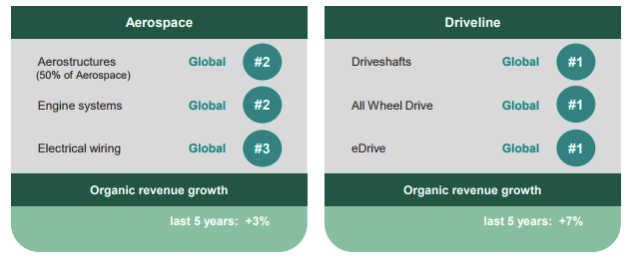
The overall picture seems to be of a firm with global scale and market-leading products, but only average profitability:
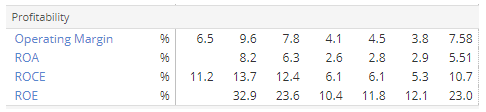
On this basis, I think the case for a turnaround is quite strong.
Pension problem? One quality problem which doesn’t show up in the QualityRank score is the pension deficit. As of 30 June 2017, GKN’s total pension deficit stood at £1,849m.
Deficit reduction payments during H1 totalled £70m. However, plans were in place to pay a lump sum of £250m into one of the UK schemes in the second half, in the hope that deficit reduction payments might be reduced this year. I suspect that these deficit reduction payments are the main reason why dividends aren’t more generous.
Although I have a policy of ruling out firms with outsized pension deficits, I don’t think this deficit is big enough to justify excluding the stock. Unlike at Hogg Robinson, GKN’s £1.8bn deficit is still only a fraction of its market cap and its annual revenue. And as I commented when I added BAE Systems to the portfolio last year, “I believe [big caps’] capacity for financial engineering and low-cost borrowing means that deficits are less likely to become critical”.
Soaring momentum
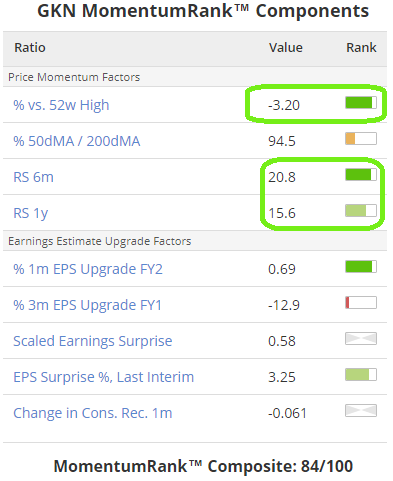
As you might expect, GKN’s MomentumRank has improved sharply in recent days. According to Stockopedia, it’s risen from 43 to 84 over the last month!
Friday’s 26% share price surge is probably the main factor here, as it’s lifted the stock to a new 52-week high and given the stock a positive relative strength:
A modest improvement in broker forecasts for 2018 may also have helped: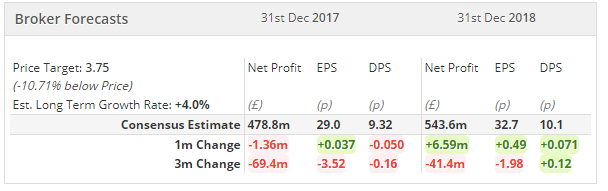
My decision
As GKN is in a bid situation, it’s hard to predict what might happen next. Melrose has until 9 February to make a firm offer or withdraw.
In parallel to this, GKN’s new chief executive appears to be putting in place her own plan to improve the operational efficiency and culture of the company, prior to splitting it up.
Both situations seem likely to me to generate value for shareholders. But the size and timescale of these improvements is hard to predict. Rather to my surprise, I think that GKN shares still look quite attractive after last week’s gains. I intend to add the shares to the SIF portfolio and to my own this week.
Disclosure: Roland owns shares of BAE Systems.
Disclaimer
This is not financial advice. Our content is intended to be used and must be used for information and education purposes only. Please read our disclaimer and terms and conditions to understand our obligations.

10 comments
Have to agree with Cisk
Melrose don't mess around and spend a very long time assessing potential targets, They prefer a recommended offer if possible but they are more than happy to proceed if such recommendation is not forthcoming.
GKN has done a mediocre group of growing the business and it is only now starting to address the critics of low margins/nonsensical structure. How much confidence that this can be achieved will this team engender in the City? Not much Id say.
Contrast this with the track record that Melrose have consistently delivered over many deals in different business sectors. Look at the improvements that they have made (and how quickly) at their recent deals.
Melrose management is much more respected" than GKN.
My guess would be that there will be demands from the instos for GKN to sit down and negotiate a better price for a recommended deal. If they refuse then Melrose will raise their offer. The risk is that Melrose walk as they have very definite ideas as to value that can be extracted.
I’ve owned shares in both for years. Hope melrose win. GKN are panicked rabbits caught in the headlights. The new CEO not owning any shares - just shows who the company is being run for. GKN is a great business, it suddenly finding £100m holes in US subsidiaries speaks volumes of how much better they could be managed. And I think MRO will do just that.
Hi star8,
I agree with your assessment that the Melrose Industries (LON:MRO) offer is not "final" and that this is a deliberate tactic, leaving the door open for a higher offer if this is required to win over GKN (LON:GKN) shareholders. At this early stage, there's no reason for Melrose Industries (LON:MRO) to fully open the kimono as to their best bid. What they've already tabled has put c.25% on the GKN (LON:GKN) share price and got them through the door to meet the key institutional shareholders. They don't need to do any more at this stage.
This is a very unusual situation in many respects, not least because it is a "hostile" bid (i.e. without the endorsement of the GKN (LON:GKN) board) and the majority of the value of the bid (about 80%) is in the form of "new Melrose" shares representing about 57% of the combined Melrose/GKN entity. In recent times (like the last 20 years or so) most bids have ultimately been made on a non-hostile basis or occasionally, where it has been hostile, 100% in cash. As I recall, even the 2009 Kraft takeover of Cadbury which this transaction is being compared to, started out as a hostile bid at 745p/share and eventually ended up as a recommended bid at 840p after the two sides had been brought together by key shareholders and effectively put into a shotgun marriage for more cash once Kraft had been given access to Cadbury's books.
However, because the purchase price of this deal is based mainly on the shares in the new entity, the currency of the bid is, in my opinion, predominantly in the quality of the two management teams and their plans for getting maximum shareholder value out of GKN over the next 5 years or so. This is much more of a qualitative assessment than a simple trading of pence per share bid numbers.
Using your analogy of chess and poker, I would suggest that a recommended bid is very much a game of chess (both sides get up close and personal behind closed doors, the advisers do some due diligence of the target and the Chairman haggle over a cash price that one will pay and the other is happy to recommend to shareholders - basically most of the variables are known and its a game of strategy of making best use of the pieces). A hostile cash bid is similarly chess like with a little bit of additional bluff and bluster in the press and a few more unknowns until eventually the cash offer established based on disclosure of most information and is either accepted (possibly after it is increased to sweeten the offer/get a recommendation) or is rejected. I think in this case we're much more in a game of poker with neither side really knowing what cards the other side has to play. The shareholders may yet require GKN (LON:GKN) to give Melrose access with a view to getting a recommendation at a sweetened offer price but at his early stage this seems unlikely.
Over the next few weeks, I think we'll see both sides puffing out their chests and claiming they'll give a better deal over time to the various stakeholders (employees/ customers/ pensioners / shareholders / "Great Britain" etc.) and rubbishing the credentials of the other side - we've already seen the early skirmishes this week. Presumably various talking heads like Vince Cable will feel obliged to stick their oars in and try and muddy the waters/make political capital. Doubtless, issues such as "national interest", "competition", "strategic importance", "industrial heritage" etc., will all get wheeled out and play across the media.
All said and done, however, while all this noise will be quite entertaining it is, in my opinion, an irrelevant distraction. It's hard to see any regulatory or competition type issues in this instance so the politicians don't really have any grounds to interfere (and generally in the UK we take a reasonably laissez faire attitude to corporate takeovers). Most of the other stakeholders are, at this stage, little more than interested spectators. Ultimately the decision here will be made by the institutional shareholders and I suspect, as this plays out, an increasing number of hedge funds that will take positions and make their decision based on which side has the best prospects of squeezing out the highest possible price over time. Rather than basing this on the PR battle, I believe this will be assessed on which side has the best business plan and track record for implementing it. Absent another bidder entering the fray with a knockout all cash offer, I think this gives Melrose Industries (LON:MRO) the edge at this point.
Gus.
Important - the dog that didn't bark
(Disclosure: I and a separate member of my family have long-standing holdings in GKN.)
(I have not yet received the Melrose offer document for GKN and am going by press comment.)
Melrose has made an"offer" for GKN . The wording is significant and the dog that didn't bark is the missing word"final". Although a long way from an expert on Takeover Regulations, my understanding is that an offer may be increased (within certain time frames not relevant at present) as long as an offer has not been declared to be "final". Since Melrose is very well informed and advised and experienced this omission is not an accident.
The normal interpretation of this situation (and you must make your own assessment - this is NOT advice) is that Melrose has started with a low ball and will make its final and serious offer later - hence it cannot use the word "final" as in "final offer" since that would shut out the possibility of another offer (within the following 6 months).
Consider too that Melrose has incurred substantial expense in just getting to this stage. Would it just walk away if the current offer fails ?
Finally if you were spending Billions on an acquisition would you give your best offer immediately or try to assess the situation and tempt out shareholders with a low ball offer ? If you could save just 5%by offering less than you would really pay, then on the £ 8 Billion total offer value that would be £ 400m - not petty cash on anyone's scale.
A possible negative against the above is that very bad news might suddenly emerge from the tussle which would cause Melrose to walk away - a possibility but under current regulations not a highly probably situation.
We are in a variation between poker and chess : in chess all is revealed and in poker the most important information is not revealed. Enjoy !
Roland,
Do you have price targets on the SIF portfolio?
If so what are you aiming for here?
One can buy GKN today for 444 pounds and the offer is 430 pounds.
From my recollection of the rules, holdings are kept as long as they still meet all criteria but cannot be sold until some period of time has elapsed.
So how do you see the near future?
Scenario A: the bid succeeds your position shows a small loss but the stock still meets criteria. Hold.
Scenario B: the bid fails your position shows a larger loss but the stock still meets criteria. Hold OR Add?
aflash,
I don't have price targets. All stocks are held for a minimum period of nine months, after which they stay in the portfolio for as long as they still pass my screening rules. If they no longer qualify for the SIF screen, then they're sold.
If a bid goes through at an indicative value of 430p per share (remember that most if it is in Melrose Industries (LON:MRO) shares, so the value could vary) then the portfolio's position will be closed, potentially at a loss. If the bid fails then I won't do anything. I don't average down or average up -- all positions are a fixed size, with one purchase of stock only.
Because of the rules-based nature of the portfolio, I try to avoid too much crystal ball gazing. But I have to admit that in this case the situation seems more unpredictable than usual.
Broadly speaking, my view is that GKN (LON:GKN) is probably worth upwards of 400p per share. But if the Melrose Industries (LON:MRO) bid falls through, it's anyone's guess how long it will take to reach this level again.
Then again, the promise of a turnaround and break-up plan might keep the stock at 400p+ even without a successful bid. We've seen that sort of market reaction with AstraZeneca (LON:AZN) and Unilever (LON:ULVR) in recent years.
Regards,
Roland
As always Roland's comments are quality observations and worth considering and learning from.
I take as a negative reflection on GKN its' comments that Melrose is "opportunistic". I hope all the companies in which I invest are "opportunistic" besides working coherently and systematically to develop shareholder value. Giving a snide comment on a company that sees an opportunity is not IMHO a worthy or impressive defence.
The Times today (19 January) points out that Anne Stevens ( the suddenly appointed GKN CEO ) although put on the Board in July 2016, has never bought any shares in the company - a shocking and unacceptable situation and implicitly a negative vote of confidence in the company.
Indeed it appears that after the sudden removal of the new CEO after his previous responsibility, the aerospace division, was suddenly discovered to have a hole of possibly over £ 100m, GKN was looking elsewhere to fill the position. Along comes the Melrose offer and suddenly Ms Stevens is thrust into the CEO role. Hardly encouraging as a strong vote for her - nor looking at the overall picture, an impressive performance by GKN as regards accurate accounting, management control or succession planning.
The Times today also has comment by pension experts dismissing the "sabre rattling" by GKN Pension Fund Trustees and shows their close former involvement in GKN as employees.
Disclosure: I have held shares in GKN for several years via a corporate vehicle. A member of my family also has held shares in GKN for a similar period.
Morning star8.
I concur with your thoughts on the GKN (LON:GKN) situation.
As the old adage goes when a yokel was asked for directions, “if I wanted to get to the Post Office, I wouldn’t want to start from here”. GKN (LON:GKN) have been caught off guard. They are necessarily on the defensive as the Melrose Industries (LON:MRO) bid has come at an inopportune time when there’s a big hole in the accounts and a disrupted CEO succession in play. They could have done one of two things; open the books to Melrose Industries (LON:MRO) and try and get the best price available for shareholders (in my opinion there was scope for a second higher offer if GKN (LON:GKN) had been a bit more conciliatory to the initial approach - evidenced by Melrose Industries (LON:MRO) ‘s willingness to go hostile and table a bid without confirmatory due diligence); or, in the alternative, pull up the drawbridge and start chucking rocks at the Scots invaders.
Clearly, GKN (LON:GKN) have chosen the latter - probably no surprise given the combative reputation of the GKN (LON:GKN) Chairman for being “a bit of a bruiser”. Personally, I think GKN (LON:GKN) missed a trick by not entering discussions with Melrose Industries (LON:MRO) when first approached and using the time to build their case/understand Melrose’s plans and preparedness to go hostile. By disclosing the approach immediately before they were really ready (and perhaps surprised by just how ready Melrose were), GKN (LON:GKN) are on the back foot and are reacting to rather than controlling the agenda and look flaky. I wonder if those that really matter (the institutional investors) think the same way?
In this kind of situation it’s primarily the Chairman’s job to call the shots with the rest of the board being pawns in the game. Ms. Stevens may well be a thoroughly brilliant CEO but even if she was a complete idiot GKN (LON:GKN) ‘s PR machine would be championing her as the perfect fit for the job (even if her original intention as a non exec was simply to top up her pension). At this stage the marching orders will be to do or say anything to try and win the hearts and minds of shareholders (for both sides). So far it has been “robust sparring” rather than full on combat. Given the personalities involved, I suspect this could get quite messy over the next few weeks with a fair bit of muck slinging from both sides. Marvellous!
Gus.
Firm offer made this morning. Implied price (based on rise in Melrose Industries (LON:MRO) share price) now above 430p/share.
https://www.investegate.co.uk/melrose-industries/mro/firm-offer-for-gkn-plc/201801170800010978C/?fe=1&utm_source=FE%20Investegate%20Alerts&utm_medium=Email&utm_content=Announcement%20Alert%20Mail&utm_campaign=Melrose%20Industries%20Alert
Gus.
Hi Gus,
Thanks for highlighting this. I'd just seen it too, so I've added an update into the article pointing out that Melrose Industries (LON:MRO) has now made a firm offer worth 430p per share for GKN (LON:GKN).
Regards,
Roland