SIF Portfolio: Why I'm investing my own cash, plus RM, Costain & Taptica

As I mentioned last week, I’m in the process of shifting part of my own portfolio into the SIF portfolio stocks. In the interests of transparency, I thought I should explain what I’m doing in more detail this week.
I won’t be buying all of the stocks already in the portfolio, although I have bought some. But what I will do, in general, is to buy each new stock which joins the SIF Portfolio. I started this process last week by investing in McBride.
I’ve decided to do this for two reasons. I’ve been writing the Stock in Focus column weekly for nearly two years. During that time I’ve learned a lot about how the StockRanks system works and been impressed by the results achieved to date.
I’ve also been encouraged by the progress of my rules-based SIF portfolio in its first year, so I’ve decided to put some skin in the game by investing some of my own cash into this portfolio.
What I’m not doing is providing buy or sell recommendations. I do not guarantee to invest in any of the stocks I write about, and I’m free to sell those I do own at any time, without notice. The SIF portfolio fantasy fund will not be a direct match to my personal holdings and shouldn’t be treated as such.
I’m sorry to labour the point, but it’s all too easy for opinions to be taken as advice. That’s not what I do here.
What about a new stock?
The good news is that the Stock in Focus screen has identified several new stocks recently. Most of them must be ruled out as they duplicate existing holdings, but they are still worth a brief look:
Costain: This engineering and construction business overlaps too heavily with recent addition Morgan Sindall. But Costain was the company I wrote about in my first ever Stock in Focus column, in May 2015.
It’s turned out to be a great case study of a good, improving stock with high QVM scores:
| May 2015 | April 2017 | |
| StockRank | 99 | 99 |
| Share price | c.325p | c.460p (+40%) |
| Forecast P/E | 15 | 13.2 |
| Forecast yield | 3.1% | 3.3% |
A classic super stock performance
The other two new stocks are media group Taptica International and educational IT specialist RM.
Taptica International: An Israeli IT company that’s focused on digital marketing for big brands. Paul Scott was impressed recently and it does looks like it might be an attractive business. However, Taptica overlaps too heavily with fellow Israeli digital marketing group XLMedia, which is already in the portfolio.
RM could be interesting
A few years ago, critics were predicting the demise of educational solutions group RM.
But it turns out that RM’s offering just needed updating. Schools are only likely to become more computerised. And it’s obvious that centrally-managed and supported services to deliver curriculum, connectivity and security are now required by all schools.
By shifting its focus from commoditised hardware to proprietary software and services, RM has delivered a robust turnaround since 2013. It now boasts a StockRank of 95.
With high ranking scores across the board, could RM be a super stock in the making? Or are there skeletons in the company’s closets?
Value investors must mind the gap
RM’s ValueRank of 72 looks promising. The group’s trailing P/E of 10.9 and dividend yield of 3.4% are attractive to me. And I very much like the earnings yield of 14.9%, which suggests to me that RM is cheap relative to its profitability.
But there’s one big fly in the ointment which needs closer examination:
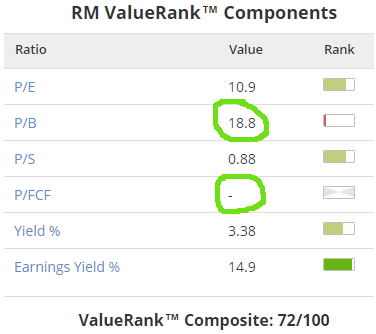
The pairing of a high price/book value and negative free cash flow often indicate a problematic pension deficit. That’s the case here. RM’s pension deficit rose by £12.9m to £34.8m last year, despite a £12m deficit reduction payment.
This massive injection of cash pretty much wiped out the group’s free cash flow, which would otherwise have been quite attractive:
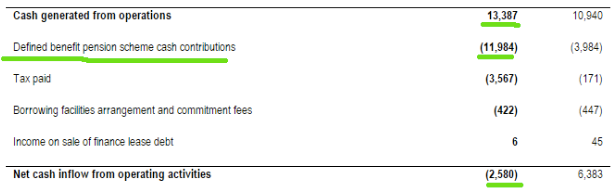
The good news is that last year’s £12m payout was a one-off. RM has agreed to £3.6m annual payments from now until 2024, although these could change following the 2018 triennial valuation of the pension scheme.
It’s also worth noting that RM has net cash of £40m and no debt, so could theoretically use cash to make whole the pension deficit.
I estimate that if RM had only paid this year’s £3.6m deficit reduction payment last year, it would have generated underlying free cash flow of £6m. That’s about 51% of the group’s post-tax profit of £11.6m and would have covered the dividend. In my view, that’s not outstanding, but is still fairly attractive.
Improving quality
RM’s operating margin fell to -6.7% in 2011, and was just 2.8% in 2012. But the group’s shift towards higher margin software and services has improved margins. I believe this strategy is also helping the firm to develop something of a defensive moat.
The stock’s main quality metrics seem to support this theory. RM’s operating margin hit 11% in 2015 and was a respectable 9.5% in 2016. Stripping out a £1.6m restructuring charge lifts this to 10.4%, which seems reasonably consistent to me.
RM scores six out of a possible nine on Stockopedia’s main measure of quality, the Piotroski F-Score. Unsurprisingly, the failures relate to poor cash generation and lower profitability than last year. Based on the management commentary in the 2016 results, I’d hope to see some of these turn positive after this year’s interim results. This could give RM’s QualityRank a further boost.
A momentum party
There’s no doubt that momentum is where it’s happening for RM. The group’s MomentumRank is 97/100, having risen sharply after the 2016 results were published in February. There are several reasons for this:
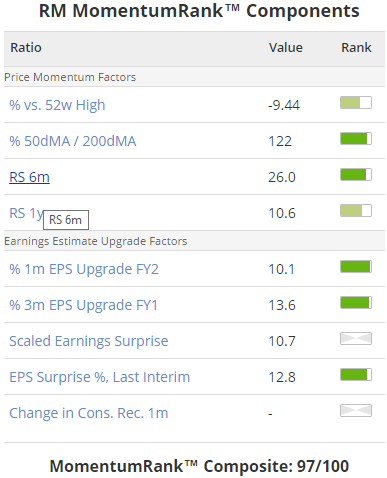
Starting at the top, technical momentum looks strong. The share price is less than 10% below its 52-week high and the 50-day moving average (dMA) is more than double the 200 dMA, indicating a strong uptrend. Relative strength is also positive, providing further support.
RM’s chart explains the picture better than I can:
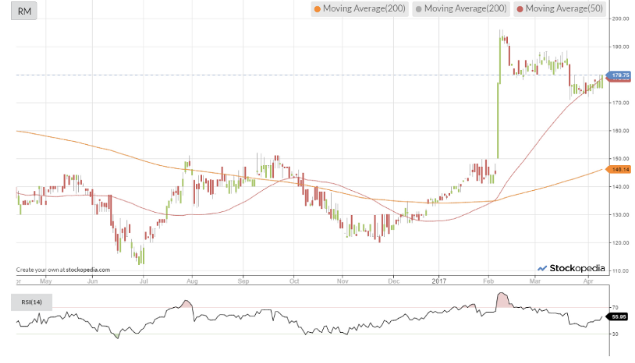
The shares appear to have escaped from last year’s range-bound trading and made a decisive move higher. The second part of the MomentumRank breakdown above shows why this has happened. 2016 earnings were ahead of expectations, and 2017 forecasts have been upgraded:
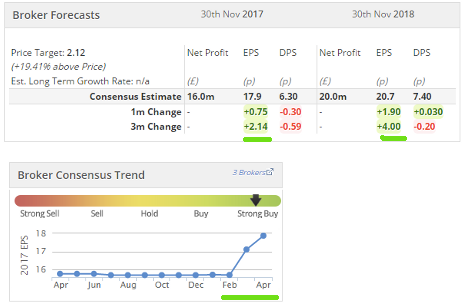
RM currently trades on a forecast P/E of 9.4, with a prospective yield of 3.8%. Forecasts for double-digit percentage eps growth seem to suggest that the stock is cheap and the net cash provides further downside protection. The only catch is the pension deficit, which is a very real drain on cash and could still worsen.
I’m prepared to take a chance on this, as my feeling is the impact of low bond yields has mostly been priced in. But I could be wrong. This is a real risk, especially for investors planning on longer holding periods than the SIF portfolio.
My decision: I’m going to add RM to the SIF portfolio (and to my own) this week.
Disclosure: Roland owns shares of RM.
Disclaimer
This is not financial advice. Our content is intended to be used and must be used for information and education purposes only. Please read our disclaimer and terms and conditions to understand our obligations.

3 comments
Hi Roland
An interesting review of RM and one to consider as a potential investment. The increase in recurring revenue streams at RM Education resulting from the transition to higher margin software services is attractive, as is the acquisition of the Connect education business. However the acquisition is subject to CMA approval, which is presumably anticipated, but not a given.
Also I note the anticipated adverse £2m fx impact on the results to Nov 2017, which I assume is included in current forecasts.
Best wishes
Jonno
Stockopedia thinks there is a high risk of earnings manipulation going on. Such shares are best avoided. RM may well be a value trap. The numbers do not impress me.
Hi Lennart,
Thanks for your comment. I agree with you in general, but in this case I think RM's restructuring and change of business focus may make things seem worse than they are.
There are currently three fails in the M-Score earnings manipulation results. I've included my comments under each one. I've not included an explanation of how each metric is calculated, as the calculations are explained in detail if you click on the M-Score link.
* Is the quality of assets stable?
There are several moving parts here. But playing with the numbers suggests to me that the single factor which caused this test to fail is the £8.3m reduction in RM's cash balance last year. This money corresponds to the one-off extra £8m pension deficit payment made last year. Reversing this payment and leaving all other variables as reported for 2016 achieves a pass score on this test.
So I guess the lesson here is that a big pension deficit can threaten the quality of a firm's earnings. That makes sense, as deficit reduction payments can drain the cash out of a business, preventing it from generating free cash flow from its profits.
* Are SG&A expenses under control?
I mentioned RM's lower operating margin in the article. This was the result of a rise in operating expenses last year. The three main items were all exceptional items:
- A £2.4m release of lease dilapidation provisions in 2015
- A £1.6m restructuring charge and £525k of acquisition costs on 2016
I'm fairly comfortable with adjusting these items out, as they appear to be genuine one-offs. On this adjusted basis, operating expenses actually fell last year. So I'm quite comfortable with the situation here.
* Are accurals low as a proportion of total assets?
I can't be sure about this. Accrued income did rise last year, while trade receivables fell quite significantly. This doesn't sound very attractive, but there are a couple of comments in the results which suggest it might be a side effect of the group's changing business activities:
"Cash generated from operations is expected to continue to be less than operating profit in the year ahead, reflecting the reversal of a favourable working capital position related to long-term contracts."
RM also says that one of the key risks to the business is:
"significantly increased working capital requirements within the RM Education and RM Results long-term contract portfolios and requirements in evolving RM Education business models"
The changing profile of the business is likely to bring with it some changes in working capital requirements and payment profiles. I'm not in a position to assess them in detail, but it's definitely a risk to watch, as this could place demands on the group's net cash pile.
Overall, I'm going to record an open verdict here. I'm not concerned about the increase in operating expenses, but the other two factors need to be monitored. In my view the key risk is the pension deficit, as it could prevent the group's net cash from being fully available to fund growth.
Cheers,
Roland