Small Cap Value Report (24 Jun 2014) - SHOE, UNG, THW, ANP

Good morning! I had a burst of energy last night, and reviewed three more company results (Porvair (LON:PRV), Accumuli (LON:ACM), and £ODX ), so here is the link for yesterday's updated report. Also, I reviewed last week's accounts from Norcros (LON:NXR), updating my report from 19 Jun 2014, for anyone interested in that company. It looks good value to me, but as always please do your own research (DYOR), that's just my personal opinion, not a recommendation.
Shoe Zone (LON:SHOE)
This is a mainly UK discount shoe retailer, which recently floated on AIM (23 May 2014). I've been having a read through the AIM Admission Document to understand the background. Interim results for the six months to 5 April 2014 have been published this morning.
It's a family controlled company, with the IPO releasing 22.5m shares at 160p to new shareholders. That leaves the Smith family with 55% remaining. No new cash was raised for the company itself, it was the family selling down part of their interest, but retaining control. So it's really a private company that happens to have a Listing - so not ideal in my opinion.
At 175p the shares are usefully ahead of the 160p IPO price. The company is based in Leicester, and has 553 stores, selling shoes for an average price of £9.77! I must visit one of their stores, as I'm clearly being profligate by paying 3-5 times that amount at Marks & Spencer!
Unfortunately there are no broker forecasts that I can find, so it's a bit difficult to value the shares on a PER basis. Today's interim results show turnover down a surprisingly large amount, from £98.9m to £82.9m for the most recent H1, which is said to be due to the "planned closure of a number of temporary stores". That's a 16% drop, so there must have been a lot of temporary stores, and I wonder how many they still have, and if more closures are likely? I would need to know the ongoing scale of the business in order to value it.
A modest profit of £3.2m was reported for H1 this year (up from a £0.5m loss in the prior year H1). So it's a low margin business by the looks of it, although it looks as if there might be an H2 bias to trading, so if the same pattern happens this year then full year profit might be heading towards £9-10m perhaps (based on a £6m profit in H2 last year).
The company made 3.7p EPS in H1, so say double that for H2, and I'm getting a very rough estimate of about 11p for full year EPS (last year it did 6.9p). That would be a PER of 15.9, which is probably about the right price.
My quick Balance Sheet review is passed, with a sound working capital position of £41.3m current assets, representing a healthy 170% of the £24.2m current liabilities. So the FD will sleep easily at night. Bear in mind also that the interim period end of 5 April is only a fortnight after all the quarterly up-front rent & service charge invoices will have been paid on March quarter day (25 Mar). So being in a £5.9m net cash position at this time of year (at or near the lowest point in the year for cash) is a solid position to be in.
Note that there is a small pension deficit of £2.5m, but that is immaterial in my opinion, and it's not an iceberg deficit either, as I've checked the admission document, and the total scheme is only about 10 times that figure, very roughly. Although having said that, payments of £300k per half year are being made into the pension scheme, according to the cashflow statement, which I'm pretty sure doesn't go through the P&L. So that is a cash outflow which would otherwise have been used to pay divis.
Overall, I quite like this share, and it will go on my watch list. Discounters will remain in demand, as such a large proportion of the population live on low incomes, and are likely to continue to do so. So it shouldn't be affected much by competition or the macro economy overall - cheap shoes will always be necessary. Competition are likely to be Primark, George at ASDA, and the other supermarkets. Shoezone also sell online.
The strength of sterling is helping UK non-food retailers at the moment, so margins will come under pressure if sterling weakens. The opportunity here is if the company out-performs, as it seems to be trading well, with the outlook statement saying;
In the 10 weeks to 14 June 2014 since the half-year, our LFL's and margins have been in line with management's expectations. Online performance remains strong and continues to be ahead of market growth projections.
(note: "LFL" means Like For Like - i.e. ongoing sales performance, with the impact of new store openings, and store closures stripped out).
Anyway, it looks quite a good business, but the shares don't scream value at me - they're priced about right probably for the time being.
Universe (LON:UNG)
It's surprising how many small caps charts are now starting to look the same - with a big rise in the autumn of 2013, peaking & flattening off in the spring of 2014, and dropping like a stone on bad news now. This is a healthy weeding out process in my opinion, with the speculative froth being washed away - last year the market was rewarding bad investors making bad decisions, so it's good to see that changing now. Any company putting out less than bullish figures will be punished, and rightly so.
Some good companies are being pulled down with the bad, so that's creating a few selective buying opportunities at attractive prices in my view.
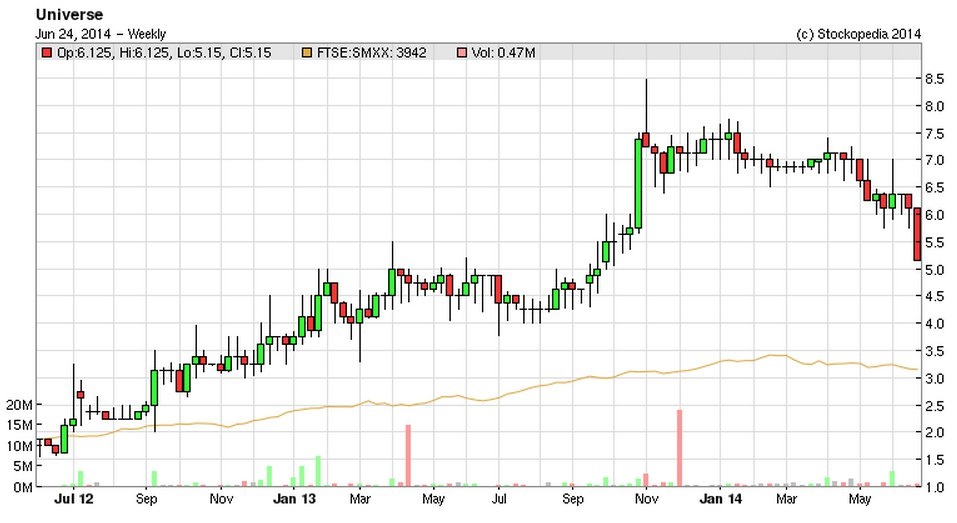
Today's victim is Universe Group, a micro cap specialist in the EPoS and loyalty card area. Its shares have dropped 16% to 5.15p this morning, on a hesitant-sounding AGM statement. The company says that H1 has been similar to last year, so that's OK. However the H2 outlook sounds wobbly;
The outturn for the financial year will be weighted towards the second half, and remains dependent on securing certain large-scale roll-outs and while we are confident of securing them, their timing is uncertain.
So it sounds as if we're being warmed up for a potential profit warning in H2. Current market consensus forecast is for 0.8p EPS this year, so a PER of just 6.4. Although really, for a very small company with uncertain profitability, a PER of 6 is actually about the right price. In this current bull market people are paying daft multiples for very small companies.
If we allow for a profit warning in H2, then EPS might come in around say 0.4-0.5p, so the PER then would be in the 10-12 range. There is no dividend here either, so all in all it strikes me as a share that is probably best avoided. I'd rather look for something that has more reliable earnings, dividends, and easier to forecast growth.
Daniel Thwaites (OFEX:THW)
This is an ISDX-Listed brewery, pubs & hotels group, based in Blackburn. It's a family company with a Listing on the tiny market below AIM. In my opinion there could be hidden value in this company. The most striking figure is the huge discount to NAV. So NAV reported today is £189.8m, with negligible intangibles on the Balance Sheet. Yet the market cap is only £61m at the present share price of 102.5p. So you effectively get a reasonable sized pubs group for less than a third of its own Balance Sheet net tangible assets. Most of the assets are freeholds.
Now of course people will start saying that Pubs are closing, and probably aren't worth anything like book value. However, in this case the company revalues 20% of the estate each year, so they are all post credit crunch now, and also interestingly the pubs that are being sold off (15 in the year reported today - under-performing "wet" pubs) are going for pretty much book value. A loss of only £0.2m was reported against those disposals.
Therefore I like that this is a deeply discounted asset play, and it seems as if the company takes good care of the assets, with plenty of pictures of nicely fitted out pubs & inns in the Annual Report.
There are some flies in the ointment though. The company has some legacy issues, including the closure of its ramshackle old brewery in Blackburn, and a failure to agree a redevelopment of the site with Sainsburys and the local council. However, a new, smaller site has been identified in the same area to modernise and downsize their operations.
Also there is a fair bit of debt (but not a problem, as supported by freeholds), and a disastrously costly interest rate swap arrangement was undertaken, making me think that management here are probably not very good. At some point though, the family might agree a sale of the business, and it's not going to happen on the cheap.
In the meantime decent divis are paid out, with a total payout each year of 4.46p, yielding about 4.4%, which is not bad going. Therefore I bought some of these for my long term portfolio, and just sit and collect the divis. The share price never seems to move at all, and it's horribly illiquid.
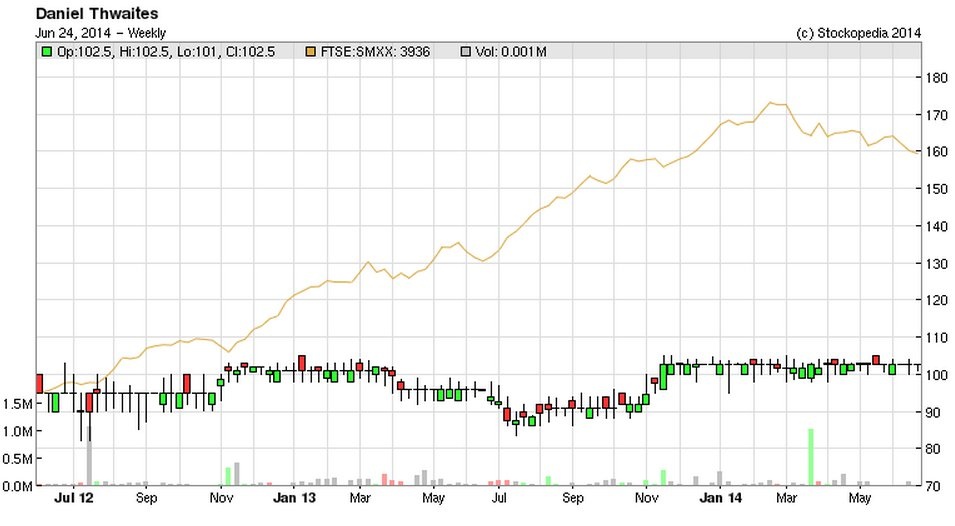
At some point though, maybe in a few years' time, something will happen, and the value in the company will be unlocked. This share will not appeal to many people, but as a long term value share, I think it's interesting. Note from the chart also how, because it's Listed on ISDX, this share is totally off the radar for most investors. Therefore it hasn't re-rated at all. That is a clear pricing anomaly in my view, and means that a move to 160p is implied if it had been Listed on AIM. Maybe a move to AIM is the catalyst needed to trigger a re-rating? I like it anyway, so the more patient value investors amongst you might like to have a look at it.
EDIT: I forgot to mention the pension deficit. Today's results comment as follows. Note that it's a significant drain on cashflow, but won't last forever. So again, another potential catalyst for a re-rating, when the deficit issue recedes?
The Group made contributions to the defined benefit pension scheme of GBP3.8m
(2013: GBP3.4m). Whilst this scheme was closed in August 2009, the Group is
committed to funding the deficit on the scheme which was GBP14.9m at 31 March
2014, a reduction of GBP1.5m from GBP16.4m at 31 March 2013.
Anpario (LON:ANP)
This is a natural animal feed additives company. I've raised concerns about the lofty valuation on these shares for a while now, and today's AGM trading statement sounds a bit too hesitant for a company on a forward PER of 20, in my opinion.
The Group continues to make good progress developing the business and is on track to meet market profit expectations for the year to 31 December 2014.
The Group has experienced some effect from the strengthening of the pound against the dollar, which means that sales and gross profit, in sterling, are expected to be at a similar level to those achieved in last year's strong first half performance. However, volumes are ahead of last year.
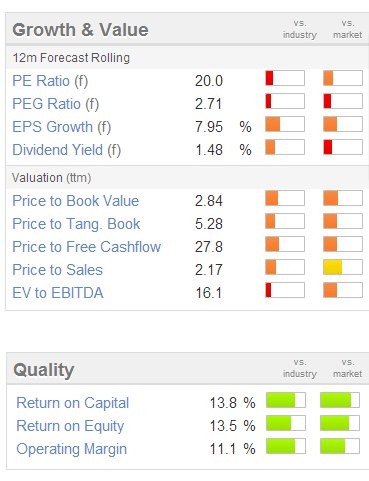
I'm surprised that sales & gross profit are only flat against last year, even allowing for the exchange rate movement. That implies pedestrian growth rates, perhaps more suitable to a stock with a PER in the low to mid teens, rather than 20. I don't know anything about the company's products or markets, so do not have a view on what the future might hold, I just go by the historic figures & broker forecasts, and on those the valuation currently seems rather rich.
Note that Anpario scores poorly on Stockopedia's valuation measures, but quite highly on the quality measures. It's StockRank of 64 is not as high as I would have expected.
So it looks a nice company, but it's too pricey for me at 265p per share. Also, with the next interims showing flat turnover, it's difficult to see a short term catalyst for the shares to go up.
Disclaimer
This is not financial advice. Our content is intended to be used and must be used for information and education purposes only. Please read our disclaimer and terms and conditions to understand our obligations.

16 comments
Paul, great to see that you have spotted Daniel Thwaites’ under valued potential. However, I fear that it could be a very long haul.
As a DarwenLad I have always had a soft spot for Thwaites’ ale, (particularly Wainwrights). But the company has a big estate of marginally profitable pubs in some of the most depressed parts of Lancashire and its efforts to diversify into the higher margin hospitality business with a small chain of upmarket pubs (6 ‘Inns of Character’) and another 6 regional hotels, proceeds at a snails pace. It sold off the Stafford, its one London crown jewel, for £77.5m in September 2009 – a price which looks a real bargain now.
It has spent the last three years trying to sort out its new brewery and realise the value of its existing site in the centre of Blackburn with limited success. It has finally announced a plan for a new brewery on the outskirts of Blackburn. But can it afford this investment before it has sold its redundant city centre brewery site? Perhaps New River Retail, which recently bought a load of Marstons pubs, could buy Thwaites’ site and help it unlock its undoubted property potential?
The undervaluation of Thwaites’ shares has attracted predators in the past. Guinness Peat built up a stake of around 10%, in the hope of using it as a lever to trigger a consolidation of asset rich regional brewers. But it gave up hope and exited in July 2012 selling its stake back to the company and directors at a rock-bottom price of around 82p a share.
There is undoubtedly a lot of potential in the 217-year-old Thwaites, the biggest independent brewer in the North of England. But there are three problems for investors – a weak management and board, the illiquid ISDX listing, and the domination of the founding families which control around 40% of the capital. (Reed Elsevier Pension Scheme, the only substantial outside shareholder, appears to be running down its strake which now stands at 4.2%.)
In particular, the family orientated composition of the board appears to stand in the way of a fundamental reversal of Thwaites’ slow long-term decline.
Ann Yerburgh, Thwaites’ chairman, has been on the board since 1974 and chairman since 2000. Richard Bailey, Thwaites’ chief executive, is her son-in-law, and her daughter, Arabella, is also on the board. Until this month the company had only one independent non-executive director on its five strong board. (John Barnes, who built up the Harry Ramsden’s fish and chip shop chain, has just joined the board – after a 15 month search).
The company shows no appetite for wanting to upgrade its listing to AIM, and refuses to post its slide presentations at its annual meeting on its website.
The one catalyst that might change things is the recent death of John Yerburgh, the current chairman’s husband, who was a director for nearly 50 years, including 27 years as chairman. Although he stepped down as chairman in 1993, he remained a powerful figure behind the scenes.
It is unclear what will happen to his shareholding. However, the younger generation of the Yerburgh family (he has five children) may not be quite as committed to Thwaites’ independence as the current board.
Hi DarwenLad,
Some great background in there, thanks for posting.
I've held shares in Daniel Thwaites (OFEX:THW) for about a year now, so I'm up about 8% on the purchase price, plus have received almost 5% in divis into my SIPP, so a 13% return so far is perfectly acceptable.
To me it seems a get rich slowly type of share - just something to tuck away in the darkest corner of your SIPP, and forget about. Then at some point a larger group might well make a bid for it, and you could suddenly wake up having doubled your money.
The key feature of THW in my view is under-utilised assets. The asset values on the Bal Sheet look fine - not overstated at all - they write down property to realisable amounts, and disposals have tended to happen at or near book value, a good sign.
So at some point, maybe further into the economic cycle, someone could well bid for it, and make the family an offer they cannot refuse. Let's hope so anyway!
In the meantime I'm along for the ride, and get my 4.5% divis each year, plus the upside at some point from the significant value in the property.
It's not one I would go crazy over, and have only got about 2.5% of my SIPP in it.
Regards, Paul.
Hi,
Thanks for the comments on pension scheme accounting. I must admit to finding this area horribly confusing, and I seem to tie myself in knots whenever I seek to unravel how it works! Maybe I should have paid more attention when studying for my accountancy exams, instead of going clubbing 5 nights a week in the 1990s, lol!
As I understand it, the overview is that when a deficit opens up on a pension scheme, the company agrees a recovery plan with the trustees, whereby an agreed amount of extra cash is paid into the pension scheme. This seems to by-pass the P&L, since it's a Balance Sheet movement - reducing a liability.
However the confusion arises because there seem to be two methods of accounting for the pension scheme which operate in parallel. One is the way it is presented in the accounts. The other is the (usually) three yearly actuarial valuation, which usually seems to be far more conservative - i.e. often producing a much bigger deficit than is shown in the accounts.
To my mind this is a crazy situation, and the accounts don't show a true & fair view in my opinion. So I tend to look in the notes to the Annual Report, to find out what the actuarial deficit is, and how much is being paid each year in recovery payments. Those are the numbers that matter the most, and really those are the numbers that should (but don't) go into the published accounts.
The way I see it, the recovery payments are a cash outflow that would otherwise be available to be paid out as dividends, so one should reduce the valuation of a company somewhat, depending on what recovery payments they are making, and how long you expect them to be making those payments.
An additional factor is that rising interest rates should reduce (or even eliminate) many pension deficits, dependent on bond yields rising in due course (as bond yields are used for the discount rate by which future liabilities are discounted to present value - i.e. the lower the interest rate on bonds, then the higher the pension scheme liabilities will become).
I've only tried to understand the overview of pension accounting, which hopefully is correct (above). It's not an area that I want to get into in too much detail, as one loses the will to live after a while when digging into technical areas like this!
Regards, Paul.
In so far as equity is some sort of perpetual bond, increasing rates should also decrease the value of the equity on the asset side of pension funds, which will dampen the rates' effect on deficits/surpluses. A fund which has the bulk of its assets in corporate bonds of a similar maturity and risk profile as those used for discounting liabilities will have almost no exposure to rates.
Er.. I think you mean "defined contribution schemes" purpleski. Slip of the typing finger?
Hi Paul
Thanks for working overtime to produce more reviews. I, and I think many others, appreciate your efforts in going the extra mile.
Paul,I agree with you on THW. When the sale to Sainsburys does eventually go through,debt will be reduced further.
As you say,I cannot see the family selling out at anything like these prices.They fairly recently bought more shares,at the same time as buying in some for cancellation when a corporate raider threw in the towel (Brierly,I think).
A very good ,conservatively run(with the exception of the disastrous interest rate swap,(I think one of the family worked in The City!)),long term buy.
Cheers,Graham.
Shoe Zone. I have been in couple of these stores over the past year. Basically warehouses with 'pile them, sell them cheap' philosophy. Not sure but the shoes appeared to be seconds or end of lines. The pair I bought didn't last long, but it was dead cheap!. Is this a Lidl equivalent? Mmmm I don't think so. Based on my customer experience, not one for my share portfolio.
Paul or anybody else who can explain.
If you have a moment can you explain
"Although having said that, payments of £300k per half year are being made into the pension scheme, according to the cashflow statement, which I'm pretty sure doesn't go through the P&L."
Why do pension payments not go through the P&L? Surely they are an expense, which ever way you look at it. To me pension received in retirement, by a former employee, is just deferred salary/wages, so if the pension contributions had been paid as wages for the employee to do as he wished then the "pension contributions" would have gone through the P&L as an expense.
Understand if you dont have the time but as a relative newbie I am perplexed.
Thank you.
Ref Thwaites pension
Hello purpleski
The pension deficit is sat on the balance sheet as a liability on the accounts - so any payments made towards this "past quantified estimated expense" have already been made in earlier years. Main thing to watch for is the size of the deficit and the scheme assets (they are 100 million of this company) - the higher the scheme assets then the more the potential there is for a later material adjustment for extra provisions (can go the other way too).
Note there will be normal pension payments made within the profit and loss business expenses - so the expenses you are expecting will be there within staff costs (note 8 indicates this is the case)
There is also another profit and loss adjustment for the change in the pension deficit for the year (2.7 million this year) - so the extra amounts payable doing the math this year above and beyond what was previously expected have an equivalent profit and loss entry here - although the timing of the amounts will be completely different from the amounts paid towards the deficit.
Thanks for pointing this business out Paul - Pubs if run conservatively tend to make good investments as they can be nice cash cows - although the presence debt can bring risk - so deffo worth more research - particularly with the discount to book value. Seems a no brainer that this company should be on AIM if major shareholders want to maximise an exit route - perhaps there are some Aim rules that would make life more complicated with regard to red tape or financials.
Hi rmillaree
Thanks for the comprehensive reply and makes sense now I think. But just to clarify at some point in the past the company will have done the following accounting:
Cr Pension Liability account (Balance Sheet item)
Dr Staff costs pension payments.
So the retained profits reflect the cost of the pension?
Have I got that right?
Hello purpleski
The entry for the "specific increase in liability due to a re-evaluation" will have primarily been
Cr Pension Liability account (Balance Sheet item)
Dr Recognised actuarial gain (loss) on pension schemes less related taxation **
** this bit is shown on the section labelled "statement of total recognised gains and losses" this section takes the profit from ordinary activities and add/deducts other P&l type adjusts to get the overall total gain/loss for year.
If you look at the 2011 accounts the comparative column shows shows there was a £7.4 million hit in 2010 - in that year the balance sheet liability for pension deficit increased by a similar amount.
Best to check all the notes to find the full details as there may be other minor adjustments shown elsewhere on the profit and loss or w/off of elsewhere.
"So the retained profits reflect the cost of the pension?"
Pretty much - there is the charge for this years costs - and an adjustment to correct any under or over provision previously made.
The problem with pension adjustments is that they can be lumpy and large - hence that nasty 7 million hit in 2010.
Pensions tend to be reviewed in more detail once every few years to the lack of a hit in any particular year doesn't mean that there won't be one hiding around the corner.
Thank you for this very enlightening. No wonder companies are going over to defined benefit schemes!
Thwaite's Wainwrights ale, mmmmmm.
Just a watching post.