Small Cap Value Report (Fri 25 Nov 2022) - MOTR, SCE, VID, De-listings, SCS, DVO, FCAP, LSL

Good morning! It's just Paul here today, as it's Friday. I prepared some stuff last night, so we're off to a flying start! Today's report is now finished. Have a smashing weekend! I'll be podcasting as usual tomorrow, with my weekly summary.
Agenda
Paul’s Section:
Motorpoint (LON:MOTR) [quick comment] - H1 results (to 9/2022) came out yesterday. Revenues rose a lot, but volumes (vehicles sold) were actually down. Profit has dropped, so it’s trading barely above breakeven now. Conventional car dealership chains have been making a fortune during this period of restricted supply (hence much higher prices), whereas MOTR has barely scraped into a tiny profit for H1. That does call into question its business model. Maybe people prefer buying from a conventional dealer? I’m less convinced by MOTR shares than I was in the past, due to this collapse in profitability. It dangles the prospect of future profits in front of us, on higher revenues & market share, but there's not much to go on in terms of valuation now. So it's become a bit more speculative than in the past.
Surface Transforms (LON:SCE) [quick comment] - rose 10% yesterday, on a big contract win (£100m over 6 years). I particularly like that it says this order replaces the incumbent, its main competitor. There are also delays in ramping up production. It now has a remarkable £290m of orders, average 5 year contract length. So this share is now all about execution, getting new production facilities up to scale, which will obviously come with challenges. Overall, it looks very interesting in my view. A very rare jam tomorrow share that actually seems to have received a lot of genuine orders for its jam! (ceramic brake discs actually)
Videndum (LON:VID) [quick comment] - this is the new name for Vitec. The shares have held up well in this bear market so far. It issued an in line with expectations update yesterday, for FY 12/2022. It claims to have a “robust” balance sheet, so I had to check, and I disagree. It’s been acquiring other companies, so the balance sheet shows rapidly increasing intangible assets, and debt. I’m not keen on companies racking up debt at this stage in the economic cycle. So the valuation, taking into account increased debt, looks up with events. [no section below]
SCS (LON:SCS) - an in line trading update today. There's been a sharp improvement in order intake in recent weeks, as the last of the tough comparatives drops out. Cash pile is enormous, and way above SCS's own market cap. Forecasts have been lowered, and now look realistic. Divi yield over 8%, and looks sustainable. I think this might be a sensible time to be dipping our toes in here again. High StockRank of 94. Thumbs up from me. More detail below.
De-listings - we're seeing more companies leaving the UK stock market, usually very small, and poorly performing companies. News of a de-listing is usually accompanied with a c.50% plunge in share price, as many investors become forced sellers. I review below several recent cases, and pluck out common themes, which could help us predict, and avoid companies likely to de-list in future.
Devro (LON:DVO) - shareholders should be celebrating, with a cash takeover bid at a 65% premium from a privately owned European food group. I look at the valuation metrics, to see if this could have been predicted. The value and quality figures certainly looked attractive last night, so well done to everyone who spotted the value here. Graham did too, with a nice review of its interim numbers in Aug 2022. It's not a share I'm familiar with, so missed this one. More detail below.
finnCap (LON:FCAP) - shares plunge 22% today, on news last night that the takeover talks with Panmure Gordon are off. I discuss below the attractions of the sector (bombed out valuations, and recovery potential), plus my view that Finncap remaining independent is great news for us, because it has a culture of being open & helpful towards private investors - e.g. publishing loads of research for us to access easily. Patient shareholders should do well long term, in the next bull market. More detail below.
LSL Property Services (LON:LSL) - a very detailed update, so I've only drawn out the key points below. It states the obvious - that the housing market is slowing, and hence expectations are reduced. The outlook for 2023 concerns me, and I don't think existing forecasts look anywhere near credible - i.e. far too high. For that reason, I'm steering clear of this share, as it feels way too early to be calling a bottom in earnings. More detail below.
Explanatory notes -
A quick reminder that we don’t recommend any stocks. We aim to review trading updates & results of the day and offer our opinions on them as possible candidates for further research if they interest you. Our opinions will sometimes turn out to be right, and sometimes wrong, because it's anybody's guess what direction market sentiment will take & nobody can predict the future with certainty. We are analysing the company fundamentals, not trying to predict market sentiment.
We stick to companies that have issued news on the day, with market caps up to about £700m. We avoid the smallest, and most speculative companies, and also avoid a few specialist sectors (e.g. natural resources, pharma/biotech).
A key assumption is that readers DYOR (do your own research), and make your own investment decisions. Reader comments are welcomed - please be civil, rational, and include the company name/ticker, otherwise people won't necessarily know what company you are referring to.
De-listing risk
This is a topic we've mentioned here before in the SCVRs. When (usually the smallest & worst) companies announce they intend to de-list, it often instantly knocks c.50% off the share price, and many smaller investors become effectively forced sellers - because we can’t, or don’t want to, hold shares in private companies (e.g. rules of a SIPP or ISA may not allow this).
Recently there has been a flurry of further de-listings announced. For example the lamentable Parsley Box (MEAL), which is running out of cash again, pursuing a doomed business model (in my view) that bleeds cash at an alarming rate.
MEAL announced on 25 Oct 2022 that it was reviewing ways to raise more cash, and that it might be easier to raise more funding as a private company. So in other words, it sounds like institutional shareholders might have indicated they did not have an appetite for any further fundraisings, and thus might have effectively written off their existing shares. Or, they prefer to refinance it behind closed doors, and without the scrutiny of a public listing?
On 18 Nov 2022, MEAL announced that it has indeed decided to de-list, and become a private company, which requires a 75% shareholder vote in favour. Lack of liquidity in the shares, and “valuation volatility” are mentioned.
A weak share price has created negative perceptions -
…the adverse share price performance is detrimental to the perception of the Group amongst customers, suppliers and other partners, which, in turn, has the potential to negatively impact its product development, staff morale and industry reputation.
In other words, as a private company, its poor performance can be better hidden!
Cost savings & regulatory hassle - MEAL says it can save £400k p.a. by de-listing.
Under-valuation - MEAL management think the derisory market cap is too low, which also means acquisitions are not viable using shares.
The meeting to vote on the de-listing is on 14 Dec 2022, and assuming it achieves the necessary 75%, then the last day of dealing would be 21 Dec 2022.
The share price seems very volatile of late, going as low as 1.5p, then bizarrely spiking to 4-5p in recent days. There is a concert party here connected to the CEO, who might be buying, as indicated in a previous RNS that they intended going up to 29.9% (just under the mandatory takeover threshold).
Thank goodness we won’t need to waste any more time reporting on this disaster of a company. Could de-listing have been foreseen? Yes, it was obvious the business model was failing, and would need more funding, so we’ve had it down as uninvestable for some time at the SCVR.
DeepMatter (DMTR) - down 54% today, so the market cap is now down to little more than £2m, at which point it’s clearly not worth being a listed company. It announces today that discussions with institutions & other potential funders have resulted in it concluding that it would be better to de-list.
It intends doing a £1m fundraise shortly, then a bigger fundraise in 2023 once it’s a private company.
Could it have been foreseen? - again, yes very much so. It’s a jam tomorrow company, with a good idea, but no commercial success to date, just years of losses and minimal revenues. This type of company rarely succeeds, and even if they do, it usually takes much longer, and requires multiple fundraisings usually at increasingly low prices, hence bigger dilution as time goes on. After several fundraisings & no progress, investors understandably lose the will to support any more fundraisings, so de-listing looks the only option.
SourceBio (SBI) - I’m not familiar with this company, but it has also announced it intends to de-list. This one is a bit more surprising, as it’s a decent market cap of £83m, and it made profits in 2020, and 2021, which looks like a pandemic-related boost.
It seems that the major shareholders are not interested in keeping the listing, as they reckon it undervalues the company.
A tender offer at 115p looks like it should be enough to take out most of the small shareholders who want to exit (because holders of 79.2% have said they won’t enter the tender offer).
Reasons given for delisting, are that the AIM market undervalues the company (in their opinion!) and hence it’s not attractive for raising growth capital. Costs of listing are c.£500k p.a., plus considerable management team dealing with investor relations, and regulations. So it’s not worth it. Also low liquidity is mentioned.
Note that there are 3 dominant shareholders, together holding 73%, including Christopher Mills of Harwood Capital (22.5%), who likes taking companies private on the cheap.
My view - this type of share is impossible to value, and the route to get rid of private shareholders via a tender offer, actually looks quite fair to me.
EDIT: I forgot to name-check Mary and Ian, who I spoke to at Mello. Mary flagged delistings, and that she was disappointed I hadn't commented on SourceBio delisting, so hopefully she sees this! We need to encourage more women to get involved in investing! Without wanting to generalise too much, I think women are often better investors than men, being less prone to making impulsive decisions. End of edit.
Assessing de-listing risks
If any investments we hold are vulnerable to a de-listing, it’s usually pretty obvious. This generally applies to shares with very small market caps (below say £20m I’d say). So for anything of that small size in our portfolios, it’s worth running through these risk factors below to see if a de-listing could be coming -
Cost - maintaining a stock market listing is expensive, costing hundreds of thousands of pounds per year (I’ve heard figures ranging from £200-600k for even the smallest companies). Is this reasonable in the context of a company’s accounts? If it’s loss-making, and running out of cash, then slashing costs through a de-listing could be necessary just to survive.
Liquidity - dries up in bear markets, as we’re seeing. If there’s no interest in the shares, then there’s little point in remaining listed. So if a share only trades small amounts, and not very often, then it could be likely to de-list.
Cash burn - blue sky or jam tomorrow companies that constantly burn cash, obviously creates a need to keep coming back for more fundraisings. It’s easy to work out when they’ll need more cash - just look at how much cash is remaining on the balance sheet, then look at the rate of cash burn in the last 6 month reporting period. Once a failing business has tapped the market several times for cash, then it becomes increasingly difficult, even impossible, to raise any more.
Fundraisings - in the good times, equity markets are awash with cash for new floats, and follow-on funding for speculative companies. Whereas in a bear market, appetite for riskier funding dries up, as we’re seeing, and if it is possible at all, usually comes with a hefty price discount. So it might be easier, and less costly, to raise fresh funding privately. Also, I suspect that institutions might prefer to refinance failed companies privately, without the associated glare of publicity from a listing. Better to have your mistakes off the published list, and lumped into “other”, maybe?!
Negative impact of a listing - if a company’s business model is failing, then doing so in the glare of publicity from being a listed company, can harm the business, as MEAL points out. A collapsing share price can have a negative impact on suppliers, bank, and employee confidence. Whereas private companies don't have a share price as such, they're worth whatever people think they're worth.
Regulatory burdens & management time - being a listed company involves a lot of work for Directors, plus hefty advisor fees. If there’s no benefit to the company from this, then it’s better to de-list.
Concentration of shareholdings - if there is one, or several major shareholders who have a high percentage of the shares in issue, then they effectively control the company, and as small shareholders we’re along for the ride. So if they decide that a listing is a dead loss, and they want to take it private, then there’s not much we can do about it.
Overall - there’s a big problem here. The UK market is just not interested in a lot of smaller, speculative companies, and to be fair, many probably should never have listed in the first place. We’ve seen over the years that many new listings are speculative junk, or over-priced, opportunistic floats after a year or two of good trading (e.g. during the pandemic). There are not enough decent companies on reasonable valuations being floated.
So I suspect we’re in for a fallow patch when lots of companies leave the market on a low. That’s going to be bad for us, if we hold them. I have one share personally, Seraphine (LON:BUMP) where Christopher Mills has been buying shares, and there’s a big 43% holder in the shape of the previous private equity owner. So my worry is they could strong-arm the CEO into de-listing at a low. So I’ve booked a call with the CEO to make the point that he needs to look after the small shareholders, and not let the big holders nick the company on the cheap! But if people keep selling, then you’re handing the company on a plate to anyone who wants to buy it on the cheap.
Please do add any thoughts, or examples you have in the comments below. This was all I could think of, off the top of my head, so there could be other good points I've missed.
SCS (LON:SCS)
140p (pre market open)
Market cap £50m
Trading Update (AGM)
Company’s headline -
Encouraging recent performance despite the challenging trading conditions
ScS, one of the UK's largest retailers of upholstered furniture and floorings, provides the following update ahead of the Company's Annual General Meeting ("AGM") to be held at 14:00 GMT today at its registered office, ScS, 45-49 Villiers Street, Sunderland, SR1 1HA. At the meeting, the Group's Chair, Alan Smith will provide the following update on performance and outlook…
The current financial year is FY 7/2023.
Key points -
Trading resiliently
In line with (lowered) full year expectations
“Challenging period”
Sharp improvement in LFL order intake in recent weeks (see table below)
Gaining market share
Cash £89.7m (up from £70.8m at end July 2022) - way above its own market cap
Key trading period now, over winter
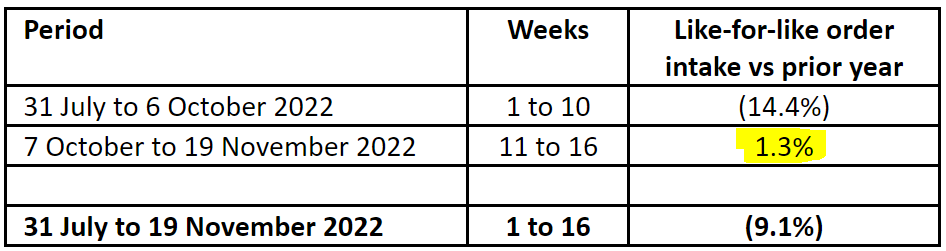
That’s a sharp improvement in recent weeks, although prior year comps are normalising, which have been skewing the figures ever since the pandemic began.
My opinion - this is encouraging. The cash pile being so high, indicates that there must still be significant supply chain delays, so that would be a key question to ask management - how long is the order backlog? Freight costs from the Far East have collapsed in price, which is great for importers of bulky items like furniture.
Forecasts have been lowered, and now look realistic, and the in line update today reinforces that.
Dividend yield is highly attractive at over 8%, and looks sustainable, at 1.5x cover in a difficult year, and with mountains of cash in the bank (some belongs to customers, but it continuously rotates, as we know this sector has highly attractive working capital structure).
StockRank of 94.
I wouldn’t get greedy about entry price, this looks low enough at 140p, if you’re prepared to be patient, and you’ll get paid nice divis whilst you wait for it to double in price once the economy settles down at some stage. Thumbs up from me.
Devro (LON:DVO)
308p (up 60%)
Market cap £514m
A statement issued by SARIA Nederland B.V. says it has reached agreement with the Board of Devro (a maker of sausage skins) to buy it for 316.1p in cash. That’s a marvellous premium of 65%, which should delight Devro shareholders. Although it’s customary to pretend that you’re disappointed, claiming it undervalues the company!
I’m not familiar with this company, it just flew under the radar. Although Graham reviewed its recent interim results here in Aug 2022, concluding positively that the company looks good, and shares seemed “unloved and underappreciated”.
The Stockopedia metrics as of last night also look attractive - a low PER, decent divi yield, decent asset backing, and high quality scores -
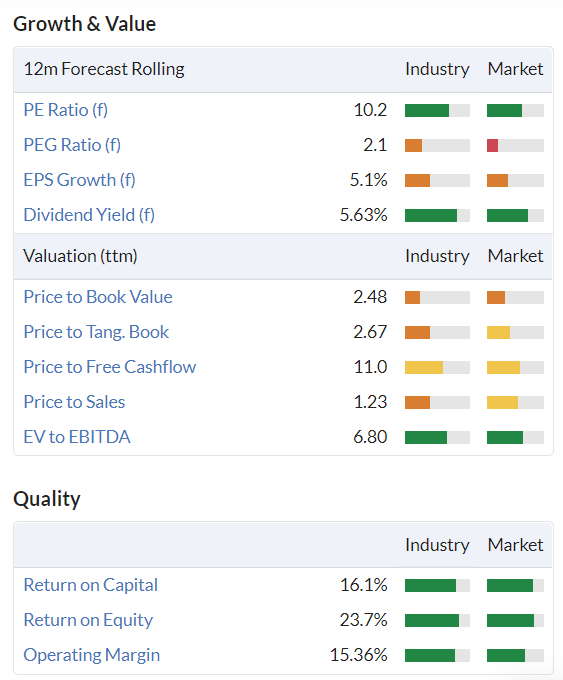
.
So this share does indeed look attractive on a conventional value basis.
Still, the acquirer paying a 65% premium suggests they might have seen some other attractions too.
This is a superb outcome for Devro shareholders, well done!
An added advantage of takeover bids right now, is you can recycle the cash into something else that’s very cheap, and you’ve got 65% more cash to deploy, so a double benefit.
There’s no point in me reviewing its trading update, also out today, as this deal looks very likely to go ahead.
finnCap (LON:FCAP)
14.5p (down 22%)
Market cap £26m
Finncap had been in talks with Panmure Gordon about a possible takeover deal. Last night, within 5 minutes, both stockbrokers issued statements saying the deal is off. Out of curiosity, I’ll have a look to see if there any differences in their accounts of events!
Finncap - says it was not possible to find mutually agreeable terms or structure for a combination.
Panmure Gordon - oh how disappointing, it uses the same wording as Finncap. I was hoping for some drama and mud-slinging, to liven up my day, but sadly that’s not the case! It all sounds rather civilised.
My opinion - Finncap is exemplary in providing private investors with research notes on many small caps, and providing easy access to company management. As such, I was hoping a combination with Panmure Gordon would fail, because Panmures are considerably less helpful to PIs. They did publish some notes on Research Tree a while back, but that seems to have gone now. Brokers that refuse to publish research on the small caps they cover, are completely useless to the people who are actually buying/selling the shares & setting the price - i.e. us! Hence whenever I talk to company management, I always urge them to ditch brokers which restrict access to research notes to PIs, and try to limit the information in RNSs.
So bravo to Finncap remaining independent, this is excellent news actually. Less so for shareholders. Although as Graham has pointed out here, brokers and fund managers’ shares are highly cyclical, as they tend to produce feast or famine results. We’re currently in a famine, with bombed out share prices, so this is probably a good time to be buying the ones that have sound balance sheets - tuck them away for a couple of years, and you’ll probably make a decent profit, and maybe pick up some divis too.
Finncap’s balance sheet is sound, with about £20m NTAV. The cost base tends to be fairly flexible, with staff and bonuses being the main cost, so they get paid very well in the good times, and unfortunately are at risk of redundancy in the bad times. The other thing to check is the liabilities relating to glitzy offices.
Serving a lot of lower end clients, Finncap might also suffer from de-listings, and also of course not so many deals for a while. As long as it can bump along at or around breakeven, then it should be fine longer term.
.
LSL Property Services (LON:LSL)
233p (down 11%)
Market cap £241m
The market cap has dropped by £31m today, and this is another one where the recent “everything bounce” as I’m now calling it, has turned out to be spurious. This makes me wonder if we should be selling big bounces, where they’re purely down to sentiment, and not backed up by any newsflow on fundamentals improving. But that’s for each investor to decide for yourselves.
This covers the 10 months to end Oct 2022, of FY 12/2022.
There’s a lot of detail, so I’ll just draw out the key points -
Conditions have become more challenging since the last update - which shouldn’t come as a surprise to anyone -
… this has given rise to a reduction in mortgage activity and new house sales, and an increase in fall-throughs of previously agreed sales.
This challenging background means that there is a wider range of potential outcomes for the full year than previously expected.
Balance sheet - it claims to have “a very strong balance sheet”. It doesn’t. Once you eliminate intangible assets, NTAV is only about £23m. That looks adequate for a sector that doesn’t need a lot of capital, but it’s certainly not “very strong”.
Net cash looks fine, at £29.1m.
I see it’s doing share buybacks, which is not a good idea going into a market downturn of unknown length & severity. They should be protecting the cash pile in my view, at this stage in the cycle.
Conveyancing delays are continuing, but “slightly easing”
Re-mortgaging business has been restricted by recent turmoil in mortgage markets.
Surveying & valuation also taken a hit, but expected to be temporary.
Outlook -
The lead-time required to complete transactions means that for Financial Services and Estate Agency, the financial impact of the recent turbulent market conditions will largely be reflected in the first quarter of 2023.
Overall outcome for FY 12/2022 below expectations -
The overall Group performance is expected to be below our prior expectations with full year profit now anticipated to be in a range just above or just below that reported in 2019, which included a contribution of £1.4m from LMS and TM Group, which were both disposed of during 2021…
The housing market is heavily impacted by sentiment and has the potential to surprise on the upside. However, with the recent reduction in activity levels and continuing uncertainty over UK economic conditions, until we have greater clarity on the economic backdrop, we are cautious on the market outlook for 2023. A significant reduction in housing transactions would clearly have a material effect on our Estate Agency residential sales business and our direct-to consumer financial services business.
We continue to focus on proactive management of our cost base, to limit the impact of these pressures.
My opinion - this update is mostly stating the obvious - we should all know by now that the housing market is slowing, for a variety of reasons.
Therefore I think it’s sensible to regard 2022 results as almost irrelevant, and probably peak earnings for the time being. That makes it very difficult to value shares in the whole sector.
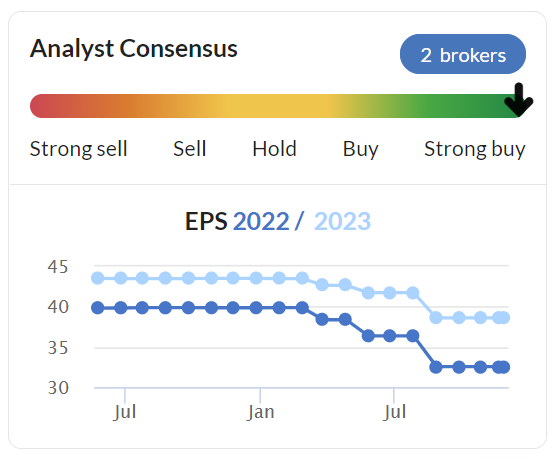
I would expect 2023 forecasts to now be well below 2022 forecasts, but the Stockopedia graph below shows the opposite - i.e. earnings growth in 2023, which looks completely unrealistic.
Therefore, I think the broker forecasts look well behind the curve, making another profit warning highly likely. For that reason, I’ll steer clear of this share as we go into a downturn for housing, and re-assess it once forecasts have tumbled to something more realistic. I could see the 2023 forecasts maybe even halving from where they are now. That’s not likely to be good for the share price. Best avoided, I reckon, for now.
Disclaimer
This is not financial advice. Our content is intended to be used and must be used for information and education purposes only. Please read our disclaimer and terms and conditions to understand our obligations.

94 comments
The issue with small caps isn’t the spread, it’s the liquidity. On any reasonable holding period where you would describe your activity as investing rather than trading, a couple of percent lost on entry and exit should be irrelevant. The real problem is getting out at any time other than on a very good news day, when you would logically be looking to build your stake not reduce it. Otherwise it can take weeks to sell down a position, usually against a falling share price, while the name into which you aim to repurpose the funds inevitably rises away from you.
For this reason I’ve recently raised the threshold at which I’m prepared to invest in a company. And I think Paul and Graham would be doing the community a favour if they took a similar view. That’s not to say that their analysis of smaller entities doesn’t come with a well signposted warning, but it takes up bandwidth which could be applied to broader appeal up the liquidity scale.
Much depends on your position size, which is a factor of what level of concentration an investor is willing to accept and how much their total investment pot is. Personally, I am putting no more than £10-15k into a single company, so generally would have little trouble getting in or out in a few transaction. Obviously other people will have a different perspective if they have larger pots or are more concentrated.
Hence for me, I am happy for the focus to stay on smaller companies, even with the lesser liquidity.
SCS (LON:SCS) - not an accountant but use stock for a quick squizz on a company.
The gearing ratio shows how encumbered a company is with debt. Depending on the industry, a gearing ratio of 15% might be considered prudent, while anything over 100% would certainly be considered risky or 'highly geared'. As a general rule, net gearing of 50% + merits further investigation, particularly if it is mostly short-term debt.
Ok but 'intangibles' of concern and pension and cash pile deposits from customers presumably so not their money. But Stocko gives it a good thumb as does Mr Scott - but Mr Altman not so bullish.
In this risk off environment just trying to understand what's going on without the DYOR. I use technical analysis so in the tea leaves of history and what the share price is doing, and leave Stock to tell me if its a going concern with growth potential. KISS.
£eaas Hi Paul, I'm not in but could you have a look at Eaas finance package and results if you get chance?
alarm bells are ringing when they come out after the markets closed on a Friday ..
Hi NewInvestor1972,
I'm off duty now! Also, if it's got the word "Energy" in the name, then I won't usually cover it, as no sector expertise.
The balance sheet of Eenergy (LON:EAAS) looks wobbly at a quick glance - negative NTAV.
Looks like quite late results issued tonight might have been dependent on agreeing the new (expensive) bond funding. Going concern note 2.4 seems to confirm this.
You'd need to check the terms of the Warrants too, as that can dilute the upside.
John Foley, and Hawk Investments, rings a bell. They seem to have been involved with PTSG, which turned out well for holders, despite odd-looking accounts, it was taken over at a nice premium. I remember meeting management.
EAAS looks a special situation, that would need very close scrutiny. Not something we could cover within the time constraints of the SCVRs I'm afraid.
Regards, Paul.
Thanks for the feedback Paul, appreciated.
£xpf BBB Oxford Street opens tonight, looks like it will be a great addition to their portfolio..
https://instagram.com/stories/...
Hi Paul,
Many thanks for writing up your thoughts regarding delistings (and the name-check!) and for all the interesting reader comments that have emanated from it. Sourcebio International (LON:SBI) delisting was particularly annoying for me as I had taken a starter position back in April and topped up at the beginning of September only for the de-listing to be announced on 9th November. I took the decision at that point to sell out straight away (at a loss) as I couldn't see another offer appearing nor did I know what the timescale would be for them to raise the funding and therefore for me to receive any proceeds (which would have still resulted in a loss).
I also have a position in EMIS (LON:EMIS) and the finalising of that takeover, which was announced in June and is not expected to complete until Q1 2023. But as the markets have been pretty rough I have decided in this instance to hold out for the full offer price, as the share price has been hovering around 50pence below this, and I have also collected a dividend payment along the way.
Another issue that has arisen today is regarding a holding in Abcam (LON:ABC) in an ISA . From their RNS: "The Company is providing an opportunity for shareholders to deposit their Ordinary Shares with the Company's ADS depositary in exchange for delivery of ADSs, without cost, in connection with the AIM Delisting whether prior, on, or subsequent to 14 December 2022 (being the date on which the AIM Delisting takes effect)." The problem with this is that these ADSs cannot be held in an ISA. It is also sad to see good companies like these delisting from UK markets, but the reasons given by the CEO are shown below.
Alan Hirzel, Chief Executive Officer of Abcam, said:
"This proposed listing change will make it possible for Abcam to attract more investors to our global business. With the change, we see a path to creating value by increasing stock trading liquidity for our current and potential shareholders. We are grateful to have the support from current shareholders for our proposal and look forward to attracting new life science investors to the Abcam story."
Mary
Abcam (LON:ABC), so volatile over the years, one could almost think one could buy low and sell high ad-finitum, so it's a shame to see the dream come to an end. I don't hold, having sold out not wanting to be a part of this but I do have some EMIS (LON:EMIS) and will wait to see it out when the much-vaunted recession will present a bargain or two to invest the cash in.
The delisting of Abcam (LON:ABC) from Aim stinks and I suggest the Chairman is a fool. It is very damaging for small investors. Us old holders supported the company and new management have wasted enormous amounts of money on IT projects (all capitalised of course!).
Abcam (LON:ABC)
The problem with this is that these ADSs cannot be held in an ISA.
Is that true? I thought that ADSs could be held in an ISA. Ref: https://www.gov.uk/guidance/stocks-and-shares-investments-for-isa-managers#deprecAmer
Is there some reason that these don't qualify for an ISA or is it a broker-specific problem?-- (i.e. moving the shares to another broker would mean that you could hold these in an ISA)
Yes it is true, the reason for these ADSs not being held in an ISA is because they are OTCs. Moving to another broker won’t help.
£DVO Well yes Paul i am one of the delighted with this result & generous of Saria to pay such a premium in this market , i believe as it is a rather unique product. However sad to see another firm lost to the LSE.
Not a small cap apologies....
Investec (LON:INVP) Over a £1,500,000 in director sales today. Time to take profits perhaps.
Investec PLC and Ltd - Sandton, Johannesburg-based financial services firm - Ruth Leas sells the most shares amounting to 125,000 at £5.05 each, worth £630,850.14. Leas is the chief executive of Investec Bank PLC, a division houses non-Southern African lending operations in the UK, the US, the Channel Islands, India and Ireland. Executive director Richard Wainwright offloads 100,000 at R 101.43, worth R 10.1 million. Chief Financial Officer Nishlan Samujh sells 75,000 at £5.05 each for £378,750.00
Thanks, had not spotted that, think you are right, had a good run, taken some profits.
Is this a short - just saying for a friend. He's not been very successful Superdry (LON:SDRY) the first try.
Great to see Paul's thoughts on delisting risk. I think both these and, ironically, takeovers can be a tangible risk to small shareholders.
Imagine if Apple or Google had been UK companies had been UK based only to be taken over 25 years ago just as the party was getting going.
Back home, I've been wondering at what point the Khamani family might take Boohoo (LON:BOO) private? I thought Graham Neary's youtube comments on Boohoo (LON:BOO) are spot on.
An interesting development at Curtis Banks which is another share with Harwood on the register. Nucleus Financial Group are looking at making an offer, and completing confrmatory due diligence.
Foxtons (LON:FOXT)
Interesting news article flagged up from 'ridavies' (thanks for that) on the current lettings market, and the increased prices of rental properties
I wonder if this will act as a tail wind for Foxtons (LON:FOXT) who's business is made up of 2/3 rentals and outlook of 27 October was already stating it was trading ahead of expectations.
Lettings - £29.2m
Sales - £11.9m
Financial Services - £2.8m
Down 2.9% today so not everyone agrees.
Are any other of the estate agents operating with that sort of ratio to sales?
Foxtons (LON:FOXT) (I hold)
Hi TheFloatingInvestor
Sadly I'm not sure how much we can read into rent rises for the likes of Foxtons (LON:FOXT) and Belvoir (LON:BLV) because it's unclear:
I know that M Winkworth (LON:WINK) for example, indicate that c50% of their lettings revenue is a monthly management fee i.e. it's sticky and should only really increase in a rising rents environment.
However, I imagine the company will currently be losing out where, for example, they only get a fee for placing a new tenant. With rents rising so much, there have been reports of people staying in the same place for longer (i.e. not moving around as much), thereby reducing this revenue source.
Subsequently I think it's quite hard to know what's really going on at these businesses until they announce it themselves.
One way to smooth out revenues would be for these agencies to buy up their own rental properties. I recall Dorian, the CEO of Belvoir (LON:BLV) , saying that they had discussed this option and as a shareholder I hope they seriously consider it.
---
On you question about other companies with similar lettings/sales splits, here is the gross profit splits for Belvoir (LON:BLV) over the last few years.
For clarity I hold both Foxtons (LON:FOXT) and Belvoir (LON:BLV) primarily due to their focus on lettings.
Cheers
A
Thanks Abtan that's interesting, and really appreciate your thoughts on it!
I hold Foxtons (LON:FOXT) but not £BLV.
As you say is the demand for lettings there, or going to come on stream quickly...mmmm.
Belvoir at Mello
I did raise the question of buying some of the rental properties they manage.
Dorian presentation indicated that the current market is favourable as they earn more from the rental rather than sale. Also the remortgaging is a good part of their income.
regarding becoming a landlord company he said it is something we are considering , the fact that Stefano, the ex chief of Telford Homes is the chairman helps! It is however, capital intensive and may need shareholders approval.
The discussions about about delisting are very timely. I am a holder of LON:AFS - Amiad Water Systems. Paul has commentated on them in the past. It is a decent sized company (£100m+ market cap) based in Israel. The ticker has disappeared from Stocko et al because it is "delisting". Yesterday I thought I would chase it up. On speaking to Barclays this process is "not yet complete" and could "take years" it has already taken 18 months. And the polite feedback from Barclays was "your on your own chum". Contact the company directly. Is this the norm?
There has been no contact from Amiad but I can see that is listed on the Tel Aviv stock exchange. I've tried to reach out but heard nothing yet.
Anyone else a holder or has been a holder post delisting? If so have you had any feedback? Have the shares been transfered to the TASC?
Berksbee - I am not a holder of Amiad Water Systems but this looked odd so I looked it up. It is not in the process of delisting - it delisted from AIM on 26/8/21 https://www.investegate.co.uk/...
This one is unusual in that it has transferred the dealing in shares to Tel Aviv, which means ditching the use of registrars in this country. If you haven't done so you should read the mechanism here https://www.investegate.co.uk/... in particular you can only trade through an Israeli company.
I find Barclays treatment of you shocking and worthy of a formal complaint. You should ask them if they have "an Israeli affiliate or correspondent broker" who they use and whether their nominee has been informed by "Reznik Raz Nevo Trusts Ltd." that they hold the shares of which you are the benificial holder.
Hi Sharw, thanks very much for your response. I hope it also helps any other Stocko subs in mine or a similar position.
The proposed listing transfer remains subject to the approval of shareholders at the company's extraordinary general meeting on July 29 2022.
Suppose we all need to look at company agendas for their meetings. Another lesson.
Paul, it looks as though today's tag for SCS (LON:SCS) needs to be added again so that today's SCVR gets picked up in the Discussions.
Hi FREng,
Thanks, yes I spotted the missing tags today, and added them all back in a few hours ago. Just double-checked, and they all seem to have hung on. Thanks for double-checking though :-)
Regards, Paul.
SCS (LON:SCS) (no position)
I was working through various forecasts for FY23 and thought I'd share some of my numbers.
The Semi-Variable and Fixed Operating Costs are key in my opinion and I've crudely assumed a continuation of the FY22 H2 figures into FY23.
---
I've also assumed a recovery in gross margins as freight prices fall.
---
Gross sales are down 9% so far this year, which was against a 16.9% fall in H1 last year.
It's of course hard to know what will happen in the next 6-12 months, but I think it's worth noting the strong H2 performance from last year (+41.2%).
This could be hard to beat.
----
By my estimates a 23% drop in FY23 year-on-year revenue is where the company turns loss-making. Given the strong performance in H2 last year, this doesn't seem completely unrealistic.
Of course, there's the healthy cash balance, and as someone helpfully pointed out in the comments today, decent interest income to help offset any weakness.
---
For comparison purposes, a 10% year-on-year drop in sales will result in an operating profit of c.£13.8m, which of course isn't too bad given the current c.£50m market cap.
It will certainly be interesting to see where this ends up in 12 months.
A
SCS - Can someone explain what their actual cash position is. I am not very good with balance sheets. Stocko says it has net debt of 35.9m - which corresponds to the EV v market cap. If I understand correctly - capital lease obligations are included within this figure. Balance sheet says 87m. Does that mean they have 50m in cash? Dividend cover at 1.5 suggests maybe around 6m in cash. So how do I work out the actual cash position and also Paul mentioned they have customer cash also - is there a way of knowing how much is customer cash based on the balance sheet? Apologies for my ignorance, I just can't get my head around what their actual cash position is.
SCS (LON:SCS)
Hi MetalMaid
A great question and I'm sure you'll hear multiple answers today.
Personally I see their cash position as c.£13m
This is made up of:
I'm fully aware that I am probably being overly cautious and others will exclude the AP balance in their calculation.
Cheers
A
Aside from the question of how much cash is theirs, they should still be able to receive interest on the full 90 odd million? This should be worth a lot at current interest rates.
SCS (LON:SCS)
Hi Bouden54.
"they should still be able to receive interest on the full 90 odd million"
Completely agree and I mentioned this in my comment earlier. Hat tip to Eparo for highlighting this earlier too.
A
Many thanks abtan, very much appreciated.
You can't just pick and choose which bits you want to include from current assets and liabilities to suit a narrative abtan! :)
At year end it is reasonable to say that they had cash £71m + inventory and receivables offset against the AP balance + tax + provisions though.
That is £96.6m - £58m = £38.6m of cash that is actually theirs.
Looks like cash held has gone up £18m but can't see how much of that is customer deposits unfortunately.
Nonetheless let's assume the vast majority is customer deposits so a round number of £40m net cash/current assets of the company. Thats 80% of the market cap.
SCS (LON:SCS)
Hi David
"You can't just pick and choose which bits you want to include from current assets and liabilities to suit a narrative abtan! :)"
It's a fair point. As I previously noted, I am aware that I am being far too cautious. There are 2 reasons for this:
So after shipping it could be months before a supplier is paid for their work.
I find these payment terms far too generous and I am wary that they could change. Although if the last 2 years hasn't changed them, perhaps nothing will.
I think it's dangerous to assume that it won't happen again, despite the seemingly safe working capital arrangements.
https://www.theguardian.com/bu...
On your point about the year end cash position, I'd need to go back and check, but I believe there were additional boosts, particularly around rent deferrals. Or maybe I'm getting my financial years wrong - there have been a lot of (legitimate) adjustments in the accounts over the last few years.
---
For the avoidance of doubt, I don't think the company will go under, but I fear the share price reaction in the current market if sales don't go as well as expected in the next couple of months.
Cheers
A
MetalMaid Your question about the cash in SCS (LON:SCS) (I hold) is specially important if we are heading into a recession. FY 2022 report is here: https://www.scsplc.co.uk/media... If you open this and search for 'deposits' I think your question is answered by text explanations as much as well as the actual figures - I would put a fuller answer here but sorry I don't have time.
Many thanks Michael. Page 129 does give the net debt position as 35.9m, taking into account lease liabilities of £106m with cash and cash equivalents at 70m. The balance sheet on Stocko shows the 'current portion of long term debt / capital leases' at 19.7m - I assume this is the 12-month lease costs coming out of the 106m which I assume covers approximately 5 years future lease payments?
Thanks for the de-listing information. I recently took a position in a company partly because I heard rumours that the major shareholder is considering taking the company private. I thought this would mean buying the shares at a premium, should I instead be worried about a potential de-listing? Company has a market cap of c£80m
SCS (LON:SCS) - They should be getting a decent income on the £89m in cash. £1.5m-£2m. Payout a special dividend then?
£SCS
It’s a fair estimate you make but I’m not sure they will get quite up to £2m of interest on that (CFO has confirmed circa 1% ish) - I did query the company at the beginning of October as the interest they seemed to receive on cash deposits seemed very low (even by post pandemic interest rate standards)……………..
I had an investor relations query related to the interest received on bank deposit and I wondered if you could be so kind as to answer.
Last years interested received was £15,000 on a balance of £70,819,000 (ie effective rate of 0.02%). Whilst I understand that interest rates went down during 2020 and 2021 am unsure why the rate seems so low.
I would appreciate if you could enquire as to why the interest received last financial year was comparatively so low, obviously I am understanding that it is a July year end.
By comparison this is the effective interest received versus B O E interest rate :
Year
Interested received (000s)
Cash balance
Effective interest rate
Bank of England base rate
2022
15
70,819
0.02%
0.25-2.25%
2021
81
87,650
0.09%
0.1%
2020
355
82,282
0.43%
0.1%
2019
417
57,666
0.7%
0.75%
2018
205
48,162
0.4%
0.5%
2017
70
40,126
0.17%
0.25%
This was the answer from the CFO………….
Thanks for passing this on.
Over the last couple of years the banks have been paying nothing on cash in the bank.
We have historically had monies on 32 and 90+ deposit accounts but again rates on these types of products were removed.
We have recently agreed a rate over 1% and are looking to push this further with the bank as we speak.
We would expect interest received in fy23 to be ahead of the amounts noted below
Kind regards
Chris
Sent from my iPad
Chris Muir
Chief Financial Officer | ScS
General comment on SCS (LON:SCS) when compared with something like Jet2 (LON:JET2) for example. No comparison I hear them say. That may be true, but my read from Jet2 (LON:JET2) figures and outlook the other day was that the results were encouraging and the future bright - if people make the right choice - for Jet2 (LON:JET2) and other holiday companies - nest year. If on the other hand, they decide to stay at home and improve their living surroundings, then that may well come down in favour of the likes of SCS (LON:SCS) and I dont know which one.
I personally would go for the holiday rather than he new suite - not for me but the population in general. I think there will be a fed--up feeling in 2023 and a desire to go for a holiday abroad instead. The £ is rising against the $ and the Euro and hopefully that may continue and Jet2 (LON:JET2) is for me the one with the improving market share and the all round value holiday experience, backed up by very good service and a strong flight only offering too.
All IMHO of course, but would be interested in the thoughts of others.
Thanks a lot for this Paul and Graham! Great insights as always.
Paul - would be great to get your views on De La Rue (LON:DLAR) De La Rue (I hold) after the update / profit warning earlier this week.
Thanks IanMac,
Yes I'll try to finish De La Rue (LON:DLAR) today. It's quite complicated, so I got a bit bogged down on it.
Regards, Paul.
Sorry, didn't get round to finishing DLAR, there's so much else going on.
I am going to ask a stupid question on the Devro takeover as i have never been in this situation before,do i sell my shares now or being as it is a takeover do i have to wait for it to go through,currently they are at 306.5p.
its up to you, a lot of folk sell half and keep half...there may be another bid even higher...
RE: Devro (LON:DVO)
Not stupid at all, it's a perfectly reasonable question.
The possible future paths are:
As it stands it looks like the bid will succeed, so no obvious urgency to sell, other than to get access to the cash. If you hang on until December 2nd you qualify for the 2.9p dividend though.
For balance, I'd note Devro was recommended by the much maliged Richard Leonard.
timarr
I’d add that a bid can also collapse because the acquirer pulls out owing to an issue emerging during due diligence or a big shift in the market. We’ve seen that with well-signposted bids for GB Group and Darktrace recently. On both occasions I sold very profitably on the initial announcement of an interest and then sighed with relief - and bought back into the former - as the share prices halved.
The other side of the coin is that I sold Aveva on the day of the bid announcement for a return 3% lower than it is worth today. But I’m happy to have been able to re-purpose the funds - possibly profitably - while holders wait for the deal to go through.
Thank you for all of the helpful replies to my question,as there is no urgency for the cash i will sit and wait till it all goes through.
re Devro (LON:DVO)
You also need to consider that the transaction is not scheduled to complete until '.....before the end of Q3 '23.....'
So you wont get paid for approximately 9 months during which you do run some risks (admittedly slim risks but risks nonetheless). Is it worth waiting 9 months to get paid an extra 12p per share (including the 2.9p dividend)?
That is an extra 3.9% for 9 months wait. You may alternatively decide you can potentially earn a better return elsewhere.
I took the view that the certainty of (marginally reduced) sale proceeds now is a better option and hence had no hesitation in selling this morning.
Each to their own.
Snazzy
True about Richard Leonard, but I seem to recall that in a later PI interview he said he had grown impatient and had sold out to move on to something else.
The grass is often greener over the fence, sell and make some money from the present rather than wait for months to get what you can get out of Devro now. The only saving that can definitely be made by keeping your share is in the dealing cost. I don't hold, by the way.
Wouldn't want to give advice but for a generous offer like this I would be tempted to sell the bulk as there is always the risk of deal collapsing, either at due diligence phase or if markets really tank for some reason. There is also opportunity cost to consider, as all that cash can be redeployed elsewhere (and there are a lot of interesting opportunities around right now).
Of course, where the premium is not generous I would usually hold on for something better - I remember couple of years ago the Codemasters offer was really poor (about 15% above prevailing share price from memory), but other bids eventually came through and it went a lot higher. However, a 60% premium for Devro looks pretty generous in my view.
The trading update from Breedon (LON:BREE) looks encouraging given its markets, economic gloom and unhappy geopolitical backdrop. I wander whether there is a potential read across to Sigmaroc (LON:SRC), although its operations have much more of a European bias. I hold Sigmaroc (LON:SRC)
On Devro (LON:DVO) (I hold), I have revisited my notes (written at the time) to see if I could have spotted that it was a potential takeover target. and sadly I didn't really think about it. And also got a bit uncertain as the price fell. With hindsight of course, it's obvious.
14/7/21: 219p Looks good company. ROCE:12.6%, Operating Margin of 14.6%, but on a PE of 12.6x. Only 2 companies in this market, so expect some pricing power if there is inflation. Free cashflow looks good. Only real concern is pension deficit where they paid £7.4m. Bought some shares.
30/5/22: 207p Stocko eps forecast of 18.1p for FY22 (11.4x), not very exciting company. Particularly low aspirations over inflation, not sure whether this is managing expectations. They aim to recover £ cost, which means % margin will fall. Decent yield at 4.4% and normalised FCF yield of 8.6%. Their focus in their Prelims presentation was on best growth for a few years, but my feeling was that it could all fall back. Note - Russia was included last year as a growth driver! Pension deficit funding of £6.1m pa expected to continue for 5 years! Continue to hold as low pe and strong FCF, but look for evidence that they can maintain margin % as inflation comes through.
4/11/22 180p Catch up review of Interim results. Price has been down to 164p, but cautious of adding to my holding here. FY22 forecast have been consistently around eps of 18p, with FY23 at 19.2p. Targeted price increase in the 2H. But given profit step backwards in 1H, need some over-performance in 2H to achieve forecast. Turns out that last year's 1H results had a "non-repeat hedging gain of £2.9m", which I don't remember being mentioned at the time.
So my conclusion is that it is luck, hold 30-40 good companies and occasionally this will happen.
Paul. Thanks for your very interesting piece on the delisting trend. I wonder if there is value to be had in some of the stocks after the price has collapsed on the delisting announcement. These collapses are understandable as if a holder needs the liquidity or is holding the stock in an ISA, they become virtually a forced seller.
While some companies’ decision to delist is understandable - when the market cap becomes too small, I find the proposed delisting of Sourcebio International (LON:SBI) particularly difficult to justify - because of the history of the company.
SourceBioscience was listed in 1999, then taken private by Harwood Capital and Continental in 2016. The company was restructured and the current management put in place. Covid happened and the company was profiting from high testimg sales. In October 2020, the company was relisted, with Harwood remaining a key shareholder. Now Harwood is supporting the upcoming delisting (just two years later) on the basis that the company would be better run privately.
There is no way that Harwood can claim to be unfamiliar with how the listed market operates. It is difficult to understand why the company which apparently was so suited for being listed in October 2020 is now better run as a private company.
General practice is that when a bid is made for a company a premium should be paid. What I find concerning is that in these delisting bids (as in the case of SBI), the major holders end up increasing their ownership without paying a premium. Effectively the gun on delisting is put to the heads of minority holders to encourage them to accept the bid price - at a level they would presumably not accept, without the threat of delisting hanging over them.
Seraphine
Despite the caution raised took a very small starter position .
Main reason being is that it’s a business I can fully understand, and I was at one stage in very similar position in my own business, with 8 million stock and 16 million turnover and 2 million debt
All we needed was a good FD to kick us up the ass and get us to a 4 time stock turn and lo and behold 12 months later we had 4 million stock 16 million turnover and 2 million quid in the bank .
Given I don’t see Seraphine stock as obsolete just poor stock turn I’m happy to have a very small punt .
Richard Staveley at Rockwood strategic has been a guy I always listen to and one of the first guys to highlight the Crestchic turnaround, with Rockwood building a stake I’m happy to follow and they don’t tend to take companies private so I see that risk as minimal .
It’s more of a bet than an investment but the upside looks high if they can execute what I think is a simple strategy and it’s down to the FD to get rhe company with correct margin, stock turn and stock levels.
Interesting comments today... I did pen something yesterday but must have hit cancel not add reply. As you have taken a small position maybe you will see it as supportive.
I know you have this understandable stance re LTIP and option awards ... a view shared by many. In my experience institutions worry about this type of thing much less - mainly because they want to make sure the right management are in place. The options in question were not an obscene amount of money so I would be much more relaxed on a discreet basis. Obviously when a company is just diluting you aggressively that is different. Most management teams who drop down the market cap into key roles are looking to make a little money and often don't have a war chest to sink into the stock. An option package is part of the overall incentives and Id argue £100k is reasonable.
As for zero cost Vs current price... if you want the current award to rank as near cash .... and treated as a bonus then you would go zero / v low cost. Clearly you can issue less shares at zero cost. I know its fashionable on Twitter to criticise such awards but you have to take the overall package in place and what is appropriate to retain good people. Now whilst we all get very upset when things go wrong it isn't necessarily helped if the management just leave since their incentives are worthless. New management that replace them would need something.... and may or may not be better. Which returns me to the more important point, that is, are these the right guys?
I don't know this team but as you say today some pretty shrewd operators are on the list so my guess is they are backing the team.... or changes will come fairly swiftly. Ultimately you want them to make you some money and if they also make some along the way, that's great isn't it? Everyone is happy.... good luck with the play, hopefully the recovery works well out for you all.
Thanks for the comments .
I do agree incoming FD is maybe deserving .
Definitely do not agree that the incumbent CEO and other beneficiary deserve new options , that is just plain wrong . This pair have “form” and their previous options are effectively worthless but this is down to their performance so should be worthless that’s their burden to carry for an overpriced float and dismal performance .
I am 100% sure that Harwood / Staveley will be all over these guys and the luxury of an overhyped float and then dire underperformance will not be allowed to happen again - that’s what I’m betting on .
But unacceptable for a team to have options, totally fail to reach them then simple re-issue at a lower price that is a joke .
I’m pleased that the possible bid for finnCap (LON:FCAP) has been discontinued as it seemed opportunistic and likely to undervalue the company. I hold.
Just reading the finnCap/Panmure RNS from yesterday. Insufficient 'cultural fit'. But both are small/mid cap brokers. I suspect Panmure see themselves as a cut above the plebs at finnCAP.
Hi Paul ,
That was an excellent summary this morning about liquidity, cash burn and the lack of quality companies in the small cap field. I would like to add that the spread on most of these small caps is close to criminal and affects liquidity. Market makers are just having a laugh on small cap investors.
Also , although I have been a critic of SCS in the past I think that the downside risk is minimal now and I would be adding my usual 5% position to my portfolio today.
Also , I have been looking at Logistics Development Group and the price is much undervalued as well and I will be adding that as well to my portfolio.
Thanks yiannos1!
Yes, I agree that risk:reward on SCS (LON:SCS) now looks good (no position personally).
I haven't followed Logistics Development (LON:LDG) because it always looked a complicated special situation. But I see it now seems to have become an investment company, and is building a position in Finsbury Food (LON:FIF) - a nice value share, that we like here at the SCVR. Also it seems to be involved in Caretech.
I see from its last balance sheet that LDG had loads of cash, and its NAV was well above the current market cap.
I'd be interested to hear more about this one, if you have time to post more details about it. Unfortunately that type of share takes me too long to analyse in detail within the time constraints of the SCVR, hence why we don't normally cover special situations or investment companies.
Regards, Paul.
P.S. re the ridiculously wide spreads on micro caps - yes I totally agree. Although the published quotes are not reality. I found using a proper broker, I would often be able to buy well inside the spread, sometimes close to the bid price, if there's a seller lurking in the background. Although if things go badly, you can end up trapped in these things, unable to sell in any size. So it's precarious stuff, as I'm sure you know.
Good to meet you at Mello, Paul. Please could you expand on your "proper broker" point? I just use ii or Barclays and get the price they offer when I plug in a number of shares that I want to buy. TBF, sometimes it is within the published spread.
Hi martinck1,
Yes indeed, I really enjoyed catching up with everyone at Mello, we've got a smashing friendly & supportive community!
I've found there are 2 types of brokers for small caps -
1. Cheap online brokers, which tend to use the RSP (retail service provider) system, which is provided by market makers, who quote prices usually inside the published spread. So when you put in your buy or sell trade, it usually gives you a quote online that you have say 15 seconds to accept or reject, and it says "price improved by xp" or similar. A lot of people use that just to find out what the actual market prices are! It also shows you if the MM wants to buy or wants to sell (since they'll offer a better price, and a bigger size in the direction they want to trade). This works fine for most people. Limit orders can also be a good way to seek out a better price.
2. A proper telephone broker, where you ring up, tell them what you want to do (buy or sell), name your price, and they'll then contact market makers to see if they can negotiate a deal. This is particularly useful when you're dealing in a larger size. I get my broker to "work" an order, usually "good for the day", and he will then place the order with a market maker, who then adjusts his RSP prices to try to accumulate shares, which he'll then sell on to my broker at the end of the day. This is why we often see large trades printed at the end of the day, because those orders would have been "working" during the day. This is also why prices sometimes move in what seem strange directions - and people ask on bulletin boards, why is the price falling, when all the trades are buys? It's because there's a seller in the background, who is feeding in shares through a MM working an order. Sometimes big orders can be spread over days, or even weeks. Hence why following the printed trades, you're not seeing the full picture, just the small, retail trades. There could be big buyers and/or sellers in the background, whose trades are moving the price, but we don't see them until they're printed, on a delay.
A proper telephone broker costs more, but when dealing in decent size, in micro caps, more than pay for themselves. The online brokers also have a telephone service, but they charge more for it. I prefer to use a specialist broker for my micro cap trades, where I always speak to the same person, who gets to know me over time, and rings me up if there's anything interesting going on in stocks I like. So they can add value considerably if they're good, and they look after you.
I find it's good to have both a cheap online dealing account, for mid to large caps, where the spread doesn't matter, so the most important thing is low cost fees. Then also have a higher cost, more specialised dealing account with a telephone broker, to work the more difficult orders, and focused on price improvement, which is more important than low fees. After all, if he gets you a micro cap stock at say 5% cheaper than the published price, then you can easily justify a fee of under 1%.
Hope that helps!
I should add that, for the majority of investors, a mainstream online dealing account is perfectly satisfactory, hence the best route.
Regards, Paul.
Paul. Can you name any of these proper telephone brokers that you use (or don’t use)? I am always surprised at an event like Mello, these brokers don’t have a stall - you would think that would be a good use of the marketing budget.
Paul - thanks for the very helpful notes above.
I have always wanted to know - are the Market Makers allowed to be naked short of a share, selling shares they don't have because they expect to buy them later at a lower price?
If you are using a 'proper' regulated broker then as far as I am aware they have to purchase the shares for you and hold them in a separate account. FCSC protection means you have £85000 cash protection but if you hold shares then I believe this is unlimited as they have to hold the actual shares for you - therefore I do not believe they can take a position against you. A spread betting site can take a position against you - and if you are a losing trader then that is what they are likely doing.
hi Paul
A proper telephone broker costs more, but when dealing in decent size, in micro caps, more than pay for themselves..............
How would you define 'decent size'?
Snazzy
Very helpful - thanks Paul
Hi Paul ,
You have covered about everything on Logistics Development Group.
It’s simple really as the cash it holds is shareholders cash + Finsbury Food and Caretech that add up to 20p per share. Nice value share ( not many of these around these days ) that trades on 12.5p and at a big discount.
But the Stobart group has a big stake here and as they desperately need the money they will sell at some point in the near future. Perhaps the clever money is waiting for this first.
Regards the spreads I often find when using my HL a/c to purchase shares that the initial indicative quote can show a large spread, but when you actually place an order in the market the live quote you get back is a much smaller spread.
If it remains too large I obviously don't buy, but its worth bearing in mind that its worth getting a live quote to really see what's going on - this doesn't commit you to buying until you pores the "purchase" button in the 15 second window you get.
LSL Property Services (LON:LSL) rambling report after 10 months, and down 13% in early trading. However detailed review of what is happening in the various sections of the business, Read across to Belvoir (LON:BLV) and Property Franchise (LON:TPFG) I wonder. A different kind of business though has strong links with Property Franchise (LON:TPFG) if I remember correctly.
Thanks, I'll take a look at LSL Property Services (LON:LSL) later this morning.
Replying to myself on my comment on the read across fro m LSL Property Services (LON:LSL) t5o Belvoir (LON:BLV) and Property Franchise (LON:TPFG) I have also picked this up this morning. It indicates that the pressure on letting demand is unrelenting, and I guess that is one of the strengths of Belvoir (LON:BLV) and £TPFG. Perhaps they may be less affected though if there are less landlords on the market, presumably their volumes are likely to be down too.
Here is the report from the Guardian:
(Sharecast News) - Demand for rental homes across the UK has jumped by
nearly a quarter in a year, research has found, piling more pressure on
an oversubscribed market and pushing record private rents even higher.
The number of people enquiring about homes to rent is up 23%
on this time last year, according to the property website Rightmove,
driven in part by some would-be buyers putting their plans on hold in
the hope that mortgage rates will drop in the new year. - Guardian
Paul indicated that he will have a look at LSL Property Services (LON:LSL) later so we will see what his broader thoughts are too I guess as well as
Northern Bear (LON:NTBR) - decent figures factoring in lowly shareprice here. Good to hear they are concentrating on higher margin stuff. I am content to play the long game here I suspect most holders get bored and move on but each year they churn out decent results the business finances get stronger. With current outlook I am also not against them conserving cash (paying down last of their debt practically speaking) as things may very well get tough if we enter a proper recession soon.
Good review of SCS (LON:SCS) Paul. Pleasantly surprised by the update. So have taken a position now.
Me too.
Another recent delisting announcement was Allied Minds (LON:ALM) - whose value (if any) depends largely on whether Federated Wireless is a success. Crystal Amber Fund (LON:CRS) is a large shareholder in Allied Minds and seems to believe there is still value there.
And of course Crystal Amber Fund (LON:CRS) is itself winding up and liquidating its investments!
Amazing to see a 316.1 pence cash per share offer for Devro (LON:DVO) currently 192.05p (65% premium) - slightly lower than its all time high of 360p back in 2013. I held a while back but couldn't get excited about its prospects though it had been mentioned as a possible bid target. Just shows how much patience is needed in such cases.
Disappointing though to see yet another UK company being sold abroad.
To be fair £DVO has been treading water for years. Revenue in FY 2014 was £243m. Revenue in FY 2021 was £252m. EBIT in FY 2014 was £42m and in FY 2021 was £43m. In the interim it's been through successive rounds of restructuring. And there have been hiccups on the way such as a margin plunge / profit collapse as recently as 2019. Only in the last 2 years, and with the benefit of hindsight, can one say that they have perhaps turned the corner, with margins recovering and ROCE back into double digits. Even then revenue growth has essentially been stagnant. From £250m in 19 to £252m in 21. So when you say "I couldn't get excited about its prospects", the answer is and rightly so. Basically this has historically looked a lot like a classic value trap type share. It would be fascinating to be able to know how the stock / business would have performed over the next 5 years if the Dutch (who presumably will be able to wring some strategic synergies from the business, hence part of the justification for the big control premium) hadn't pounced.
If I may be so bold I think there are 2 lessons from £DVO. The first, not a great one for us PIs. And that's how difficult it can be as outsiders to really understand the competitive dynamics of a business / industry. Sausage skins are pretty niche. How many can really claim to know this industry? Who, for example, knew the other players and that this Dutch outfit was a potential industry consolidator. The second, is counterfactually more optimistic, as its analysis driven. And that is that revenue growth is key. ROCE is important. But its no good on its own without revenue growth. Devro (LON:DVO) for much of its recent life had minimal revenue growth and a highly variable margin (feeding into a wildly fluctuating ROCE) to boot. In other words in my book it was a 'dog'. Failing the recent bid its not clear whether the share price wouldn't have continued to tread water for some years yet. I guess all a long winded way of saying that it is only with the benefit of hindsight and post-bid that its obvious there was such hidden value on the table here. For much of the company's recent life that absolutely wasn't evident...
Well batted to all Devro holders. Ive just re joined Stocko after a break. Is there any new research/articles on here that highlight takeover targets
I found November's newsletter from Howard Marks at Oaktree Capital very topical. It argues that it's futile trying to time the markets, irrespective of prevailing or perceived macro economics. Quite a difficult approach to execute with so many media articles and economists telling us we're on the precipice of global down turn.
https://www.oaktreecapital.com...
There is a podcast of the article even better
Thanks mikebianchi, for flagging up the podcast for Oaktree Capital. I subscribe to Howards Marks' memos, but they're way too long, and after a day spent on screen reading & writing, I don't have the capacity to plough through a long-winded written article. So I've just signed up for the podcasts instead, much palatable to take in some of it, whilst walking by the sea down in Bournemouth!
Thanks for the heads-up on Howard Marks. I've added it to my growing list of podcasts - I do a 2-3hr commute a couple of times a week and find that this just about fits in with my weekly list of podcast material.
I find this a brilliant way to while away the hours whilst enhancing my knowledge. For anyone interested my weekly list includes;
- Pauls weekly update
- Fortnightly "The Twin Petes"
- Weekly "Money Makers"
- Weekly "Investing Matters"
- Monthly "Behind the Balance Sheet"
and then any interesting one-offs from IC, Infinite Loops, Vox Market interviews plus anything interesting I get recommended.
Couldn't agree more with Howard Marks, although he clearly doesn't need the advice of a private investor. As said previously, I have yet to meet a genuine clairvoyant and have no doubt I never will.
Cuddlesticks. Thanks for posting this. This note is a treasure trove of great insight. But all that being said I think all he is fundamentally doing is just parroting Buffet's (great) wisdom i.e. Think like an owner, not a trader. Think ultra long term: in the short term the market is a voting machine, in the long term it's a a weighing machine. If you have a LT hold period (and no external stakeholders to justify your performance to) the best thing you can do is ignore ST volatility, etc, etc. This is great advice but what he fails to mention that it will ONLY work if you invest in great businesses. And those are few and far between. This strategy doesn't work in industries that are highly cyclical, in businesses that don't cover their cost of capital, jam tomorrow stocks, etc. In those it is hard to make money without a trader / special situation investor type strategy. I would argue that most of the media / institutions are only interested in the ST. I mean whats the fun of making money slowly. What's the fun in telling you to buy Diageo (LON:DGE) and sit on it for 20 years. Volatility equals brokerage fees, sells news, requires specialists / advisors, etc.. Luckily for the City I can't see the Marks approach ever being mainstream. It goes against both human nature and vested interests.
Also, Devro (LON:DVO) being taken over at 316p a share (currently 192p):
https://www.londonstockexchang...
timarr
re Delisting section - thank you, most informative. Regrettably, I got into Deepmatter (LON:DMTR) and ponder what to do now.
anyone having issues with Advfn recently? I can't login
It seems to be working today. I did have problems yesterday.