Small Cap Value Report (Mon 14 Aug 2017) - TCM, TRCS

Good morning!
Thank you for the feedback last week, re timing of these reports. The consensus (of those who responded) seems to be that readers prefer us to take our time, and get it right, rather than rush for a deadline. I think the existing 1pm email deadline is a good compromise, so I've resolved to have early nights on school days, and get at least the bulk of my reports out by 1pm.
You've probably already realised that a conventional 9-5 work schedule never suited me. That's why I bowed to the inevitable, leaving full-time employment for the last time in 2002, to become self-employed.
Anyway, on to today's results & trading updates.
Telit Communications (LON:TCM)
Share price: 145p (up 17% at time of writing, but is volatile)
No. shares: 129.8m
Market cap: £188.2m
(at the time of writing, I hold a short position in this share)
Resignation of CEO, and Board to be reinforced - I'm not really meant to write about companies where I hold a short position. However, that rule was only introduced because Stockopedia lost some (idiot) subscribers, who objected to me ringing the alarm bells about Globo some time ago. So every now & then, I do flout this rule, because it's so important to discuss such a topical & controversial stock.
As I predicted, the allegations against the CEO (of having committed fraud in the USA, years ago, and fleeing the country) have been admitted to be true;
Oozi Cats, has resigned from the Board and his employment with immediate effect. The independent review has found that the evidence shows that an indictment was issued against Oozi Cats in the US and that this fact was knowingly withheld from advisers...
The Board's indignation that a fraudster failed to tell them that he was a fraudster, strikes me as quite comical;
...It is a source of considerable anger to the Board that the historical indictment against Oozi Cats was never disclosed to them or previous members of the Board and that they have only been made aware of its existence through third parties...
Surely the company, and its advisers should have checked the background of the former CEO, years ago? Isn't that their job, rather than Tom Winnifrith's (who was the whistleblower in this case, hat tip to him)?
This opens up a wider question of why it is that we expect people to be scrupulously honest, through society's obsession with filling in forms, which are then taken at face value, with usually no additional checks. This is true in many walks of life. The trouble is, if people have something to hide, then they tend to lie.
There's an article in today's Guardian, saying that in one London borough, only half of landlords disclose their rental income to the taxman. I've always thought self-assessment an absurd system. There must be enormous amounts slipping through the net, in uncollected tax.
The same is true of job applications & CVs. Many CVs are largely works of fiction. Or they at least have sufficient distortions, half-truths, exaggerations, and omissions, to make them very unreliable. I always enjoy that part of The Apprentice, when Claude Littner reveals in his interviews, that he has discovered some massive lie on a candidate's CV, by making some simple background checks himself. Hence too why canny potential employers often use Facebook & other social media to find out more reliable details.
An acquaintance of mine decided that her degree (a Third) was holding back her career, so she unilaterally upped her grade disclosed on her CV, to a 2:1. One canny potential employer double-checked with the University, and revealed the truth in her interview. She feigned a coughing fit, and asked to use the bathroom, never to return to the interview. Shortly afterwards she got a job at another organisation, on a 6-figure salary, who hadn't bothered to check any of her credentials. It's depressing how this type of thing is now so widespread - largely because there's no serious downside risk - often nothing happens when people are caught lying. Even if people lose their jobs, as Mr Cats has found at Telit, he's trousered so much money already through years of high salary, and share sales, that crime has paid very well for him.
This also applies to investing. Looking back, a lot of my biggest investing mistakes have occurred because my sole source of information about a company was from that company itself. So rather stupidly, I based my investing decisions on an often highly distorted, overly optimistic view of things.
For that reason, I now try to find out additional information on companies from third parties - e.g. customers, suppliers, (former) employees, Google, etc. That's often a lot more insightful than what the CEO, or the paid advisers (broker, PR, etc) tells you.
I can't remember who it was (some renowned investor anyway) who said that investors shouldn't employ analysts, they should employ private investigators - to dig up the dirt. What's astonishing about Telit, is that a fraudster could be the CEO for so long, without anybody apparently noticing.
New NEDs - the company says it will be appointing 3 new, UK-based NEDs;
The Board intends to appoint three additional independent non-executive directors as soon as practicable to reinforce it, one of whom will become Chairman. It is expected that the non-executive appointments will be UK based and have previous PLC Board experience. The Nominations Committee has appointed Korn Ferry to conduct this search.
To my mind, that doesn't seem a very satisfactory response. NEDs are generally pretty useless, in my experience. Often they're used to give a cloak of respectability to unsatisfactory businesses. Although in this case, I suspect the Institutional shareholders are likely to be leaning on the company to appoint some heavyweight NEDs, with a bit of gumption.
There are additional comments, which presumably must refer to a series of articles published on Shareprophets in recent days;
The Board is also aware of additional speculation from third parties relating to Telit's financial condition, trading performance and business relationships and has considered that speculation in detail.
The Board confirms that there is no substance to the speculative and accusatory articles that have been published and that it stands behind the Group's audited accounts to 31 December 2016 and the most recently published interim statement.
It's hardly surprising that the company stands by its 2016 accounts, given that the CFO has become the interim CEO. He's not likely to admit that any of the figures are wrong, is he?
More detail is given about distributors, and a company called BAMES which went bust in 2013, having had some kind of relationship with Telit.
EDIT: I forgot to mention, this paragraph is also interesting;
The Board is now moving on from this difficult situation and will continue to deliver on its stated strategy under the interim leadership of Yosi Fait. He will be conducting a preliminary review of the Group's activities and cost base.
I see this as a tacit admission that the company is under financial pressure, and needs to cut costs.
My opinion - my view is that when a CEO is exposed as having been a fraudster, then there's no way I would invest in that share. Corporate culture usually tends to flow down from the CEO, in my experience. Therefore, my feeling is that a company which had a crook as its long-standing CEO, is unlikely to be squeaky clean in other respects. So I think there could well be more dirt to emerge here.
Certainly that's what the accounts are telling me, with some obvious red flags. Primarily, excessive capitalisation of costs into intangible assets, poor cashflow, and excessive debtors. Those are the 3 key signs I look for, of aggressive (or worse) accounting.
So, in my opinion, I think it's probably only a matter of time before this share experiences another leg down, due to accounting issues. That's why I've opened a smallish short position.
As regards the bank situation - Shareprophets flagged up that the recent interim results, note 5.2 revealed that a banking covenant had been breached. However, that the bank had waived this breach. It's not clear whether the bank has waived the covenant completely, or just for the 30 Jun 2017. If it's the latter, then presumably the same covenant breach could occur on 30 Sep 2017?
My hunch is that the bank borrowings don't look anywhere near enough to cause the company to fail. So I'm fairly sanguine about that. So possibly this risk is somewhat exaggerated? The company could always raise a bit of additional cash from Institutions, once it's convinced them that everything is fine now the bent CEO has gone.
Once again, the outstanding tech analyst from Cantors, Kevin Ashton, has hit the mail on the head. He points out that Telit has never made an economic return. He's absolutely right. This company creates artificial profits from excessive capitalisation of costs into intangibles, something I've long been flagging up in these reports.
My industry source tells me that Telit actually has very good products, and decent customer support. So there could be some merit in the company. However, what's the point, if it doesn't actually (to date) generate any genuine profit?
The company's recent outlook comments suggest a much better H2, but there is also doubt over the timing of new business, as it admits. So I wonder how reliable those outlook comments are - especially given who was CEO at the time?
Overall, it looks a can of worms to me, and I suspect the accounts are likely to come under much closer scrutiny. Although possibly that might be deferred until the company has shored up its balance sheet, maybe with another equity raise?
In the past, I've mentioned the possibility of a short squeeze. This share is very heavily shorted, and ultimately shorts have to buy back. So if there's good news, that can cause an explosive move upwards. That could still happen. So I'm not terribly comfortable with my own short position here.
However, on balance, I think the risk is probably to the downside, due to all the accounting red flags. It would make sense for the company to kitchen-sink the accounts (which would surely require the departure of the new interim CEO, due to him being former CFO). The company would then need a complete new broom as CEO, to adopt much more conservative accounting policies.
Overall then, a fascinating situation, which could go either way. I think the risk is leaning towards further downside. It's worth noting that, once again, the bears called it right. Bears are not always right, but it does seem true to me that they often dig deeper than bulls. Where there are obvious red flags in the accounts, as there are with Telit, then I think people need to be terribly careful.
What fascinates me is how many investors (Institutions, just as much as PIs) will believe what they want to believe. So, you often see bulls strongly defend a stock, and buy more, even when presented with irrefutable evidence that something is badly wrong.
Tracsis (LON:TRCS)
Share price: 450p (up 2.3% today)
No. shares: 28.0m
Market cap: £126.0m
Trading update - for the year ended 31 Jul 2017.
Tracsis is an acquisitive group of companies, with a focus mainly on technology & software for the rail industry.
You might recall that the company put out a warning in Feb 2017, which I reported on here. It said that trading was expected to be H2 weighted. The reason wasn't anything the company could control - it was due to the timing of rail franchises being granted.
This is what the company says today;
Group trading for the year has been in line with market expectations. Revenues for the year were in excess of £34m (2016: £32.6m) with good trading experienced throughout all parts of the business.
EBITDA and Adjusted Profit are expected to be in line with market expectations and also ahead of the previous year (2016: EBITDA £7.6m, Adjusted Profit £6.9m)...
I like - the company has given both the EBITDA and the adjusted profit comparatives from last year. This is much better than just giving the (often meaningless) EBITDA figure on its own.
I dislike - the company confirms market expectations, but doesn't give a footnote stating what those expectations actually are. This creates more work for investors, since we have to now try to find out what expectations are. With small caps, that information can be difficult or impossible to get hold of, or inaccurate. So I strongly urge smaller companies to put in a helpful note, stating what they believe market expectations are, at the same time as confirming that trading is in line. This is already done by some companies, and I'm keen to help make RNSs more user-friendly, by urging all companies to clearly state both the adjusted profit, and the adjusted EPS which they believe to be the consensus market expectations.
EDIT: please see comment no.8 below this article, where the CEO of Tracsis has responded to my comments. Isn't that great! Let's hope more company management, and maybe even some City advisers, might care to comment in future too, which I very much welcome.
Valuation - Stockopedia shows market consensus of 22.p adj EPS for y/e 31 Jul 2017. That results in a PER of 20.3
It's good when a company delivers on revised guidance, as in this case;
As anticipated and communicated at the interim results, the second half of the financial year was considerably stronger than the first half. H2 revenues were c. £19m (H1 2017: £15.6m), and profitability was also stronger in the second half (H1 2017: EBITDA £3.5m, Adjusted Profit £3.1m).
This announcement jumps about a bit, so you have to read it carefully to make sure that you've read it correctly!
Cash - Tracsis has a history of being risk-averse, and it likes to keep a decent cash pile on the balance sheet. This also gives it the firepower to make more acquisitions of course;
At 31 July 2017, Group cash balances remained strong at c. £15m (2016: £11.4m), which reflects excellent cash generation in the year and after paying contingent consideration of £1.1m in respect of acquisitions made in 2015 (SEP and On-Trac). The Group continues to be debt free and highly cash generative.
There are some earnouts to consider, which I believe are in the region of about £4m. The earn outs are structured well, and designed to be self-funding in cashflow terms.
Outlook comments sound fairly good;
..The combination of these initiatives, our continued diversification, a good pipeline of M&A prospects, and anticipated industry momentum leaves the Group well positioned as we enter the new financial year.
Specific points noted include;
Significant multi-million pound contract win for our TRACS Enterprise Software - maybe this is what might have pushed the H2 results over the line, I wonder?
Successful delivery of a North American contract for our RCM technology - this is interesting, as North America could be an exciting area of future growth.
Strong trading for our recently-acquired business On-Trac and SEP - the group really hasn't put a foot wrong, and is a (rare!) example of a successful acquisitive group. Hence I feel the shares do deserve a premium for good management, based on the excellent track record.
Restructuring in traffic & data services division - which should improve future profit margins.
Vivacity Labs investment is flagged as having considerable potential.
I think there's probably enough red meat in the above points to keep shareholders happy.
Although the existing forecasts only show modest EPS growth, so I would want to see the company exceeding those forecasts to continue to justify a fairly warm PER.
My opinion - this is a good collection of (mostly) high margin, niche businesses.
Management have an excellent track record of making good acquisitions, and not over-paying.
The balance sheet is excellent, with plenty of cash.
There could be decent upside, if the USA market really takes off for the RCM division.
For me, I probably don't see enough upside to make me want to buy the shares. I generally look for things where I can foresee a fairly easy 50%+ upside, in a reasonable timescale (say a year, or less). I'm not convinced there's enough upside with Tracsis to get me interested.
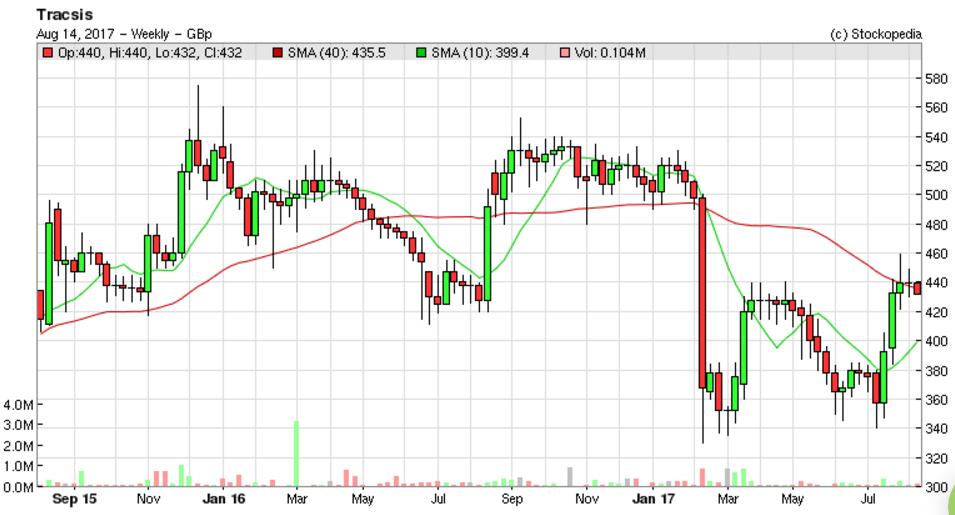
It has been a good share to buy on the dips though, as you can see from the 2-year chart below. I think the market has done a fairly good job, in pricing this share in accordance with the newsflow. It's tricky to trade though - I've found it very illiquid, and haven't been able to buy in any decent size, on those dips, despite trying!
I can't see anything else of interest within my remit today, so will sign off for the day.
Regards, Paul.
Disclaimer
This is not financial advice. Our content is intended to be used and must be used for information and education purposes only. Please read our disclaimer and terms and conditions to understand our obligations.

44 comments
TCM moved up more than 21% !?
http://www.stockopedia.com/share-prices/telit-communications-LON:TCM/news/rns/170831tcm3608p.htm/?title=telit-certifies-lte-cat-m1-with-att
In reply to Herbie47 #42 hi herbie47 Thanks very much for your information.It is my 2nd year with Stockopedia. I read quite a lot of your helful comments.It is the best place to learn.thanks again. Best regards. Kokpond
You are welcome.
gsbmba99
My final comments if it helps:
- Yes, I appreciate the narrative relating to on-trac and SEP come from our annual report but the statement regarding profit contribution 'had they been acquired in August 2015' is something we are required to include to show annualised revenue and profit contribution (as was) but this was not a forecast on what they would contribute going forwards which is what you seem to be assuming. As mentioned previously, on-trac in particular had a record year prior to acquisition so rolling these profits forward is incorrect. This was made very clear in the market forecasts and from the consideration that was paid.
- Secondly, all revenue and profit streams (whether acquired or existing) still need to be maintained going forwards and this performance is not assured. When we come together with a new business there will often be areas of overlap with revenue/service/people/process cannibalisation. Often this is by design for the greater good i.e. we might choose to kill/reduce a service line in one part of the business to help grow prospects elsewhere. Therefore, measurement of 'M&A' versus 'pure organic' is imprecise and in my view largely irrelevant without understanding the detail.
- What matters is that a company moves the dial from one year to the next without the balance sheet getting weakened or with dilution to shareholders.
The simplest way to do this is look at absolute growth from point A to point B and then adjust back for share dilution, debt, etc. If growth is achieved it doesn't make a bean of difference whether this came via existing revenue streams or new ones.
If you disagree with this point of view (and some people do) then ask yourself this. If Tracsis had not done these deals but instead spent the same amount of time and money developing products and services that delivered the same numbers, would you consider this growth? If the answer is yes then why is this different?
- Finally, with regards providing transparency to shareholders I would like to think we already do this in spades. The detail relating to the above will be covered in the annual report but naturally not in a year end trading update. We are always happy to engage with shareholders - both institutional and private - and I often meet people in Leeds or London should they wish to find out more about our business. To this end if you would like to meet in person I'd welcome the opportunity.
Best regards
J
Fascinating to see this dilemma from a small company perspective John, thanks for sharing.
I am in favour of you talking about shares you have shorted as it is an additional check for me in case I have missed something bad about a company. Please keep this up if you can.
The Sunday Times article on Purplebricks (LON:PURP) was mainly highlighting the sales of shares and options by people closely involved with the company, even the marketing officer of the Australian business. Their point seemed to be principally that sales by so many individuals with inside knowledge is puzzling.
Personally I find it somewhat difficult when to judge when a sale by an insider is a perfectly acceptable harvesting of profit for all the hard work and when to see it as a lack of faith in the future prospects for the share price.
(I hold no direct position; I have a small long position via collective investment)
RE: PURP
Whilst this has been a good investment so far, I believe that the wheels will start to come off the PURP story before long. The bottom line is, when you pay for an estate agency service up front, there is no real incentive for the company to actually sell your property. Reviews of the PURP service confirm that customer service/sales progression is very poor and there will probably be a big difference between properties under offer and completed sales. Also, the quality of the property particulars and photography that I have seen is generally below average. The PURP property "experts" probably lack the vital knowledge of the local market because they cover wide areas and the deferred payment/loan option is likely explained to potential customers in an opaque manner. Time will tell ...
hi jonesj
With a very smiley face on.
I get an email, I don't log on to get the information.
Comments show that those who want "to offer an opinion" are happy. Those who don't either find the mismash disappointing and put up with it or wander away. We have no data on the growth or possible growth of this blog, so who knows.
As to alternative timing; well they send out the email. I just receive it. I have to admit I seldom bother to review the email as it changes on the website (who has enough life?), as you kind of say, it is time dependant and the time has gone.
I shall now return my focus to a very fine Burgundy.
:-)
Smiley off.
While I would rather reports were done well rather than quickly, I think - and I don't know if this would be feasible, but if it is it'd be great if Ed fixed it so that a placeholder page was posted at 7am each day so subscribers could exchange views on the day's RNSes themselves, with Graham & Paul adding the reports later. That way we could also all request they look at various things early doors without clogging their twitter feeds.
Isn't matylda's daily thread fulfilling precisely that purpose?
http://www.stockopedia.com/content/i-read-the-news-today-oh-boy-14-aug-2017-207948/
Thanks for bringing that to my attention Crazycoops!
Re TCM was it Tom Winnifrith Or Simon cawkwell who flagged TCM originally?
Re: Tracsis (LON:TRCS), looking at the splits on H2 compared to last year, it seems they are reporting the same level of turnover i.e. £19m, and although H2 was stronger than H1, it pretty well always as it always weighted to the second half.
In fact I think H1 was stronger than the comparable prior year H1, which has helped make the uplift in total revenues for the year. But the impression given by the words in the statement may lead you believe that the H2 was stronger than last year, but actually they don't give the comparison, which is broadly flat. The words used are truthful, but arguably slightly artful in the impression they give unless you bother to do the comparison yourself.
I am holder so I found these results pretty uninspiring because the suggestion in the trading statement suggests a couple of divisions are starting to drive growth, whereas the splits seem to cast doubt on that. Maybe they are talking more about the order book at this stage?
This is a sensible company generating good cash, and pay a small divi, but it is not quite the growth wunderkind - at this stage- that it seemed to promise to be, which maybe isn't their fault, as perhaps the market rather decided that for them. At least they do not appear to be rushing into acquisitions for the sake of generating revenue growth headlines?
In the EBITDA adjustments for last year end there was a chunky figure for share based awards. I thought most of their reward policies were generally conservative, but I would be worried something is out of kilter if a big figure appears this year, because that might lead me to think there is more incentive for management to shape the results than there is in genuine performance to justify them.
I share some of your concerns.
If you go back to notes 5a) and 5b) from the 2016 annual report you will see the disclosures in relation to SEP and On-trac.
SEP - "In the period to 31 July 2016 the Company contributed revenue of £4.1m and pre tax profit of £0.15m to the Group’s results, excluding amortisation of associated intangible assets, exceptional costs and share based payments. If the acquisition had occurred on 1 August 2015, management estimates that the contribution to Group revenue would have been £5.4m and Group pre tax profit for the period of £0.35m." In other words, full year inclusion in FY17, assuming no growth, should have benefitted revenue by £1.3m and pre-exceptional PBT by £0.2m.
On-trac - "In the period to 31 July 2016 the Company contributed revenue of £3.2m and pre tax profit of £1.1m to the Group’s results, excluding amortisation of associated intangible assets, exceptional costs and share based payment charges. If the acquisition had occurred on 1 August 2015, management estimates that the contribution to Group revenue would have been £5.2m and Group pre tax profit for the period of £1.7m." In other words, full year inclusion in FY17, assuming no growth, should have benefitted revenue by £2.0m and pre-exceptional PBT by £0.6m.
For SEP and On-trac together, full year inclusion should have benefitted revenue by £3.3m and pre-exceptional PBT by £0.8m excluding any growth.
Given the above, my assumption was that the "core" business excluding SEP and On-trac declined modestly. I believe previous years have been impacted both positively and negatively by the timing of rail franchise bids and was hoping this was a contributing factor. However, the "good trading experienced throughout all parts of the business" doesn't make sense to me. I don't understand how this can be correct.
I also note the company doesn't disclose organic constant currency growth which I would expect. I am hoping that 2018 will be a better year.
Yes I agree the missing analysis is arguably 'organic growth' i.e. core growth before acquired revenue.
I can only think that in contrast to their trading statement in early 2017 which talked about lengthening sales cycles, they feel they have at least met 'market expectations' despite these longer sales cycles. I suppose that shows some resilience if true, but begs the question of what is underperforming?
Looks like we are going to have to wait until November to have a clearer picture.
gsbmba99
Again, responding as best I can:
1) When we bought SEP and On-trac we did not assume that the status quo trading figures for these business would roll forward and indeed the market forecasts reflected this assumption and so too did the price/consideration we paid. All businesses obviously have relative ups/downs and trading purple patches and we are wise to this with on-trac having just had a particularly spectacular record year.
2) Also, and this is important to note, the numbers we have to quote in an RNS (that you state above for SEP and on-trac) are the Companies House reported numbers for revenue and profit. Trading figures for private companies are almost always distorted due to management paying dividends which are typically taken in lieu of salary. In other words, most/all private companies choose divvies over salary but when we buy them we need to adjust this back i.e. pay higher salary costs as the divvies are no longer payable. For On-trac and SEP this was a significant number.
3) Finally, as you may have heard me discuss in the past, I make no distinction between organic Vs acquired growth and neither should anyone else PROVIDED that shareholders aren't paying for M&A via dilution.
From my position as CEO, it makes no difference whether we spend say £5M on buying a company that delivers £Xm profit or spending £5M on R&D and delivering the same profit. The reason people discount M&A is that it usually involves a fundraise (i.e. equivalent dilution so no net gain to investors) and carries execution risk. With Tracsis all M&A growth is funded from retained profit and our execution thus far has been as good (or perhaps even better) than our ability to utilise cash for internal product development.
The ultimate proof of this is clear in our numbers. Over 10 years on AIM we've only raised £4M in equity capital, are currently debt free with a cash pile of c £15M and have bought 8 profitable businesses that are paid for in full. If you choose to ignore this you are overlooking one of our key reasons of success.
Cheers
John
John,
Thank you for taking the time to respond to my post.
Perhaps my post wasn't clear, but the quotes I included were from the Tracsis annual report for the year ending 31 July 2016. These numbers represent the contributions from SEP and On-trac to Tracsis under Tracsis ownership for the period they were owned in the year ended 31 July 2016 and management's estimate of the contribution had they been owned for the entire year from 1 August 2015. I presume these numbers would reflect whatever adjustments to executive pay you made after the acquisitions were completed. So, my point that "for SEP and On-trac together, full year inclusion should have benefitted revenue by £3.3m and pre-exceptional PBT by £0.8m excluding any growth" is, I believe, still valid.
In responding to Trident's post you said: "It is incorrect to say that our revenues are ‘broadly flat’. Last year Group revenue was £31.4M (or £32.6M if you include the revenue from the business in Australia we sold). Our recent trading statement indicates revenue ‘in excess of £34m’." If I combine the benefit of full year inclusion for SEP and On-trac of £3.3m to the £31.4m you cite for last year, that gets me to £34.7m as the starting point for this year excluding any growth in SEP, On-trac or the "core" business (excluding the acquistions).
Perhaps this is a philosophical point but I suspect that most people would agree. If full year inclusion of SEP and On-trac is the only reason that the statutory accounts for this year show a higher revenue number than last year, I wouldn't consider that "growth" because nothing actually "grew". You just included more months of SEP and On-trac this year than last year. The management narrative doesn't seem to reflect this.
The trading statement refers to "good trading experienced throughout all parts of the business". I still don't understand how this can be true if the starting point for revenue this year (pro forma for full year SEP and On-trac inclusion) was £31.4m + £3.3m = £34.7m and the business delivered "in excess of £34m".
I certainly acknowledge that the company has done an excellent job of acquiring and integrating businesses using internally generated cash. I also think that there are potentially interesting prospects going forward. I wouldn't be a shareholder unless I did. I accept that you will continue to buy businesses that fit well strategically. I hope to benefit as a result.
There's a great quote in the most recent annual report for Immunodiagnostic Systems Holdings (LON:IDH) attributed to Warren Buffett. "At Berkshire full reporting means giving you the information which we would wish you to give to us if our positions were reversed." The Immunodiagnostic Systems Holdings (LON:IDH) annual report is also worth reading as it gives a remarkably frank assessment of their business. Their shareholder communications, as a whole, offer a very clear picture of all the moving parts, what went up and what went down, and what worked and what didn't.
Trident,
I'm not sure I understand all the points you make but by way of response:
• With regards H1 v H2 splits I think you may be forgetting that our H1 results this year (and H2 last year) were boosted by the impact of SEP and on-trac which were acquired in Sept ’16 and Dec ’16 respectively.
• It is incorrect to say that our revenues are ‘broadly flat’. Last year Group revenue was £31.4M (or £32.6M if you include the revenue from the business in Australia we sold). Our recent trading statement indicates revenue ‘in excess of £34m’. I concede 8% isn’t stellar top line growth but from my viewpoint it’s a good result in an otherwise quiet year that was impacted by all sorts of macro factors that slowed customer spending (i.e. Brexit, the election, Network Rail status, no franchise bidding, etc). Also, for what it's worth, I should reiterate that Tracsis doesn't, and never will, blindly chase revenue for the sake of revenue – we are a highly profitable technology company and pride ourselves on profit/cash growth first and foremost.
• Yes, there are share based payments going through the business. Part of this is an employee share scheme and part of this is a very typical Directors scheme that is directly aligned with delivering shareholder value (EPS and TSR) over a 3 year vesting period. Where management don’t deliver this potential cost isn’t payable i.e. the options lapse in full. Likewise if staff leave early the options lapse. The accounting for this cost getting recycled back into the business confuses me to be honest but our CFO would be happy to walk you through it. Whatever the case, I think this ‘cost’ should absolutely be adjusted back for the purpose of measuring performance as it is a non-cash item that is only payable where investors/shareholders also benefit (I appreciate opinion varies on this subject but this seems due to the myriad companies that pay ludicrous bonuses and stock awards to executives that have no relationship to shareholder benefit).
Hope this is useful.
Regards
John
I don't mind when you issue your reports, I just wish you would do it once, rather than keep adding to them at different times.
Images of "dogs" come to mind but I will not go there :-)
Bobo, if you want to read one completed report, well log in at about 8:00pm every day.
If you consider the information to be not time sensitive, that should work fine.
If you do consider the information to be time sensitive, well then Paul & Graham are correct to post as soon as they are ready.
For what it's worth, comments show most readers are happy with the current style -flexible timing but with consistent high quality.
Just to be clear, lying on your CV is fraud and can carry up to 10 years in jail as a criminal act.
Have the board contacted Mr Plod?
Paul, Your views on Telit are of great value. The traps you describe are the ones that I have [expensively] found for myself in the past 35 years of investing.
I am pleased that you describe shorts as well as longs.
If Stockopedia seek to limit dissemination of your short ideas, as people disagree and there is a commercial incentive for Stockopedia, the natural consequence, would be for them to encourage you to write glowing articles, when it is to their commercial benefit for you to do so, rather than your real views.
Their views appear ill thought out and should be reviewed.
Hi xxx,
I should emphasise that I have total editorial freedom in these reports.
Stockopedia don't interfere at all on a day-to-day basis. I can only recall a couple of instances where they asked me to tone down my negative comments on micro caps, and that was several years ago.
Both Globo & Quindell were very difficult for Stockopedia, because my extremely negative reporting on both companies, over a long period of time, understandably upset those subscribers who had foolishly bought long positions in those companies. What was despicable though, was that some (former) subscribers tried to blackmail Stockopedia into sacking me.
To their great credit, the bosses at Stockopedia backed me, rather than sacking me. Plus of course I was proven correct about both companies being utter rubbish! So sometimes it can be better to take some short term pain, in return for the long term gain.
I don't generally do very much shorting anyway, and usually on indices or large caps. It's too risky to short small caps, in my view. So this problem rarely arises anyway.
Regards, Paul.
The board: "evidence shows that an indictment was issued against Oozi Cats in the US"
Paul: "As I predicted, the allegations against the CEO (of having committed fraud in the USA, years ago, and fleeing the country) have been admitted to be true."
As I understand US legal terminology, doesn't that just mean he was charged with an offence (but not convicted) and thus that the allegations that he committed fraud are not necessarily true?
Clearly, he did lie to the board, though, and that is a different matter, and probably a sackable offence anyway.
Re TCM. I've followed your lead and sold although I do believe this will come good in the end. Caution says wait and see how things go, as you have pointed out very well, rather too many iffs at the moment. Alan Martin
Yes Quality is important zero need to rush these reports.
Thanks a lot
Richard
Telit.
Chapeau to Leon Boros for this one: "it's a dead Katz bounce"
Thanks everyone, it's the way I Telit...
https://m.youtube.com/watch?v=V-Ikob9agKs
Hi Paul
With regards your update note on Tracsis, I agree that re-stating market forecast numbers within an RNS would be useful but in my 10 years of running a PLC I have never found a house broker or PR firm who is happy to sign off on a release that includes these.
As you will know, market/consensus forecasts are not 'technically' owned by the company but rather by banks and analysts who follow the stock and it is deemed inappropriate for company management to re-quote these. Perhaps this is the City trying to keep this information within the institutional investor circles or perhaps it's just etiquette. No idea.
Like you, I don't really agree with this approach given a house broker takes their information directly from management (ergo, market forecasts are really management forecasts) but this seems to be the norm.
Obviously all of our institutions will receive a market update from the house analyst on the day of an RNS release which provides a reminder on forecasts but this info isn't typically available to private institutions. Going forward, I think the Research Tree initiative will solve this problem by publishing all broker notes from banks that subscribe but this won't provide universal coverage as some houses (typically the bigger, more prestigious ones I would wager) won't wish to take part.
Hope this is useful. As ever, PIs can contact me directly with any questions.
Cheers
John
(CEO, Tracsis PLC).
As I understand it, the reason why brokers generally discourage companies from including explicit references to expected profits is because these statements could fall under the Takeover Panel's profit forecast regime and may be required to be reported on in the event of an M&A transaction. Reporting on a profit forecast can sometimes be tricky (eg a company with lumpy revenue reporting on a full year forecast early in the fiscal year). Reporting on a profit forecast also previously required the directors to take responsibility for such profit forecast. This was particularly tricky for NEDs.
These rules were amended and relaxed by the Panel in 2013. There's a useful (if technical) presentation here ( http://www.thetakeoverpanel.org.uk/wp-content/uploads/2008/11/Profit-Forecasts-and-Quantified-Financial-Benefits-Statements.pdf ) and a PwC summary here ( http://www.pwc.co.uk/finance/capital-markets/changes-to-the-takeover-code.html ).
I gave you an up-tick, John, and it went from 1 to 12. Didn't know i carried so much weight!
I am a happy long term holder.
Richard
Hi John - Firstly let me say how refreshing it is to see a CEO take time out to reply in detail to PIs - the number of thumbs-up given to your post is ample proof of our appreciation.
I generally buy the argument that market forecasts are ultimately owned by the brokers, albeit that the base data comes from the company. So it would be inappropriate to show these in an interim statement. OK.
But I 'd like to come from a different direction to achieve the same purpose.
I have always maintained that the gold standard for market forecasts and guidance goes to Next (LON:NXT)
Here is an extract from their recent trading update
Now I appreciate that this is a £6bn market cap company, much larger than Tracsis. So the upper and lower ranges of your guidance would be wider.
In principle I do not see any reason why Tracsis or for that matter any AIM quoted company (bar the very small ones) cannot follow Next's lead.
Regards, Ram
Hi Ramridge,
I totally agree the Next format is much more transparent, and from my point of view I'd far rather include the forecasts so that any 'in line' or 'upgrade' statement can be evidenced back to hard numbers without question. Good companies will benefit from this and dodgy companies will get found out which I would love to see.
The problem with AIM is that most companies (I'm guessing >98%) only have the house broker writing on them so there is no such thing as consensus forecasts, or rather it is a consensus of 1! The house broker provides research to big institutions and high nets as part of the relationship with fees being paid so they will not want other people (such as Tracsis) quoting these openly in public statements.
Like I said previously, the market is definitely changing in this regard which can only be a good thing.
Cheers
John
I agree with Paul's comments on Telit. When I was running an accountancy practice it always wound me up once a year that I had to get the staff to tick off boxes and sign forms to say that they had never been charged with fraud, etc. Do you know I never employed anyone who had ever done anything wrong! I guess if you want to be a schoolteacher you tick off a form saying that you have never molested any children!
Re: IQE (LON:IQE). The CFO was questioned about this stock at a private investor's meeting by David Stredder, and he seemed to suggest the money raised by the CEO by pledging stock had been used to buy more stock. Obviously, I don't know the truth of that, but if correct doesn't sound like the behaviour of the Quindell scenario.
Since it looks to be a slow news day, Arcontech (LON:ARC) reported full year results today. Currently under the £10m market cap threshold for the blog but some really interesting characteristics.
A fair amount of clean up in the last 12 months with 125:1 share consolidation and balance sheet reconstruction to create distributable reserves. Maiden dividend of 1p announced.
Reasonable revenue growth which, combined with strong cost control, is bringing attractive growth in profitability. Contract terms are typically 3 years with annual payment in advance. This strikes me as extremely unusual for a company of its size. Generally good renewal rates and some impressive customers. Very significant cash balance (>100% revenue) partially offset by deferred income. R&D is expensed. CapEx very low. About £9m of tax loss carryforwards so won't be paying tax anytime soon. A not insignificant portion of profitability from r&d tax credits which are static so EPS growth looks a bit muted. Company recovering nicely from loss of 2nd largest customer due to early termination in 2H FY16. Customer revenues extremely concentrated with top 3 >50% of revenue.
New desktop product is now available and has been in trial with 5 tier 1 customers. So far only one customer has taken it up at one location though further roll-out with the customer possible.
As an income first investor, I like the potential for dividend growth ahead of EPS growth. The company's statement that it expects to maintain cash balance at this level (absent M&A or "exceptional items") implies that future cash generation above the current level could be returned to shareholders. I hold.
Hi Paul. Purplebricks (LON:PURP) seems to be gathering some negative momentum following harsh criticism in the media over the past week. Watchdog aside, the Sunday Times yesterday pointed out some supposed flaws in the numbers used by Purplebricks. One poster on LSE pointed out some inconsistences in these findings. I would be interested to hear your views? I would be quite angry if shoddy journalism has knocked this share down another 7%.
Hi Browndogwork,
Re Purplebricks (LON:PURP) (I hold a long position in this share). Incidentally, I also hold a long position in IQE (LON:IQE) but forgot to include that disclosure in my comment above, and unfortunately the site won't let me edit my comment now, hence me correcting that omission here.
The Watchdog allegations were pretty lame I thought - nothing of any substance. That resulted in the share price recovering rapidly in the days following the show. It's falling quite sharply again now. I think the key criticism of PURP is that they're concealing the number of transactions which actually complete. The suggestion is that this figure is probably a lot lower than sales which are agreed through its website.
To me it seems pretty obvious that the figure for sales which actually complete is bound to be a lot lower than sales agreed through the website. That's because loads of sales agreed fail to complete, for numerous reasons, regardless of who is the estate agent. A reader here commented that they had heard from a conventional estate agent, that usually only about a third of agreed sales actually complete.
Personally I'm not particularly bothered by the mud being slung at PURP. They're an estate agent, so of course they exaggerate, and paint a rosy picture - that's what all estate agents do, and we all know to take it with a pinch of salt!
I accept that PURP is a very volatile share, but for me it's a long-term hold now. They've cracked the UK market, and are miles ahead of any competitor, in terms of market share, website traffic, etc.
Australia seems to be going well, and the wild card is California, which launches soon.
So if things go the way I hope, then I think the negative comments about the company could be overtaken by continuing very strong growth.
Also, it you look at the detailed financial analysis in broker notes, it's striking how cash generative the business has already become, at a pre-marketing costs level. What this means is that the business is able to out-spend the competition on marketing, driving home its dominance.
So although there is arguably not yet a network effect (but there could be in future, if PURP becomes big enough to by-pass Rightmove), I see PURP's deep pockets for marketing as being a key competitive advantage.
PURP's business model is that if offers savvy sellers, with a simple property to sell, a more cost effective way to sell their home, and manage the process themselves, without an estate agent holding their hand. That will appeal to a lot of people.
However, I think PURP will undoubtedly end up with disappointed customers, if they (naively) expected to get a full estate agent service, for a fraction of the normal cost. So bears are right to point out that PURP's business model will result in some disgruntled customers, where PURP fails to achieve a sale, yet have taken the cash fee up-front.
So I think it could be a controversial business model. I hope the growth overwhelms those concerns though. Time will tell!
Regards, Paul.
Thanks Paul, and as always your comments are very interesting.
I think it's in the nature of disruptive companies such as Purplebricks (LON:PURP) to attract so much criticism; rather than nestle their way into a small segment of the pie, they have this ability to take a whole slab of it. It would be pretty hard to do this without ruffling a few feathers, especially when it involves upsetting other estate agents!
Cheers!
Hi Paul
I think that the Sunday times revealed directors were selling shares ahead of Watchdog programme, essentially large sales shares and the question is why? I hold a small position as not sure the volatility is for me
Good morning Paul
On the question of leadership behaviour, do you or any readers have any concerns about the CEO of IQE (LON:IQE) and the Equities first transaction he did three years ago that unwinds this October? https://www.shareprophets.com/views/8961/iqe-plc-some-additional-detail-on-transaction-with-equities-first-provided-but-significant-questions-still-to-be-answered
(I was long IQE)
Hi fwyburd,
That's an interesting question (about IQE's CEO having done one of those nasty transactions with Equities First).
To my mind, those Equities First deals seemed to be a sneaky way for Directors of dodgy companies (e.g. Quindell) to secretly dispose of shares, whilst concealing it from the market. EF modus operandi seemed to be to immediately sell the shares in the market, giving them a profit - as in most cases the shares would collapse in value, because the companies were usually rubbish.
However, in IQE's case, the share price has rocketed. So EF looks to be in a horrible mess, as my understanding is that they need to buy back the shares, at the now massively higher price.
I've no idea how that will pan out.
IQE seems to be a rare exception, in that it's clearly an excellent company. So quite why the CEO wanted to jump through hoops to sell & buy back his shares, I've no idea.
It seems to be the case that there are often exceptions to the rules with shares. Red flags like the EF deals do not necessarily make a share uninvestable. I'm coming round to the view that one red flag on its own (as in this case with IQE) does not necessarily make a share uninvestable. However, where there are a whole series of red flags, then that does make a share uninvestable.
Regards, Paul.
fwyburd,
IQE (LON:IQE) You were long. Me too, bought in teens, sold in thirties, should have held on, BMUS could have taken them off me for about three times what I got. But I do sleep better at night!
Regards, Seadoc