Small Cap Value Report (Mon 8 Feb 2021) - OTB, FCCN, BOO, LOOP, UPGS, TRX

Good morning, it’s Paul & Jack here with the SCVR for Monday.
Timing - TBC
Agenda -
On The Beach (LON:OTB) - Trading Update - from Friday last week, which I looked at over the weekend.
French Connection (LON:FCCN) (I hold) - Mike Ashley ( Frasers (LON:FRAS) ) dumps his entire 25% stake - who's bought it then? We don't know yet.
Boohoo (LON:BOO) (I hold) - confirms that it is buying Arcadia brands Wallis, Dorothy Perkins, and Burton out of administration, with completion of the deal set for tomorrow, 9 Feb 2021.
Loopup (LON:LOOP) (I hold) - in line trading update, but a big deterioration in H2 vs H1
Up Global Sourcing Holdings (LON:UPGS) - another strong trading update
Contribution from Jack :
Tissue Regenix (LON:TRX) - Trading update for FY 12/2020
Mello Monday tonight
The popular investor evening on Zoom is back.
I’ve been roped in to comment on the BASH session at the end, to give Jack a break!
One of the companies presenting is Scs (LON:SCS) (I hold) so I’m looking forward to that one. It’s a boring value share, but looks well set to resume paying good divis in future, in my view. So I think this could be one for readers to consider researching, as a long-term income share, e.g. for SIPPs in drawdown. The share price never seems to go anywhere much, so probably not of interest to people who like to trade in & out of things. Anyway, see what you think of management this evening.
David Hornsby of Ideagen (LON:IDEA) is retiring soon apparently. Investors that backed him following his first Mello presentation would now be 25 times the richer, and he's entertained us along the way too! What next? David will hopefully share his thoughts on the next entrepreneurial journey with Mello viewers and also reveal how he sets about delivering amazing returns for investors.
You can see the full programme and recordings of some previous shows here
https://melloevents.com/mellomonday-8th-february-2021/
Discount code for Stockopedia subscribers: MMStocko21
.
On The Beach (LON:OTB)
355p - mkt cap £559m
On the Beach Group plc (LSE: OTB.L), the UK's leading online retailer for beach holidays, today issues the following trading update for the four months to 31 January 2021
This sounds very negative -
… consumer demand for forward holidays has remained very weak with UK traffic, bookings and spend on online marketing activity across the first four months of the financial year down 73%, 83% and 85% respectively.
Rather confusing wording there, I couldn’t work out why they only give 3 figures, for 4 months. Then I realised what they’re trying to say is this -
Traffic (website?) down 73%
Bookings down 83%
Online marketing activity down 85%
That sounds awful. I thought that the public were booking up holidays in their droves, in anticipation of the lifting of restrictions? OTB isn’t seeing that, at all. Quite the opposite.
Outlook -
We expect booking demand to remain weak until these restrictions are lifted and vaccine deployment is more widespread, both in the UK and our major travel destinations, which will impact H1 and full year performance…
the Board believes that booking volumes will remain weak through H1 and into H2. Following the prudent activities undertaken in the last financial year, the Group remains in a strong and debt-free financial position.
No guidance provided, due to market uncertainties.
Cash position - £39m as at 31 Jan 2021.
Undrawn £75m bank facility.
Monthly cash burn (at zero revenues) is £2m
Therefore liquidity sounds fine - it could tread water for a long time in current conditions.
My opinion - I’m quite shocked by this, as it seems completely at odds with the positive recent update from Saga (LON:SAGA) (I hold), which indicated strong retention (of customer bookings happy to defer their cruise rather than cancel), and strong pent-up demand, e.g.
Saga said -
Customer retention across both businesses remains high; the average proportion of Cruise guests who have re-booked rather than take a refund stands at an average of 69% through the travel suspension period, but rose to 86% more recently, showing the pent up demand for Cruise amongst our guests who will benefit from the first round of the vaccine roll out.
Customer demand has also been very resilient, with £140m of total Cruise bookings as at 23 January, representing 68% and 28% of the latest revenue targets for 2021/22 and 2022/23 respectively.
[Saga trading update, 26 Jan 2021]
That seems completely at odds with OTB saying demand has almost completely dried up for their package holidays website.
My opinion - from what I can make out, it sounds like the over-50s are eager to get on cruise ships again, but people generally don’t seem to be booking beach holidays (yet).
I’ve just visited OnTheBeach website, and put in some random dates in August, and November 2021 for holiday bookings, and the only place that comes up is Cape Verde. That’s it, nothing else. So it seems as if the website is basically shut down, or on hold almost completely at the moment.
It’s only burning £2m per month, which is nothing really, given that it has £39m cash in the bank. Therefore, does it really matter when holiday demand returns? If it’s another 6 months, which seems pessimistic to me, then £12m cash would be burned over that period, making a dent in the £39m cash pile, but not really material to the £559m market cap.
If the share price recovers to pre-covid levels, then 500p might be on the cards again. Although with every company we need to check that the share count hasn’t gone up in the last year. In this case, the share count has risen, by about 20%, in a placing at 257.5p in May 2020. Therefore the share price may not necessarily regain the 500p level on the chart, given that would equate to a 20% higher market cap than before covid. I wonder if some people might buy the shares without realising that? We are in a bull market after all, and people sometimes don’t check the small print in markets like this, and end up inadvertently over-paying. Always double-check the share count!
.

.
Overall I can’t get excited about OTB, with so much upside already priced-in. I think there’s possibly better upside on my existing position in SAGA.
.
French Connection (LON:FCCN)
(I hold)
25.7p - mkt cap £24.8m
The reason for an unusual rise in share price last Thursday was revealed on Friday, when the company admitted it had received two possible bid approaches from named investment firms - see Friday's SCVR.
The shares were held mainly by two key investors - the founder, Stephen Marks, holds 41.5%, and Mike Ashley's Frasers (LON:FRAS) held 24.9%. Therefore any bid approaches would we a done deal if both agreed on the terms.
Things have been mixed up a bit this morning, with an announcement that Frasers has sold its entire stake, and did so on Thursday 4 Feb 2021, last week. It's not a big surprise, as they had been dribbling out bits previously. Although that the whole lot has been sold is quite a surprise.
It remains to be seen which party or parties has bought this stake. I noted an extraordinary volume of trades in this micro cap last week, It will certainly be interesting to see how this pans out.
I've been highlighting the sum-of-the-parts value here, and the likelihood that the 75-year old founder would eventually sell, since before the dawn of time, it feels like! Still it's nice to see a plan come together. I hope a few readers hung on here, and recouped previous losses. Or even made some money, if you bought near the lows in March 2020, which amazingly were about 4p at one point I think.
Let's see what happens. I'm guessing we'll have more Holding in Company RNSs this week, given that the second largest shareholder has sold out. Rightly or wrongly, I'm sitting tight for now, and haven't sold any. If it keeps rising, I might be tempted to top-slice, as it's already getting a bit toppy in terms of portfolio weighting, hence am keeping my options open. So please bear in mind that my opinions expressed here are at this particular point in time, and subject to change as the situation develops. I'll keep you posted though, and obviously as always, please make up your own minds.
.
Boohoo (LON:BOO)
(I hold)
365p - mkt cap £4.6bn
Acquisition of Dorothy Perkins, Wallis & Burton
boohoo, a leading online fashion retailer, is pleased to announce that it has agreed to acquire all of the e-commerce and digital assets and associated intellectual property rights, including customer data, related business information and inventory of the Burton, Dorothy Perkins and Wallis brands ("the Brands") from the joint administrators of Arcadia Group Limited (in administration) and its relevant subsidiaries ("the Transaction"). boohoo will pay £25.2 million in cash, funded from existing cash resources, on completion.
I don't think the stock market has yet grasped how significant this deal, and the acquisition of Debenhams are going to be for BOO. It greatly expands the group's demographics, and should see a step-change in scale of the group once these new brands are absorbed into the BooHoo machine.
Therefore, over time, I reckon we should see large increases in forecast revenues & profits.
Remember that these brands were already trading online, with a big customer base. In the case of Debenhams, the annual online revenues were about £400m, or £300m if we take off click & collect in-store. Put that on BOO's usual 10% EBITDA margin, and it's a potentially £30m boost to profits. Add onto that the growth that BOO's expertise in product & marketing should bring over time, and the £55m acquisition price for DEB could end up looking a remarkable bargain.
Ditto with the 3 additional brands acquired today. At the end of today's announcement, it refers to revenues of £178.8m for the "continuing businesses" for FY 08/2020. Presumably that means online sales, as that's the continuing business. {Edit: also wholesaling, as today's Zeus note points out]
That's equivalent to an additional 14% revenues on BooHoo group's £1,235m revenues for its FY 02/2020. Add that on to the c.£300m additional revenues bought in from DEB, and we're looking at £479m of additional, annual revenues bought in. That's assuming under BooHoo ownership the 4 new brands just match historic online revenues. In practise, I suggest they'll be aiming to grow the historic revenues, aggressively.
Once all this starts to feed into analyst forecasts, I think we could see a big re-rating of the shares, to reflect a much faster growth rate.
Online sales tax - this is a potential negative for all online retailers. Press reports suggest that the Govt might be succumbing to muddle-headed thinking, that online retailers have a cost advantage by not paying much in business rates.
This is complete nonsense, since it isolates just one cost, whilst ignoring other differences in business models. Online retailers do pay less business rates, yes. However, they pay about the same amount (c.8% of sales) in online marketing costs that physical retailers pay in rent+rates. Physical retailers have the customers come to them - which they pay rent & rates for. Online retailers have to fund substantial online marketing costs, to draw customers to their websites. It's directly equivalent. One a physical shopfront with heavy costs, the other a virtual shopfront, also with heavy costs to attract customers.
Also, online retailers have to fund 40-50% customer returns (two lots of packing, handling & postage costs, and all the logistics involved), whereas physical retailers enjoy a sub 10% returns rate.
When you compare the two business models in their entirety, online retailers don't have a cost advantage at all. That's why so few online retailers actually make a decent profit! Let's hope the online retailers explain this point to the Govt. The fact is that any additional taxes on online sales would just be passed on to customers.
What High Streets need more than anything, is more flexible leases, so that rental costs can fall when times are hard. That's what is driving the High Street out of business, on top of covid lockdowns. Ultimately customers vote with their feet - people want to buy more stuff online, which inevitably means there's less market share for physical retailers. I can't see the point in Govt action to attempt to stand in the way of this tide. We need fewer physical retailers, to match reduced demand. It's not rocket science!
.
Loopup (LON:LOOP)
(I hold)
78p (up 1%, at 09:34) - mkt cap £44m
LoopUp Group plc (AIM: LOOP), the cloud platform for premium external communications, is pleased to provide the following trading update.
No change from previous guidance, by the looks of it -
In line with the trading statement of 27 November 2020, the Group can now confirm that it expects revenue for year ended 31 December 2020 to be approximately £50.2 million (FY2019: £42.5 million) and EBITDA to be approximately £15.3 million (FY2019: £6.4 million).
I really dislike it when companies report EBITDA, as that forces me to check the last accounts to see how much they’re capitalising into intangibles, to find out what real profits are.
Looking back at H1, it made £12.2m adj EBITDA, which turned into £9.2m adj operating profit. So there’s £3.0m per half year, in depreciation & amortisation of capitalised development costs, which to my mind renders EBITDA meaningless.
Also note that in H1 capitalised development spend of £3.2m exceeded amortisation of development spend of £2.2m, so this accounting treatment is certainly flattering reported profits above what I see as real-world cash profits.
What I don’t really understand, is why LOOP had such a spectacularly good H1, then went backwards significantly in H2? This is why the share price soared, then crashed last year, unfortunately taking some of my money with it (my avg buy price of 158p after excellent H1 trading updates, is looking sickly now, with a 51% running loss).
Here is the split this year, using figures I've compiled from today’s TU and the interim results:
£m’s | H1 | H2 | FY 12/2020 |
Revenues | 31.9 | 18.3 | 50.2 |
Adj EBITDA | 12.2 | 3.1 | 15.3 |
As you can see, that’s a fabulous H1, then a relatively poor H2. Operational gearing plays its part there, working in reverse.
Liquidity - looks fine, with net debt of £0.7m, down dramatically from £11.5m a year earlier, although nothing is said about whether any creditors have been stretched, so without that information we can’t rely on the net debt figure being reliable as a long-term position.
Diary date - 23 March 2021, for FY 12/2021 results.
My opinion - I feel in the dark here, not really knowing what is driving these gyrations in business performance. Clearly LOOP had a spectacularly good lockdown 1, but a significant number of users must have then decided to use an alternative product in H2 - Teams, or Zoom, maybe?
The idea with LOOP is that it’s a high-end, secure system, which is why firms of solicitors & accountants are prepared to pay a lot to use it. Maybe investors should talk to any contacts we have in that space, to anecdotally get a handle on what's going on? That might give a clearer view than what LOOP tells us, possibly?
Management made a big song & dance last year about their telephony add-on for Microsoft Teams being terrifically exciting. They don't say anything about that today.
For me the big question is whether it’s a busted flush, and I should sell up and move on? On balance, with the market cap only £44m, and net debt eliminated (hence should be no insolvency risk) and an easily variable cost base (mostly people), then I’m going to stick with it & see what happens. It’s less than 1% of my portfolio, so not a big deal either way. Also, last year when I sold out in despair, it 4-bagged within about 3 months! So it seems to just be one of those unlucky shares, where doing the opposite of what I do, would be highly profitable. You can't let these things get to you, it goes with the territory sometimes.
.
.
Up Global Sourcing Holdings (LON:UPGS)
140p (up 4%, at 11:48) - mkt cap £115m
Ultimate Products, the owner, manager, designer and developer of an extensive range of value-focused consumer goods brands, announces the following trading update for the six months ended 31 January 2021 ("the period").
This looks good -
- H1 revenues up 11.4% to £75.4m
- Online & supermarket channels doing particularly well
- Beldray brand is stand-out performer, and other homewares popular
- Net debt almost eliminated now, at £(1.5)m
- Plenty of liquidity headroom, at £25.5m
Outlook for FY 07/2021 -
- Continuing momentum in order book
- FY will be ahead of current expectations
- Higher shipping costs from China mentioned, but seems to be baked into the revised guidance, the way I’m reading it
Revised guidance for FY 07/2021 -
While the Group is currently seeing an increase in shipping rates ahead of the start of the Chinese New Year on 12 February (in common with all businesses that source product from China), the Board nevertheless currently expects that underlying EBITDA for FY21 will be in excess of £12.6m (FY20: £10.4m) with underlying PBT in excess of £10.3m (FY20: £8.2m).
I was about to go off on one, about EBITDA again, but they kindly included my preferred measure of underlying PBT also, so I can calm down again!
Adj EPS would have been a helpful disclosure.
Research update - from Equity Development, forecasts 10.1p adj EPS this year, up from 7.9p last year. At 140p per share, the PER is 13.9 - that looks decent value to me. Assuming that this increased level of profits is sustainable, and not a one-off boost from people having less to spend their money on during lockdown?
Dividend - the forecast divi of 5.1p gives a yield of 3.6% - healthy, when interest rates are low.
Diary date - 30 April 2021 for FY 07/2021 results publication.
Balance sheet - looks fine, no issues here.
My opinion - a very nice company, performing well, and repeatedly issuing positive updates. Hence I can see why UPGS shareholders would be happy with progress.
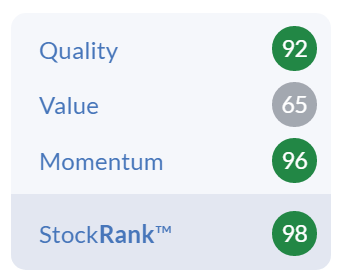
Very high StockRank gives us nice confirmation of my positive view -
.
Jack’s section
Tissue Regenix (LON:TRX)
Share price: 0.67p (-10.6%)
Shares in issue: 7,033,077,499
Market cap: £47m
(I hold)
Tissue Regenix (LON:TRX) is a medical technology company spun out of Leeds University in 2006. It focuses on regenerative products based on its two platform technologies (dCell and BioRinse). The tech is to do with providing organic donor scaffolds for wound care (as well as other things), but, crucially, it strips these scaffolds of foreign DNA and cellular materials so that the patient’s body can build on them.
It’s not as complicated as I probably just made it sound. Here’s a two minute video about dCell in particular, which is used in both the group’s Orthopaedics and Biosurgery divisions.
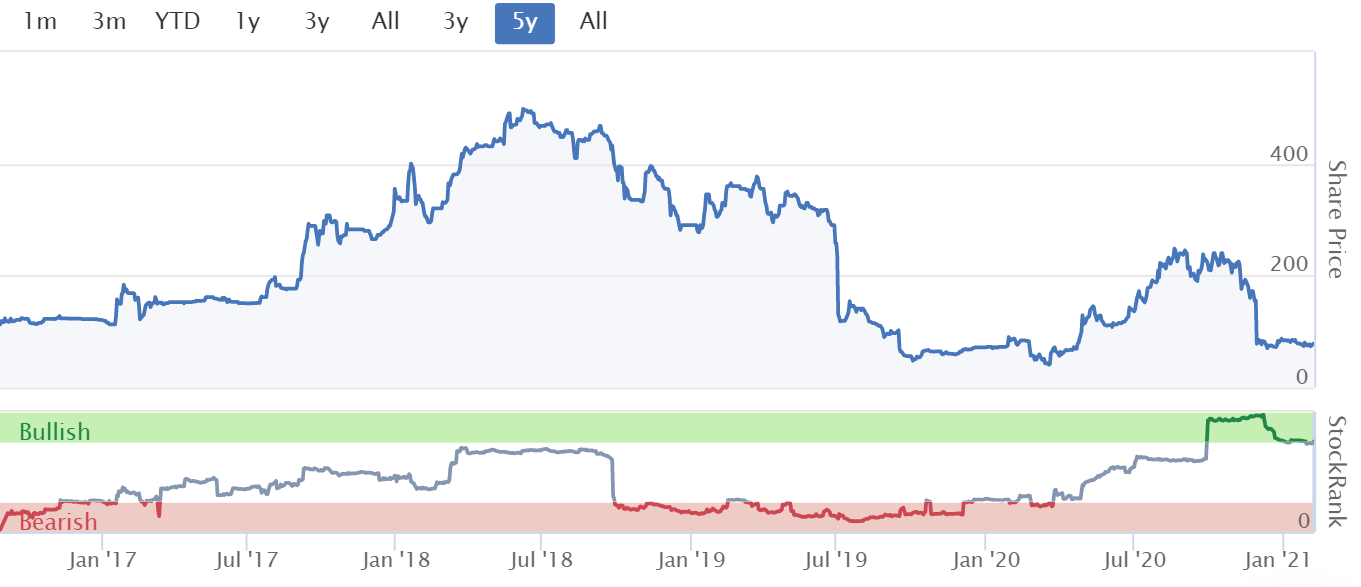
TRX has been on quite a journey as a listed company - one that will immediately turn off more risk averse investors. The share price chart below should give a sense of the risks.

To recap:
- TRX IPOd at multiples of the current share price despite having far less revenue, based purely on the commercial potential of its technology,
- It then generated years of substantial net losses as it developed its medical products,

- It has had to repeatedly tap shareholders for cash,

- At the same time, its share price has been dragged down by the Neil Woodford saga.
The company is forecast to continue making losses, but its price/sales valuation has never been better and TRX does still have great products directed at big markets (the Global Regenerative Medicine Market is expected to be worth $81bn by 2023).
Revenue has been increasing (albeit that trend has been hit by Covid), and the company recently raised c£9m of cash.

A lot of lessons have been learnt over the past few years, so you are essentially paying a lot less for a lot more revenue, and a management team more focused on commercialising its portfolio, with a share price that has been depressed by a distressed large seller.
It’s far from a slam dunk and is still very risky, hence a small holding only, but the risk:reward here is better than it has been in years. The shares have been strong in recent weeks though, possibly too strong, and being down c10% today isn’t too surprising.
Trading update for the year ended 31 December 2020
Total revenue of £12.8m is in line with revised guidance. There’s a strong cash position now of £9.5m following the fundraise in June 2020. But it’s important to note that TRX is still loss-making and has been so for many years.
However there are signs of growth capex and a more commercial mindset, with TRX’s capacity expansion project in San Antonio on schedule and ‘additional commercial partnerships and product launches undertaken’.
Phase 1 of the San Antonio build out began in July 2020 and remains on schedule to come onstream during H1 2021. This will allow for a c.50% increase in the BioRinse® (CellRight) processing capacity, as well as allowing improvements in the Dermis and Amnion throughput.
In the meantime, steady revenue is a fairly good result in an industry where many companies experienced a downturn in demand as hospital resources were redirected and many elective surgical procedures were postponed.
TRX is observing a slight uptick in the recommencement of these procedures, ‘however, it remains difficult to predict at what pace a return to pre-pandemic procedure levels will occur.’
There will be further cost-cutting - a restructuring of the US business is expected to reduce the overhead cost base by some c.$700k on an annualised basis. Additionally, the group’s UK manufacturing operations have been relocated to smaller premises in Garforth, ‘with many aspects of the OrthoPure® XT production process successfully outsourced’. This new facility should become operational in Q1 of this year and will contribute a further £400k in annualised overhead cost savings.
It makes you wonder how this group’s cost base has been managed in the past, but on the plus side, that makes for around £1m in annualised savings to be achieved by the end of 2021.
Conclusion
Having followed this company for a few years (as a Leeds uni spin out), there does seem to be a shift in management language towards a more commercial mindset. That, along with a much reduced market cap, makes it worth a look.
In May, a white label manufacturing agreement was concluded with a top 10 global healthcare company for the launch of a new soft tissue orthopaedic product. Sales traction here is anticipated to increase throughout 2021 as levels of procedures begin to normalise.
There have been additional, smaller white label agreements as well, but there is still that key assumption of ‘normalisation’ to bear in mind.
And TRX remains a heavily loss-making medical tech stock that has consistently diluted shareholders in the past. As such, profit-taking on a strong recent share price is not too surprising and it is quite possible that at 75p, TRX was getting ahead of itself.
I’m happy to let this one run and give the management team a chance to execute. The board and executive management team have undergone a number of changes in recent months and the company is well capitalised to invest in growth and capacity expansion.
It’s still very high risk and has it all to prove, hence the small, speculative holding. That makes the volatility far easier to handle.
Disclaimer
This is not financial advice. Our content is intended to be used and must be used for information and education purposes only. Please read our disclaimer and terms and conditions to understand our obligations.

143 comments
As the week progresses, I am looking at the divergence in updates of On The Beach (LON:OTB) and Saga (LON:SAGA) where it appears the former is recognizing the issues around Government announcements relating to Foreign travel and the latter has yet to take this into account. Saga (LON:SAGA) is most definitely rolling over the 2020 bookings but clearly the effect of loosing travel time through to June currently is just recirculating 'old money'. They have additional sources through Insurance etc but, for the travel sector, new additional bookings will be very much required. The fact that #SAGA have said that Customer retention across both businesses remains high; the average proportion of Cruise guests who have re-booked rather than take a refund stands at an average of 69% through the travel suspension period, but rose to 86% more recently, showing the pent up demand for Cruise amongst our guests who will benefit from the first round of the vaccine roll out has not taken account of the need for additional new monies. Also, the vaccine roll out in other countries is very much lower at the current time. Hopefully, this will accelerate because this will add to the delay in opening up the sector. BUT, here is what has not been picked up by that #SAGA update. MANY of their customers whilst eager to return to the seas and other holidays rolled over their monies from 2020, re-booking 2021. Those roll overs between now and June are themselves being cancelled. We have spoken directly to the Covid weary agents dealing with this. Our view is that #OTB has given a more realistic perspective of what is ACTUALLY happening. We continue to hold off from investments in this area as we research fully all information available.
Hi Roy
Our view is that On The Beach (LON:OTB) has given a more realistic perspective of what is ACTUALLY happening. We continue to hold off from investments in this area as we research fully all information available.
Who are "we"?
Anyway, independently of this I sold both On The Beach (LON:OTB) and Saga (LON:SAGA) today. There are too many uncertainties around the rest of 2021 to be comfortable in the overseas travel sector.
timarr
Notice Tesla got publicity today for buying $1.5bn of Bitcoin - and sent it rocketing.
They also mooted accepting payment for their cars in Bitcoin.
This is what I don't understand.
The powers that be will warn about Bitcoin investing but won't get involved - caveat emptor. If people start actually buying things with Bitcoin then the Money Laundering laws come into play - as far as I understand, as a fundamental principle, the source of Bitcoin funds are untraceable. Therefore surely the DoJ in the US will start investigating Tesla and probably fine them - $1.5bn seems like a good number.
Bemused
Phil
Re Tesla Bitcoin
This sounds like a crazy move from a James Bond villain who fears his game is up. Its either genius or insanity.
Checklist:-
- Exotic cars
- Exotic locations
- Space ships
- Insane AI
- Masterplan
...
Maniacal laugh?
Looks as though MA’s 25% holding in French Connection (LON:FCCN) has been picked up in a single bloc by a Mr Apinder Singh from Newcastle.
https://www.stockopedia.com/sh...
No immediately obvious link apparent to the two bidders already disclosed so potentially a third player or perhaps just a HNW punter with access to Mike Ashley’s ear wanting to take a stake in the game. Company search suggests interests in clothing/retail so possibly more than just a speculative punt. Time will tell.
#boo Nice to see no job losses resulting from purchases by Asos and City Chic. Only nasty BooHoo. Lol
#boo Nice to see no job losses resulting from purchases by Asos and City Chic. Only nasty BooHoo. Lol
13,000 lost their jobs as a result of the ASOS takeover of Arcadia brands (including my daughter). So no idea what you're talking about.
timarr
That's the exact point the OP is making. Despite there being job losses resulting from ASOS's purchases there is no mention of it in the BBC article. Only job losses relating to the BooHoo purchase. I assume the conclusion OP is suggesting is there is media bias against BooHoo.
Admittedly I'm guessing the article relates solely to BooHoo which may explain why this is the case.
That's the exact point the OP is making. Despite there being job losses resulting from ASOS's purchases there is no mention of it in the BBC article. Only job losses relating to the BooHoo purchase. I assume the conclusion OP is suggesting is there is media bias against BooHoo.
D'oh! Fair point. Personal bias no doubt played a part in my response :-/
Appropriate apologies to the OP.
timarr
Timarr, Hope your daughter finds another job soon.
Timarr, Hope your daughter finds another job soon.
Hi Berksbee
Aw, thank you.
She was a bit unlucky - she was on the digital team, but Asos got rid of everyone. Any of the other bidders she'd have been kept on. It's disappointing for her but she's in a lot better position than the people from head office or the shops, who are in a massive scramble for a very limited number of jobs.
It's tough out there.
timarr
It seems as though their plan is to operate the Topshop brands from the asos site. I'm not sure why they aren't maintaining standalone websites/ apps etc I think it's a bit like boarding up a few display windows in a shop personally.
It seems as though their plan is to operate the Topshop brands from the asos site. I'm not sure why they aren't maintaining standalone websites/ apps etc I think it's a bit like boarding up a few display windows in a shop personally.
Yep, that's right. I listened to the analyst call and their position was (roughly) that the ASOS website gets a billion hits year and the Topshop websites about 50 million (which tells you why Topshop went bust when their stores were forceably closed), so the latter is a rounding error for the former. They kept the social media team.
It did seem a bit head scratching to close the existing websites instantly, but that's what they've done. They've just stuck a redirect notice on the old Topshop website.
timarr
I see Tesla has bought $1.5bn bitcoin. ...."trying to maximise returns on cash that is not being used in day-to-day running of the company"
I'm surprised that they didn't buy Dogecoins given Elon Musk's recent tweets!
For those who are into their PGMs, appears that PGM is nearing if not at all time highs, despite being Chinese NY (Chinese off for a big holiday and are the biggest consumers of PGM). Rhodium and Iridium also priced very high.
Hence, after a recent breather, Sylvania Platinum (LON:SLP) and Tharisa (LON:THS) are on the move again (just bought back into them today). I noticed heavier buys for Tharisa (LON:THS) today compared to recent days.
Up Global Sourcing Holdings (LON:UPGS)
See this post from Nov 2020 for recent comment:
https://www.stockopedia.com/co...
I've pulled out the underlying growth figures by segment from post here:
Some summary stats on underlying revenue growth patterns are interesting:
Cumulative revenue growth CAGRs by category (reporting year first broken out in data) + [2020 %age of total revenue]:
Total 14.0% (2014) [100%]
UK 9.2% (2015) [64.0%]
Europe 30.9% (2015) [35.2%]
Germany 99.1% (2016) [9.5%]
Europe ex Germany 15.7% (2016) [25.7%]
Supermarkets 51.7% (2016) [24.3%]
Discount retailers 3.7% (2016) [38.6%]
Online 56.3% (2016) [14.4%] (& note that in H2 2020 was 18.8%, expected c.20% H1 2021)
Premier brands 27.6% (2014) [69.9%]
Other key brands 8.6% (2014) [14.3%]
Other (lesser) brands and own label -4.5% (2014) [15.7% -> from 45.5%]
It's interesting to note that the only categories to report positive absolute YoY growth in every year (so including poor 2018) are Supermarkets, online and Germany. Obviously, there's a base effect in that these three categories came from lower levels.
It's informative for why growth surprises have been persistent. Time will tell but it looks like UPGS may be at a point of inflexion upwards in terms of top line growth as the business matures out of some prior 'commodity product' areas that have seen attrition in sales.
UPGS tend to guide conservatively so the guidance of >£135m sales (>£20m YoY growth) is quite punchy for them suggesting that order book is really quite strong. They didn't mention Europe in this release but will be interesting to see what they report at presentations in coming weeks and when interims come out. I note that the CEO was very positive on Europe before year end.
The low debt despite high order flow shows that cash generation is good even though half is paid to dividend and so increasingly have retained cash cycling through working capital which is good for robustness.
Business rates help fund our local services and have been around in some form since the Poor Laws in the 16th Century. None of the money ends up in Central Government coffers. Instead it is distributed to all local Councils by a distribution formula. The amounts charged can be substantial. I remember the Finance Director of M and S explaining why they were closing a booming food store in Central London. The store was constantly packed and they made a good profit but the business rates cost was too much...."we are selling sandwiches" he said.
Of course online retailers should pay towards local services; they and their staff benefit substantially. Most of us have benefited from the fact that Council Tax bands have not been revalued for nearly 30 years. Business rates helps those who cannot afford to pay their Council Tax; mostly the elderly and those with long term disabilities.
I am clearly biased having worked in the local government area for most of my working life but I think all business has to pay fairly and reasonably towards our local services and that includes on line too.
On a fairly quiet Monday, let’s try a little quiz. Which small to mid-cap business do you believe has the strongest moat?
I would suggest that Bioventix (LON:BVXP) has a pretty good moat.
I don't hold it, and I'm not saying it's good value at the current price, but it's hard to see any newcomer invading its space.
Well said Gostevie, when I read the question Bioventix (LON:BVXP) immediately sprung to mind to me too. (I'm a holder and thinking of adding to my position.)
The long term tie in for medical approvals on their products was explained by Peter Harrison (CEO) as to why they don't take out patents on their products. It would take many years for a competitor to get the regulatory approval and even then would customers be willing to move to the new competitor.
It’s a great company. I always struggle with the question “How much do I really know about the world of sheep monoclonal antibodies (or other animal monoclonal antibodies)?” and that has kept me from investing to date.
You'd be better off setting up a separate thread for that :)
"On a fairly quiet Monday.." yours is post 92 and we only had 94 in the whole of last Monday. Agree with IGPJ - start your own thread (and as a separate topic it will survive longer term than hidden in reports for one day).
What High Streets need more than anything, is more flexible leases, so that rental costs can fall when times are hard.
I do not see this as a get out of jail free card.
Paul. Being a commercial landlord means low risk low fixed yield. A gold plated tenant can command a lower rent because the landlord will have more confidence that they will pay and won't bugger them about. A tenant trying to wriggle out of paying needs to then pay a higher rent. This is precisely the reason why the yield on say a doctors surgery is lower than say the yield on a cafe. A sensible landlord will look at the strength of the tenant covenant and a turnover based rent because the tenant is wary about future performance has to weaken the covenant. Moreover a turnover rent will impact adversely on a landlords leverage costs which would then have to be recovered from the tenant by way of increased rent at the intiial negotiation. I just don't get it. The legal costs involved in setting one of these up would not be insubstantial either. I simply cannot conceive of a situation where a trend towards turnover rent is not ultimately going to be significatly inflationary both for the market generally as well as the tenant concened.
Turnover rents are an absolute minefield, specifically how much scrutiny the landlord then needs of the tenants books, the whole area of where the turnover is actually recorded in a multi-site or even multi-platform business. I could also argue that a turnover rent essentially becomes a variable cost of sale.....and the boot then ends up on the other foot when trade is going well. It is not a one way street. If you want the landlord to share the risk they have to share the upside as well.
A turnover rent has to mean the management are not confident about future performance and gets a sell vote from me. If anything I would argue that rules should be strengthened to stop companies going down the CVA route and throwing the landlord under the bus. There seems to be a general perception that landlord means anonymous punch bag. Being a high street landlord must be tough at the moment.
If I was a high street landlord at the moment with a tenant coming to me with this request I can tell you that the upside would have to be uncapped, that the formula would be progressive and that it would be calculated to give me a better overall yield. A 6% yield would become a 10% yield. I would be looking for guarantors and I would be looking for break clauses being bilateral rather than unilateral as a quid pro quo so that I could go for a more profitable tenant if I felt like it.
No doubt some landlords will go for it, it may even be more attractive than an open market rent review mechanism at the moment but I am doubtful it will save the high street. The issue here is more that crap zombie companies should be allowed to fail is it not? (The current Covid crisis is exceptional. I think most landlords will be being flexible at the moment if they can see it is in their interest)
Interesting that you have mentionedLON : TRX Tissue Regenix, I held these shares about 4 years ago and sold them all at about 15p each, I liked them then as like you could see the positives in they are used for treating wounds that wouldn't heal using the sterile platforms scaffold, but they just kept dropping and diluting the shares so I bailed out thank goodness. I usually steer clear of Biotechs now but have invested in LON: DXRX Diaceutics, which is a company that is engaged in collecting diagnostic test results from multiple diagnostic pharmaceutical companies particularily those testing for cancers placed them all in a data lake platform and in turn is using these to collaborate with companies to speed up the time it takes to get the right medicine to cancer patients faster. They have done some fund raising to launch the DXRX platform and are breaking even so it will be interesting to see how the company performs now that the platform has gone live from Nov 2020. Final Results due 15 March .
I fail to understand why the Government's tax policy should favour online retail against physical stores
Well I don't believe they do, they are just unsuccessful in taxing the online retailers ability to work beyond fiscal borders. The reality hit me when a few years ago I went on business to Norway via Amsterdam airport
I bought a Norwegian colleague an item in the Amsterdam Duty Free store. My bank notified me via my phone that I had just been shopping in Luxembourg. My immediate thought was I had been scammed and my card fraudulently used! I contacted them to find that was just how the service was set up!
I arrived at the airport in Norway and paid the taxi driver for the trip to my hotel. Again my bank messaged me that I had just used a service in Sweden, This time I assumed it was legit (again it was)
BOTH purchases were in my mind physical purchases - Well no longer these days they were supplied from low digital tax countries
Well I don't believe they do, they are just unsuccessful in taxing the online retailers ability to work beyond fiscal borders. The reality hit me when a few years ago I went on business to Norway via Amsterdam airport
What you're probably describing is the way payment systems work. If you used a physical Point of Sale device the actual sale took place in the country you were in at the time. The payment processors would have been in Luxembourg and Sweden respectively (in the latter case probably SWEDBANK). But that's nothing to do with the tax domicile of the retailer.
In online transactions, where you're using your own personal device, whether it's a mobile or a PC, the Point of Sale will be wherever the online business decides to operate out of, which will generally be selected with the intention of minimising taxes.
With card payments it's only been possible to transact in one country and process the payments in another since 2015 when the EU enacted the Interchange Fee Regulation to force Visa and Mastercard to change their rules. That's the same regulation that limits the fees Mastercard and Visa allow banks to charge which, as was publicised a few weeks ago, no longer applies in the UK.
timarr
TX timarr - re when is a purchase a purchase
Nice to now understand when a sale, is a sale AND WHERE a sale, is a sale.
No wonder no one can follow the cash! Appreciate your input as always
Apologies if it's already been mentioned here but, over the weekend, Vaccine Minister Nadhim Zahawi has said there are currently no plans to introduce vaccine passports in the UK. I'm a little surprised at this, as I'd assumed that offering some kind of certification that isn't easily forged appears essential to revive the tourist industry.
His suggestion that letters from GPs are a sensible alternative if required by other countries/tour operators doesn't seem very helpful. GP letters can be forged by virtually anyone with a PC and a printer. They also waste surgery resources, when there must be a massive backlog of patients with health problems who have delayed visiting their surgeries during the pandemic.
https://www.independent.co.uk/...I
The government aren't going to waste £££ on a vaccine passport scheme that would realistically only cover a few months based on pace of vaccine rollout. Not to mention that primary driver of vaccine status is age; the political optics of 'older generation protected, off you pop on cruise vs. younger generation unprotected, stay home or else', is pretty much untenable.
The government aren't going to waste £££ on a vaccine passport scheme that would realistically only cover a few months based on pace of vaccine rollout
Other countries including Denmark and Sweden are looking to implement and there's an ICAO project to do so internationally. Technically, creating an updatable online vaccine passport which can be checked in real time isn't that hard.
Unfortunately if you put the phrases "UK government" and "IT project" in the same equation you get a result that includes the phrases "Expensive overseas consultants", "Scope creep", "Massive cost overrun" and "Project abandoned".
From a Conservative party perspective a vaccine passport is personally intrusive and smacks of Big Brother but there's going to have to be some solution if other countries are going to require proof of vaccination. Turning up in Copenhagen with a piece of paper from my GP isn't likely to constitute adequate proof in the eyes of their border control officials.
timarr
Couldn't the GP surgeries do a deal with De La Rue (LON:DLAR) and create un unforgeable card that they can then sell to punters for £50 each so that they can prove they have had the vaccination ?
No need for the government to get involved.
Win win all round !
Good idea. Write to your MP. I would write to mine, but he's about as much use as a chocolate teapot.
I've got Brexit Bulldog. Count yourself lucky.
"Win win all round !"
Certainly would be for De La Rue (LON:DLAR)
"Couldn't the GP surgeries do a deal with De La Rue (LON:DLAR) and create un unforgeable card that they can then sell to punters for £50 each so that they can prove they have had the vaccination ?
No need for the government to get involved."
Big problem is NHS I.T..
How would they securely and reliably upload the data to the master database?
Another problem is which version of the vaccine, which variant, which batch, which dates?
How would they deal with issues like The French not recognising certain UK vaccines?
Who would control the master database? Perhaps Facebook, Apple or Google?
It will quickly creep in to a substantial dataset.
Now I can see why Ministers want to step over this turd on the lawn.
"Apologies if it's already been mentioned here but, over the weekend, Vaccine Minister Nadhim Zahawi has said there are currently no plans to introduce vaccine passports in the UK."
"No plans to introduce..." is Government speak for "we may well do it".
Its a Sir Humphrey-ism.
Not sure that the government will get a say. At the end of the day I assume say a cruise operator can do what it wants and insist on some evidence, as will the travel insurance industry surely?? and Zahawi can say what he wants but if you can't get out of the UK without one, the govt will have to buckle and sort something out. It is a populist government after all.
Isn't the difference in consumer behaviour between On The Beach (LON:OTB) and Saga (LON:SAGA) just down to the difference in what they are actually offering and to whom?
The offer from Saga is: book now (or don't cancel your old booking) and we will take you on the first cruise when it is safe to do so. Don't worry about when that is exactly, just leave your money with us and we will work with the govt to ensure that you can have a holiday as soon as it is safe.
The offer from OTB is: do you feel lucky punk? I over state to make the point, but it does seem to me that with OTB, the risk and decision making is much more on the shoulders of the customer. Given the high level of uncertainty faced by the average consumer, I can well believe that asking them to make specific decisions about the summer is a stretch too far at the moment.
Then there is the difference in customer demographics. Saga customers are more likely to be retired, so have more flexibility in their schedule and more likely to know when their vaccine shot is coming. OTB customers are more likely to be working families with kids who have many more unknowns and less flexibility.
I don't know these companies inside out, but as an outside observer, the differences in booking behaviour dont surprise me that much.
IMO it's more to do with the business turning off the marketing taps rather than fundamental tastes.
For instance, Easyjet holidays I would think are a very similar customer segment, and for the beach holidays probably exactly the same product.
Easyjet reported over a week ago and said that bookings for Summer 2021 were significantly ahead of last year.
Aren't OTB dependent on the co-operation of the low-cost airlines going forward? What if someone like Ryanair declined selling to them, or more likely there was a competitive response? For instance Easyjet could encourage holiday bookings via incentives, some kind of 'book with us and get 5kg extra luggage' would be a benefit none of the online groups could copy.
I'm with Paul on this, fair enough buying it for a recovery, but the price has already assumed a recovery.
Isn't the difference in consumer behaviour between On The Beach (LON:OTB) and Saga (LON:SAGA) just down to the difference in what they are actually offering and to whom?
It's possible, but given they serve different customer types that would be the place I'd start in analysing why they're seeing different consumer behaviour. That would be in accordance with the recent update from Tui Ag (LON:TUI) who've seen a wave of bookings from over 50's without making Saga type offers.
OTB, on the other hand, mainly serve younger age groups, primarily families.
timarr
I agree with your comments - trying to compare On The Beach (LON:OTB) and Saga (LON:SAGA) is like chalk and cheese and I can't understand why people are surprised.
Here is why trading is poor at On The Beach (LON:OTB) :
https://www.bbc.co.uk/news/business-55826646
As for Saga (LON:SAGA) all cruises depart from and return to Southampton so you don't need to share a plane with yobs to get there and you know that none of your fellow passengers will have been allowed on without providing vaccination certificates - it's a different world!
https://travel.saga.co.uk/travel-updates/cruise-coronavirus-vaccine.aspx
As I mentioned in my comment on Saga (LON:SAGA) on Friday's SCVR, they have "gamed the KPI" to show lots of forward bookings for their first two cruises.
They offered cancelled cruisers two choices:
Of course if you do this you get lots of people choosing Option #2 - rebooking for the first few cruises. Who wouldn't turn away an option get 10% off, but still get the choice of a refund or further changing their dates?
The proof in the pudding is, when we get to 1-2 months out from the first SAGA cruises in May and June, how many further changes and cancellations do we get.
Loopup (LON:LOOP) are facing competition from the big names for their core product since both MS and Cisco offer secure, encrypted services that tie in with the standard offerings businesses may already have with those vendors. They have the potential to continue slow, organic growth with the services they now provide and should continue to win business. I feel the current valuation is low based on their potential which I why Im still holding but it will probably be a year until the market sees figures from them that encourages an upward price movement towards 100p.
On The Beach (LON:OTB) reminds me of last minute.com which was a far more well-known brand in its heyday and yet it still struggled to prosper. I don’t see what On The Beach (LON:OTB) has that is truly differentiated. The point about it having segregated customer funds (i.e. they dont use our holiday deposits to pay their staff wages in the quiet seasons!) may be better than some peers approach but ultimately all travel agents will have to follow this approach (regulation along these lines is inevitable) so it’s hardly a differentiator. I like the founder and respect what he’s built but the international expansion has failed to date and the move into package holidays (Classic) looks a bit desperate. I struggle to see this biz being around 10 years from now. Lots of people wanting to invest in this as it’s obvious we’re all desperate for a sunshine holiday but I would be cautious on this one.
Jack on Tissue Regenix (LON:TRX) review third para from the end you quote historic 75p share price. Should be 0.75p I believe
I too was in at the low end (5 pence). I have a relatively small holding which is not really life changing money even if it doubled now, so I shall take my 500% gain in a mere 6 months and move onto something else :-)
in what? Unless you reference which share or add it as a reply other readers have no hope of knowing what you are talking about. :)
I mean if you read the context of the article fully you would obviously know but sure £FCCN. Hope that clarifies
Surprised no-one has mentioned the excellent APF update today
Anglo Pacific (LON:APF) is not the type of company that is covered here.
Why not?
Paul does not cover resources, mining or commodity stocks.
Thanks for your feedback herbie47.
I've been a holder of Anglo Pacific (LON:APF) for a number of years and view it as a royalty company, it does not own any mines and it earns royalties (admittedly) from the performance of a number of mines in a number of commodities, the most notable being coal from it's biggest royalty agreement with Kestrel.
I can't remember the name of the company, however on here Graham Neary often covered a royalty company, which for a while he was invested in. Hence royalty companies are not off limit.
Further Jack has covered Sylvania Platinum (LON:SLP) which has exposure to commodities. If Paul doesn't feel comfortable covering Anglo Pacific (LON:APF) then maybe it is of interest to Jack?
In addition there is no harm in readers discussing small cap stocks in the comments section here and APF is a small cap.
As a very brief summary on my part the trading summary today is encouraging with the final dividend being held to a comparable level to prior years, a recent share buyback has alongside prospects for future royalties helped the share price turn a corner and now hopefully bottomed out. Also moving from a net debt to a net cash position (post year end) is encouraging as the directors look for new royalty opportunities.
In addition there is no harm in readers discussing small cap stocks in the comments section here and Anglo Pacific (LON:APF) is a small cap.
There's no rule against discussing any small cap company on the SCVR, it's just that Paul doesn't cover commodity stocks.
Royalty stocks are interesting, but they're not that common over here - we have Duke Royalty (LON:DUKE) and Hipgnosis Songs Fund (LON:SONG) but not a lot else. Canada is the place for commodity royalty companies, although the last time I looked they all seemed quite expensive.
I ditched Anglo Pacific (LON:APF) because i didn't like the exposure to coal. The diversificiation is going well but the sp is still well off the Pyad inspired peak in 2011.
timarr
I ditched Anglo Pacific (LON:APF) because i didn't like the exposure to coal. The diversificiation is going well but the sp is still well off the Pyad inspired peak in 2011.
That takes me back. I held APF in 2003-2004, inspired in many ways by Pyad. But I clearly wasn't paying attention in 2011, and looking at the chart, I should have been!
Yes Anglo Pacific (LON:APF) maybe something Jack may wish to cover. But as Paul does not cover these type of stocks, then it's no surprise that that is not much comment of those type of shares on this report. But there are other threads on going that do cover Anglo Pacific (LON:APF) and mining shares which you may wish to read.
I do actually have a small holding in Anglo Pacific (LON:APF).
I also hold Anglo Pacific (LON:APF), and have done for many years - primarily for the dividends. The elephant in the kitchen with this particular stock is the Kestrel royalties, which will be tailing off sharply in a couple of years time - management have been building up other royalty streams in compensation, but Kestrel is a big slice of current revenues, so there is unlikely to be room for dividend growth over the next few years. That said, I think the current share price does discount all this, and a 7% reasonably solid yield is a lot better than a poke in the eye with a sharp stick.
Paul, very sensibly, does not waste his time on stocks, however interesting, which he considers outside of his areas of expertise, and royalty streamers like Anglo Pacific (LON:APF) must surely be a very specialist niche from an analysis point of view.
Graham covered Duke Royalty (LON:DUKE)
Exchanging thoughts regarding Anglo Pacific (LON:APF) in the community area is absolutely fine. There are many mining bugs amongst us including myself!
Regarding Anglo Pacific (LON:APF) , sold out of them after their dire Q3 TU (where they sneakily compared Q3 2020 figures to Q2 2020 + 9 months comparatives but avoided comparing Q3 2020 vs Q3 2019 side by side (probably bit too much of a shocker !).
Bogged down with coal royalties that are about to end , selling down on LIORC iron ore holdings without adding to their current portfolio. They have announced they would like to acquire royalties that are connected to the EV space but the management should well know , given their level of experience, the best time to buy mines are when no one wants them and not when the prices are at all time high (or very high)! Thus, seems now they inevitably have to buy new royalties at a premium. One huge thumbs up is their option to buy more of the Brazilian nickel mine for $50mn (they acquired the option a few years back when they got in cheap). However, revenue is only expected in 3 years time. What can shareholders look forward to meanwhile?
On pro side, one can argue, SP has all the negative news baked in, coking and thermal coal prices are regaining strength.
Overall, it's obvious they will need to add to their royalties. Still, I can not help to think the winners are your Horizonte Minerals (LON:HZM) , Bacanora Lithium (LON:BCN) , Cadence Minerals (LON:KDNC) , Mkango Resources (LON:MKA) who have purchased their mining assets when the assets were dead cheap. That's my two cents. Personally, I like the management and the company, simply questioning where they are currently heading to. GL
It's market cap is only 228M so surely fits into the small cap definition fine?!
I don't cover the natural resources sector here. But I have no objection to readers discussing any small caps in that sector if you think they're good.
Given the US Govt has hitherto opposed a special tax on its online industries, this creates an issue for future trade negotiations, and is likely to have some influence over what the Govt does.
I wonder if they will tempted by a windfall tax, which is a one off tax, and which perhaps might have some appeal to the US Govt, who have been wary of using Anti Trust laws to limit their online giants.
The problem the Govt has is any tax could blow up in its face, and have unforeseen consequences. Its needs to encourage growth, and increased employment at this time, rather than create a another hurdle for business to deal with when they have been battling in difficult circumstances.
Its a conundrum for the Treasury.
I bought TRX last week. What is quite interesting is that the new board all bought heavily into the fund raising last summer, a couple of directors put in around a quarter of a million pounds each. Additionally a month ago a non exec bought 2.7m. It is always nice to know directors have good skin in the game imo
Of course they have "good skin in the game." It is a tissue regeneration company after all.
It would have been silly not to at 0.25p per share and 70+% discount to the prevailing share price at the time?
If I had the privilege to participate in the Tissue Regenix (LON:TRX) fundraising at such a deep discount, I would have done the same!
Hi Paul,
You said, "When you compare the two business models in their entirety, online retailers don't have a cost advantage at all".
I'm sorry, I don't accept this at all. Automated and semi-automated picking centres can be operated from low rent out-of-town warehouse/picking centres with far fewer staff than chains of bricks 'n mortar stores selling an equivalent amount of stock. Lower rents and far less staff equals big cost savings. Please note this is a view based on intuition rather than hard figures, but I'm willing to change my mind if anyone can provide data that supports the view that online/offline retailers have similar cost bases.
Personally, I am in support of an online retailer tax, although it will need to be applied selectively, as companies still picking orders from their stores rather than from out-of-town picking centres actually have increased costs for online orders. e.g. Most of the main UK supermarkets' online shopping orders are still picked by staff in their bigger stores, so for them online shopping obviously adds to their costs. However, I expect recent increases in online food shopping could lead to the big supermarket companies building more dedicated picking centres and picking less orders in their stores.
I hold Boohoo (LON:BOO) and smaller positions in the UK listed supermarkets.
P.S. FWIW, I've seen posters here forming views on various supermarkets' investability based on their experiences with their own online orders. Unless you happen to live near one of a limited number of supermarket picking centres, it is quite possible that any problems you have with an online food order is representative of an issue at a local store, or a regional one, rather than being representative of the whole company's operations.
Pricer (I hold)
On the point of supermarket staff needing to pick up items individually for online orders, I thought the below video might be of interest.
I do hold Pricer, despite being wary of the valuation now, and I am posting for those interested in seeing how supermarkets might be looking to decrease online ordering/staff picking up costs.
It's quite a simple solution that makes it easier and quicker for a picker to collect items - I can't see how a supermarket, or in fact any sort of store, that adopts a similar system wouldn't save money with increasing click and collect ordering worldwide.
The benefits from remotely changing prices is also of course a good thing and will save money, time and printing costs, but that it less to do with online ordering.
Cheers
A
I somewhat disagree with Paul on the online retailers tax.
Most online retailers charge a delivery charge, which they dont refund you when returning items. I agree that the playing field needs to be levelled to some extent, and either a sales tax or increase rates for online businesses, and reduced rates for physical stores, who help
Online retailers do pay less business rates, yes. However, they pay about the same amount (c.8% of sales) in online marketing costs that physical retailers pay in rent+rates. Physical retailers have the customers come to them - which they pay rent & rates for. Online retailers have to fund substantial online marketing costs, to draw customers to their websites. It's directly equivalent.
Paul,
I can't help but disagree with your logic above. These things may or may not be equivalent from the companies point of view but they certainly are not from the government's point of view as rates raise money for government spending on services while online marketing raises none.
Business rates raise about £30b annually and represent a substantial burden on physical retailers who also spend money on marketing costs in order to attract people to their stores (at least in good times). The point is that government has to find a way to tax trade and with online retailers, the businesses are set up in a way to avoid this. Whether it's online retailers avoiding rates, Uber avoiding NIC or AirBnB avoiding VAT, I'm increasing of the opinion that the entire online business model is simply an increasingly sophisticated tax dodge. Throughout history, it was always this way as governments sought to impose taxes and businesses sought to avoid them. However with online, domiciled in another country behind a maze of efficient tax loopholes employing far fewer people over time I don't see how else government can effectively tax these businesses other than a sales tax, however regressive it might be (we are effectively taxing the poorest in society with a blanket sales tax rather than the businesses themselves).
If you believe (as you do) that online is the future of retail then governments have no choice but to try and tax them not to save the "high street" but to save themselves.
Interesting points on both sides and worthy of further thought. Perhaps we should in the meantime but a few of Martin Sorrel's new company....
That is should be Sorrell with two 'Ls' and the company is S4 Capital SFOR - it is not yet profitable, I do not own any but when I last looked revenues and acquisitions were heading straight north.
How much is Martin Sorrell taking out of the company each year?
Excuse me talking to myself but for the reord I am now a small shareholder
I think it's Thomas Piketty who espouses a 'customer tax' for online companies. Sure, they can have a handful of permanent staff and move all sales to a server in Bermuda, but they can't move the customers off-shore.
The government here really do let the online companies get away with murder plain and simple
It almost voluntary whether they pay corp tax tax on uk derived income (bill radom line items from ssociated company abroad - or take the viewpoint you arent trading in the uk)
Same with vat - particularly google and facebook - they simply dont bill uk vat as default so there is huge vat leakage and competitive advantage being gained by them . Eg uk non vat registered small business is not charged vat by google (reverse charge b2b allows them to get away with this) - the same uk based advertising agency providing services to uk small buisness must bill uk vat - its criminal that google and facebook get away with this.
Uber dont provide taxi services you know - as that would be vatable income - pull the other one
Add in the business rates aspect as mentioned by Phuntt and its clear thart online companies and particulalry those billing from overseas have it way to good compared to the physically located shops and physiclaly located other uk traders.
I can't see any logical reason now not to fully tax these online entities so they pay the same as fully uk based companies and also uk individuals - if they take the cash from uk based customers we have the ability to at least ask them to pay 19/20+some rates - being corporation tax on proper uk profits - vat on sales to uk entities and contribution to business rates via online sales tax.
These online behemoths arent ever going to stop selling to the uk however much we tax them (within reason!) as the fact is they are making a fortune of easy money.
If our chancellor doesnt act this budget or soon he is a complete bufoon IMHO as its easy tax revenues down the drain and further lost confidence that the tax system is fair. He seems to have more of a bee in his bonnet about limited company directors who pay 19% corp tax and 7.5% dividend tax and comply with the rules he has laid down ! Hopefully he will right some of his own wrongs in this regard soon but i wouldnt bet on it. To be fair to him Rome wasnt built in a day and the dust has only now settled ref leaving the EC so up to now he has had some excuses.
I agree with a sales tax on online businesses. The Government are already tied to not increasing income tax over the life of this parliament. There is talk of increases to Corporation Tax with which I do not agree. If Biden increases CT in the US this is an opportunity to keep our CT low and attract more business to our shores. Less High St retailers mean less rates collected. Whether for national or local purposes money has to come from somewhere and where better than from the sector that is in general doing best.
Although I'm arguing against myself, I have to point out an online sales tax does have a big drawback in that it's completely regressive. If we stick with the example of clothing, let's say the average UK adult spends £500 a year on clothes. If my after tax income is £25,000 that's 2% of my money that attracts the sales tax. If my after tax income is £100,000 then only 0.5% of my income attracts the sales tax.
Sales taxes are horrible things which in reality aren't paid by the company but by the consumer. And they therefore fall hardest on the poorest of society which is the opposite effect to what most modern economies are trying to achieve.
But what is the alternative if you are effectively running the economy with MMT, printing loads of money and unable to raise interest rates? You have to find ways to increase taxation. Raising business rates gives online businesses a competitive advantage, raising corporation tax forces even more companies offshore, raising NIC simply incentivizes businesses to employ less people. I just don't see an alternative to an online sales tax. Especially as more and more of the goods sold are non-corporeal services (google, netflix, Steam, spotify, every app on my phone, Stockopedia (lol))...
I am not sure an online sales tax is as regressive as you suggest. I am well aware that some comparatively wealthy people (men usually) simply don't like spending on clothes. However, the less well off have no alternative but to go to Primark, Boohoo or similar and spend a lot less than the better off. Most of the people I know would spend way more than that. I had better tell my wife that the average person only spends £500 pa on clothes (or on second thoughts perhaps not)!! I would settle for her spending £500 per month!!
Phuntt, I think you are right. The online retailers pay less tax, and if Paul's numbers are right, spend it on marketing and managing returns. I fail to understand why the Government's tax policy should favour online retail against physical stores , especially when the poorer employment conditions of e.g. Amazon workers (would you rather work in an Amazon warehouse or on the shopfloor) and the social impact of declining town centres has been well documented. The tax take from both forms of activity should at least be comparable, if not tilted towards the physical.
"Phuntt, I think you are right. The online retailers pay less tax, and if Paul's numbers are right, spend it on marketing and managing returns."
It should also be remembered that online business subcontracts all those hundreds of thousands of white van men / parcel slingers / Mad Max-ers.
I've done deliveries myself (during the DOT-COM crash of the 2002/3).
Its quite a challenging way to earn a living to drive up to 200 miles in a day, sling out up to 40 packages, be shouted at by a Controller for pickups, deal with ******** customers, and then the roads, two rush hours, mothers, speed scameras, congestion charges and err low bridges, aherm.
The best set-up I've seen is a local 2005 van, flood lights on the side, reversing cameras, and there's two men in it: One to drive and turn the wagon around whilst the other does the hit and run parcel drop. Kudos for getting their unit so efficient.
There's VAT on the delivery work and motoring costs so HMRC are getting some revenue there.
Regarding bricks and mortar retail shops vs online shops - is the fixed vs variable costs argument . Online shops marketing costs are incurred only when someone clicks on them (ok I am not referring to staff writing content and SEO optimization etc). Delivery expenses to the business are only payable when there is a willing customer who wants to buy something. Compared to business rates for retail shops, the latter are fixed costs regardless of the level of biz. Could this be where the perceived "unfairness" lies?
Morning Paul and Jack. Will you be covering the Up Global Sourcing Holdings (LON:UPGS) trading update. i bought shares in them at 120p last week.Looks to be a good trading update this morning.
As a holder, I'm a bit disappointed in the lack of detail in the Loopup (LON:LOOP) trading update this morning given the profit warning late last year. Given the slowdowns in certain areas an update on how they've performed since then would have been nice, rather than three sentences.
I no longer hold but considered going in again recently. The second half was as bad as expected when you look at the excellent first half. It seems to me fairly simple - have they now got rid of the costs and ambitions of entering the non professional market and does the professional market (law, accoutancy etc) still have the legs to grow for them. I would think that to be the case, which would mean reasonably good forward prospects but one probably won't get an inkling until the outlook comments on the full year release. Good luck with it anyway - I and many others got hammered on the profit warning.
Paul, Not sure if you are prepared to comment because I know you don't cover Financials, but interested Bob Noyen CIO of Record has sold 1.5m shares at 49p. The share price has jumped a little having previously failed to get over 50p. Does anyone have any insight into why this would be seen as positive for the company?
... interested Bob Noyen CIO of Record has sold 1.5m shares at 49p. Does anyone have any insight into why this would be seen as positive for the company?
RE: Record (LON:REC)
Nothing to do with it, the jump is due to a Simon Thompson tip in Investor's Chronicle.
timarr
Anyone know why Totally (LON:TLY) is down 15% this morning?
I think (but only that) this is entirely down to the proposed changes to the NHS funding controls ? These imply (again, I think) a reversal of the Cameron/Osborne/Hunt policy of privatisation of NHS medical services. When I read the proposals in The Times this was immediately the company that came to mind as a possible injured party.
Thank you
Thankfully I dropped them at 33.5 for a small profit...
Which share are you talking about?
So many comments today which don't mention what the shares are.
Thankyou Timarr.
Boohoo (LON:BOO) (I hold) The chart has been forming a nice pennant since the big low last March, which looks like coming to a conclusion in the next couple of months. My thesis is that at that point the weight of buyers encouraged by the two recent big brand purchases will finally overwhelm the remaining ESG-driven institutional sellers and we then see a large breakout upwards, taking out at the very least the 415p ATH in June.
Not just ESG concerns holding Boohoo (LON:BOO) back but also:
The tailwinds are of course:
Online Sale Tax Online and offline retailers are competing in the same market . I am not sure why traditional retailers haven't spent the same level of advertising as online in the past. But they will likely need to in the future. And they would like the opportunity to do so as well I.m sure. So to justify online not paying a sales tax because of advertising levels chosen by online retailers is not a legitimate argument. And also you have always argued that one of the strengths of online retailers is the ability to flex their marketing to reduce cost and raise profits when necessary. So they can choose to have lower marketing when they want. It is not an absolute
Additionally the sales tax would be a general one across all online retailers not just clothes. The returns rates are higher for clothes due to the variety of fit. Many online retailers will have much lower levels of returns. And probably lower levels of advertising. I am sure that Amazon has a huge cost advantage on traditional book sellers. I doubt a lot of books are returned. I think the online sales tax is justifiable but I hope there will be some quality studies in this area to determine the real situation before it goes ahead.
Yes I agree, even though I hold BOO, I think that the results are in, online retailers are destroying traditional highstreet retailers at an alarming rate. It's usually cheaper to buy on line so it seems logical to apply a tax to sales. Is this straight forward ? I don't know, what about sites not based in the uk ? you can try to impose an import tax, that has it's own complexities as then delivery service might need to get involved in collecting it, perhaps brexit has ruined that kind of business already anyway so no need to worry about it. I would hate to get into some ridiculous situation like we had before where dvds were being sold via channel islands, which were for some bizarre reason exempted of vat on items under 15 pounds. Probably the reason this hasn't happened already is that it's not straight forward to implement. Perhaps desperation to collect extra tax will mean this actually happens now, plus of course being free from the eu might make it easier to implement this kind of tax.
Paul - You miss an important political dimension of the proposed Online Tax . Politically it is NOT wooly minded!
It can be easily constructed to focus only on larger companies (>£1Mn T/O to avoid Mom& Pop traders) and plays into a populist narrative of countering i) tax avoidance by Amazon etc ii) tackling environmental externalities of lots of delivery vans/cardboard and iii) job losses in High St - 3 areas of weakness for the current govt.
(I don't debate here the rights or wrongs of the tax per se - although I declare myself in favour of it- despite agreeing it is convenience/range that drives online success vs High St. I am trying to focus, as per guidelines for this site, on the investment implications.)
The companies most affected will low have value orders/tight margins - like online fast fashion. Within that therefore, online companies like Next are better placed than BooHoo but both will do better than the small/middle rankers for whom it more complexity.
I think novel taxes will be a regular feature of the near future that investors will need to consider more closely. They can raise money for the Chancellor in a way that does not break manifesto promises and can be portrayed as tackling "issues".
Amazon just pass the tax down the line to the sellers by increasing the merchant fee % they charge them (already happened last year with 0.3% increase). This then gets passed onto the consumer. Shit always flows downhill.
MTRO are being boosted this morning.
The Reddit gang, I believe.
Hi Paul
I suggest you consider sending your comments re an online sales tax to Guido Fawkes (https://order-order.com/), the political website. They get wide coverage and have just tweeted,
"The debate on online shops versus high street shops on #r4today is a bit "Candle makers support light bulb tax"."
So would probably take on board your points and widely circulate them.
Kind Regards, Martin
On The Beach (LON:OTB)
Looks priced on hope and narrative at this point. Really good business but with acute problems now and uncertain trajectory out. Close your eyes and it will most probably be worth a chunk more 5 years from now, however...
Its likely to have a tough-ish path to reality short to mid term. When we have a social and economic move back to a form of interactive functional reality (eg going to the pub) it will likely be with a backdrop of govt intervention and stimulus within the economy that is a diluted shade of post WW2 rebuild and realignment.
This is a tailwind to the old and mundane parts of the economy cyclically and structurally and will place severe expectations pressure on 'new economy' models that are not executing pretty hotly...
IMO this looks like an expectations hollow for OTB that could be very short term painful. The future usually isn't as smooth as the dream...
Paul and others interested,
Although released late (at 8am!) fairly recent IPO Elixirr International (LON:ELIX) have an ahead of expectations trading update. FinnCap have a note available on their website with a nice "potential for further share price target upgrades." comment pending the FY results to be released on 12 April.
Their acquisition has been integrated well. "Directors expect Q1 revenue to increase by more than 50% compared to Q1 2020"
@mginvestor
Paul
Understand the points on the online sales tax however it will be instructive to understand the impact on traffic levels of the growth in online retail versus bricks and mortar. If online has materially increased the number of transactions/trips per £ sold then there is a case for saying they should be paying their way for increased use of the transport infrastructure.
Transport infrastructure is bought and paid for. This would appear to be Selective Employment Tax.
Re traffic levels - don’t they cancel out? If my stuff isn’t delivered then I will drive to the shops to fetch it.
I could argue the Amazon deliveries are more efficient. They seem to stop at half a dozen houses in my road every day so that’s potentially half a dozen individual journeys saved.
Something I've not understood about OTB, it's description is as such:
On the Beach act as an agent providing a web search interface between you and various third party suppliers of travel products (e.g. flight, hotel or transfer).
Isn't this the same thing as Expedia? There doesn't seem to be anything proprietary in it; ie you could book the same package at any site - Tripadvisor and Booking I think integrate flights, and the airline site itself offers the same package.
I think your search must be wrong though, I looked in August and there are holidays to usual places like Spain, Canary Islands, Dubai.
Yes. I’ve made the same comment before about On The Beach (LON:OTB) being basically the same as Expedia. I think the difference may come in how the company does it’s marketing. I have the impression, from the advertising I’ve seen that OTB use ads targeted to the British family holiday in the Med type market rather than more general generic promotions by Expedia.
I wonder how Skyscanner are doing?
On the Beach act as an agent providing a web search interface between you and various third party suppliers of travel products (e.g. flight, hotel or transfer).
It's an OTE (Online Travel Agent) so, yes, it's the same sort of thing as the other companies. They differentiate themselves in a number of ways but the main one for OTB is brand awareness and exclusivity of certain holidays. It had by far the greatest percentage of own brand holidays among OTEs.
The relationship between OTE's and airlines is fraught - there's lots of material out there about airlines trying to stop the OTE's scraping data off their sites and using it to book flights on behalf of customers. This has been part of the refund issue - the OTE's have been unable to get refunds because the airlines don't accept that they're the beneficiaries. The airlines have been blamed, but it's actually part of an underlying commercial war, where customers are the hapless victims.
OTB largely escrow customer funds - that is, they keep them in a segregated account - so that they can be refunded. They've still had refund issues - some monies have to be provided to airlines ahead of times, but they've been far less affected than many of the other companies because of their model. It means their accounts are pretty clean, without a lot of difficult to assess future liabilities.
Personally I think the capital light, highly flexible business model makes this a decent way to play the possibility of an international travel resumption. But the date for that appears to be forever extending into the future.
timarr
They are also able to offer keener prices than normal OTAs like Expedia.
Expedia's "package" is just selling you the flight and hotel at the same time. They give you a small discount, out of their regular commissions for the publicly available list price of the flight and hotels on their website.
What package providers do is negotiate special rates on the flights and hotels, cheaper than the list price on OTAs.
Why would suppliers give package providers lower prices? Because the airline or hotel forbid the package provider (eg On The Beach) to sell the flight or hotel on its own. So customers never see the discounted "price" compared to the list price, because in a package you can't tell how much of it was flight, and how much was hotel.
I'm probably not explaining this well, but a search on google for opaque pricing in package, hotels etc will explain it better!
This is also why British Airways does British Airways Holidays, sometimes much much cheaper than buying separately - because they are effectively able to sell excess seats cheaper, without having to lower prices on the main British Airways website for the flights-only bookings.
I don’t understand what you’re saying I’m afraid.
Opaque pricing as I understand it is when the customer is buying a package holiday that doesn’t specify which hotel will be provided. The customer only finds that out after the booking has been made.
So, many UK flights are now with airlines like EasyJet and Ryanair (and others who will just sell a flight) that it is very often easy to check what the cost of the flight is on its own.
It’s also easy to compare the price of the package bought through Expedia with say the same bought through Tui.
Not quite.
Actually airline tickets is a complex subject and there exists many fare 'buckets' into which availability is placed.
Such buckets allow the management of revenue. When you see the price of a flight jump, it most likely means the tickets allocated to that fare code have gone, and the next ones are more expensive.
The fare buckets allow different rules to be created. For example a ticket involving a weekend stay could price out cheaper than one that doesn't, because availability of these tickets are from different buckets.
Some fare codes are also allocated to the online travel agents and come with different terms and prices; some can be allocated to their own holiday sites. That give rise sometimes to 'arbitrage', but this is not that common and needs a combination of the underlying flight becoming expensive and also the cheap flights in the holiday bucket not selling out.
What I don't get is where this leads into any competitive advantage for On The Beach. The rest of the online sites can access the same bucket too if they want to offer the same products. If you want a flight/hotel to Tenerife, there must be dozens of companies you can go to for it.
Their P/E is on a par with something like Ryanair, which strikes me as a little absurd considering one has a moat and the other one does not.
Angle (LON:AGL) Interesting presentation entitled ‘A technology review of CTC harvesting methods – what are the differences and why does it matter’.
https://www.youtube.com/watch?v=W63eUOt4Dnc&feature=youtu.be
It covers a comparison of the CellSearch and the ISET systems then the CellSearch and Parsortix systems (latter at about 48 mins). Many pointers to future cancer diagnostic / treatment possibilities esp in the Q&A session – though having a medical dictionary to hand would have been useful !
PS Another RCS this morning relating to progress in lung cancer treatment.
https://www.stockopedia.com/share-prices/angle-LON:AGL/news/rcs-angle-plc-parsortix-dynamic-assessment-of-patient-response-urn:newsml:reuters.com:20210208:nRSH2259Oa
Angle (LON:AGL) No, I’m not trying to take over SCVR ! Just watched another short interview by the CEO this morning. The latter part (11 min) highlights the devastating effect C19 is having on cancer patients (165,000 die pa in UK) and their current (lack of) treatments and how Parsortix could help immediately if the powers that be listened.
https://m.youtube.com/watch?v=z1LTl7c6Q7A&t=2s
Jim lad, I dont think you are taking over SCVR. I am grateful for the extra information on Angle (LON:AGL), as a long term holder and perhaps more important believer in the company. It seems to be getting more of a commercial airing recently, and the effect on the SP has been significant. The company seems to have been able to go so far with heaps of medical research centre support. It is amazing that other companies especially in the US are hugely valued and yet their technology seems to be less advantageous as a tool for the medical profession in these important areas of breast, ovarian and prostate cancers. I have talking with tthe Investors Manager to try to give the CEO an even wider hearing with a group I participate in and this could only be of benefit in what would seem to be a crucial year for Angle (LON:AGL) - impending FDA approval in the US and at the same time the need for funds to create the labs the companies seems to think are necessary.
Hi Jim
RE £Angle (I hold)
First invested in 2014.
Perhaps a new post ,could be started, on the Angle Web page, with your links.
Unfortunately ,I lack the technological abilities.
But I agree, the news flow is becoming very interesting.
I notice a number of people have started to comment ,but if you do not read the daily comments, you will miss them as they are not linked to the stock.
Best wishes
Angle (LON:AGL)
AJC – I also invested in 2014, as I suspect so did ridavies and others. Hard work this Buy & Hold investing 8-) I’m happy for now to post on SCVR re ongoing news as it’s probably the widest audience on Stocko. You never know, we may get Paul or Jack interested ! Maybe when the company becomes a mid cap we will migrate to pastures new.
Several people suggested earlier moving posts by Anglers to the Angle discussion page on Stockopedia. However, that is not so simple. Someone has to post an article, then this will appear on the discussion page and posts can be added to it. A few people have added posts to the first article on the page from 2011. That was an interesting read in itself as Parsortix was meant to come to market by 2013. It shows how many years and how many rounds of financing are required to bring a product like this to market.
The question does need to be asked at some stage what is Angle's Plan B. Everything at the moment seems very promising. All peer reviews are supportive and the benefits of the Parsortix system seem obvious. The FDA may, however, think otherwise and I wonder what we will be left with should the application be rejected or, indeed, a request made for further data which could take time to provide and require further financing.
rogerh Some caution is understandable but as the FDA have worked very closely with Angle determining the details required for the application I believe any idea of a rejection at this stage would be very damaging to them. Relating to the old investment adage of not investing in miners but the company that makes the shovels, Angle have invented a new shovel that far outperforms the old ones and can be used in old and new mines to improve performance dramatically.
The current application relates to breast cancer and new submissions may be needed for other cancers but there are so many research labs using the device new submissions should be relatively straightforward using the existing evidence.
Their Plan B is the 2 commercial labs they are opening in the UK and Canada and the results from these are likely to make widespread clinical use in hospital labs inevitable IMO, even without the FDA’s blessing.
Recent research seems to point to CTC clusters being the agents that allow cancer to spread throughout the body and that if they can be targeted and destroyed then the cancer can be localised and dealt with – Parsortix is the only system at present that can capture these clusters intact to help determine treatment.
Reference Angling Direct (LON:ANG)
I can understand why we want to draw attention to the share. I would not be holding it since 2014 if I did not believe, but it is, what I call a single story stock.
And it has disappointed in the past, While it may be on the cusp of greatness, I am prepared to be disappointed with a delay to FDA clearance, hence not doubling up.
But I also do not want to be guilty of turning these pages into a ramping machine. Yes we have now called attention to our beliefs, and informed our fellow stocko members.
Let the Angle share pages and the share price, along with the publicity efforts of the Company speak for itself.
And I can understand why, we need to speak. For years I have felt like I was alone in the wilderness, and can now see the promised land.
But if we keep these comments on the Angle site, it would be better for the rest of the community and for those who want to research Angle
But thanks everyone for their comments.
My research has been completed years ago, and my fingers are still crossed behind my back.
AJC
Sorry Angle (LON:AGL) not Angling
Angle (LON:AGL)
Damm-old man syndrome
Sorry
My morning smallcap tweet:
1Spatial (LON:SPA) UP Global Sourcing Holdings (LON:UPGS) Yourgene Health (LON:YGEN) Gabelli Value Plus + Trust (LON:GVP) Bigblu Broadband (LON:BBB) Abingdon Health (LON:ABDX) Verici Dx (LON:VRCI) Avacta (LON:AVCT) Assetco (LON:ASTO) Omega Diagnostics (LON:ODX) Fulham Shore (LON:FUL) 4D Pharma (LON:DDDD) Lokn Store (LON:LOK) Velocys (LON:VLS) RBG Holdings (LON:RBGP) Seeing Machines (LON:SEE), Tissue Regenix (LON:TRX), LoopUp (LON:LOOP)
1Spatial (SPA) wins £1m multi-year contract with Northern Gas Networks. Over £0.2m is recurring. [SP=27.53 Cap=31m]
UP Global Sourcing (UPGS) guides H1(Jan) rev up 11%. Expects FY rev up over 17%, ahead of (mkt?) expectations. Guides U/L pretax £10.3m (£8.2m) despite increased shipping rates. [SP=135 Cap=111m]
Yourgene Health (YGEN) guides FY(Mar) rev £18-20m, under mkt exp. Blames covid. "A number of positive developments in H2 are not only expected to contribute further to overall double-digit growth for the current year but will also provide momentum into the next FY." [SP=13.1 Cap=94m]
Gabelli Value Plus+ Trust (GVP) to hold winding-up vote. [SP=145.8 Cap=143m]
Bigblu Broadband (BBB) partnership with 'leading next-generation Asia Pacific broadband satellite operator' Kacific Broadband to provide a high-speed broadband, initially across New Zealand. Co to invest up to £1m in year 1. Expects breakeven within c.20 months of launch. [SP=105.35 Cap=62m]
Abingdon Health (ABDX) re Daily Mail article on Sat: see De, Jan RNSs "which accurately reflect the Company's position and current performance". Does not explicitly refute it then! Co doesn't quote the article and no wonder: "Ministers ignored legal advice to give failing company a huge Covid test contract leaving taxpayers with £87m bill when tests didn't work." https://www.dailymail.co.uk/news/article-9229507/Taxpayers-foot-87m-bill-ministers-failing-company-Covid-contract-cancel-it.html [SP=105 Cap=100m]
Verici Dx (VRCI) after a review initiated after the IPO in Nov, it's "accelerating its CLIA laboratory opening and approvals strategy for its two lead products, Clarava and Tuteva." [SP=92.5 Cap=131m]
Avacta (AVCT) partnership with Mologic to accelerate to market it's rapid covid test. It "will provide a faster route to market for Avacta's rapid antigen test by CE marking it for professional use under Mologic's existing ISO13485 quality system. The CE mark will then be transferred to Avacta when it receives ISO13485 accreditation, which is expected by the end of March 2021." Partnership "also provides a framework agreement for the future development of a pipeline of tests in a range of disease areas." [SP=127.5 Cap=322m]
AssetCo (ASTO) strategy change to "the development of an asset and wealth management business." Means AIM re-admission, with comletion target of 3 months. [SP=855 Cap=105m]
Omega Diagnostics (ODX) re article in FT: co is "continuing to modify its Alva-based facility to upscale significantly its lateral flow test production capacity." Will RNSs orders as received. Article says Gov't "has chosen Omega Diagnostics, SureScreen and Global Access Diagnostics to produce up to 2m lateral flow devices per day for the UK, according to two people briefed on the decision." https://www.ft.com/content/37011547-c7b1-403b-abfd-9b3e554fb4b2 [SP=69.5 Cap=125m]
Fulham Shore (FUL) rev 46% of normal through delivery and take out services, which is impressive. [SP=10.25 Cap=62m]
4d Pharma (DDDD) clinical trial collaboration and supply agreement with Merck and and Pfizer to evaluate MRx0518 in combination with BAVENCIO for the treatment of locally advanced or metastatic urothelial carcinoma. No £££. [SP=132 Cap=174m]
Lok'nStore (LOK) guides H1(Jan) rev up 11% and unit occupancy up 25%, an indicator of accelerating revenue growth. In line? [SP=671.4 Cap=198m]
Velocys (VLS) collaboration with Toyo Engineering to start the development of their commercial projects to produce Sustainable Aviation Fuel and other renewable fuels in Japan. Follows successful work already conducted with Toyo. [SP=7.58 Cap=81m]
RBG Holdings (RBGP) Convex Capital has concluded another two deals. Total fee income to date £1.1m. [SP=80.3 Cap=69m]
Seeing Machines (SEE) Driver Monitoring System now available in the Cadillac Escalade, having been integrated into the Joyson supplied Driver Attention System. [SP=11.37 Cap=425m]
In line: Tissue Regenix (LON:TRX) LoopUp (LON:LOOP) I hold.
Boohoo (LON:BOO) lets hope this announcement this morning about suppliers means ESG issues are now in the rear view mirror - I suspect it was possibly a contingency or possibly to maintain some sort of ESG business rating relating to the acquisitions of Debenhams et al. hence the very short window for the suppliers.
Environmental issues can almost by definition never be behind us in the fast fashion market as the impact of wearing clothes just a few times before throwing them away is a behavioural issue by the consumer that feeds this market. If the company serves that market it will pretty much always be there unless some very low impact recycling process is developed. However, their diversification into brands that are not fast fashion will gradually dilute this and the media will move on to something else as this story around Boohoo (LON:BOO) gets old.
Throwaways clothing the Third World, recycling at its best!
Silver
Except that their cheapest clothing goes out of shape relatively quickly and true, some reaches the second hand/third world re-use market, but a fair proportion ends up in landfill. ESG won't go away - delivery and returns have an environmental impact; polyester sheds micro plastics on every wash. Cotton is an alternative, but commercial cotton relies on massive amounts of water and organic cotton on cheap labour.
Loopup (LON:LOOP) Trading update seems to confirm their November trading update.
£50.2 million (FY2019: £42.5 million) and EBITDA to be approximately £15.3 million (FY2019: £6.4 million).
The Group ended the year with gross cash of £12.1 million (FY2019: £3.0 million) and net debt of £0.7 million (FY2019: £11.5 million).
On The Beach (LON:OTB). I am a bit surprised by just how bad the update is too. After the first lockdown many people were surprisingly happy to get on a plane to Spain for a summer holiday. It would be interesting to know how well bookings are going for summer holidays in the UK.
I don’t think concerns about the Oxford AstraZeneca vaccine being less effective against the South Africa variant can be a factor as that’s only just come to light. Similarly the revamped quarantine restrictions.
Saga do seem to be much better placed given the demographic of their customers (but that may change) and the possibility of ‘cruises to nowhere’ departing from UK ports (presumably no need to quarantine after a cruise to nowhere unless there has been an outbreak onboard). But any airline or holiday company dependent on the family or business markets are still ultra high risk. I find it amazing that Ryanair Holdings (LON:RYA) shares are only just below where they were a year ago. Amazing!
International family and business travel markets are ultra high risk for now.
Cruises to nowhere for the vaccinated people departing from the UK look like the only game in town. So Saga well placed. Presumably, no need to quarantine if you haven’t visited anywhere and there’s no outbreak on the ship. So really it is quarantine, just a much more enjoyable version of it!
sorry for the garbled post. The message board editor function is playing silly whatsits today
On The Beach (LON:OTB). I am a bit surprised by just how bad the update is too.
Me too (I hold). The only plausible explanation I can think of is that their target demographic - families - are reluctant to book travel. That's perhaps a function of lack of visibility of border reopening, previous bad experiences getting refunds or vaccination timescales, but I know from friends who work in schools they get a constant stream of contacts from worried parents. People are very risk adverse when it comes to their childrens' health, regardless of the evidence that only a very small number are badly affected by CV-19.
The news about the reduced efficiacy of vaccines against the South African variant is too new to have impacted OTB's results. We need to wait to see the clinical results but it looks like this takes a vaccine induced herd immunity strategy off the table for now. The suggestion that the vaccines still protect against severe illness is, if true, very important, but it means that anyone who's vulnerable and isn't vaccinated will remain at risk for the foreseeable future.
My guess is that we're going to see border restrictions and elevated testing for quite a long time. I doubt this will radically impact any domestic reopening strategy unless there's information we don't yet know. Anyway, we'll know more when the Oxford data is published.
On The Beach (LON:OTB) have incredible flexibility around costs, so they can continue in stealth mode for a long time, but the future remains as murky as ever for the international leisure sector.
timarr
On cruises to nowhere - is there lots of appeal? I'm yet to be convinced that Saga (LON:SAGA) will see the same demand if its two cruises in May are revised to cruises to nowhere, without ports in the itinerary.
Before COVID there were cruises to nowhere - but they were mainly booze and party cruises, and limited in duration (2-3 nights). But people might be desperate enough now to cruise again, so maybe even a cruise to nowhere would appeal. Don't know.
Boohoo (LON:BOO) have sent an email to all contractors according to the BBC
"Online fashion firm Boohoo has told its Leicester-based suppliers that they must bring all clothes-making work in-house, either buying out or cutting ties with sub-contractors.... Boohoo has given them a deadline of 5 March to stop using outside labour."
In fairness this was an explicit recommendation of the Levitt report into Boohoo (LON:BOO) sourcing issue so presumably many suppliers have been preparing for this change.
Will we now get the media complaining how terrible boohoo are as people in sub-co tractors are losing their jobs...? I expect so.
Meanwhile very interesting news re the Arcadia brands, this appears to be a clear strategy re 1. Increasing brands for men
2. Debenhams market place
This battle (or is it carve up into separate niches?) of the market places is making retail very interesting, now and for the next few years.
I think that’s a reminder that £BOO are in the unusual position that their supply chain is ultimately being run by Sir Brian Leveson PC. I expect he will have dictated that deadline and doesn’t want to be with them forever.
Given that some Leicester firms were found to be sub contracting the work to Morocco the impact on jobs in Leicester could work both ways - some work re-shored but other work placed abroad by BOO directly. Perhaps all the new brand acquisitions will bring new supplier options as well. It will be a fascinating test case.
At a time when Boohoo (LON:BOO) will invest (ahead of future profitability) in Debs business to build and position for future, the Leveson supply chain impact (which they must address fully given their very UK centric pivot strategically) is an added potential cost.
What's the implication of re-shoring and removing subcontracting, on purchase prices from its Leicester suppliers by Boohoo (LON:BOO) ?
And now the BBC reports:
"Boohoo tells suppliers not to subcontract, raising job fears"
https://www.bbc.co.uk/news/bus...
You couldn't make this up.
I hold largest position.
What the largest position to everyone else ????
Announcement by Boohoo (LON:BOO) this morning acquiring Dorothy Perkins, Wallis & Burton
Note on research tree, only visible to paid subscribers, it seems they think it's a good price
https://www.research-tree.com/...