Small Cap Value Report (Thur 3 Jan 2019) - AAPL, NXT, VEC, COST, FCAP

Good morning!
The following section was written by Graham Neary:
Continuing our China theme from yesterday, I note that Apple (US:AAPL) has blamed an "economic deceleration, particularly in Greater China" as its Q1 revenues are expected to come in 8% lower than the forecast it made only two months ago.
There are multiple layers to this story.
As many of you will have heard, the CFO of Apple's Chinese rival, Huawei, is currently on bail in Canada while the US seeks her extradition over alleged dealings with Iran.
This comes as Huawei is now beating Apple into second place in global smartphone sales for the first time.
There can be little doubt that US-China relations have frostened. Zero Hedge reckons that Apple is "indirectly accusing China of boycotting Apple products".
It's a grim situation and Apple's market cap is still so big ($700 billion) that it can seriously affect the US stock indexes, whose sentiment then leaks over to the UK indexes. The NASDAQ is down more than 2% in after-hours trading and FTSE futures look set to open in the red tomorrow.
Maybe not such a good morning after all!
End of Graham's section
The rest of today's report is written by Paul Scott:
Good morning! Haha, I see Graham got the date wrong, and originally put in 2018! I've corrected it now to 2019. Great to see that it's not only me who struggles with date changes.
Graham has passed me the reins. I hope we haven't confused too many people by sharing the report writing today.
Happy New Year to everyone! Let's hope the markets are a little more kind to us in 2019 than they have been in the last few months.
Just to reiterate, neither Graham or myself are traders. We tend to pick stocks we think are good, and take long-term positions in them. From time to time, some of those shares will go wrong. Over time though, the trajectory should be upwards. We're not trying to time the markets, that's not what we do.
I just thought it would be useful to clarify all this, given the comments last week from a reader who helpfully, and kindly, pointed out that my portfolio is not doing terribly well at the moment. With friends like that .... !
On to today's news.
Next (LON:NXT)
Share price: 4,306p (up 3.1% today, at 09:10)
No. shares: 139.7m
Market cap: £6,015.5m
(at the time of writing, I hold a long position in this share)
Given widespread news of terrible trading for retailers in November, the market has beaten up shares in Next, anticipating a profit warning. What a pleasant surprise then, for Next to produce a solid update today. The summary says;
Full price sales for the Christmas trading period (between Sunday 28 October and Saturday 29 December) have been in line with the guidance we gave in September and were up +1.5% on last year.
Strong sales in the three weeks prior to Christmas along with a good half-term holiday week at the end of October made up for disappointing sales in November. This is shown in the chart below which sets out our weekly sales performance for the second half of the year to date.
As you can see, Next had a poor November, but made up the shortfall in December;
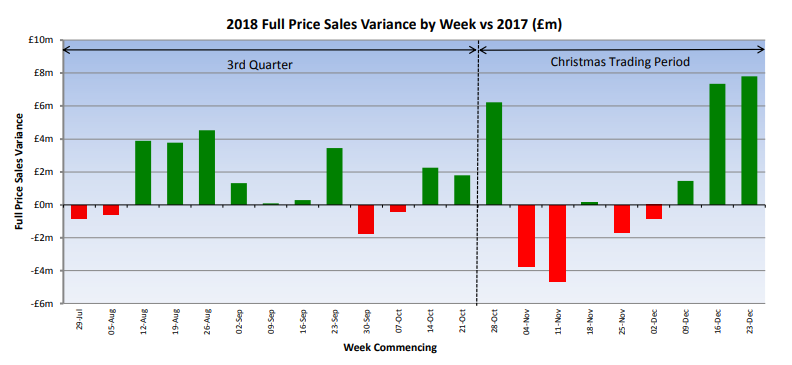
A vitally important point to remember here, is that the above shows retail and online combined. Next has an unusually high proportion of its sales online (more than from its physical stores). This is critical to its resilience.
The way I look at it, Next is demonstrating that it is successfully holding onto its customer base. They just prefer buying online these days. It has a well-publicised plan to gradually close down unprofitable stores as leases expire. Big rent reductions are being sought on lease renewals, otherwise the store is handed back to the landlord.
I'm struggling to think of any other conventional retailer which is managing the shift online so well. I think this share looks attractively cheap at the moment (forward PER of just under 10). I am surprised today's solid update hasn't triggered a bigger share price recovery yet.
Retailers which have a lower proportion of sales online than Next, are likely to be struggling big time. Just look at the breakdown of sales from Next, and how big the fall in store sales has been (which it has recouped through its online operation);
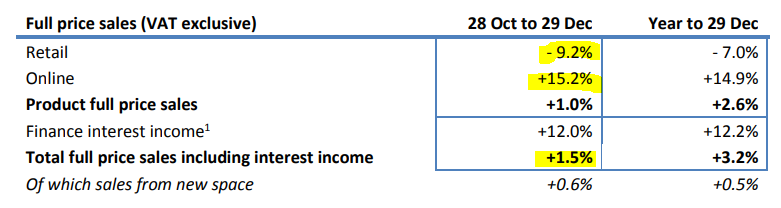
Guidance - the current year profit guidance has barely changed - it's now £723m, instead of previously £727m. I think that's a remarkably resilient performance (thanks to online growth), in retail conditions which have widely been considered dire.
EPS guidance for this year, is now 435.2p, up 4.4% on last year. How many other retailers are reporting rising profit right now? The PER is just below 10.
Remember that Next doesn't really have any debt either - because its customer loan book is larger than its external debt.
My opinion - as regulars know, I've long been a fan of this business. The transition to online sales is going smoothly, and in my view the current lowly valuation does not reflect that.
Generally, I see 2019 and beyond being a time of retail carnage. Large numbers of shops will have to close, as leases expire, and weaker-financed chains go bust. Sad though this is, the reality is that so many UK shoppers prefer to shop online, that we simply have far too many traditional shops. There's nothing wrong with aggregate demand, indeed retail sales in total are growing at a healthy pace.
Next will not only survive, but I think it could prosper, as weaker competitors go bust. That frees up more customers for Next. In the meantime, it can slash its rental costs, as leases renew or lapse.
The massive cashflows continue, and are used to fund a 4% dividend, plus large share buybacks (which increase EPS each year, and feed through to bigger divis too).
For these reasons, I see the £43 level as being a decent entry point, taking a longer-term view. This is a remarkably resilient business, as has been proved by today's update.
The sell-off from £62 to £40 in the last 6 months seems to have been unjustified on fundamentals, hence why I see this as a buying opportunity;
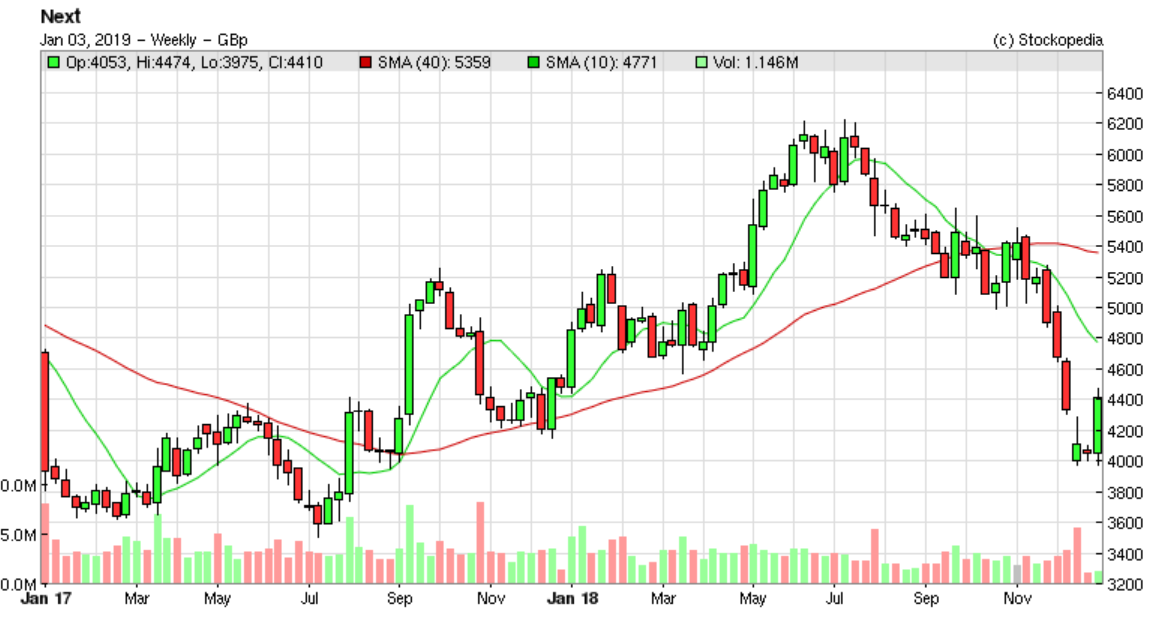
There could be read-across from today's Next update, to online retailers. So perhaps the massive sell-off in ASOS (LON:ASC) and a lesser sell-off in Boohoo (LON:BOO) might attract buying attention?
Vectura (LON:VEC)
Share price: 78.2p (up 10.8% today, at 09:57)
No. shares: 665.4m
Market cap: £520.3m
Not my area of expertise this, but thought I'd flag what looks like a positive update from this drugs company, in case readers are interested.
Some of the product names ring a bell with me - I think Vectura is the new incarnation of what used to be a company called Skyepharma.
Today it says;
Vectura Group plc (LSE: VEC) ("Vectura" or "the Group") today announces an unaudited 2018 pre-close trading update.
The Group expects revenue to be in line with, and EBITDA to be materially above, current market consensus expectations.
Vectura will report its preliminary results for the year ended 31 December 2018 on Tuesday 26 March 2019.
More detail is given in the announcement.
My opinion - none, as it's not a sector I have any knowledge of.
FinnCap
Maiden interim results have been published here. This mainly smaller caps broker floated recently, in early Dec 2018.
I like FinnCap a lot, because they have a proactive approach towards linking private investors with smaller companies. Myself and investor friends have met many companies at FinnCap's offices over the years, which is extremely helpful of them.
FinnCap compare very favourably with the aloof, sniffy approach of some other brokers, who actively try to prevent private investors meeting company managements & receiving research. Who the hell do they think are going to buy the shares, create the market liquidity & set the share price then?! It's no wonder so many small caps have so little liquidity, as their brokers are asleep at the wheel all too often.
Therefore, I wish FinnCap well in their recent transition to becoming a listed company themselves.
Listed companies with less proactive brokers should be asking searching questions about what exactly they are getting for the fees?
Costain (LON:COST) is up 6% on an in line with expectations update today.
Low margin contracting type companies don't interest me at all.
That's it from us today - there's nothing else of interest, as you would expect in this quiet end of week. The fun should start properly next week.
Best wishes, Paul.
Disclaimer
This is not financial advice. Our content is intended to be used and must be used for information and education purposes only. Please read our disclaimer and terms and conditions to understand our obligations.

40 comments
I haven't been around Next checking labels, but the low cost sources for garments are places like Cambodia, Bangladesh and so on. Since these are not in the EU, I wouldn't expect much direct disruption for Next.
I haven't been around Next checking labels, but the low cost sources for garments are places like Cambodia, Bangladesh and so on. Since these are not in the EU, I wouldn't expect much direct disruption for Next.
You don't have to speculate, you just have to read Next's own analysis:
3% of imports are covered by EU trade deals, which presumably will be lost, 31% are covered by WTO tariffs and 10% are from the EU and Turkey, and attract no duty. In total that means an extra £20 million in costs for Next assuming that the GSP status mentioned above is maintained and they're unable to pass on costs.
The report is interesting as it does give an insight into the preparation needed by a relatively straightforward business with an EU import / export challenge. In Next's case this includes setting up German and Irish companies, accurately estimating demand across the UK, EU and Eire, bonding the German warehouse, updating computer systems to handle the additional workload and hedging currency exposure over an 18 month period.
My take on this is that larger companies, with deeper pockets and better organisation are likely to be the short term winners. The BoE reckon that two thirds of companies hadn't made any preparation by end last November.
The one thing I don't understand in the Next report is that they seem very concerned about tariff rates even though the actual impact on them is very small. The issue is that WTO tariffs on EU goods in this category would be set at 11.8%. After reading a few times I came to the conclusion that this isn't Next's issue but a broader one - as they say:
This is their CEO making a case for reducing all tariffs to balance the impact - i.e. reducing the overall tariff rate for all countries to 5.8% would mean that the government's income remains the same, but non-EU countries see a tariff fall. Eminently sensible, but given that the government appears to be unable to distinguish a ferry company from a pizza delivery service I can't say I'm hopeful in the short-term.
timarr
Do people think that Apple will be able to regain it's $1 trillion MCAP due to such strong branding?
Thanks Paul. Happy new year.
Regards
Andrew
Re Huawei and Apple
Another layer to this conversation is that Huawei are also a big manufacturer of phone infrastructure equipment, ie the kit installed in lights-out buildings routing phone calls as data between the base stations. The US Gov are using every bit of leverage they have to prevent the spread of Huawei equipment with the possibility of Chinese spyware monitoring calls. Presumably because Uncle Sam is already doing it, they are well aware of the risks.
So what's really inside that new Huawei phone...................and we worried about Apple collecting data on us...................
Lots of reading if interested.
https://www.quora.com/Why-is-Huawei-banned-in-the-USA
Interesting comments about on line and in store. I am interested in this from the letting / estate agent side. Purple bricks seems to be struggling yet not as much as say Countrywide...the largest high street agent. If business is bad it will affect all.
Food delivery is growing fast and yet the papers were full of stories of people unwrapping home delivered turkeys on Xmas day only to find them rotten. Yuk! I got my meat delivered but only from a local farm outlet because I knew it would be fresh and top quality. It was. Cost a bit more but the quality was superb. Best Xmas dinner ever. So I think there will always be pockets of resistance....my wife told me that very few women would buy a hat on line for instance. The other issue I would flag up is tax. At some stage the government will have to change corporation tax to equalise the costs. Next must make a big tax saving by closing down stores and moving on line but I cannot see that lasting.
Paul: "Remember that Next doesn't really have any debt either - because its customer loan book is larger than its external debt."
Apologies if this has been discussed before but I find that view hard to reconcile with the figures.
Plus: would we say a bank didn't really have any debt if its customer loans were larger than its debt?
Plus: what value would there be in a pile of UK consumer debt following a messy Brexit?
Hi
Quite a noticeable new contract win for WANdisco (LON:WAND) (up 13% at time of typing).
This is a partial extract from the RNS.
$565k contract for multi-cloud and multi tenancy use cases
WANdisco (LSE: WAND), the LiveData company, is pleased to announce it has secured its first multi-cloud contract with one of the largest mobile network operators in the world (the "Client"). The agreement is valued at approximately $565,000 and will see the Client deploy the Company's patented Big Data and Cloud product, WANdisco Fusion for Multi-Cloud ("Fusion").
$565k contract for multi-cloud and multi tenancy use cases
https://www.investegate.co.uk/wandisco-plc--wand-/rns/inaugural-multi-cloud-contract-win/201901030700090162M/
I just bought a minute holding. It's been rising since early December on other healthcare contract wins as well.
Regards
Howard
Re Next (LON:NXT) NEXT is a quality company and there is no doubt in my mind that it will thrive in the long term. However I am not sure how resilient it will be in 2019. Here is what today's trading statement says:
"Any sales forecast made in January comes with a high degree of uncertainty. This year uncertainty
around the performance of the UK economy after Brexit makes forecasting particularly difficult. We
have not factored into our sales estimates the potential benefits of a smooth transition or the
downsides of a disorderly Brexit."
I don't view this as a boilerplate statement. What it says to me is that with a smooth transition, the upside could be spectacular because the current sp has been beaten down severely. A quick look at the sp chart will convince you of that. However in the case of a disorderly Brexit, the sp fall could get worse. But it would be asymmetrical in my opinion, in favour of the upside.
Having made a quick turn over the past two days (8%) , I shall wait and see which way the wind blows. If the probability of an orderly Brexit increases, then I shall be a serious buyer. Otherwise, as Timarr put it so succinctly , I'll continue to look for dirt cheap, not just inexpensive.
Hi Ramridge
I don't view this as a boilerplate statement. What it says to me is that with a smooth transition, the upside could be spectacular because the current sp has been beaten down severely. A quick look at the sp chart will convince you of that. However in the case of a disorderly Brexit, the sp fall could get worse. But it would be asymmetrical in my opinion, in favour of the upside.
I agree that there could be some upside with a smooth transition, but I don't think you'll see any huge growth because even the best deal available will have some economic effect. Next included a very interesting section on their Brexit preparations in their half-year report so this is already in the public domain:
https://www.investegate.co.uk/...
Firstly this needs to be taken in the context that Simon Wolfson, the CEO of Next, is a vocal Brexit supporter, so you'd expect his company to prepare well and be positive. However, the analysis presented is well worth a long read. My take on it, after due consideration, was:
Taken all in all this scared the willies out of me.
As Next's position on the worst case hard Brexit is already known you'd imagine that the market is pricing that in. Most likely the depressed share price is due to general market conditions, flat profits and a reduction in consumer confidence as well as online competition. I don't see any of that changing post-Brexit - although a flash crash in that event would throw up a lot of interesting opportunities!
timarr
Adding a bit of detail to Costain (LON:COST). More attractive that it might first appear (in my opinion). Costain (LON:COST) are moving away from being a small margin contractor into a specialised "smart infrastructure business". Sounds like PR speak - but they are already a big player and the potential market is massive.
They have completed smart motorway projects and others are in progress and planned. Consider the scale and potential for smart energy, water and transport. These are the areas Costain (LON:COST) work in. The are regularly winning big new contracts as shown by the current order book. Selling services into a new and unexploited sector is so much more profitable than tendering for construction projects against other big building firms.
Consider some of the financials:
Improving net margin: 2.25% against 1 yr ago: 1.78%
Profit to sales ratio of 0.21 (so you could buy the whole business for one fifth of turnover)
High yield of 5.16% and great dividend cover of 2.38
Net debt to market cap of -23%. I.e. equivalent to cash in the bank equal to 23% of the market cap.
Regarding Next (LON:NXT) , whatever the preferences of the public for on line shopping, it is imperative that the experience is satisfactory. My own experience was not and although this is just one example, it suggests that Next have some way to go to achieve the reliability of, say, John Lewis.com
I ordered a toaster from Next (agreed, not clothing) in late November, due to be collected in store. n email arrived saying it was ready for collection but on arrival in store, there was no toaster. They could not explain why so cancelled my original order and initiated a new one for free delivery to my home. A week or so later, it had not arrived so I phoned. "That order doesn't seem to be happening" they said and offered to cancel and re-order. They also said they would "monitor" the order to make sure it was fulfilled. Another week passed but still no delivery so I phoned again. "It's due for delivery on Saturday" they said. It didn't arrive so I phoned again. A new delivery date was given and behold, the toaster arrived as promised. All in all it took about three weeks. and lots of aggravation. There was no evidence that anyone was "monitoring" my order and I never received any email about the delivery.
NEXT time (sorry) I'll shop where I can be confident of fulfilment.
Paul what do you make of Taptica International (LON:TAP) announcement today?
They have "suspended [the] share buyback program as [they have] entered into preliminary discussions with a potential acquisition target."
The buyback was only announced on the 12th of December, as a way to return money to shareholders as "there are no conversations ongoing [with potential acquisition targets]". However, they only bought shares on the very next day, the 13th, then stopped.
I think Apple is in a very serious trouble partly of their making and partly due to competition. Chinese manufacturers Huawei, Xiaomi, OnePlus and others are making excellent phones at very competitive prices. While Apple continues to increase prices to the point where many people are delaying upgrade or looking elsewhere for their new phones. I would typically upgrade my phone every 2 years and get new Ipad every 2-3 years for top of the range models but I can not justify spending £1,000 on phone or £750 for new Ipad.
Also their other product lines especially Mac is in quite poor shape: still selling 2013 MacPro, soldering memory, hard drives, design issues i.e. butterfly keyboards, bending Ipads. Also Windows have improved a lot while MacOS barely made progress since Jobs days.
Normally Apple would bounce back from bumps fairly quickly but this time there are more structural problems recent year may be high point which they many not reach for number of years. However, in comparison Apple trades at quite modest P/E.
Very interesting and important discussion here about retail v online. I hope my response isn't too much of a ramble.
I was a chartered surveyor specialising in the management of very large retail estates for 20 years. In my last role I was on the main board of a large privately owned multiple retailer. I have also invested in property myself.
When online shopping first arrived I started giving out two warnings to anyone who would listen. To those who said online would only ever take 10% or 15% of trade I pointed out that for the typical UK shop that loss of turnover would be a big problem. To those who were investing in retail property I warned that in the long run rents were going to decline. To my friend who had built up a large business investing in secondary shop property I said that he should get out. He didn't and is no longer a wealthy man. A lot of people don't realise that when you walk through an average shopping centre some of the shops are holding over after a lease expiry on a nil rent basis, paying only the service charge and business rates, because the landlords are so terrified of voids. I echo the comment about UK retail REITs and propcos. In my mind they are all baregpoles at the moment.
Another thing I know a bit about is the shift away from using disposable income to buy stuff (most people's houses are rammed with junk that will end up in landfill) towards using it to buy experiences. I built a tourist attraction which is going well and will do even better next year.
And finally I have an appreciation of how difficult it is to make money by selling stuff online and delivering it to the customer. I study Amazon's accounts with amazement, and I have personal knowledge of how unprofitable a lot of their retail online business must be. It costs an absolute fortune to generate website visits, process sales, handle the merchandise, deliver it, and deal with customer queries and returns. Online shopping is really nothing more than the time-honoured catalogue shopping business with the catalogue replaced by a website. The websites are more popular than the catalogues used to be but the costs and difficulties of running the businesses are similar. And on top of all that people expect the online price to be less than the physical shop price. Madness.
Therefore I read the Next (LON:NXT) statement with great interest where it talks about online v physical shop business.
I personally think that Next (LON:NXT) will survive and thrive, and at a yield nearer 5% I will buy back in.
But a better thing to look out for, I think, based on my experience, is businesses who sell something special and hard to copy, which customers want in tangible form and don't often send back as returns, who have a physical estate which isn't hampered by legacy leases, and who have a well-run online presence. Games Workshop (LON:GAW) is a good example. I am looking for early-stage ideas like that.
Hi Michael
Excellent post. The cost to Next of the transition from retail to online is partially obscuring the performance, but even without that, compared to the other carnage on the High Street, their performance is admirable.
Just to note on your 5% yield requirement that if you include buybacks Next is already exceeding that by a significant distance. If they wanted to they could be paying out 8% without a problem. I know people have different opinions on buybacks, but Next is a shining example of how to use them to enhance shareholder value.
timarr
Great comments to which I concur. Please let us know after you have bought into the next great early-stage idea so we can join you!
Michael - great post; it's good when others can add comments from their own personal experience / expertise. It's what makes this investment community so valuable !
One quick question - you mention that you "built a tourist attraction which is going well and will do even better next year."
I'm intrigued - what is this attraction and how did you go about creating one !?
Thanks,
N
Sorry for delay, been offline today. Not the right place for a long answer but I'll try to make it relevant. My wife and I bought a derelict 22 acre smallholding in 1993 and built a paid-entry visitor attraction. Costs and regulation then were nothing compared to now but even so we went over budget and had to open before it was fully developed. It took a lot longer to become profitable than we expected - we both had to take part-time jobs to make ends meet. In the end it was OK and there was an MBO in 2014 following which we retired. It hasn't been a great investment but it's doing well now and quite often young parents show us their kids and tell us they remember coming as a kid themselves, and how much they liked it. So that's nice.
Investment lessons:
1. Start-ups and early stage businesses - it usually costs more and takes longer to achieve success than anyone expects. (When I look at big projects like HS2 I just feel sick - that thing is going to cost at least twice what they think). I have been following Seedrs and Crowdcube for ages - 90% of what I see there is unadulterated bargepole.
2. Businesses with fixed costs can in theory make a lot once the costs are covered and the majority of revenue flows to the bottom line. But in a lot of cases the costs turn out to not be fixed at all and rise almost as fast as revenue.
3. If a business isn't portable it's best to buy the freehold of any property you need - that's one thing we did get right. But beware of buying property for a business that is portable. For years Marks and Spencer (LON:MKS) were the lynchpin of the High Street and benefitted by owning their own properties. More recently that has tied them to locations which are no longer right, and their properties are worth a fraction of what they were at the top.
Great insight - thanks Michael. I too am curious about your tourism business.
I had a chance to meet a commercial property director at Property Partner and he concurred about retail and how a small shift online can cause problems.
He was more bullish on retail reit and specifically Intu (which he thought was one of the best bargains in the whole property sector, discount as owner wants an exit).
Without any great experience in the sector, I would tend to concur on retail being a bargepole although there will need to be consolidation which could result in profits for the more opportunistic amongst us.
Disclosure: own Tritax Big Box Reit (LON:BBOX) Primary Health Properties (LON:PHP) Regional REIT (LON:RGL) Warehouse REIT (LON:WHR)
Rgl has retail exposure, but represent <10% of their assets. All the above except PHP were bought in Q4 18
Next closed down its store in St. Helier and opened a concession in de Gruchy.
Hi Graham,
I'd also like to have your opinion on Alpha FX (LON:AFX) . Yet another "ahead" TS this morning.
There was an excellent write-up at the start of Dec 18 by one of the commentators on here.
https://www.stockopedia.com/content/alpha-fx-expectations-beating-and-lt-compounding-potential-423543/
I think that in part this discussion is a factor of the leases Next pay on their shops. Ware housing is cheaper but there are some very good deals going on via the high street. Frankly I wouldn't touch retail REITs.
Re Next (LON:NXT) I was remembering their commentary in their last annual report where they said:
Looking at last year’s numbers it appears that every Pound of full price sales lost in Retail cost us 60p whilst every Pound gained Online delivered only 19p of profit.
This margin erosion is partly a result of the shift in sales from Retail to Online. Retail carries large fixed costs (such as rent, rates and energy) which, in the short term, are unable to contract with reducing sales. On the other hand, the Online business has significant variable costs which increase with sales (delivery, warehouse picking, returns processing, call centre activity etc.).
https://www.nextplc.co.uk/~/me...
Good Morning Graham,
I note Alpha FX (LON:AFX) have advised they are 'ahead of market expectation. I wonder, should you have time, if this would be of interest to readers?
Thanks IG.
NB - I do not have any current position in £AFX
Apple is quite big for a small cap :-]
The people here have no sense of humour !
Next (LON:NXT) trading statements are always interesting, both in themselves and for the read-across to other retailers. Here's the version with the weekly sales graph:
https://www.rns-pdf.londonstockexchange.com/rns/0183M_1-2019-1-2.pdf
There is a small cut to profit outlook for FY to Jan 2019, but enough to take the central profit forecast from +0.1% to -0.4%. EPS continues to grow due to share buybacks. For what it is worth, FY 2020 is for a 1.1% drop in profitability before buybacks. The current share price seems fair rather than especially cheap to me.
The takeaways for me were: a) Yes, November was bad, but not that bad and b) In the short term a shift from in-store to online sales adds costs (presumably due to mostly fixed costs in stores and mostly variable online).
The takeaways for me were: a) Yes, November was bad, but not that bad and b) In the short term a shift from in-store to online sales adds costs (presumably due to mostly fixed costs in stores and mostly variable online).
The increase in online costs is probably due to increased warehousing requirements, that's the usual pattern. I imagine that warehouse space supply is getting tight, so maybe that'll be a drag on performance too, although that would apply across the sector and Next (LON:NXT) is likely to be better prepared than smaller or less cash rich competitors.
The big issue is really around Brexit both in terms of consumer uncertainty and border issues. As they indicated in their previous report they've made extensive preparations for Brexit but can't control disruption at the border.
Overall Next (LON:NXT) looks cheap for a quality outfit, with a virtually guaranteed 4% dividend and equivalent buyback and robust forecasting. But at this point I'd like to see dirt cheap rather than merely inexpensive.
timarrThe problem for Next (LON:NXT) is that their online sales are lower margin than in-store. So switching to online will allow them to survive but it will hit profits.
If a customer buys in store they take the goods away with them. If they buy online there’s the warehousing, picking and packing, delivery, and returns processing costs to bear. They offer free delivery over £50.
I'm not clear how true that is, for Next (LON:NXT). Costs per high street sale must be higher than online (or why is everyone doing it!). Yes there are return costs, but warehouses are much cheaper per item dispatched than shops. True, as timarr has said above, there are setup costs - new warehousing etc, but those are costs of growth, not ongoing costs (unless they keep growing - which I can live with).
Actually, I think one possible explanation of why some retailers were rather slow to go online is that in the short term it makes little financial sense. Stores have mostly fixed costs so there is no "saving" of costs when a sale moves from in-store to online, only the additional costs of warehousing, delivery and returns. Of course on a longer timespan stores can be closed / moved to smaller locations (depending of course on the length of leases) and so savings are made from such canibalisation. But of course the main motivation should be that if you do not have an effective online presence then you will lose sales entirely to somebody that does.
"Costs per high street sale must be higher than online (or why is everyone doing it!)"
Irrespective of comparative costs they have no alternative but to sell online or eventually they will have no sales. We and many of our friends do not go out shopping - I mean my wife never, ever, goes out to buy food or clothes. We basically only go out for a meal or entertainment. Other friends do go to the larger shopping centres to look around but then return home to buy online. Was it a fund manager the other day who said that internet sales would not take much more of a percentage because people liked to shop - that is totally delusional! I can imagine a future where the only retail shops that can survive are those offering personal services (e.g. hairdressers) or convenience foods (to top up what people have not already had delivered). Retailers like Next will still want units in busier locations as much as an advertising space for their products but the online sales will continue to account for an ever larger percentage of their business.
On the flip side - delivery is as inconvenient to as many people as it is convenient. Even worse is the thought of ever having to return something. For some people I know that only shop online their process seems to be risibly more time consuming than going to a physical store. So ultimately a balance will be struck, but there is certainly far too much retail real estate as of now.
The problem for Next (LON:NXT) is that their online sales are lower margin than in-store. So switching to online will allow them to survive but it will hit profits.
That's incorrect. Their last half year figures had retail margin at 7.9% and online margin at 18.3%. The two businesses are of roughly equal size, with online growing and retail shrinking.
In addition any store with an operating margin of less than 9% is being managed out. It's a very well managed business, probably one of the few that are managing the transition to online with relatively little disruption.
timarr
Yes, its a problem for all retailers with a mixed store/online model.
The late Ken Morrison hated the idea of online shopping with home delivery for exactly this reason - too much extra work as he knew from his time delivering groceries to customers in Bradford on his bike. Much cheaper to have the customer come to you, choose what they want then take it home themselves.
My morning smallcap tweet:
Getech (LON:GTC), Corero Network Security (LON:CNS), Tracsis (LON:TRCS), Alpha FX (LON:AFX)
GETECH Group (GTC) $3.2m sale, majority will be recognised in FY18. Guides FY18 rev up 10%.
Corero Network Security (CNS) guides FY rev $10m up 18%, lower than expected. Blames "the longer time required to ramp up new go-to-market partners and secure contracts."
Tracsis (TRCS) 'significant' five year Framework Agreement with a major Train Owning Group. Believes it will will lead to significant recurring revenue opportunities. Helpfully states "at this point in time there will be no change made to current year forecasts."
Alpha FX Group (AFX) guides FY earnings ahead of market expectations.
First Apple downgrade for twenty years! Another piece of negative news likely to add to an already battered IQE (LON:IQE) woes?
I believe IQE do not only supply Apply phones, so other phone manufacturers usurping Apple's pre-eminence shouldn't affect too much in the long run. However, I know there are other contributors who are more knowledgeable than I on this subject ..