Small Cap Value Report (Wed 16 Oct 2019) - LGRS, TSTL, AUG

Good morning, it's Paul here.
Estimated time of completion today: 3pm.
Update at 14:49 - today's report is now finished.
Bregg-zit
It looks as if compromise is in the air.
FWIW, my view is that a last-minute compromise deal, or fudge of some kind, is probably the most likely outcome. That's normal for the EU whenever there's an apparently intractable problem.
As we saw on Friday last week, the merest sniff of a deal, triggered some spectacular large & mid cap rallies. Therefore, if some kind of vaguely acceptable deal is done, as now seems likely, then I imagine we could see a big recovery in bombed-out shares. That's why I've remained fully invested during this tough period - because there could be some significant re-ratings, if the market starts to see the glass half full again. Maybe.
For this reason, I'm drawing up a list of bombed out, but fundamentally sound, companies, with my finger poised over the buy button.
EDIT: please also see the comments section below, where we discuss small caps market despondency, and Woodford, amongst other topics.
Loungers (LON:LGRS)
Share price: 199p (price unchanged today, at 11:28)
No. shares: 92.5m
Market cap: £184.1m
Loungers, the operator of 157 café / bar / restaurants across England and Wales which trade under the Lounge and Cosy Club brands, announces a trading update for the 24 weeks ended 6 October 2019.
This company listed at end Apr 2019.
My sector expert tells me that it's a very good operator. That may be the case, but I find the valuation too high. All too often, companies list on the stock market when the figures are looking great, only to plunge in value once the shine comes off trading.
The other problem is that when brokers float companies like this, they tend to place the stock in lumps with institutions. Resulting in almost no liquidity in the market, post float. A basic error that keeps happening. Why? Because advisers just want to bank the lucrative fees, for as little work as possible. Whereas they should try to distribute plenty of shares to smaller & medium investors (as well as institutional blocks), in order to ensure proper post-float liquidity. This issue really gets up my goat.
LFL sales - in H1 are still excellent at +5.4%. Although that's slightly down on the 6-7% that the company had achieved in the previous 3 years.
There seem to be differing opinions on the strong LFL sales growth at Loungers;
Bull case - it's an excellent, well-run business, so is out-performing competitors & gaining market share.
Bear case - lots of new openings, creates soft first year figures, which are then easily beaten in year 2, as each site becomes more established.
Or, it could be a bit of both?
New site openings - 10 opened in H1, 15 more planned for H2.
This is consistent with previous growth, e.g. (page 16 of Admission Document;
The Group opened 21, 20 and 22 sites in FY16, FY17 and FY18 respectively. The Group opened 25 sites and relocated one site in FY19.
Historically, the group has achieved a high ROI from new sites, e.g. (extract below from page 23 of Admission Document);
New site capital expenditure is tightly controlled and is typically £0.6 million for a Lounge and £1.0 million for a Cosy Club.
The overall cash return on capital invested has remained consistent at circa 34 per cent. in each of FY17, FY18 and the 24 weeks to 7 October 2018.
That's clearly a very heavy capex programme, so it will be interesting to see from the next set of accounts how much is self-funded, and how much from increased debt.
Note that Revolution Bars (LON:RBG) (in which I have a long position) halted its new site opening programme, due to falling ROI on new sites. Although it also had internal problems, which I think it is beginning to recover from. This is however a good example of how the share price dropped by about two-thirds, once the roll-out programme stopped. There must be a similar risk with Loungers, hence why personally I wouldn't touch this share at the current, lofty valuation. It would only take one poor trading update, and you've lost maybe 40% of your money instantly. Why take that risk? Although I suppose you could make that same point about all small caps.
Outlook - this falls short of saying in line with expectations, but is implied (and gives wiggle room, in case expectations are not met);
"We remain confident of delivering another year of positive progress for the Group and are encouraged by the performance of our new openings."
My opinion - this seems a nice business. It targets off-pitch, low rent sites, and then trades all day from them, in a hybrid bar/cafe/restaurant format. I've only done one site visit (to a larger Cozy Club), and was impressed with the decor, food, and quality of staff.
The big question with a roll-out, is whether management can maintain the same quality levels once the business is much larger? As we saw with RBG, the performance of the business hinges on attracting & retaining key staff (area managers, and good site managers). Once the good people leave, then performance can rapidly tail off, due to the operational gearing of c.75% gross margins.
For this reason, I wouldn't want to pay top dollar for a chain like Loungers, which is performing well currently. There's too much downside risk if/when performance tails off.
It's making a 13.5% adj EBITDA margin (down from 13.7% prior year). With relentless pressure on costs, especially staff, it's difficult to see how that margin could be expanded, indeed it could fall.
There seems hardly any liquidity in the market too, so picking up or selling a position in this share could be tricky.
The upside case is that management are skilled operators, undertaking a fairly rapid roll-out. Therefore, if all goes well, the business could be making substantially larger profits in a few years time. This share is really a punt on whether the roll-out works well - in which case shareholders should make a decent profit, and get a future flow of divis. Or, if the roll-out goes wrong, then there could be nasty downside on the current fairly ambitious valuation.
Tristel (LON:TSTL)
Share price: 301.5p (up 2.7% today, at 12:25)
No. shares: 44.58m
Market cap: £134.4m
Tristel plc (AIM: TSTL), the manufacturer of infection prevention and contamination control products, announces its unaudited results for the year ended 30 June 2019.
The financial highlights section looks good.
- Revenue growth (up 18% to £26.2m)
- Profit margin is high, at 21% adjusted, 18% unadjusted - so a genuinely high margin, not relying on adjustments to flatter it
- Adj EPS up 21% to 11.08p - giving a PER of 27.2 - high, so clearly the market is anticipating considerable further profit growth
- Strong balance sheet - including £4.2m net cash - after making 3 small acquisitions
- Dividends - small yield of about 2% , but consistently growing. Historially, the company has topped up the yield with special dividends.
My opinion - the figures look good to me. As regards to what the future holds, I don't feel that any comments from me would add much value. Investors need to make up your own minds - the narrative with today's figures explains the upside potential. A lot of that seems to hinge on breaking into the American market.
Overall, Tristel has delivered a strong track record in the last few years. I suppose investors have to decide whether this business is worth the £134m market cap?
Stockopedia says: very high quality, but expensive;
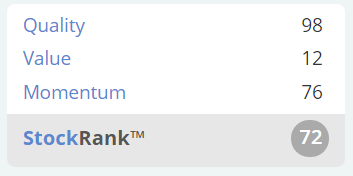
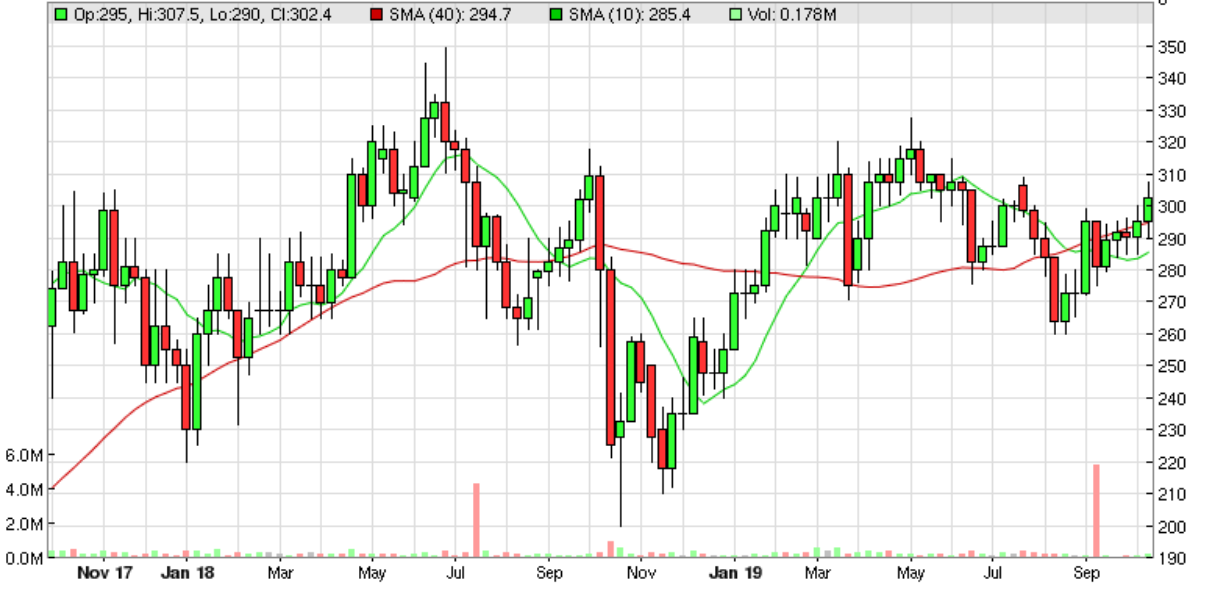
This year has been brutal for many small caps. Tristel stands out as looking resilient, and bouncing back strongly from share price falls. That suggests to me that it could have scope for another upward move, if it delivers good news in future.
Augean (LON:AUG)
Share price: 134.5p (up 14% today, at 14:16)
No. shares: 104.1m
Market cap: £140.0m
Augean, one of the UK's leading specialist waste management businesses, provides the following trading update.
This is a cracking update;
Due to a strong Group trading performance in the third quarter, the Group's profit for the year to 31 December 2019 is expected to be materially ahead of current published consensus market expectations of an adjusted profit before tax of £16.5m.
I take that as meaning, at least 10% ahead of the £16.5m expectation, so £18.2m+ profit.
What's caused this out-performance?
Results for the year to date have benefitted from a 20% increase in landfill volumes across all waste types, improved landfill pricing by a further 20%, increased radioactive waste profit and a good performance by both the treatment and North Sea businesses.
I thought landfill was supposed to be bad?
Balance sheet - I've checked the most recent one, and it looks OK, with £22.8m net cash as at 30 June 2019.
Due to the nature of the business, it has negligible inventories, so that gives an unusually favourable working capital position overall - i.e. little capital tied up in holding inventories.
Note there is an £8.4m long-term provision of some kind - which is a bit like debt - i.e. it's usually cash out of the door in the future.
Other than that, it all looks fine to me.
Reading through the RNS, there seems to be a possible fine from HMRC of £4.6m, which the company is disputing.
My opinion - I don't really know much about this company, but the figures look great.
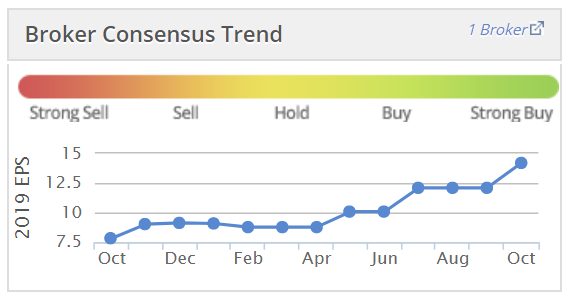
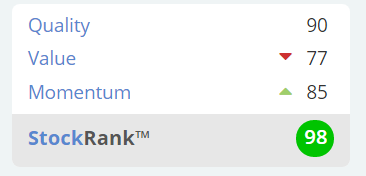
Stockopedia picked up on the strong earnings momentum, one of the reasons why it has a very high StockRank.
I'm curious as to why the company doesn't seem to be paying dividends.
On a brief review today, I see a lot of things to like here, in the numbers. Hence I think Augean looks worthy of a closer look.
I'll leave it there for today. If anything interesting crops up, then I'll put it into tomorrow's placeholder article.
Best wishes, Paul.
Disclaimer
This is not financial advice. Our content is intended to be used and must be used for information and education purposes only. Please read our disclaimer and terms and conditions to understand our obligations.

48 comments
Not just the HMRC fine that is at stake but the extra tax they will need to be paying if the decision goes against them. Either way, been a great long term investment for me and I will take some more off the table if there is a further rise tomorrow.
Excellent financial analysis. Well done Paul. When will you be producing report on companies share prices knocked down by Brexit? Best Simon
Augean (LON:AUG) "Reading through the RNS, there seems to be a possible fine from HMRC of £4.6m, which the company is disputing."
I believe this is only a small part of the on going tax dispute with HMRC. If Augean (LON:AUG) loses this dispute it will be far more than £4.6m, that is just the fine for non payment.
Quite correct and there is also a disputed penalty on Augean North of £2.9mn so seems to be £7.5mn penalty in toto. Net cash on the last results date at end June (which can be subject to manipulation) had seen a huge uplift to £23mn compared to a year earlier. It almost looks too good to be true but it does certainly look good on the face of it.
I was wondering if the decrease in discussion was a function of the new site design. The older format did seem more convivial and forum-like whereas the new look is much more functional and imo less engaging in the social media sense.
The mid cap rally has been pretty dramatic with some of the price action since last Friday being more akin to the small /micro caps that the relative behemoths in the 250. Of the 250 constituents, 119 have rallied more than 5% and 34 more than 10% since Friday : sector overviews below - home builders/household care , retailers and REITS/REIS have all outperformed. These sector rotations may well give clues to the nascent rally underway in the AIM and Small Caps
FWIW on market sentiment, markets YTD haven't been too moribund with the FTSE 100 up 7.3%, FTSE 250 +16% ( 6.5% in the past week) while the AIM All Share is only up 1.5% on the year - the 2019 AIM low was higher than the Dec 2018 low so arguably there should be less misery about on a comparative basis. A lot of the big story stocks have taken a pounding so that may well have reduced the volume of cheer leading from over crowed growth-at-any-price positions. AIM All-Share does look to have bottomed and is rallying off a good technical reversal although the prevailing longer term trend remains very much downwards. Given the speed of reversal in the 250, we may well see similar rapid re-ratings if herding continues. If nothing else it makes for great trading
Worth noting that for all the FTSE 250 outperformance in 2019, it still hasn't recovered its losses from 2018 so year-on-year it is down around 10% from the 2018 high ( which was an all-time-high)
The GBP rally will likely unwind some of the FTSE 100 safety plays . The likes of £ULVR has already retreated significantly from its ATH of a few weeks ago and has given back around 16%. Given the global macro is far from rosy then cyclicals are likely to struggle so the FTSE 100 may face headwinds given the weighting of oilers and miners. That said, if the Brexit bear is at bay then who knows..
I think Mr Woodford was perhaps unfortunately believing all the hype himself, and is a lesson to all of us getting over confident. When you think you are it, you are finished. How often, when a sports team beat a good team, do they react like they have won the World Cup, only to get beaten up in the next game? And Mr Market can certainly beat you up. Now Mr Woodford is not as bad as people are saying. Keep your concentration.
Just had a go at the screener... I think this is right:
Price below cash, market cap under £200m (excluding financials, mining, oil & gas). Nothing jumping out at me...
In my experience over the last 20 years in small caps, it's when everyone goes quiet & despondent, that you get the biggest pricing anomalies. Gutsy purchases now, could well turn out to be highly profitable decisions in future.
Therefore, I think this is a time to be excited about the considerable value that can (selectively) be found in small caps.
When I left work, to become a professional small caps investor, in Sept 2002, everyone thought I was mad. Markets were absolutely bombed out, and plenty of micro caps were trading below the value of their own net cash. After a wobbly start, for the first 6 months, I then went on to make about a million quid the following year (6 times my starting pot) on rapidly recovering small/micro cap stocks. Which goes to show that buying at the bottom, when everyone is terrified, or has given up altogether, is a great way to make money.
If a Brexit deal is done, this removes massive uncertainty. We could therefore see a strong recovery in business investment, takeover bids, consumer confidence, etc. Hence why I think investors need to be primed to act fast, and buy up over-sold, overlooked small caps, if a deal is done.
There's a lot to be said for being bold when others are despondent. Also, I think shares react more slowly to good news in times like this. That's another opportunity - as it gives us more time to dive into shares which are likely to go up.
What I do find very strange about the current market, is that many shares (especially mid caps, and high-performing small caps) seem very expensive. Yet other shares (especially ones which have had profit warnings) seem priced for Armageddon. It feels very disjointed.
Regards, Paul.
Boris still needs to get any deal through House of Commons and I cant see him doing that, in fact i'm not positive of his chances of getting a deal with EU to put before MPs thats not a copy of T Mays deal
although this is a good article about state of German economy
https://www.spectator.co.uk/20...
On the whole Brexit thing: the way it's shaping up so far, it seems that BoJo has managed to accomplish in two months what the previous incumbent couldn't achieve in three years.
Are you going to share any of your list of "bombed out, but fundamentally sound, companies", Paul? Or do you fear that some people would take this as 'advice' and just buy the whole lot?
Hi andrea34l,
I've been wondering how long it would take for that question to be asked! :-)
It would not be a good idea to publish a list, because I think that would then be moving into the realms of share tipping - which is not what Graham & I do here. We're just analysing each day's results & trading updates, and giving our personal opinion on each one, to hopefully give readers some useful info & views to blend into your own investing process. The onus is then on subscribers to do your own research, and make your own investing decisions. Hopefully we help that process by explaining our own process (e.g. of assessing balance sheets, cashflow, etc), and also by flagging up risks or potential risks. After all, sometimes small caps feels like walking through a minefield - there's so much rubbish out there, but also a few hundred decent companies.
Best wishes, Paul.
That prompted me to take a look at exactly what Paul wrote this morning, as i like others on here, read it that Paul was going to share said list on here, which I thought would be great of course, albeit very generous (competition-wise...generally these tips are only shared retrospectively, when the tip-giver has aready taken their full position!).
"For this reason, I'm drawing up a list of bombed out, but fundamentally
sound, companies, with my finger poised over the buy button."
Read again, I can see Paul was just musing about his own personal strategy - bit of a tease though!
I think UK small caps right now are reflecting a kind of weird options theory: it is clear that a lot more information is going to be on the table in 4-14 days depending on Brexit outcomes. Many people interested in UK small caps are therefore simply waiting for 'results'day before placing their bets and holding quite a lot in cash or parking their money in big MNCs that will scarcely notice Brexit.
Cash has a cost until prices tank when it becomes a real asset and relative success vs holding losers and incurring a capital loss. Readers of this column probably recall the opportunity after the referendum and hope to capitalise this time round. I certainly do.
I think therefore there may be quite big moves in Nov (or Jan or....) in small cap territory as this small cap money 'commits' - sadly, just not sure in which direction it will travel and when.
This board should be about investing and UK small cap shares and NOT politics but for now politics is winning.
ref AA (LON:AA.)
mojomogoz
I guess most bods have one of these in their portfolio - my equivalent is Centrica (LON:CNA) - god knows why i ever bought shares in this company - i knew about the debt and knew about the unpredictability of their markets - and went ahead and bought anyway - i thought it seemed a reasonable gamble in a sector i had little exposure too at the time looking broker forecasts back then. Debt though is the killer and i have been amply rewarded for my stupidity in choosing this stock- all i can say to myself is that at least i bought at 200p and not 400p - hey ho based on the rebased dividend i might get my money back in divis in 40 years or so.
In some respects AA. looks the much better gamble of the two but i am guessing both are fundamentally more of the thomas cook variety rather than any sensible investment choice due to debt level- although i am perhaps judging aa. too harshly? - as a binary gamble with their expected profits i can see some decent possible upside if they can grow profits organically or even churn out enough profits to reduce the debt pile to get back some proper pe valuation.
Well rmillaree
I have not covered myself in glory with AA (LON:AA.) but my average price is 63p so I'm not too sad. (PS on Tremor International (LON:TRMR) I'm up and Mercia Asset Management (LON:MERC) down a little c.10%)...but I could become very sad. The price moves recently have been pretty bad.
I have a giant note on AA that I've never finished. I might do that and unleash on stocko!
I don't believe that AA is going under. Its debt position is stupid....but its op margins should come in around 30% once the current investment phase settles down (currently mid 20s)...and with growth can push higher into the 30s.
They don't need to be better or cheaper than all the upstart roadside guys....they just need to beat the even more feeble RAC.
If today they were to raise £1bn equity for debt swap then I think the sp outcome in the following year would be a higher price than today as the company would look like a high quality stable earnings business with a not abnormal debt load for a company like that. So at least high teens multiple and probably into the 20s (look at Diageo's rating and growth profile). Throw in some top line growth and you'd have a highly rated company that would have the ability to pay down debt or buy back shares.
Fly in ointment currently is the FCA review of general insurance and the associated CMA super complaint on insurance pricing. Not directly AA (and much more directly Green Flag) but there will be some impact. I think it highly unlikely to be very damaging as AA is really a full service company and not just insurance. For the FCA to claim gouging would mean they would implicitly being interfering in the total economics of the business. This is ground FCA uncomfortable to get drawn onto....would need political backing and that just aint happening.
Price falls earlier in the year was due to yield on debt generally going up (on everything and AA caught in that). They need to refinance £800m ish in 2022. At yields earlier in year they would have needed to pay twice interest cost (so adding c.£22m pa....they currently pay low). Not great. But they could and quite easily if they have top line. IMO yields are unlikely to generally stay up. As a world we just can't cope with it and politically we do not have the stomach for the pain caused by fast capital destruction...we've run that movie recently! So I see the price of AA debt (barring explicit business failure) to be part of the broader macro....and if that goes bad for debt then my 100% loss on AA will only be slightly worse than the 75% on everything else!
The AA is right at my max tolerance. I do not like the debt dynamics. And they have certainly stuffed up business mgt in the past. The price is like the game is up....obvs the share price can go lower and to zero....but I think that's hysterical price action at the mo rather than visible fact driven.
Fingers crossed.
I believe I have 3 potential stages: 1) value reversion to about 120-150p, 2) perceptions of some quality and that new mgt is doing alright job debt can be controlled to about 5-7x current and 3) quality non cyclical modest growth with gradual debt pay down-> 10-20x current
Mad?
I agree with that analysis. In fact it is a good play if you are inclined to take risk.
On the downside it could be a wipeout and another Thomas Cook - nobody's gonna come in and bail them out unless it's a Flybe-Virgin type deal where a competitor gets them for 1 or 2p.
There is quite a lot of upside if they do get it right from here. In fact I think the upside is huge if they can pull it off, bigger than probably all companies of similar size.
Trouble is there are so many risks attached to it, and the time needed to transform the company amplifies any of them happening. Even a £1bn equity raise would still see their debt pile being too large (for my liking).
I see this as akin to betting on red on a roulette wheel where 19 position were red and 18 were black, but £1000 was the minimum bet. It's a bet that has positive expectations but you would understand it if people were not taking it up.
Hi Snoo
Take £1bn off debt and then look at Diageo (LON:DGE) as a benchmark for what can be in terms of overall valuation and how equity and debt relate to each other. Both are high margin at similar 30% level (AA currently a little depressed due to heavy investment cycle) and non-cyclical revenue (to some extent the AA may be counter cyclical a little in that if people own cars for longer getting full roadside cover is more needed - but conjecture and not hanging my hat on that in any way). AA (LON:AA.) will still be a bit lower quality in terms of debt to revenue terms plus its not as big so not quite as much premium (on the same growth level), but on the bright side....
1) The AA has chance of higher top line growth than Diaego given current investments in roadside and insurance. There's a chance that FCA general insurance pricing investigation is net favourable for growth as AA is not general insurance (nor RAC) - its a membership and service company. Whereas all the upstarts are GI with the cost of the product hidden in that the guy who turns up to fix your motor can be good or bad (no service guarantees)...IMO if you have Green Flag its quite likely that the guy who turns up in van to fix car is very often not likely to be one of best mechanics from that garage...why have them on the road and/or working anti-social hours?! So there's a chance that 'radical transparency' from FCA investigation leads to a clearer valuing of AA services relative to upstarts. Again, not a thing I'm hanging my hat on...but just trying to look through the issue creating angst right now
2) RAC is weak competitor and there's no international competition. This provides the AA with revenue defence and maybe growth irrespective of the general insurance providers like Green Flag
3) The debt level is madness...but the debt holders have absolutely nothing to gain from pushing the company into administration or squeezing the life out of equity. There are no assets to cover much beyond c.3p in the £1 (and it'll be zero all costs in)....why push the nuclear button when there's a business with a predictable revenue flow that pays out on interest. Obvs it gets complicated due to rules around what debt investors permit themselves to do but if we have 'rationality' then its probable that a straight in EV terms debt for equity swap would see the debt holder make a capital gain pretty immediately on their holding....and the AA moves to being something Diageo-ish overnight. This is not a prediction by me just a point.
Anyway, undoubtedly the quantum of debt is insane and the AA should be a future study in how PE companies are scum (and how institutional investors can be stupid as hell)....
....but underneath all that I think the AA is currently a very mispriced piece of equity.....with a longer term eps growth story that could make for great returns. The best thing for me is no equity dilution and slow climb out of the hole and say managing to pay £1bn debt over 7+ years. Slow deleverage that will lead to reflexive shift from crap to quality over the years. I genuinely believe in 10-20x return...
BUT it is super risky as that amount of debt brings negative surprise risk. I'm right at the edge of my tolerance here. I couldn't cope with another AA in the portfolio rights now....and I have Shanta Gold (LON:SHG) as a debt unwind and emergent high quality story and think that is a safer bet (despite the political risks than AA!) (PS its underreacted to all the good news so far and still great value IMO)
Ciao
PS just to clarify. Obvs the AA (LON:AA.) has a general insurance part to business (home and motor)...when I said its not insurance I mean the way its roadside business is put together is not insurance like Green Flag. On AA's direct GI arm (1/4 of revenue approx) they are relative new boys and disrupters likely to be less impacted/criticised by FCA
AA (LON:AA.)
mojomogoz
Mad?
Not in the slightest if you have done your research and are happy with risk. downside is only 100% and upside in scenarios like this is probably multibagger stuff.
I do like contrarian play myself where a company is morphing from one stuck with historical debt and has sufficient cashflow that they have a backup plan that whatever happens the debt problem should go away naturally - ideally at say 10% a year minimum.
I guess the main danger here is the idiocy of large cap directors paying out divis like there is no tomorrow to keep "whoever happy" to then suddenly realise all to late that a rights issue is needed at which point the shares are already down 40%/60%/80%/99.99% - in some respects its not their problem if shareholders are shafted if their multi million pound salary is already banked and spent.
I really can't comprehend how Thomas cook / HMV/Game and the like directors didn't see the need to raise capital if needed at the right time. - i am guessing that is the main danger with AA. if they were to take some sort of regulatory hit.
I have shares in £Mars where the debt is a little too high albeit well covered and long term - their plan to pay down debt is sell pubs rather than moderate the dividend. Ok they can justify it by saying its older not so profitable estate outlets they are disposing of but. Even moderating dividend slightly to show debt is trending in right direction naturally is a bit of a no brainer meethinks.
AA (LON:AA.) -> rmillaree -> definitely a bit on edge.
I'll probably just keep talking about AA untll I convince myself I'm being dumb :)
I've done loads of work...but that can be the trap.
Note the AA were prevented by big shareholder from passing an item at AGM that would have made share issuance easier....they seem to want them not to dilute so far.
There's a complex payout profile for dividends with AA. Only £10m pa since big cut but you are right not the most useful thing. Hangover from dividend investor client base (Woodward). Covenants prevent cash dropping down for dividends payment in number of circumstances. They've got cash to cover it for few years in that pocket....but no more cash has dropped in last couple of years.
It complicated...on top of large debt throw in historic earnings manipulation (old private equity sourced management particularly old CFO). New CEO is tidying that up and letting it all come out plus is investing for the future (and to correct past bad investments)....pain in terms of earnings profile short term....but does it bring clarity, some growth and redemption...he prays :)
I would like to believe that the Woodford administration is not going to lead to endless liquidation of fund positions but there is talk of people getting their money back, so not sure quite how it will play out.
I love the daily SCVR and learn a lot from Paul and Graham and don't want it to stop. However I have been thinking lately it would be good to have two 'experts' doing the same thing for larger caps. I looked at my Portfolios recently and decided I am far too small cap orientated and I need a few more larger caps. Anyone up for doing this? I don't have the expertise myself.
I agree that more comments on mid-caps would be very useful to me at least. Obviously larger companies already have a lot of research and there would be no point in anyone attempting to duplicate it.
Just as an comment on the Midcap requests. Graham has a regular Mid Cap report on his Cube site.
Well I'm full of nervous glee.
As a slightly cantankerous and often contrary sort of investor I enjoy the flux and discombobulation of change as I think it clarifies and brings opportunity...not that its always comfortable for me!
Benign has gone on too long for its own good :) Does anyone really know what a fair valuation is anymore....or what a realistic growth path is?
Anyone want to talk about AA (LON:AA.) , Tremor International (LON:TRMR) , Mercia Asset Management (LON:MERC) ? ....all a bit uncomfortably sketchy and its not that I'm 100% sure I'm right to be in them....but I am 51% sure. Both AA and Mercia were partly encouraged by looking at what Woodford holds and assuming that he's not all idiot. That said, I do think he got the AA very wrong
I'm actually not negative on markets and err to the side of thinking that the bull will resume as the world comes to terms with the facts (IMO) that the dollar is defunct as a hegemonic currency (will take years and fits and starts to realise) and that financial repression and low rates with authorities doing what they can to stoke inflation is the only option for our debt addled economies....
I like to finish on a positive note!
Is Mercia Asset Management share price depressed by Woodford holding ? Is it worth buying at current discount toNAV ?
DYOR obvs
My view is yes re Woodford impact:
https://www.stockopedia.com/share-prices/mercia-asset-management-LON:MERC/news/mercia-asset-mgt-plc-notification-of-major-holdings-urn:newsml:reuters.com:20191016:nRSP0421Qa/
Positive:
They are local private equity deals quite early stage. They are not part of the tech pass the parcel valuation shell game playing out elsewhere (eg I think Draper Esprit (LON:GROW) are and are a short). They have relatively clean and low valuations for the companies they hold so I don't believe there is a market/sentiment driven mark down process as will happen with Draper Esprit
Negative:
They want to make more investments. More diversification would be good. They have a decent bit of cash still but probably would like more. How do they get that? I suspect the market fears equity raise. They could also sell some portfolio stuff for cash. But neither of these are optimal. Optimal would be higher valuation at premium to NAV and equity raise!
Its not very liquid and trades lumpy at times
PS GregM -> I don't think Mercia Asset Management (LON:MERC) is a fast mover. Will take time to unfold. Value play that may find good growth
Probably an issue, the overhang was looking at around 19% of the share issue. We have added to our stakes here and frankly are pleased he is getting out. He seems to be having to off load at 'the best' price he can get. Has an impact.
I think the world order is changing and everyone is slightly bemused by events. As such you are not going to find much insight in a board focussing on small caps and AIM. Even though it does do it very well, I should add.
BTW I'm suprised how quiet this board is - have people given up on small caps?
Maybe a large number are now looking at the value of Gold / Cash Interest rates and are less invested in Small Caps?
I think when things are going very well people are more than happy to chat, but the headwinds we've had recently dampen the mood somewhat.
I think when things are going very well people are more than happy to chat, but the headwinds we've had recently dampen the mood somewhat.
That's probably correct.
Back in Motley Fool days exactly the same thing happened in 2000/2001 and again in 2007/2008, when dynamic bulletin boards full of bullish investors who very happy to talk about their successes fell silent when the tide went out. It's just human nature.
A lot of investors won't have experienced the grind of underperformance we've seen recently in small caps, and will have invested in popular stocks after they've fallen a long way from their peaks - but which are still overvalued, and still underperforming. When people are used to a particular strategy working it can take them a long time to adjust.
This is nothing like the bear markets of 2001 and 2008 though, it's just attritional rather than desperate. The economy is bearing up remarkably well considering the environment, but there's been a raft of gloomy updates from companies, mixed in with a bunch of opportunistic bids for mid-cap companies that look cheap due to the fall in sterling. With no clear direction then there's no real momentum for investors to get their teeth into.
If nothing else it's a market that demonstrates the value of diversification across asset classes and geographies as well as company size.
timarr
I've bought a few small caps recently, like:
Park (LON:PARK) Air Partner (LON:AIR) Vitec (LON:VTC)
Also have a watch list, some good small caps forming lower prices to buy off. Also some unloved stocks looking cheap, or at least, bad news priced in.
Made some gains on UK property large-caps and Silver EFT trades last month.
I think it's likely the global bull market will come back, because:
1. Trump needs to win the election, expect a China trade deal
2. Germany might actually start to spend some money, if industrial production stays weak, maybe they will
3. Brexit, hopefully, will move to some form where no deal is off the table, removing a risk discount
4. ECB, RBA, FED can't wait to ease more
5. Lots on institutional money on the sidelines, stuck in low-yield bonds, ready to rotate into stocks
Only fly in the pudding is that pesky negative yield curve on the 3 month - 10 Yr spread. Now closed, but normally leads a USA recession by 200 - 300 days. So still watching the big indicators, like employment and housing starts.
The core number of private investors who make their own decisions through thick and thin is probably a very small number.
As previously stated the number swells during a bull market and shrinks quite noticeably during a bear phase. The first signs are declining bulletin board activity and cancelled subscriptions etc.
Hi intuitive9161,
I've got to disagree with what you said;
In my experience it's quite a large number. Especially somewhere like Stockopedia, which tends to attract more sensible, longer term investors, saving for retirement, over the long term, etc.
Ah, you're talking about speculators there, not investors!
Regards, Paul.
Hi Paul
I suppose it depends on the definition of large and small.
My observations are made over the years looking at the success (or otherwise) of the various services that support private investors. This includes online execution only brokers, tip sheets and investor websites etc. If there are large numbers of private investors these services would flourish. I am not sure that this is the case.
The history of online brokers closing and consolidating suggests a somewhat difficult market. Various investor websites seem to struggle to ever make a profit and there are very few tip sheets which have survived the various market cycles.
You are quite correct that in a downturn speculators leave the market – but some core investors also depart either holding cash or investing in other assets. It also has to be said that some well-meaning investors and their carefully crafted strategies simply fail. The daily anguish of looking at a declining portfolio is too much for them and they call it a day.
My involvement in on-line broking is many years old but it did suggest to me that the private investor market is niche and cyclical. I wouldn’t be surprised if it is still the same today.
Regards
Any views on the Woodford debacle?
Good morning Paul,
I would welcome any thoughts you may have on Augean (LON:AUG), Tristel (LON:TSTL), and from yesterday, B.P. Marsh (LON:BPM).
Many thanks
Ricardo
ASOS (LON:ASC)
Had a quick look at the results and its all sooooo messy, hard to get any impression of whether topline sales growth is good enough stat to outweigh the horror story of all the cash and profits exiting out the back door.
Shares up so i guess the market likes vanity of sanity.
Having said that one would think operational issues can be sorted and if they hit broker forecasts thats £3.1 bill of sales - surely they SHOULD have the ability to turn that kind of turnover into £100 mill + per year of clean profits so broker forecasts of much less than this suggest the business will still continue to have operational issues or additional investment for further growth.
Highlight of the numbers was that the increase in stock of stock of £130 mill far exceeded the £100 mill increase in gross profit! - and the main complaint on breakfast telly is they didn't have enough stock to meet demand when customers were trying to order stuff!!
Annoying lack of notes so one can't work out where the intangibles spend has gone etc.
Puzzling comment with regard to capital investment going forward.
With the current investment in the global platform largely complete, this year represents the end of a period of elevated capital spend which we expect to fall towards more normal levels going forward. As a result, in FY20 we expect capex to be around £150m.
£150 million seems a bizarrely high figure looking at the total depreciation and amortisation charge of £71 million this year - the plant property and equipment payments this year per the cashflow section were only £97 million.
So is capex falling or growing ? - £150 mill this new year looks like an increase to me. perhaps they are including intangibles spending in their calcs. Even so in my old school book any capex above the depreciation/amortisation charge suggests the profit and loss may not be overstating the actual profitability if they need to spend more to stay still.
Overall though one would think that as long as sales continue the upward trend the end numbers will at some stage start to look less woeful than they do this year. At £2.1 bill market cap - that would be 21*£100 mill year of my notional stable profit estimates - that looks reasonably cheap to me if we say this is morphing into a global powerhouse of a brand. Interesting note superdry which will likely have higher profits than asos this year is valued at £358 mill ! - ok sales there are only 1/3 of asos.
Good morning Paul I was wondering if you could look at the good results for Tristel (LON:TSTL) this morning - debt free, counter cyclical manufacturer of antibiotic medical equipment that has bought it's distributors. high pe of 24 though. No position.
Tristel (LON:TSTL) - personally I would say the PE is around 33 based on EPS of 9.14p or diluted EPS of 8.86p. A substantial part of their profit always seems to go in share based payments. I held this share years ago and there was some controversy among investors when it was argued that some not so good news was held back long enough for the main shareholder to qualify for his rights issue. I sold them at the time which was obviously a mistake as the price is now around three times what I sold them for! They sell medical wipes and hope to get into the US market which I think is the reason for the high PE. Maybe they will double again but I am not buying back at this stage!
Tristel (LON:TSTL) quote all their headline figures "before share based payments", but as as shareholders get the "after share based payments" values, they are more likely to be interested in the latter figure. Before share based payments values are of zero relevance, unless there is some commitment to scale these down in the near future.
About 20% of the profit goes in share based payments. At the last annual report timing, share options amounted to over 5% of the company.
I do not hold & have no plans to buy.
My morning smallcap tweet: Augean cleaning up.
Loungers (LON:LGRS), Augean (LON:AUG), Eden Research (LON:EDEN)
Loungers (LGRS) H1 trading - rev up 22%, LFL 5%. Does not say if in line but "remain confident of delivering another year of positive [sic] progress."
Augean (AUG) Q3 strong, guides FY pretax materially ahead of market expectations of £16.5m.
Eden Research (EDEN) its environmentally friendly nematode pesticide Cedroz gets first EU country approval. I'm short.
Hello Paul,
Writing this on Tuesday evening I don't know what the RNS feed will have in store for us tomorrow but if it's a quiet day I'd be interested in any thoughts you might have on the Woodford debacle.
All the best,
Steve
Hi Gostevie,
I'm not sure there's anything much I can add on the Woodford debacle, that hasn't already been written & talked about elsewhere.
The fundamental problem seems to have been combining illiquid investments (lots of them in absolutely terrible, speculative rubbish), with open-ended fund structure. Thus a crisis ensued when people wanted to get their money out, forcing Woodford to sell holdings. The risk then is that the stuff that's sold is the liquid stuff, so people who stick with the fund, end up holding the illiquid rubbish.
We've seen that happen before. In 2008, a lot of open-ended funds used a technique of creating a "side pocket" of the illiquid holdings, which locked investors in, enabling more time to orderly liquidate the illiquid holdings.
Probably the other lesson from Woodford, is that when a previously good fund manager branches out into a new investment area where they have no expertise or track record, then the results are likely to be poor.
Anyway, it's easy to criticise. Everyone goes through bad patches. We can all make any mistakes we like with our own money, that's our business, but it's much more serious when it's other peoples' money for savings & retirement that is at risk. I do think Woodford was reckless, given that ordinary people trusted him with a huge amount of money. A bit more contrition from him would have been nice too.
After a disaster of this scale, I don't see any way back for him in the investment business. Who knows though, people have short memories.
Mind you, my portfolio has had a terrible time in the last 18 months, so maybe I shouldn't be in a glasshouse throwing stones?!
Regards, Paul.