Small Cap Value Report (Wed 6 May 2020) - SAA, macro, CARD, HFD, LOOP

Hi, it's Paul here with the SCVR for Weds.
I'm writing this late on Tuesday evening, because feedback has been very positive when I write about the general Macro/Covid situation, and subscribers seem to like something new to read first thing in the mornings, understandably. I'm a night owl, so it's difficult to balance all this because there are so many distractions when the market is open, even when I have managed to crank my brain into action in the mornings. Hence writing macro stuff late at night suits me well. I'll try to do this once or twice per week in these SCVRs in future, when there is something to discuss.
Embarrassing error - can't remember if I've mentioned it, but I feel a bit of a fool for putting in an incorrect link in Monday's SCVR, which I thought was CNN, but was some mickey mouse website with a similar name. Sorry about that, and thanks to readers who pointed it out. That said, the headlines & commentary in UK newspapers are no less ridiculous very often - e.g. market plunges or collapses, now seem to apply to moves of c.1%!
PIWorld podcasts
Many of us find the professional investor videos from PIWorld very useful & enjoyable. These are made for investors, by investors.
I particularly liked this discussion with Stephen English, which is full of insights. And of course anything with Leon Boros is always worth tuning in to.
What I didn't know, is that for apparently 18 months, PIWorld content has been available as audio podcasts. I've only just discovered the podcasts, and last weekend I really enjoyed listening to the charming & interesting commentator David Buik, being interviewed by Tamzin (very polite, and she doesn't interrupt!) on my headphones, whilst doing oddjobs over the weekend What a great use of otherwise wasted time!
Macro/Covid news & views
In these unprecedented times, I keep an A4 pad by me, and often jot down interesting snippets from the press, news, and CNBC. Here are the latest snippets, with my additional comments, as I'm trying (as we all are) to work out what's going on, and where it might take us. After all, that has to guide our investment decisions. Even if your approach is "do nothing", that still implies that you've decided the outlook isn't too bad, and should recover back to normal in a reasonable timescale.
In no particular order then;
UK furlough scheme
Press reports say it was intended for 3-3.5m people, but the actual number of people has turned out to be about double that. If the scheme stops, then many companies would have no choice but to make a large number of those redundant. Hence we could conceivably looking at unemployment shooting up to multiple millions. For this reason, I don't see any choice in the Government extending the scheme beyond the end of June.
Apparently the Chancellor is working on a scheme to extend/modify the scheme, so I'm watching out for news on that. Any scheme to pay people to sit at home doing nothing, could only be temporary anyway. I think it needs to somehow be modified to encourage companies to take people back on full pay, whilst perhaps the Govt could focus on paying out for vulnerable people who cannot return to work? It's fraught with risk, if it goes wrong.
Press reports suggest that Mike Ashley (who else!) has tried to get some furloughed staff to work - "volunteers" to pack up stock in closed shops & move it back to the warehouse for online sales. This is a tricky one. It sounds like breaking the rules, but surely it makes commercial sense for companies to do this? The scheme must be wide open to abuse and fraud.
I'm eagerly awaiting the mooted rent furlough scheme, reported as imminent in press articles. This could be a lifeline for the hospitality sector, as I mentioned in Monday's SCVR. Rents are the one major cash outflow that the hospitality sector currently has to pay (since staff costs, rates, and VAT/payroll taxes are currently suspended). Therefore, if a rent furlough scheme is introduced, then companies like Revolution Bars (LON:RBG) (in which I have a large long position) should be able to survive a possible extended lockdown.
Hospitality sector
It seems likely that hotels could re-open soon, with social distancing rules. I think that was covered in the Government's recent stuff about how various businesses can re-start. Obviously, bars & restaurants are likely to be further down the line. I remain of the view that this could come sooner than people think but it depends on all sorts of variables. In particular the dreaded second covid wave which may or may not happen, and may or may not be contained. It could be more lethal, or hopefully more mild. Nobody knows for sure about any of these things.
I can't find the link now, but I noted on my pad that Italy is apparently re-opening bars & restaurants on 1 June. No doubt there's more to it than that, e.g. some restrictions, etc, but it's still very interesting. If that works in Europe, then the UK is likely to follow suit. A favourable outcome would see a big re-rating in UK hospitality shares, in my view, and the potential rent furlough could protect the downside risk. It all looks interesting to me, but far too risky for most investors, I get that!
Some interesting comments
Carl Quintanilla of CNBC, who I think is an excellent presenter & interviewer, made this very important point yesterday;
The (USA) economy is re-starting. It's not normalising
The stock market seems to be already pricing in an element of normalising, before we've even hit the worst patch of economic damage.
There again, the Fed, and some other Governments/central banks, have stimulated things so much, that arguably there may not be the downside risk there should be, and investors are emboldened. After all, for markets to keep going up, somebody must be buying.
Warren Buffett recently said (paraphrasing, as I didn't write it down verbatim);
The Fed acted with such unprecedented speed and determination, this allowed masses of corporate debt to be issued on terms that would normally not have been possible.
Buffett expanded on this point, saying that Governments & civil services had learned from 2008, that fast and decisive action is required to stem economic & market meltdowns. I think that's a very important point actually. The sheer scale of USA & UK Govt stimulus, is unprecedented. If enough money is thrown at the economy & markets, it will prop things up, and stimulate recovery.
Unlimited QE?
I think Trump in particular is not likely to stop at anything to get the US economy running again. What about if the Fed is instructed to aggressively buy equities? It's possible.
Now that Govts can create unlimited quantities of new money, then use it to buy their own newly issued debt, then they can keep interest rates at zero, and issue unlimited debt. What is to stop them, especially if other Govts are doing the same thing? Currency devaluation wouldn't happen, as there's nothing to devalue against if everyone is doing the same thing. This all makes my head spin, as conventional economics has gone out of the window. I can't shake off the feeling that it's all likely to end in disaster, but I'm not sure what the catalyst would be?
Theoretically, the Bank of England could just create £1.6tn in new money, and then buy up all of the UK's Govt debt that it doesn't already own. Then just agree with the Treasury to cancel the whole lot. Contra the Treasury's liabilities, against the Bank of England's assets, and the UK's entire National Debt simply vanishes. Let's have a discussion about this, as I cannot see why in theory, this could not be done, especially if other Govts agree to do the same thing, at the same time.
Brexit
It's amazing to think that we wrangled about this for several years, yet it's barely mentioned now, understandably as we have a bigger problem.
However, this got me thinking. We now have the most economically interventionist Government since arguably the 1970s, with artificially deep pockets due to QE & zero interest rates.
The Govt is now prepared to throw previously unimaginable amounts of money at propping up people and businesses. The furlough scheme could be costing around the same as running the entire NHS on a monthly basis, according to some estimates (£8-14 bn per month).
Therefore, roll things forward a bit, to when covid is hopefully under control, and I imagine that policymakers & civil servants could be emboldened to do whatever it takes to make Brexit happen - as opposed to kicking the can down the road. If it can support the entire economy to combat the covid shutdown, then why can't it take the same sort of bold action to support businesses that could be damaged (in the short term anyway) by Brexit?
As investors, I feel we should be thinking about how we imagine Brexit could pan out. That's why I'm flagging up this issue, as something to think about for the end of year. Would we see another extension of the transition period in Dec 2020, or a strategy that is emboldened by us having overcome (hopefully) covid, and prepared to dive into a so-called hard Brexit? A few months ago, I would have put my money on another extension. Now, I'm wondering if a more bold approach might be taken? How that affects my investments? No idea, I haven't thought it through enough yet.
That's probably enough for now. Let's have a quick look at this;
M&c Saatchi (LON:SAA)
Share price: 59p (up 30%)
No. shares: 101.4m
Market cap: £59.8m
This is a dramatic price rise, which seems to be due to renowned tech investor Vinodka Murria & family buying 15.25m shares (13.25%) in this PR company.
Annoyingly, this share is on my list of potentially interesting things to research, but I hadn't got round to finishing off my research. The financial watchdog probe over its accounting, put me off a bit. I cannot imagine that a savvy investor would take a 13.25% stake, without being satisfied that the accounting investigation might turn out to be OK.
I must find some time to properly look at this. At this stage though, when I'm not yet fully up to speed, it looks interesting.
Signing off now for Tuesday night. I'll edit it for typos in the morning.
Let's see what fresh horrors the morning RNS throws up.
Weds morning - good morning! Let's look at today's news.
Card Factory (LON:CARD)
Share price: 39.5p (up 3% today)
No. shares: 341.5m
Market cap: £134.9m
Financial and operational update on response to COVID-19
This is a large (possibly the largest?) UK retailer of greetings cards & associated products.
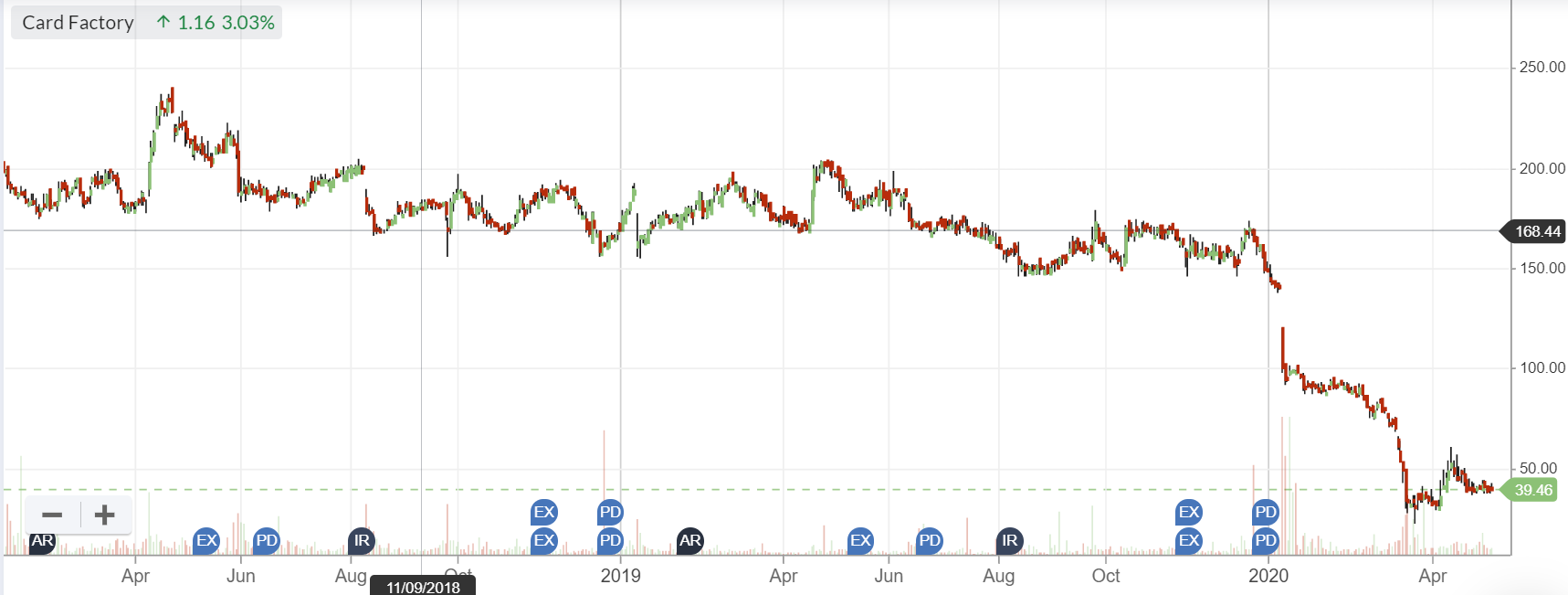
Recap - I used to like this share, for the high dividend yield, supported by amazing cash generation and a very high operating profit margin. Obviously everything has changed since covid caused shops to be shut. We don't know how long it's going to take for High Streets to return to normal, if they ever do. That's bad enough, but CARD has also (foolishly as it turns out) taken on too much debt, and paid out excessive dividends. I doubt it can carry on paying divis, hence the main attraction to the share is now gone, and it might even end up fighting for survival, due to the heavy bank debt. Hence I'm feeling negative about this share before I've even read today's update.
Today's update - much of this is similar to what so many other companies are saying - i.e. conserving cash, thank employees, etc.
Key points;
- Banks are supportive. Has £200m RCF until Oct 2023
- Bank of England confirmed access to CCFF (but not stated how much CARD can borrow)
- 90%+ staff furloughed
- Capex, VAT & payroll taxes deferred. No divi
- New store openings cut back unless contractually obliged, so only 7 in FY 01/2021
- Online sales up considerably, but only a small part of overall sales
- Confident it has sufficient liquidity
My opinion - that's all fine for the time being, but my concern is the bank debt. Bank covenants are not mentioned, and my worry is that covenants would almost certainly be breached when the stores are closed. We're not told when the stores are likely to re-open.
Given the very high level of debt, I think this share is currently too high risk and doesn't come with multibagger potential upside. As readers know, I don't mind taking on high risk positions, but only if I can see a realistic upside opportunity to make say 5 times my money. That's not likely to happen here, even if trading resumes fairly soon. Note that things were going downhill before covid struck, with a profit warning in Jan 2020.
My other concern is that income seekers who held this share for the divis, are likely to be sellers. That's an overhang that could last a long time, and keep the share price suppressed.
.
Halfords (LON:HFD)
Share price: 133p (up 15% today)
No. shares: 199.1m
Market cap: £264.8m
Halfords, the UK's leading provider of motoring and cycling products and services, today confirms the revised date for publication of its preliminary results for the year to 3 April 2020 ("results") and provides an update on recent trading and liquidity.
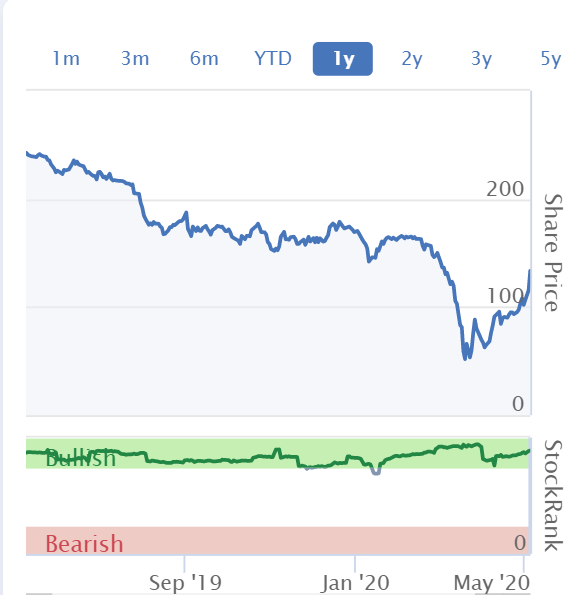
This share has bucked the trend, so well done to Halfords shareholders, who managed to pick one of the best of a bad bunch, that has recovered well.
.
Halfords stores have remained open during the lockdown, since its products and services are considered essential.
FY 03/2020 results update -
Our results for FY20 were boosted by better than expected sales in the final weeks of the financial year during the lockdown period. Subject to audit adjustments, we now expect that Adjusted Profit Before Tax, on a pre-IFRS16 and 52-week basis, will be at the upper end of our previously guided range of £50-55m.
Recent trading - this seems resilient, in the bizarre circumstances of the moment -
Group sales for the four weeks to 1 May 2020 were 23% below last year on a like-for-like basis, which was better than we initially anticipated. This was fairly consistent across the period and reflected a strong performance in Cycling, as the public explored alternatives to public transport and looked for ways to stay healthy. In Motoring, essential categories such as batteries and battery care performed well, but overall weakness reflected a significant reduction in car journeys during the lockdown period.
I never thought I would consider -23% LFL to be fairly decent! The trouble is, trading at -23% LFL is very likely to be trading at a loss. It will be interesting to find out in the future if they were better off continuing to trade, or if shutting down would have been cheaper? I think there's a lot to be said for business continuity, so staying open was probably a good decision.
Liquidity - this next section below is self-explanatory, and sounds reassuring. Although as with any other business that is relying on bank support, it's the covenants that worry me. That said, banks seem to be very flexible at the moment towards listed companies, and usually just waive or modify problematic covenants. Hence perhaps we don't need to be quite so paranoid about bank debt as in the past? Although banks remaining patient & supportive, depends on how long and how bad the recession becomes.
Better than expected trading and the proactive measures we have taken to preserve cash have resulted in an improvement in our liquidity position. On 1 May 2020, we had approximately £159m of total liquidity available, including overdraft facilities. Despite this improvement, the severity and duration of the pandemic remain very uncertain and as such the Board will continue to take the actions necessary to preserve cash in the coming months and seek to position the Group for an easing of lockdown. We also
remain in active dialogue with our existing lending syndicate to provide additional flexibility should we require it.
The last sentence worries me a bit.
My opinion - so far, Halfords seems to be weathering the storm well. That has been reflected in a strong rebound in share price. I certainly am not inclined to want to chase this share price up any higher, given its reliance on bank support, and interim results later this year that are probably going to look absolutely dire.
Timings update - for the sake of what's left of my sanity, I have to get back home to Bou'mth this afternoon, as I've been stranded in London since 27 Feb, amazingly. I got more than I bargained for, coming into London for a meeting with RBG management on 28 Feb. Oh well, as Cilla Black used to say, life is full of surprises! Hence I'm parking today's report to one side, and will finish it either tonight, or tomorrow. Apologies for any inconvenience. Paul.
Share price:
No. shares:
Market cap:
Share price:
No. shares:
Market cap:
Share price:
No. shares:
Market cap:
Disclaimer
This is not financial advice. Our content is intended to be used and must be used for information and education purposes only. Please read our disclaimer and terms and conditions to understand our obligations.

80 comments
This was a great read, thank you. In relation to CARD, I've seen a number of figures in relation to their debt, what actually is it? I have seen 3 figures across a number of communications, 137m 171m and 316m?
thankyou for you macro ramblings, very thought provoking and very interesting. Like everybody else, we dont have a clue what will happen but my gut feeling is a temporary revival in going outside, working etc and then a second wave and a second lockdown but i do hope i am wrong. I do believe that there are now three certainties in life. 1 - death, 2 - taxes and 3 - mike ashley to behave like the selfish, waste of oxygen and vital organs that he is.
As far as I aware, Modern Monetary Theory basically says government spending is not constrained by tax receipts as it is spending that creates those receipts. And you can spend as much as you like as long as inflation doesn’t take off.
That seems to imply to me that we could reduce taxes to nothing (as long as inflation doesn’t take off). But this seems absurd to me so I cannot help but think either I have misunderstood or the theory is built on a fallacy.
So, on that basis, at the moment, I believe that governments cannot spend vast amounts of money they don’t have (on the basis that if they have their own currency they can always pay their debts by “printing” money) without a negative consequence appearing somewhere - perhaps high inflation, perhaps a breakdown of faith in the currency so people refuse to accept it as payment.
But perhaps what you can do is just pay the debts off very slowly (like we did with the war debt to the USA).
It strikes me that if the BoE was insolvent, it's more a technicality than anything else. Money at the central bank is base money, meaning an account holder can't actually "take it out" of the bank anyway. They could withdraw notes, but they be printed endlessly and is only exchanging one IOU from the bank for another. A bank note is only IOU from the BoE but there is absolutely nothing you can get for that IOU. We are not on a gold standard anymore.
So from what I can see the central bank can't really go bust.
Welcome back to Bournemouth Paul. When all this is over we must catch up over a beer sometime by the seaside
I never really understood this FUNNY MONEY business of printing money to get an economy out of trouble. Surely that's what helped destroy Germany in the 1930's? Don't we have to balance the books and not spend more than what we are making? Wasn't that the point of the Thatcher administration and the recent crippling austerity of the Lib-Con pact? I started to get the gist of it when I read the books by Yanis Varoufakis and the way the EU dealt with Greece. I know that my ignorance must astound you all but if governments can create debt and write it off when ever they feel like it why don't they just get on with it? They have been doing it since 2008. What's stopping them? Could it be that all this debt will actually cause an implosion of the world's current monetary system? Does anyone out there think that we are about to witness a massive bang that will bring about rampant inflation and mass unemployment?
Definitly mass unemployment but i cant see big inflation. In the long term 50%-100% inflation, and i think we heading for stagflation...
Just looking at the government's draft guidance on easing lockdown for workers. The high level points appear to be:
https://www.buzzfeed.com/alexw...
So much like now, by the sound of it, with a bit of gentle easing round the edges. Nothing said about how much people can interact outside of work.
Anyway, Boris will speak to the nation on Sunday.
timarr
I can’t see how coming out of lockdown is going to change the fact we are in the midst of a global pandemic, it isn’t over it’s just slightly more under control (?). If a company has expanded over time to fit the demand, their outgoings grow with demand. Suddenly that demand diminishes their expenses are not reduced in line they automatically begin to lose money. This causes lay offs, potentially deflation, which affects the wider economy in a spiral.
Demand isn’t going to be back to any kind of normality for many many businesses. I can’t see how things are going to get any better anytime soon.
As an example my buddy works in one of the largest food import businesses, mostly B2B, once restaurants closed they had no customers. All Future orders cancelled, they are ordered 3 months in advance. This has caused countless problems From wastage cost through to client relationship breakdowns. People are refusing to pay down the chains because simply they can’t. if the restaurants open tomorrow they won’t have stock, it’s a 3 month lead time so there will need to be time to adjust. And obviously you can no longer run a restaurant at full capacity so does this mean the orders are now reduced? This will affect staff, layoffs etc etc.
it’s a massive massive problem maybe I’m wrong but the economy is going to implode soon
"Let's have a discussion about this, as I cannot see why in theory, this could not be done, especially if other Govts agree to do the same thing, at the same time."
All of my biggest investing mistakes have come when I couldn't see a downside to the investment. It has normally turned out that I was being blind to the risk and these things tend to unravel very quickly. Taptica was one where I couldn't understand the downside risk when it was so cheap and repeatedly beating expectations. I sold out after it dropped 50% following the CEO losing a legal case for stealing information or something like that.
My point is that the adage of if something seems too good to be true then it probably is.
In 2008 the problem was obvious, as now. But the market didn't react immediately as there always seems to be a pervading optimism. It took event like Bear Stearns, and Goldman Sachs for the market to react and drive the market lower one shock at a time. I'm of the opinion that at some point there will be a similar event although I don't know what it will be or where it will come from.
I also think that the longer governments can delay the shock the worse it will be. We have a supply and demand economy which isn't currently functioning. Therefore our economy is like a potato which looks fine on the outside until the point it starts rotting. But underneath it has been getting worse for a while we just couldn't see the damage.
Can anyone please explain how the Bank of England can just create £1.6 trn of money?
As I understand it, QE involves the BoE buying up debt in exchange for a credit to the seller - so the seller, let's say a bank, now has a credit balance/deposit at the BoE. This seems to be more useful to a bank than the debt instrument it has just sold and enables it to lend more money to borrowers. But if it spends the credit balance, it is just transferring it to another bank. The BoE still has the liability. So if the BoE and the government then agree to cancel all the government debt held by the BoE then either the BoE has also to cancel the credit balances held by the banks, making the banks massively insolvent, or if it doesn't cancel the credit balances, the BoE is massively insolvent (thus also making the banks massively insolvent). (So I think QE is better described as increasing the money supply rather than creating money).
What have I missed?
The BoE can lend money directly to the Government by using newly created money instead of purchasing existing debt from a seller (ie a Bank). In effect the Government is borrowing money from itself rather than third party financial institutions. This could in theory be written off at some stage by the BoE which has the effect of permanently increasing the money supply. This is potentially inflationary unless managed carefully.
"The BoE can lend money directly to the Government by using newly created money instead of purchasing existing debt from a seller"
That's not true actually, other than through the "Ways and Means Facility" which is basically an overdraft. But that's nothing to do with QE which is what jdnthomas was asking about.
The answer to jdnthomas is that cancelling the debt would make the BOE "insolvent" (depending on the value cancelled). But what does that insolvency mean? Arguably not a lot in real terms and there are ways that it could be "recapitalised" if that was necessary.
But when jdnthomas says that "I think QE is better described as increasing the money supply rather than creating money" he is making a meaningless distinction. The money supply is money. QE increases base money (M0). What most people think of as money is more likely a broader definition such as M4, which may or may not increase, but if QE is working it likely will increase.
Edit: I should say QE as so far conducted increases M0, not M4 directly. But there is nothing to stop this happening. If the BOE purchases assets from non banks, this would impact the higher levels of money supply directly.
No cmpeckham, I was asking how you create money. QE seems to be the popular way but what is this Ways and Means facility? Not sure any other way is fundamentally different, apart possibly from physically printing notes. If you cancel debt there must be a debt holder losing out. I am clearly not so sanguine as you about the BoE being insolvent. How would you recapitalise it ? (other than by borrowing the same amount of money you have just cancelled?)
To quote Winston Churchill: "We contend that for a nation to try to tax itself into prosperity is like a man standing in a bucket and trying to lift himself up by the handle."
Is printing money not much the same thing? If so, I don't see how QE can be successful when people eventually realise that the Emperor is not actually wearing any clothes, and the value of their money has shrunk considerably!
Re: creating money
- as I said, the Ways and Means is an overdraft. It has nothing to do with creating money. QE does.
- why does the BOE have to be "solvent"? Nothing it does need be affected by "solvency".
- can you really be "insolvent" if your only liabilities are in sterling and you can create as much sterling as you like ex nihilo?
- the BOE is owned by the UK govt (HM Treasury). If UK govt debt owned by the BOE was cancelled, then one department of the Treasury loses and another department gains an equal amount. So what difference does that really make?
- if it was really necessary to "recapitalise" then why not use the sum that the Treasury has saved by having its debt cancelled?
None of the above is to say I advocate wholsale cancellation of debt, but I do advocate understanding what it means and, just as importantly, what it doesn't mean.
Not really sure what you're trying to say, cmpeckham, unless you're just agreeing with me that cancelling government debt held by the BoE achieves nothing very much.
Well, you asked a lot of questions like "what is this Ways and Means facility?" and "How would you recapitalise it ?" etc ... and it's an area I have experience in, so I answered them for you, did I not? You're welcome.
p.s. You're wrong to say that cancelling government debt "achieves nothing very much". On the contrary it would be very significant, but perhaps you don't really want answers from me, so I suggest taking it up with someone who has a working knowledge of macro.
It seems to me that if the Government draws from the overdraft under Ways and Means and the BoE subsequently agree that the overdraft does not need to be repaid, then that is no different from the BoE printing fresh £20 notes and dropping them from a helicopter. It is going to permanently increase the supply of money.
The overdraft facility is for short term mismatches in funding flows. It is rarely non-zero and has always been repaid promptly. There is no point in using it for long term funding anyway because the govt can get any long term funding it needs at close to zero interest rate.
The BOE controls the money supply not the Treasury. This wouldn't happen, but If for some bizarre reason the WAM (overdraft) did affect the money supply, then the BOE would allow for it and would simply mop up what it didn't want to be out there via its daily open market operations. Bottom line: the WAM does not affect the money supply in any meaningful way.
"Can anyone please explain how the Bank of England can just create £1.6 trn of money?"
The Bank of England has it's own bank account and can change the number of Pounds within at will, both up or down. It is the magic money tree bank account. Yes, they just change the value. Type 100 million into the value stored in the computer's ledger. In the very old days money was paper-based and had to be physically printed to make this happen, hence the term 'printing money'.
So two examples, one traditional QE and the second, deficit financing
Traditional QE. The economy is glum and firms are not taking out loans, expanding their businesses.
The BoE decides one day to buy govt debt (gilt bonds) from private companies, in this case an insurance firm. So on that day, the BoE increases their bank balance by £100m and then buys 100m of bonds from L&G and duly transfers 100m cash into L&G's account. L&G is now free to spend this money as they see fit, in the real world. In practice L&G just swapped gilts for cash and actually need to keep holding assets for their business to run, so they go out into the market and buy higher yielding corporate bonds with that cash, thus pushing up corporate bond prices, pushing down yields, making loans cheaper out there, thus encouraging firms to borrow more at cheaper rates, thus stimulating the economy. Happy days all round. The BoE still has 100m of Gilts sitting on its desk, so one day later decides to sell these back to the private market, Aviva steps up, hands over 100m in real cash to the BoE in return for the gilts. The BoE then goes back to its computer and deletes the 100m from it's account. Round trip over. Crisis averted. Good job too.
Deficit financing. One day the Uk govt decides to run up a huge spending deficit to support the country. Normally, the Treasury goes out to the private sector and sells gilts to raise the cash. Insurance companies, banks, foreign investors etc are the usual suspects handing over their money in return for a gilt which pays them interest and repays the original principal at the end of the loan term. But, now the deficit is massive and there are not enough private actors around to buy it all at a reasonable interest rate. What to do? BoE steps up to the plate, enters 1,600 billion pounds into its own bank account, as above, and gets buying those gilts. Yum yum! The Treasury is ecstatic, suddenly it can sell a lot of gilts, collect real cash, and spend it on anything - benefits, civil servant wages, infrastructure projects, pensions, business loans. Everyone is very happy. The general public are getting a lot more from the government than they pay in taxes. Let's party.
Of course, problems eventually surface. Firstly, the BoE begins to notice something odd. Foreign investors stop buying gilts, in fact they sell all their holdings back to the BoE. The rating agencies Fitch et all downgrade the UK's sovereign rating. Even though the BoE is still buying gilts willy nilly the interest rate doesn't seem to drop any more. The Pound drops against all major currencies which pushes up the price of imported goods, inflation rises, but nothing to worry. Oddly, fixed assets of constrained supply, like property, boom in value. The Pound drops a bit further and savvy investors notice gold, in Pound terms, is zooming up and get buying. The general public get uneasy, prices of imports are up, housing is up, petrol up a lot, they feel poorer and demand wage increases from their employers. Civil servants go on strike and the govt ladles out 20% across the board wage increases, paid for by more gilt issuance. Suddenly mainstream figures it out and panics, there's a rush for the exits, gold is snapped up you can't get your hands on physical gold, the pound plunges 25% in one day as people rush to buy USD, Euros, anything. BoE wets the bed. The next morning the BoE raises the base rate to 5% to defend the Pound. Gilts crash, yields surge. People wake up to variable rate mortgages reset to 7%. The Pound drops another 25%. BoE raises rates to 7%. then 8% eventually 15%. Capital controls are imposed, buying foreign currency is limited. The property market implodes under these interest rates. The BoE stops buying gilts the govt is bankrupt and heads down to the IMF for a rescue package. The IMF agrees in return for a long period of brutal austerity.
ok, the last one is a bit extreme, but it does happen from time to time. My real concern is the govt keeps pushing on this until the markets give them a slap.
John Authers interviewing Howard Marks on 'Global Macro and Market Outlook in Uncertain Times' at the CFA Institute.
Free to register here https://annual.cfainstitute.org/
Interview Monday, 18 May 1:00 – 3:45 pm ET
Can't think of a better pairing of interviewer and interviewee!
Theoretically, the Bank of England could just create £1.6tn in new money, and then buy up all of the UK's Govt debt that it doesn't already own. Then just agree with the Treasury to cancel the whole lot. Contra the Treasury's liabilities, against the Bank of England's assets, and the UK's entire National Debt simply vanishes. Let's have a discussion about this, as I cannot see why in theory, this could not be done, especially if other Govts agree to do the same thing, at the same time.
I have thought for a few weeks some form of (global) government debt cancellation seems likely in future. Trying to raise taxes to pay back the extra debt would be a political nightmare. If one country did it it would be punished by financial markets but if the largest economies (G20?) did it simultaneously then they might get away with it.
I doubt all debt would be cancelled but the cost of fighting the self imposed lockdown would provide justification for governments to cancel maybe 25%-30% of their debt. Central banks could co-ordinate to make sure they hold enough debt and then it would disappear on an agreed date.
I'm sure it would create unintended consequences but I don't know what they would be.
"Let's have a discussion about this, as I cannot see why in theory, this could not be done"
The theoretical problem is inflation of course. But perhaps the more meaningful issue is the impact on the whole apparatus of economic policy that has served the world well since the end of the Bretton Woods system in 1973. The current system is based around central bank independence. A system that involved monetising debt would break that model by conflating monetary and fiscal policy, and allow political considerations back in to monetary policy. You would need a book to describe the impact of that, not a stocko comment!
That is why I don't see this kind of debt jubilee happening unless things turn dramatically worse. But what we can expect to see is "limitless" QE, with an extension of the assets that qualify for QE, as we have seen already in Japan and the USA. This will achieve a lot of the benefits of a debt jubilee without actually having one.
In that scenario, government debt will pile up, the BOE balance sheet will expand like crazy and people will start pulling their hair out. But none of this matters so long as inflation is contained and whether it is or not depends on the skill of the Fed and BOE. So long as they maintain their independence, I have a lot of confidence in their ability to contain inflation and bring it back to target when it starts to creep away. They have developed great skill in doing this. Much of this would be thrown away if they lose their independence.
Thank you for macro comments, they are always fascinating and thought provoking.
I write this as somebody who sold a large amount of my holdings on 19th March and this still haunts me (e.g. Boohoo (LON:BOO) sold at 155p. Having held since 2015). It has in a sense cost me a lot of money. So I am of course looking for a justification that I was right and that of course is not good.
Paul writes: “I cannot see this ending well but I don’t know what the catalyst will be”. The this being the endless printing of money. To some extent it is all too complicated for me to understand. Somebody (on twitter I think) said why stop at paying 80% of 20% or 30% of employees wages with printed money. Why not print and distribute £40,000 to each and every employee and they can all just sit at home and watch Netflix. Anything we need we can just import from abroad. Of course it is an absurd notion but where does furloughing move from being a necessity to the absurd?
I believe that markets correct for a reason and you cannot abolish, completely, boom and bust by government action but markets are behaving at the moment as though they, government, can.
We have had bear markets on a regular basis since markets began but over any 15 year period (and almost every 10 year period since 1973) the return has been positive on an annualised basis (between 6.4% and 18% depending on which period you took). So all this up and downs in share price that we all (including me) focus on so much was/is pointless. We should just buy 20 or 30 good companies, stick the certificates in a cookie jar and go and do something else instead. But markets have never seen this, they buy when they are all excited and sell when petrified (me included). This leads to bear and bull markets.
Has the Fed (by 0% interest rates, buying bonds, endless QE and the threat that they might buy stocks) managed to convince the markets that they don’t have to focus on the short term. That the market will go up and to the right over the long term and that we, the Fed, will ensure that it does so buy stocks whatever the news? Whatever the future looks like because in the long run the future is rosy?
Maybe I am just cut out for this investing malarkey?!
You need to ask yourself why you sold £BOO? Perhaps you bought into the view that it was expensive (it is) and that spending on clothes would collapse as disposable incomes came under pressure? The opposite happened in that BOO gained from the fact that it was online not the High St. It noted particular gains from sportswear/leisurewear an smart tops for work video conferencing.
I think this picks up on my thoughts yesterday, I had not held £BOO previously because of being put off by the seemingly "high" P/E valuation on several occasions and obviously I had kicked myself on several occasions when I looked back at my Ideas folio.
I have started dipping in and out over the last month as part of my recovering trading strategy, with a small part of my portfolio, so trying to take advantage the +/-% daily variation which I have not always right but I am thankfully ahead!
But again I am not ready yet to hold longer term at the current value and question is this me going to kick myself again or going to play a blinder?
I also find if that we are all honest there are many of us with a I sold £XYZ at £1.23, or thought about buying, and it is now £9.87...
Then with hindsight I would have bought 10 terraced houses in an unfashionable part of East London back in the early 2000's and be sitting somewhere very nice not even worrying about my portfolio now!
Interesting snippet on Boohoo (LON:BOO) today https://www.cityam.com/boohoos-understanding-helps-it-avoid-lockdown-tears/
Selling to 11% of 18-24 yr olds (presumably just ladies?) to my mind show huge market penetration, given the range of retailers and online sellers.
I too was guilty of anticipating a lockdown demand plummet. Wasn't it a Next or M&S spokesperson who recently said "No one buys new clothes to stay at home"? I still can't quite grasp why people would buy 'seasonal' gear if they can't wear it to impress their mates but no doubt that's what Zoom is for!
That sounds like a nasty experience, and one you'll not forget - which means you'll be able to remember this next time something like this happens. This is my first one of these unusual events, and I'm racking up quite a list of errors to remember next time! Likewise, it is great you are recognising that your mind is now looking for justification, rather than being completely rational evaluating the decision as either right decision but bad luck, or wrong decision and bad luck.
Your point about the cookie jar made me think about a section from The Little Book of Behavioural Investing. James Montier quotes Bob Kirby's "Coffee Can portfolio", in which investors would have to put stocks into and not touch them. The idea being that if you selected good, reasonably safe, not too exciting shares and held over the long term, you'd probably do ok, whilst also minimising your transition costs and admin time. The point Montier makes is that often doing nothing is really hard, and that there is huge value in doing nothing - in fact, this is usually the hardest bit of investing, but doing something (often over trading) is one of the most unprofitable things we can do. Likewise, he also tells the story of how once client had a single Bloomberg terminal in the office, and anyone approaching it was subject to ritual humiliation, as checking portfolios and prices every hour/day/week/month is often counterproductive.
Yet, there is something in all (or at least a lot) of us that really likes the idea of exciting stocks, making money quickly, taking advantage of the volatility of the up swings of a bear market. The coffee can often seems boring, and we get fear of missing out on stocks with exciting growth. For my part, I've re-written my investment plan to try and do a bit of both - buy hold forever (or decades) income stocks at this price, with further investment if the market goes south (my coffee tin retirement portfolio), or go back to my usual 6-24 month focus stockrank based strategy once the volatility and uncertainty in the market has settled, so more of the price change of companies is due to the companies (which I can measure with stockranks and feels tried and tested) rather than the macro economic situation in which I've not got a clue what is going to happen. I've also tried to follow another point Montier makes - pre-commit to the strategy. I've set buy orders at various points for my income wishlist valid for the next few months to a) stop me "having a go" on some stocks shooting up in price (as I need the cash there in case a buy order is filled) and b) means I won't be second guessing myself when I'm in the moment and the market is falling.
Of course, whether in 6 months time I'll still think this was a good plan is another matter... I suspect I'll have plenty of more hard lessons to learn in the coming months
Purpleski - I think we've all lost money at this game. Don't give up though, you've learned a huge amount in trading and investing.... learn from your mistakes and keep going.
I always think of the Terry Smith of FundSmith quote :'Some of the best investors are dead'
Meaning, they don't chop and change their investments or give in to whims, fear or much of anything else.
Of course choosing sensibly in the first place is the tricky part, and being alive is generally better than being the opposite for most other purposes :-)
This investing game is easy with hindsight. We all learn from our experiences and the reality. After the financial crash the markets soon recovered; the media gloom was repeated this time but many who remembered those times ignored the doom merchants. I freely admit that this is the most profitable time I have had in the last 25 years. Many Covid related stocks up ten and twenty fold and more. GDR hit 300p yesterday morning before raising new cash at just 80p. The thing is they explained, the share price was only 9 pence a few weeks ago.
Personally I think it is possible that markets will be at or near new highs by the end of the year. For companies, this is a great time to rationalise and change tack and lay off lots of unproductive staff. Managers reporting to managers. Some companies will go but do we really need all those overpriced restaurant chains? Or even more cruise ships? Or the cheap tourism that is overwhelming cities? More airbnb party homes? The cheap plastic rubbish?
In time, that must mean leaner and more effective companies with much stronger balance sheets as dividends are reduced and cash balances drastically increased . Of course that will mean potentially higher unemployment but that is now a Government problem. The furlough scheme and similar has set a real precedent. Already there is talk of schemes where the employer is paid a subsidy to take on younger staff / school leavers. Not actually new...back to Gordon Brown times. This may also lead to a more compliant workforce; accepting lower pay and conditions just to stay in work. A difficult time for many but possibly not for investors. Higher taxes will perhaps follow...as it did in the "buy to let" business when returns got to a crazy level.
Many expect the markets to fall sharply again. I don't know. I do know from experience that markets rarely do what they are expected to do.
Hello Purpleski,
There is an excellent book by Chris Mayor called 100 baggers in which he describes an actual example of a coffee can portfolio.
My vague recollections of it is that a broker looked after the investments of a lady and when the husband passed away, she asked the broker to manage the husband’s investments. The broker found that the husband had been buying the stocks he recommended to his wife and never sold them. He had one stock in the portfolio which was a hundred bagger which made all the other stocks which had either made losses or gone bust insignificant. The broker realised that the husbands portfolio had performed better than the wife’s.
All the best.
To print money and cancel national debt you would have to redesign the entire financial system...as you need a system of trust to move money round the world to support trade. Without this, trade collapses and therefore the economy. I think this task is beyond most of us!
Whilst the theoretical danger of money printing may be inflation, the risk of too much Government Debt is deflation. The excessive Government Debt causes a rise in saving and the economy becomes less and less productive.
If the reward for trade is a currency unit of unlimited quantity and no value you would demand something else... which is the main reason why you won't see unlimited money printing. It would drive the system back towards a gold standard to restore confidence in trade. Some believe we are on this path anyway, but why would the Fed accelerate it?
The path to a debt jubilee ( mass write off ) is similarly destructive. We are basically talking about the US and it cant be achieved and maintain reserve currency status. It is tantamount to national default.
With such uncertainty as a back drop, invest where your visibility is greatest, strong balance sheets, a safe dividend, solid business..hold lots of cash... make sure you survive.
The Donald has an interesting personal relationship and history with debt, having been near bankrupt himself in the 80's/90's.
https://www.newyorker.com/news/our-columnists/donald-trumps-business-failures-were-very-real
So you can either expect him to take a very personal view of debt obligations, and look at them in terms of leverage at the same time.
Fun and games to follow, I believe!
On printing pounds for current expenditure.
The value of anything depends on what someone else will pay for it. Every pound printed has to be owned by someone at every moment; when the currrent owner fears it may lose purchasing power they will sell it for something that feels safer and the exchange rate will move against sterling. International trade depends on exchange rates, which makes them central to inflation. So while there is any apparently safer currency available, printing pounds for current spending risks losing the confidence of overseas traders and investors and the result is inflation, possibly coupled with recession if the pound falls so far that exporting becomes unprofitable and importing too expensive.
Once that starts, what can be done to stop and reverse it?
"The Fed acted with such unprecedented speed and determination, this allowed masses of corporate debt to be issued on terms that would normally not have been possible."
Smart companies should be making the most of this if they can reduce their cost of capital and/or re-invest the funds at their own higher returns on capital. Historically, one of the best companies at timing bond issues is Apple, who despite having $40bn in cash, issued $8.5bn of bonds with record low coupons this week.
https://www.reuters.com/article/us-apple-debt/apple-borrows-on-the-cheap-to-fund-buybacks-dividends-idUSKBN22H001
Last week I noticed Diageo (LON:DGE) doing the same: https://www.investegate.co.uk/diageo-plc--dge-/rns/diageo-launches-and-prices--2-5-billion-usd-bonds/202004280700110504L/
All the best, Si
whatever your views on Brexit, its hard to see that we're in any way prepared for it to happen come year end. there's still no coherent vision of what its going to look like which seems like a pretty good reason not to rip up most of your trade agreements. its still a political football I suppose but the costs of it are very real.
I have been keeping my eye on Loopup (LON:LOOP) as the nearest UK quoted company equivalent to ZOOM. This US company has, well, zoomed ahead since the lockdowns were introduced in the western countries. The sp went from 3.4 at the start of March to 20.6, with a recent pullback to 10.4 .
No doubt the likes of Microsoft (with Team), Google and Facebook, to name its biggest tech competitors, will not take this lying down.
Loopup (LON:LOOP) 's trading update today is very encouraging and for me, it plays to the post COVID potential winners.
I went long this morning. DYOR please.
Can anyone provide a link to PI World podcasts please?
https://www.piworld.co.uk/podcasts/
Thank you for the link. Podcasts are great for when walking.
It is interesting to see that PiWorld is on Podbean. I use Podbean & have searched "investing" before and never noticed PiWorld in the results. I have found some useful content on Podbean, including Ray Dalio, Howard Marks & Joel Greenblatt.
Player FM is the other Podcast app that I use. This is the better app by far, but of course it's necessary to use whichever app has the content.
Both Player FM and Podbean allow podcasts to be downloaded, which is essential, as I listen to them when out walking and the mobile signal drops out on most of my walking routes.
I notice the Twin Petes are using Soundcloud. As I've not managed to get a download of their podcasts, I haven't been listening to these.
I did have some success converting YouTube to MP3, via some third party websites, but google seem to have blocked that. So I haven't managed to download (for example), the Berkshire Hathaway AGM to MP3 this year.
jonesj -
I have downloaded Audacity which records sounds being played and then it can be exported as an MP3 file
https://www.audacityteam.org/
(just tried it on YouTube and it works)
Jonesj, I use Podcast Addict and can access the PIWorld podcasts as well as Conkers Corner amongst others (e.g. TWs free podcast). No need to covert files or the like. I sometimes need to switch the search settings around (iTunes vs others) but once found and subscribed I get automatic notification of new episodes and download away. I'm on an android phone. Not sure if available for Apple.
Like Banzii, I Also use Podcast Addict. Having tried most, this works best for me. Not yet been unable to find a podcast I was searching for and has an excellent playlist capability so i can sort in any order I want. Free Ad Version and an Ad Free version for £3.99. Try Ad version first (ads not that intrusive) but then give the geezer his £4. It's well worth it. Accept others will have their preferences but playlist on this is magic!
Thank you Beginner
Paul, re Brexit.
Despite what is likely to be extreme criticism of the UK's preparedness for a global pandemic, this Government can almost certainly survive it on the basis that they (a) followed scientific advice; (b) were not personally involved in what seem to have been the (obviously now) unwise assumptions of the 2016 pandemic simulation https://en.wikipedia.org/wiki/Exercise_Cygnus undertaken when TM was PM.
Delaying Brexit is a completely different matter as it is the identifying principal of the current Government. I see absolutely no way the Government can delay Brexit and run the risk of being dragged into EU costs relating to the pandemic and/or whatever other pet projects they continue to think up.
Trust would be lost forever and deservedly so.
Obviously all IMHO.
But equally, refusing to extend the Brexit transition, likely leading to an effective no deal Brexit with all the economic damage that will cause, would be a deliberate action by them, and entirely in their control. They would certainly try to hide the economic damage of that with Covid, but it's far from certain that would be successful in avoiding blame when voters look back in 4 years time.
The media are having a field day this morning with the scientific advice.. The scientist ‘he who shall not be named’ providing the advice which has led to the lockdown and the consequent unprecedented damage to the economy and future livelihoods of a whole generation has been cheating! Not only cheating on the lockdown but on the cuckolded husband too!! Will we see a return to Michael Gove’s we don’t need experts philosophy?
He is still a first rate scientist and we still need them. I really don't see why he should resign over an indiscretion. I would like to see a "We don't need politicians" philosophy.
Probably getting voted down here because not relevant to SCVR and the mistaken implication that I have no time for experts. I value experts in a wide range of disciplines but I have no time for someone who has had a major influence on this devastating lockdown and can’t stick to the rules he himself recommended. I am not passing any moral judgement on his relationships - that is for him, his lover and her family to sort out. However, I tend to agree re your comment on politicians!
It doesnt look like the EU care much about Europe given their lacklustre response to helping individual nations. They have been absent during this crisis. ZERO leadership and much annoyance in European capitals
Morning all,
What is the name of the company that Graham likes that buys up the rights to old music?
Thanks in advance,
J
that would be Hipgnosis
Thats it, thank you!
I guess you are thinking of Hipgnosis Songs Fund (LON:SONG), but not sure Graham likes it. He has made a couple of comments in the SCVR. I am a holder, having bought in via the "C" shares last year and I like it as a cash generator in an ISA. And it is not all old songs - Mark Ronson was the most recent artist to join "the family". Check it out via the News and Discussions tabs.
Thats the one, I thought he was positive on it, but I just read that spotify has reported a big decrease in the (relative) number of 'new' songs that people are choosing to listen to, versus 'old' songs. It made me think of the business Hipgnosis is in, but i couldn't remember its name. And thanks for the Mark Ronson info. I watched a documentary on him (either BBC or Netflix) because he's been listed on so so many songs that I like since he came to my attention with his work with Any Winehouse. I knew nothing about him before, but came away with the impression of a man just deeply engrossed and knowledgable about music. Worth a watch if you like the odd music doc every now and then.
Cheers!
I think it's hipgnosis songs fund
Paul thanks an excellent read and yet more thoughts and ideas to consider.
My morning smallcap tweet:
Ricardo (LON:RCDO) Metro Bank (LON:MTRO) LoopUp (LON:LOOP) Empiric Student Property (LON:ESP) ULS Technology (LON:ULS) Inspiration Healthcare (LON:IHC) Card Factory (LON:CARD) Modern Water (LON:MWG) Clear Leisure (LON:CLP) Braveheart Investment (LON:BRH) One Media IP (LON:OMIP) ClearStar Inc (LON:CLSU) MPAC (LON:MPAC) Accrol Group (LON:ACRL)
Ricardo (RCDO) Q1 good with order intake £30m pcm, declined to £19m in April. Covid: "no immediate concern, we have taken action to strengthen the Group's funding to provide further headroom against the risk of the more pessimistic scenarios materialising...exercised £50m of the accordion option." Also net debt /EBITDA) covenant increased from 3.0x to 3.75x.
Metro Bank (MTRO) Capital and MREL ratios remain in excess of regulatory minima.
LoopUp (LOOP) rev for Jan to April up at least 40%. Gross margins stable and overheads broadly in line with market expectations. Confident of exceeding current market expectations for FY.
Empiric Student Property (ESP) guides 19-20 academic year rev down up to 12% (£8m) cf worst case £21m guided. In this year 47% of rooms reserved (54%). Demand from international students is continuing albeit at lower levels, but starting to see increase in bookings from UK. Increase in requests for self-contained studios and en-suite accommodation, 83% of Group's beds meet these requirements. Co remains well capitalised with significant headroom against covenants. I hold.
ULS Technology (ULS) guides FY(March) in line with market expectations. "Difficult to predict when and how quickly the housing market will recover at this point. However, the Company has sufficient cash reserves to allow it to continue to invest in its sales channels and product development."
Inspiration Healthcare (IHC) Q1 'very strong' at 27% up. Without the recent exceptional orders the order book remains strong.
Card Factory (CARD) covid loan approved, confident co has access to sufficient liquidity, even in the event of a prolonged store closure period. Huge jump in online sales but still small fraction of rev. Still supplying Aldi Australian Reject Shop.
Modern Water (MWG) Increase of water hygiene controls means "production volume has doubled to a list price value of £500k per batch." What does that mean?
Clear Leisure (CLP) Sipeim claim hearing, scheduled for 6 May has been postponed. Sosushi claim may be affected as well, although a preliminary ruling on a possible arbitration rather than a trail in court should not be affected.
Braveheart Inv Group (BRH) Update in response to social media speculation and SP movements re investee cos companies which have projects in association with the Aptamer Group. "Paraytec are in discussions with Aptamer Group and the University of Sheffield to define a project to develop a COVID-19 test. If successful, this test would enable potentially infectious individuals to be identified quickly...Kirkstall's Quasi-Vivo systems are being considered by Aptamer Group to provide a possible test bed for testing of aptamer based cancer therapeutics."
One Media IP (OMIP) to pay 0.055p interim div.
Clearstar (CLSU) FY rev up 14% as guided. This FY rev down 16% so far and current run rate ~50% down. CO unable to drawdown further funds from bank facility and expects to be required to make debt repayments in the coming months, based on its existing covenants. Covenant tests waived to June and negotiating new ones. "If the existing covenants continue, and based on the current level of trading, the Board believes that the Company has sufficient liquidity to remain viable until year end."
Mpac Group (MPAC) AGM stmt: Q1 cash generation unchanged from pre-covid plan. Remains "well positioned to meet our liquidity requirements beyond 2020 from existing resources" even under extreme assumptions.
Accrol Group (ACRL) guides FY in line with market expectations with rev up 14%. "With margins significantly recovered and core revenues at record levels in FY20, the Group has entered the new financial year in a stronger position than ever."
In other news - Loopup (LON:LOOP) are, as expected, going well (OK, very well):
... year-to-date Group revenue from January through April 2020 is at least 40% than in the same period last year
A less reassuring update from Card Factory (LON:CARD) who wax lyrical about the uplift in their online sales but are vague about everything else. At this point you'd expect companies to be providing some form of worst case scenario analysis rather than just a generic "we think it'll be OK".
Overall the trend to online is obvious - Ocado (LON:OCDO) have just announced 40% growth in retail revenue in Q2 compared to 10% in Q1, some of that will stick and more will do so the longer social distancing continues.
timarr
A great read this morning thanks Paul.
On lifting furloughing there's a decent BBC article on this here:
https://www.bbc.co.uk/news/uk-...
It highlights the challenges ahead and quotes Rishi Sunak:
"There will be no cliff edge to the furlough scheme. I am working to figure out the most effective way to wind down the scheme and ease people back into work in a measured way ... But some scenarios have suggested we are potentially spending as much on the furlough scheme as we do on the NHS, for example. Now clearly that is not a sustainable situation."
You'd think that if certain sectors - hospitality maybe - are forced to stay shut for longer then the furlough scheme could be extended for those, but it certainly looks like there'll be some form of tapering.
Despite this there is going to be mass unemployment, at least in the short-term. Statista suggest 10% this quarter falling to about 7% at the end of the year and 5.5% by the end of next year assuming a 3 month lockdown followed by a 3 month partial lockdown.
Markets seem to be looking through the short-term and it's probably reasonable to do so as long as you can avoid total wipeouts. However, I did note Charlie Munger's comments on this:
“We’re like the captain of a ship when the worst typhoon that’s ever happened comes,. We just want to get through the typhoon, and we’d rather come out of it with a whole lot of liquidity ... This thing is different. Everybody talks as if they know what's going to happen, and nobody knows what's going to happen"
timarr
”Despite this there is going to be mass unemployment, at least in the short-term. Statista suggest 10% this quarter falling to about 7% at the end of the year and 5.5% by the end of next year assuming a 3 month lockdown followed by a 3 month partial lockdown.”
Surely there is mass unemployment now? Governments have found a method of delaying giving the bad news to the country/markets until later when they hope they might have the bandwidth to deal with it?
Surely there is mass unemployment now? Governments have found a method of delaying giving the bad news to the country/markets until later when they hope they might have the bandwidth to deal with it?
No that's far too simplistic. There is a massive difference between furloughs and job losses.
It's quite true that we don't yet know what the outcome will be, and some/many of those on furlough may end up with their jobs disappearing. But many will be going back to their jobs and using their knowledge and skills to get their industries operating effectively as quickly as possible. It's a very important difference.
"Theoretically, the Bank of England could just create £1.6tn in new money, and then buy up all of the UK's Govt debt that it doesn't already own. Then just agree with the Treasury to cancel the whole lot. Contra the Treasury's liabilities, against the Bank of England's assets, and the UK's entire National Debt simply vanishes. Let's have a discussion about this, as I cannot see why in theory, this could not be done, especially if other Govts agree to do the same thing, at the same time."
There are limits to buying all the debt, given large amounts are sitting in financial institutions such as insurance companies, but your point still stands. Essentially, it's been done already, as there is no practical option to sell back the bonds into the market. When the US Fed tried to 'taper back' their bond holdings, by NOT buying back govt bonds when they expired (reached term) and let them tail off naturally, the stock market swooned and the Fed went right back to buying. So even if the bonds are not cancelled, effectively they are on the Central Banks' balance sheets in perpetuity now, it's a done deal.
"especially if other Govts agree to do the same thing, at the same time"
Yes but which govts? This problem is embedded mainly in Japan (the worst), Eurozone, UK and USA. But not China so much, SE Asia. The US is in a better position holding the world's reserve currency but pity the Pound and the Euro. If you chart the Pound versus, for example, the Thai Baht (SE Asian exporter with a large current account surplus and large pile of foreign FX reserves) it's been in a downward trend for years, which will continue. Its part of a gradual process of China and Asia rising albeit in fits and starts.
Then compare to other asset classes, e.g. gold. In the long run it tends to hold it's purchasing power to buy real things so it's likely to reflate against the increased money supply. Likewise anything which delivers an inflation-adjusted yield, such as stocks in companies which are growing or monopolies which can pass on costs more easily. The tech monopolies Apple, Google, Microsoft, Alibaba are in this position.
This brings us onto long term interest rates, which are staying near zero, if you look at ten-year bonds, for a very long time. The implications are (a) the prevalence of zombie companies loaded with debt which barely cover their cost of debt, they should be cleared out with the capital and people released for new endeavours, but their existence holds down productivity, (b) unfunded pensions - how will commitments to future retirees ever be met in this low-yield environment? Pensions and insurance companies ? (c) zombie banks - the Eurozone banks are a warning what happens with low rates for longer, they hold customer deposits at zero then feed the funds back into meger yielding govt bonds and collect a small spread, they don't expand commercial lending into zombie no-growth companies (d) the Fed, the ECB and now the BoE (via guaranteed virus loans) has bought up a load of corporate debt. the BoJ has been buying stock ETFs and now owns about 5% of market cap. What about all these assets? Distortion on the markets allocating capital, the weak companies survive. When will the Fed, ECB and BoE turn to buying stocks? Suspect the Fed will if a market crash loomed in front of the election.
Textbook econ on increasing money supply says inflation is coming, but global supply has shown strong growth preventing goods inflation and zombie companies with private sector debt deleveraging actually implies a deflationary environment, see Japan and Europe. This is bad for no-growth yield trap stocks. Avoid.
"As investors, I feel we should be thinking about how we imagine Brexit could pan out. That's why I'm flagging up this issue, as something to think about for the end of year. Would we see another extension of the transition period in Dec 2020, or a strategy that is emboldened"
Yes, a support scheme for certain industries affected would sail through in this environment. My base case is a hard exit as the transition costs on business could also be obfuscated politically with the virus downturn, so it's a bit of a open window for the govt.
So I stick to growth companies, with overseas income, a strong brand, unique franchise with limited competition. Avoid domestically focused firms reliant on growth here (banks!). The FTSE100 looks pretty dull as a basket, full of yield traps. You could buy gold, hassle is it has no earnings of course and you have to pay for storage. Buying overseas stocks, or UK stocks with earnings from abroad, has the huge advantage of diversifying away from the Pound. If stocks have a growth multiple and you are using a discount rate < 1.5% then the PE ratio goes up, a lot. There is a wall of cash sitting in funds to chase growth.
But aside from my above ramblings, what you are really asking is "if govts can print and spend without consequence, so far, why not keep going?"
The answer is - They will, until it stops working.
Excellent post. Thank you. To paraphrase Charlie Munger “Can you when it will stop working, so that I don’t go there?” :-)
As an early bird,I love your late night commentary . Many thanks Paul.
The B of E writing of all the Government debt,is certainly an intriguing suggestion,and an action ,as you state,that might make sense,if all the major economies of the world did something similar .
What about the poorer countries though,such as South Africa,where I am in Lockdown.? They are in hock to China(inevitably!!) and I cannot see the Chinese allowing the debt to be written off without major assets,including perhaps mining,being given to them. China,of course is the real economic power in many African, and poorer Asian nations.
Would they ever join the write off party.to help western governments? Doubt it
I enjoyed reading that update. I'm positive we will see a debt jubilee of some sort at some point in the future.
Thanks! I've not heard the term "debt jubilee" before. I'm aware of debt forgiveness, e.g. for third world nations, and even Germany after WWII (something they like to forget now, when brutalising Greece over its debts). Have just done some googling on debt jubilee.
What's interesting about the current situation, is that if the Bank of England were to buy up most, or even all, of the UK's National Debt, and then cancel the whole lot, then who would be the losers? Nobody, surely?!
It all seems totally bonkers, but maybe conventional economics has stopped working?
The only flaw I can see, is that inflation would eventually occur, as the money supply would expand so much, and asset values explode, that sooner or later it would be bound to trigger general price inflation. No sign of that happening yet though.
We're in utterly bizarre times. It's fascinating, but frightening too.
aren’t you basically proposing Modern Monetary Theory (MMT). In other words, rather than issue debt to investors, governments simply print money and use that. Yes, there is the intermediate step of repurchasing existing debt, but basically, it is about printing money rather than issuing debt. Which has some supporters and some interesting side effects. One of which is that most investors prefer debt to equity (this is something us stock market investors forget). So buying back debt reduces bond supply creating a huge bubble in that market. But because most assets are price with reference to risk free return, that in turn supports all other asset classes. That is where we are at the moment and anyone investing in government bonds is imo certifiable (lend money at a negative rate of interest to be repaid in a currency that is going to be debased during the lending period - how is that ever a good idea?).
The inflationary side of MMT is the biggest risk. Technology and demographics are hugely powerful forces and both are strongly deflationary at the moment. Where will inflation arise? Fuel inflation is unlikely, because as oil rises shale comes on stream, renewables have close to zero marginal cost and we are using less fuel than ever. Most goods are unlikely, again for technological reasons. TVs, phones, washing machines...prices tend not to go up. Housing ain’t going anywhere. Food and commodities are possible sources. As for wages, can’t see much upward pressure there in a time of rising unemployment.
The big challenge will be to control government spending...or do we need to bother? If all of the governments in the world decided that taxes would become a way of improving behaviour rather than of raising revenue, then everyone could fund services by printing money. If people can be furloughed for months, why not forever? If so many trillions could be conjured out of thin air to help stop the virus, why can they not be used to address obesity, inequality...the genie really has been let out of the bottle now, because the only downside to printing all this money is inflation, and there is no sign of it. Nor, really, has there been for 30 years. But that doesn’t mean it is vanquished forever.
It’s why I think gold will flourish. And possibly bitcoin, though that is not an asset I trust or understand.
This is very well put. In a way it identifies the economic reality that money is a man made commodity, based on trust and rules that apply to ensure people maintain that trust. The problem mankind has is that he uses it to buy natural resources, which are in the mainstay finite. The party stops when they run out, this discussion is merely whether we get there quicker or slower. The smarter way would be to use those resources that aren't finite and use less.
Really excellent comment regarding the macro picture, Donald! Another point I’d add regarding deflationary environments, is that we are spending more or our incomes on subscription services. These are naturally deflationary, in that the more users, the lower the cost per user for the providers eg. Netflix, social media, Spotify etc.
I can’t see an overall inflationary environment ever returning, so maybe central banks buying up and cancelling govt debt might just work. (Famous last words...)
I would recommend the book Debt: The First 5,000 Years by David Graeber.
Debt jubilees have been very common in the past. The economist Steve Keen talks a lot about this idea too.
@tinybullcapital - and in fact everyone... if you want a really excellent 2 hour listen... here's David Graeber's truly excellent BBC Radio feature about Debt - it's effectively an audio summation of his book - well produced.
Promises, Promises - a History of Debt
https://www.bbc.co.uk/programmes/b054zdp6
Nice one Ed. From Ancient Greeks to the final 10 minutes of Sub Prime and beyond
A great couple of 1 hr episodes passed my WFH (6 weeks in now) Morning!
Thanks for the link
I agree it is a good book. It does appear that that the central bank buying in government debt works, but obviously it can't in the long run or nobody would bother getting out of bed. As someone has already said it works until it doesn't, but when it doesn't we wont just be in a period of inflation, it will be starvation, who would want worthless pounds, dollars, euros or other paper money,in exchange for food ?. The US has very sensibly taken out insurance by massive spending on arms, ensuring that it's creditors will have to ask very politely for their money back. Countries like the UK which import almost everything might have grater problems.
Hi Paul, I have been thinking for years with global debt getting out of control and showing no signs of slowing there would have to be some global reset. Markets have been addicted to qe since 2008 and the addiction has only increased over the years.
There seems to be no other answer to current financial problems than creating more trillions at a key stroke as you say this might be near the time it happens with all developed economies bar China in the same boat.
Create the trillions central banks buy up all the debt everything reset to zero and off the Goverments of the day go again with a probably a ten year windown before they are back in hock to same degree where we are now at some point there will be the mother of all crashes where the trillions won't wont but these fella's have the best right foot since David Beckham when it comes to kicking the can down the road.
To of my favourite financial phrases are "delay and pray and extend and pretend" got a feeling we will be seeing the grandest ever extend and pretend in the next 18 months.
US rumblings of cancelling what they owe China I reckon at some point Donald will want some financial compensation from the Chinese probably a nice round trillion and will cancel off that amount of debt owing to China.
Yes, we all pay for it via inflation - the ultimate stealth tax and very politically expedient.
Am loving your work, as ever, Paul. Thanks for all you do for us private investors.
Hi Paul
Love your overall macro commentary ... excellent !!