Small Cap Value Report (Weds 24 June 2020) - QE, LOOP, WINE, WYN, TRB

Good morning, it's Paul here with the SCVR for Weds.
Estimated timings - I'll probably say 1pm, but will actually be finished by about 4pm. That's what usually happens.
Edit at 10:40 - there's already tons written, so my conscience is clear! I'll make a note here when I'm finished, not sure of timings.
Edit at 13:05 - today's report is finished. Broadly in line with the official finish time too!
Copying content onto advfn - please could subscribers refrain from copying content from here onto advfn (or other bulletin boards)? The SCVRs were free for about 6 years, but are now behind the paywall. It's not fair to other subscribers, who are paying to have access to these articles. Many thanks.
.
Quantitative Easing
I should emphasise that I'm not an expert in economics. I studied economics at O-Level, A-level, and as part of my Degree, so have a reasonable general understanding only.
The press have recently been publishing often alarmist articles about the explosion in UK Govt debt. This is unfortunate, because the large annual deficits incurred after the 2008-9 financial crisis had been gradually reduced, until almost eliminated. Then covid struck, and we're not just back to square one, we're now in a far worse position of over-spending than in the last crisis.
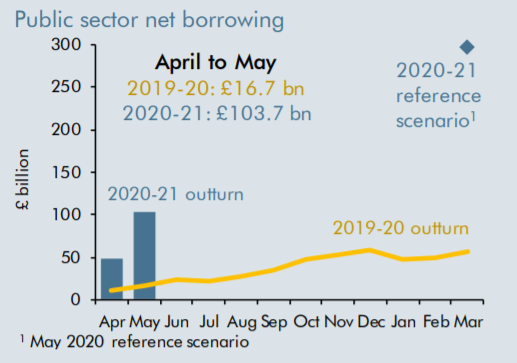
The unprecedented measures taken to keep the economy afloat during lockdown have been vastly costly - e.g. this article from the OBR (Office for Budget Responsibility) shows how Govt borrowing was £103.7bn in just two months. Tax revenues for April-May are down 43% vs LY, and central Govt spending is up 48%. Mind-boggling figures. Borrowing was only £16.7bn in the comparative 2 months LY (last year);
.
.
National debt has now risen to just over 100% of GDP, the first time it has got that high since the 1960s. Although that is based on a reduced GDP figure, adjusted to take into account the sharp economic slowdown due to lockdown. Hence the % should fall somewhat as the economy recovers.
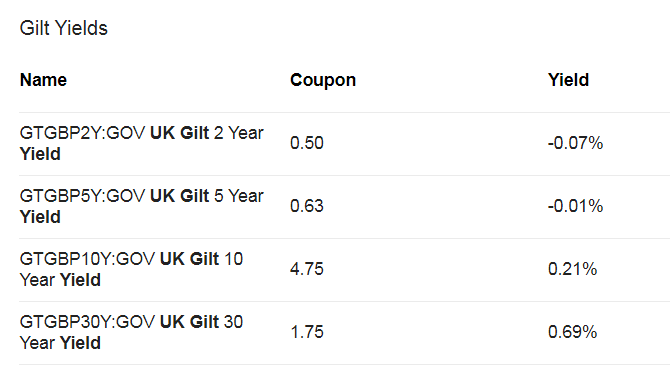
The Govt has to borrow from bond markets (by issuing Gilts) in order to finance this deficit. Conventional economics suggests that borrowing on this scale would trigger very high interest rates (a premium return required by investors, in order to take on the risk of lending money to a profligate Govt). However, as you can see, the yield on UK Govt debt is negligible - people are lending to the UK Govt for almost no return;
.
.
Why is this so? Partly because Gilts have now become an alternative to bank accounts, to park spare cash where it at least earns some return, however paltry - at least for 10 year+ gilts. Below that, and the yield is actually slightly negative.
The main reason however, is that the Govt is issuing new gilts to itself! Or rather, one arm of Govt is issuing debt to another arm of Govt (the Bank of England), via the market, in circular transactions. During this crisis so far, the BoE has bought ALL of the freshly issued debt. In fact it's bought up more than all the newly issued debt;
Between 1 April and 16 June, the DMO issued
£146 billion of gilts – 65 per cent of the £225
billion it plans to issue between April and July (net
of redemptions, gilt issuance totalled £125 billion).
In the period since 18 March, when the Bank of
England commenced purchases under the initial
£200 billion extension to quantitative easing, it has
purchased £174 billion of gilts from the market. So
in effect the Bank has purchased £28 billion more
gilts from the private and overseas sectors than the
DMO has issued so far in 2020-21 (and £49 billion
more than net DMO issuance). To date, the
Treasury has not made use of the ‘Ways & Means
Facility’ – its overdraft at the Bank.
[Source: OBR report on Govt finances]
Why hasn't sterling collapsed then? Because other Governments are taking similar action. So what would sterling devalue against?
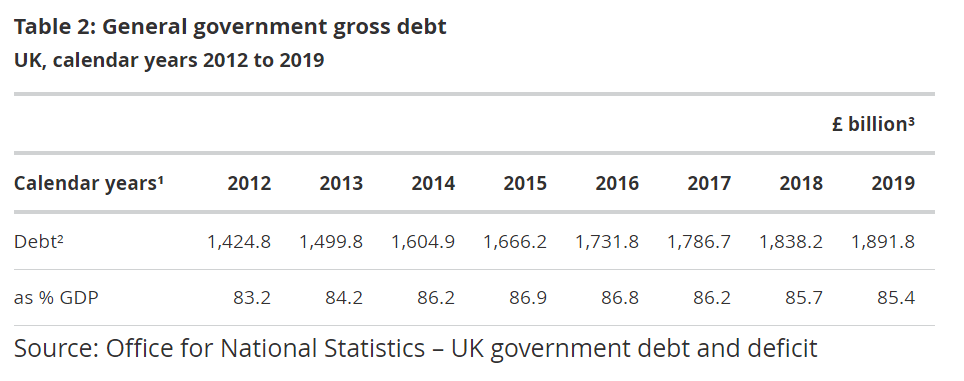
Figures for the National Debt are below. As you can see, it rose considerably during a time of supposed "austerity". The latest figures have topped £2 trillion, and is likely to reach about £2.2trn+ this year, with a projected budget deficit of over £300bn this year (about 15% of GDP, compared with a peak of c.10% of GDP in the 2008-9 financial crisis, and a similar figure in the 1990 recession). Remember that the deficit is an annual shortfall, which then adds to the national debt. Every time I hear idiot politicians use debt & deficit incorrectly or interchangeably, then I shout at the television, and mark them down as totally clueless.
.
.
So far, so bad. This situation looks grim, doesn't it? Well actually, no it doesn't, and this is why;
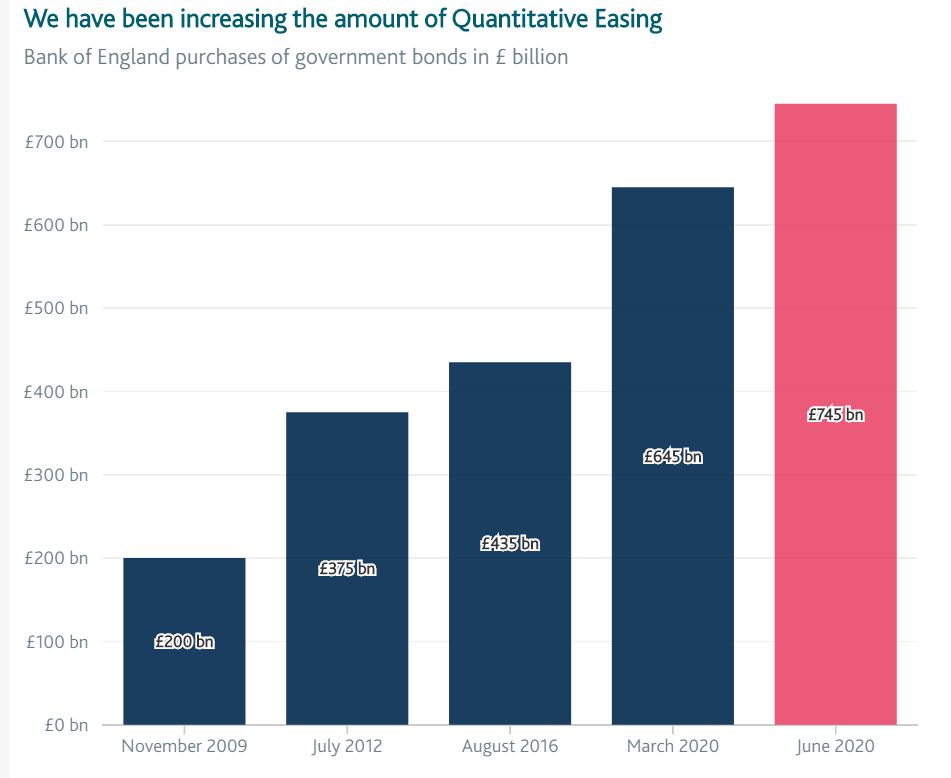
Quantitative Easing - this blue link takes you to an excellent, very clear explanation from the Bank of England, explaining QE very well. This is my synopsis: the Bank of England creates new money electronically, which it then uses to buy UK Gilts (government bonds).
Here are the figures of how much QE has been done, since this wheeze was invented in c.2009;
.
.
Therefore, of the c.£2trn in Govt debt (gilts in existence), over a third (c.37%) are actually owned by the Bank of England! Hence the reality is that UK National Debt is not £2trn, it's more like £1.3trn, or about 65% of GDP (which also happens to be c.£2trn coincidentally). 65% is generally considered a reasonable, sustainable level, especially when servicing costs are so cheap - as old gilts expire, they're replaced by new ones issued at negligible interest rates. So funding the national debt, is actually getting cheaper over time.
It all sounds crazy, but that's the reality. As things stand now, soaring Govt debt really isn't a problem at all. There's a guaranteed buyer - the Bank of England, which theoretically could keep buying gilts ad infinitum with newly created money.
How does all this end? Nobody knows.
Andrew Bailey's comments - the latest Bank of England Governor, Andrew Bailey, has made some incredibly stupid public comments this week, e.g.;
Andrew Bailey told Sky News that the government would have struggled to fund itself had the Bank not intervened during the market “meltdown”. “We basically had a pretty near meltdown of some of the core financial markets,” Mr Bailey said.
Asked what would have happened if the Bank had not intervened, he replied: “I think the prospects would have been very bad. It would have been very serious.“I think we would have a situation where in the worst element, the government would have struggled to fund itself in the short run.”
That's the sort of stuff that goes into memoirs, 5-10 years later (e.g. see Alastair Darling's excellent memoirs). When a financial system is built on confidence, you don't tell the world that it almost collapsed a few weeks ago! What a plonker.
Conclusion - of all the things that investors should be worrying about, soaring national debt really isn't one of them, at the moment anyway. Because it isn't actually soaring at all, when you adjust for QE. Although Andrew Bailey talks about reversing QE at some point, I can't see that happening, ever. Why would the Govt want to destroy money, by selling the Bank of England's holding of gilts back into the market, and then electronically writing off the cash received, and push up interest rates? That would be utter madness, and likely to push the economy into recession. It's not likely to ever happen, in my view. Long-term, I reckon the Treasury and Bank of England could just do a contra entry in their books, and bingo, a third of the national debt vanishes! Surely that must be the unspoken plan, as nothing else makes sense.
For now anyway, the UK Govt can borrow at negligible cost, and has a ready buyer (itself, basically!) for any amount of debt it wants to issue. Therefore, surely this is a perfect time to be borrowing huge amounts to fund major infrastructure projects? I would like to see the housing problem finally addressed. Private rents are far too high, and we need a massive programme of new council housing, which could then be let to young people at cheap rents, to incentivise them to work hard, and avoid gangs/crime. Plus it would inject huge new spending power into the economy (via increased disposable income), instead of lining the pockets of private landlords.
.
Robinhood client suicide
Robinhood is a commission-free stock broker in the USA, which has become extraordinarily popular recently. Apparently it has signed up something like 11-14 million clients, that are apparently punters, or beginners, interested mainly in trading. The professionals at CNBC scoff at them, e.g. for buying shares in bankrupt companies like Hertz (why on earth are its shares still allowed to trade, if it’s bankrupt?). However, apparently Robinhood punters have done very well in recent months, buying momentum stocks. Anecdotally, reports are that some Americans have put their Govt stimulus cheques into Robinhood accounts, and are playing the market successfully (for now). I hear that social media stars are appearing, who talk about their day-trading, and have large numbers of followers.
Clearly this all sounds like top of the bull market kind of stuff. What is so perplexing, is that other euphoric bull market highs like this have happened when the economy was at least ticking along OK. I can’t remember any time in my lifetime, when the economy was collapsing, yet shares are in a manic bull phase at the same time.
Things are different this time though. This is the first time ever (or at least in living memory) that we’ve had a deliberately engineered economic shutdown, due to a highly contagious disease. The level of stimulus from Govts now is also off the scale compared with other recessions, even 2008-9. So economies are definitely going to recover, but we just don’t know when. Interest rates have never been this low, for so long before - thus driving money into risk assets.
In the meantime, stimulus money could be at least partly finding its way into the stock market? Another credible theory is that with casinos being shut, and no sports to bet on, then maybe gambling money has also found its way into the stock market? I’m sure that is true, the only question is whether it’s enough money to move the dial much, given the vast existing flows of money in US stocks.
Back to Robinhood. One of its clients, just 20 years old, apparently racked up heavy losses recently, trading options, and committed suicide. I feel desperately sad about this. I wish I could have spoken to him, and explained my situation in 2008, and how you can & do recover, and life goes on. What’s the worse that could happen? Bankruptcy, and a fresh start. I chose not to go down that route, preferring a solvent solution, and negotiated payment plans (Spreadex and IG were very helpful - they don’t want to ruin anyone’s life, and will negotiate to find a solution, if people get into a mess, but co-operate with them).
I’m told that there have been occasional suicides in the UK over market losses too, particularly spread betting, over the years. Googling it reveals that about 500 people p.a. may commit suicide over all forms of gambling debts in the UK. You can't stop people gambling, if they want to. But surely more could be done to prevent that tragic death toll?
Can I make a plea to all readers here? If you get into trouble, or someone you know is struggling with awful market losses, then please ask for help - ideally from trained counsellors. Although whilst not trained, I do have experience of this personally. So I will happily give my time to anyone who’s got into a mess, and talk you through how you might resolve it.
.
Online results presentations
One positive spin-off from covid, is that many more companies are doing online results presentations, often interactive with Q&A, and a recording being available afterwards.
I haven't had time to look at the presentation yesterday from Volex (LON:VLX) because I prioritise my time to concentrate on looking at things which I am seriously considering buying, or already hold. Whilst Volex looks a really good turnaround, it has not moved from my personal watch list onto my buy list yet. Feedback from a couple of subscribers here, in yesterday's reader comments, was positive, so thanks for that. Although do bear in mind that feedback from all presentations should be positive, as companies are putting the bull case to us! If you come away from a presentation feeling negative, then the company needs to find a new CEO. that's why it's usually best to sleep on it, after a meeting, rather than rushing to buy immediately. But it depends, sometimes a prompt buy of something really exceptional can be lucrative.
Last night at bath-time, I took the risky decision to balance my laptop and a glass of wine, on one of those trays that you loosely put astride the bath, to watch a BRR Media produced results presentation which is here , from De La Rue (LON:DLAR) (I'm currently long), Thankfully my laptop didn't plunge to a watery grave (unlike an iPad mini that did last year). It's only a chromebook anyway, so cheap enough to replace.
It seemed to me, from the tone & confidence of DLAR management, that the turnaround there might be more impressive than I had hitherto realised. A large fundraising is underway at 110p, so I'm reluctant to pay much more than that in the open market. Hence am hoping the share price might slide somewhat lower than its current 151p in order that I may increase my position size from small to medium.
Anyway, thank you to all the companies that are starting to publish online results presentations/webinars. These are incredibly useful for investors, so please keep doing them, and hopefully make them standard procedure for all companies in future.
Memo to company advisers (many of whom read my reports here): please do everything you can to persuade/bully companies into doing the right thing, and communicating with all their shareholders, not just giving privileged access & information to the elite institutional shareholders (which is actually contrary to company law, by the way).
.
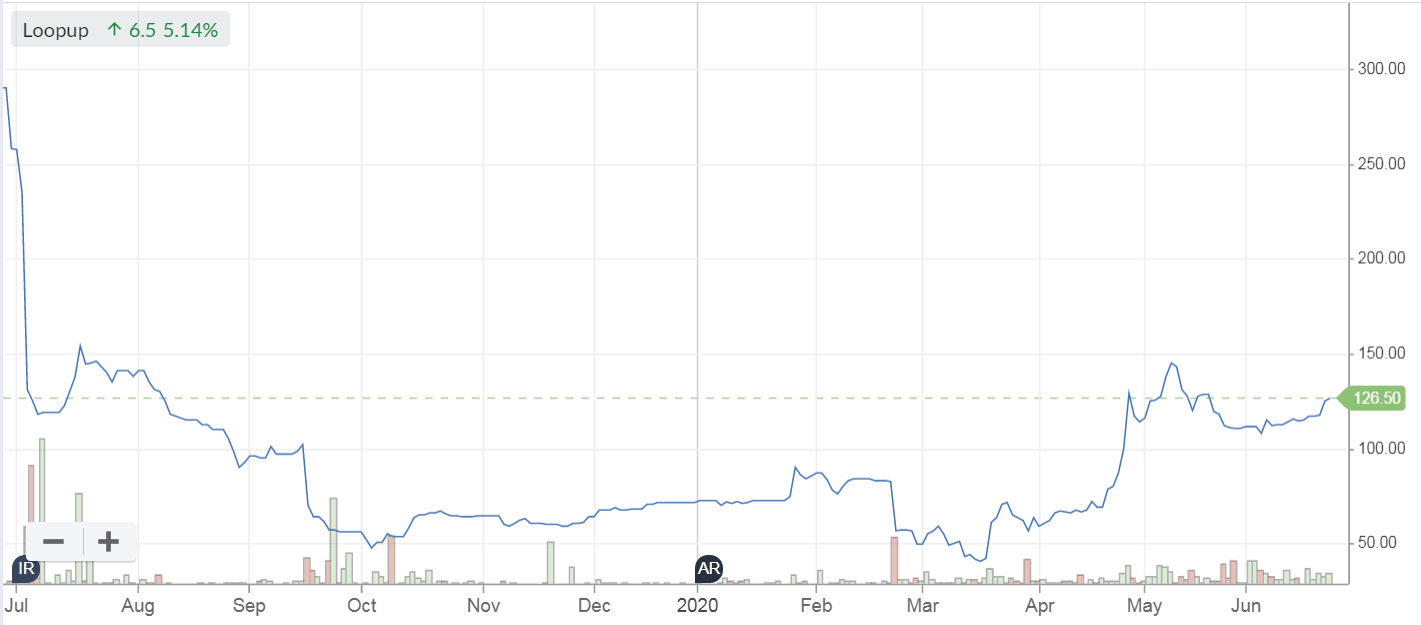
Loopup (LON:LOOP)
Share price: 140p (up 10% today, at 09:04)
No. shares: 55.4m
Market cap: £77.6m
LoopUp Group plc (AIM: LOOP), the premium remote meetings company, is pleased to provide the following statement ahead of its Annual General Meeting (AGM) at 10am today, 24 June 2020.
This is self-explanatory;
In our trading update on 6 May 2020, we noted a material increase in business volumes, driven by the large-scale migration towards working from home associated with the Covid-19 outbreak, and expressed our confidence in exceeding prevailing market expectations in terms of revenue, EBITDA and cash generation for the current financial year to 31 December 2020.
Since that update, the Group has continued to trade materially above pre Covid-19 levels. Whilst it remains difficult to predict near term developments in working practices and business climate, we do now nevertheless expect to exceed revised market expectations in terms of revenue, EBITDA and cash generation for the current financial year.
I want to know what profits are going to be like, not EBITDA.
Still, a second upgrade this year is clearly good news.
My opinion - market conditions this year couldn't have been more perfect for LoopUp - business should be booming, given that physical meetings have all but ceased, due to covid. Therefore, whilst today's update is clearly positive, is it positive enough? From what I'm hearing, meetings are moving onto Zoom, and Microsoft Teams, not onto LoopUp. Although occasionally I do hear "welcome to LoopUp" when joining a conference call, and of course it's tiny in comparison with those behemoths.
LoopUp does have some good product features, and is simple to use. But so is Zoom. To my mind, LoopUp looks a bit of an also ran. It's got a massive market opportunity right now, so let's see what the figures look like next time. It's used by firms of accountants & lawyers, and has an impressive client list. So there could be a decent niche for LOOP.
The balance sheet is weak. Last reported NTAV was negative, at about £(12m). Therefore, I think it might come under pressure to do an equity fundraising to eliminate unwelcome bank debt. That should be possible in the current environment, especially as LoopUp's product is so relevant to current circumstances. I urge management to bite the bullet, and raise c.£15m in fresh equity, which would only dilute existing holders by about 20% - well worth it, to eradicate insolvency risk. My invoice is in the post! ;-)
.
.
Naked Wines (LON:WINE)
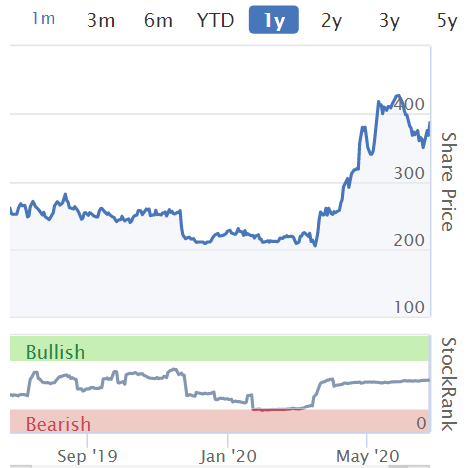
Share price: 386p (up 4.6% today, at 09:08)
No. shares: 72.9m
Market cap: £281.4m
Appointment of joint broker - sometimes a precursor to a placing. [Edit, but not in this case, as it has tons of cash]
Full Year Results for the 52 weeks ending 30 March 2020
There's no explanation given of what the company does, which is not a good start to a results statement. Further down it explains;
Naked Wines connects everyday wine drinkers with the world's best independent winemakers. Why? Because we think it's a better deal for everyone. Talented winemakers get the support, funding and freedom they need to make the best wine they've ever made. The wine drinkers who support them get much better wine at much better prices than traditional retail.
It reversed into Majestic Wines listing, and then sold off that business (the profitable bit).
The company says these are strong results. But it's not making any profit or free cashflow! How is that strong? It's a growth company, but revenue growth was only 14%, to £203m. Adjusted EBIT is a £(1.4m) loss. Why on earth is this valued at £281m, given such poor numbers?
It looks like a situation where cashflows are being recycled into marketing spend to drive growth;
Investment in new customers(6) of £22.9m (+20%)
That's fine, but revenue growth of only 14% seems a poor return for that level of "investment" (i.e. expenditure).
Its claimed 20 year payback of 4.9x cost of acquisition, for new customers, strikes me as questionable. Will customers really stick around for 20 years? I've not seen such an aggressive assumption used by other companies when calculating LTV/CAC. The workings are shown further down in the commentary.
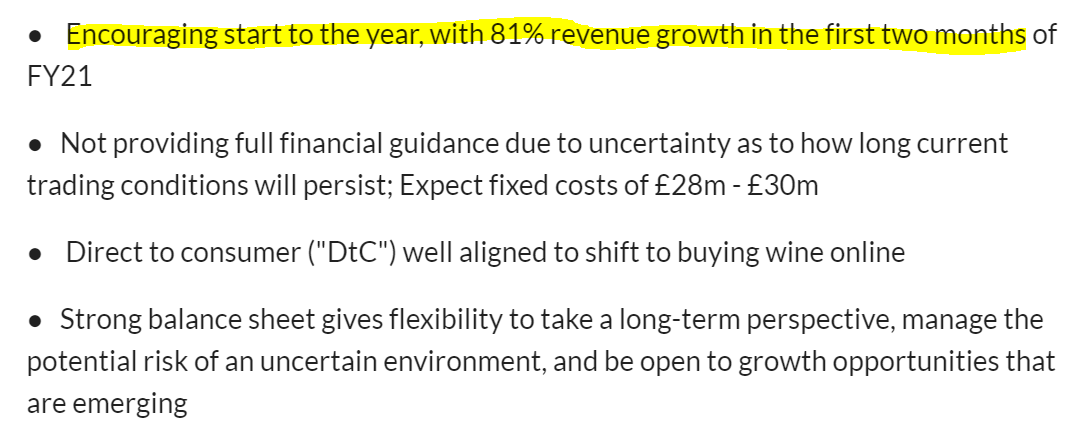
Current trading - this is a bit more like it!
.
.
That's the sort of boost I would expect an online business to be reporting due to lockdown conditions. These conditions are a one-off (we hope!), but should provide a nice springboard for online businesses to grow faster.
Balance sheet - is excellent. This includes £55m of net cash. NAV is £113.6m, less £36m of intangibles, gives a very healthy NTAV of £77.6m. I'm very happy with this balance sheet, and would say there is no insolvency risk. The commentary even mentions the possibility of returning surplus cash to shareholders.
Cashflow statement - is dominated by the disposal of the Majestic Wine stores business, so is not of much use in considering the continuing business.
My opinion - it's an interesting niche business. I like the very strong balance sheet, since this means there shouldn't be any dilution to worry about. If the business model really takes off, then existing shareholders should see nice upside.
As I see things, it's a bit in limbo at the moment. The concept is proven, but the growth is lacklustre. Also it needs to spend up-front, to recruit new customers, and the payback stretches over years. And that's assuming customer churn remains low. The risk with this type of business is that marketing could get more & more costly, then newly recruited customers might not stick around long enough to make it worthwhile for the company. Existing stats on this are not set in stone - they can change over time, as more effective forms of marketing become more expensive, or start to deliver diminishing marginal returns. I'm not saying that will happen, it's just a risk to think about.
How big is the overall market? The company says it's huge. But surely most people are perfectly happy with the vast selection of wines available immediately online or in stores? It sounds very niche to me, wanting to connect with the growers, and sponsor their production. Why bother, when you can get perfectly good wine from supermarkets from £10 per bottle?
Overall then, I think the valuation prices-in too much future progress, and the growth rate is too slow to make me want to pay up with a growth company rating. It's probably a bit too niche for my liking too, in terms of overall market size for this particular concept. I could be wrong there, as it has reported 20% growth in the USA, and there are probably plenty of wealthy wine buffs over there.
I tried out the Naked Wines platform a few years ago, and hope it has improved since then, as my experience was very poor. It struck me as very time-intensive, to research the various vineyards. When I found some I liked the sound of, they were sold out. Overall then, a disappointing experience. Maybe I should try it out again, as that was at least 4 years ago!
The other concern is that the covid premium currently in the price could scrub off, once treatments & possible vaccines enable life to return to normal.
I'm happy to hear from readers who are more positive on this, and why. People often become very certain about the upside potential when they've spent a lot of time researching companies.
.
.
Quick comments now, because my eyes are getting tired.
Wynnstay (LON:WYN)
Up 10.5% to 273p today (at 11:47) - Interim results for 6m to 30 April 2020 - looks positive, with a resilient performance (profit up). Balance sheet is surprisingly strong, given the market cap, so I like that. Maintaining the divi, which sends a strong signal of confidence. Expects trading backdrop to "remain difficult", but that hasn't stopped it trading well in H1.
Overall, I think this looks quite good - worth a closer look.
.
Tribal (LON:TRB)
Trading update - in line with expectations (remember that type of update?!).
The commentary sounds encouraging - the company & its customers adapting to working remotely. Minimal interruption to project implementation. No noticeable attrition to annual contract renewals. Sales pipeline good, but delays occurring due to uncertainty over higher education student numbers (that's got to be a big risk right now, due to covid, and students deferring for a year - why pay £9k fees, to get a few tutorials online?)
Overall, it looks a reassuring update for existing holders. I can't see any particular reason to want to buy, at the current price, which looks about right (PER of 14). Its track record is lacklustre, with the shares being lower now than 5 years ago, hence I find it difficult to conjure up much enthusiasm for this share.
.
Stuff that didn't make it into today's report;
Futura Medical (LON:FUM) and Open Orphan (LON:ORPH) - both of these are pharmas, which is a sector I don't cover, because it needs specialist sector knowledge to add any value, which I don't have. Please note that for the same reason, I don't cover any natural resources stocks. I have to draw the line somewhere, because there's only one of me, and a couple of thousand listed companies!
Pebble (LON:PEBB) also reported today. It floated in Dec 2019, so I've not looked at it before, and don't fancy spending a couple of hours looking at something new.
Therefore, I'll sign off for the day! As usual, thanks for your contributions in the comments (well, most of them anyway).
Best wishes, Paul.
Disclaimer
This is not financial advice. Our content is intended to be used and must be used for information and education purposes only. Please read our disclaimer and terms and conditions to understand our obligations.

132 comments
Thanks, Paul, for your offer of help to those who've got into difficulties - nor remotely my situation, thank God, but a very generous offer to those who might have.
Re Naked Wines, I think I’m in agreement. The corporate toing and froing has been wasteful for poor Majestic, a business I’ve appreciated as a customer. Like you, however, I tried Naked a few years ago, because I liked the aim of supporting small vineyards by buying their hopefully good-value outputs. Sadly, I found the wine over-priced and too often plain ordinary, so I stopped using them. Of course, like many wine traders, they’ve had a good C19 crisis. But I wouldn’t bank on it continuing.
It's a tad unsettling to see government debt just disappear on such a grand scale. QE is not the cost free solution it seems. We are effectively devaluing the currency, thereby impacting the cost of trade and hence raising the cost of living. If all countries adopted the same tactic then perhaps no one would notice !
We're not really devaluing the currency though, because everyone else is doing QE too! Also, devaluing the currency a little is actually very helpful, as it creates slightly higher inflation, which scrubs off even more of the debt, as nominal GDP rises, making the national debt a smaller % of GDP. It also means that gilt yields of nearly zero, are an amazing deal for the taxpayer - buyers of gilts are effectively subsidising all of us, with our grateful thanks.
I know this subject makes some people angry, because it shouldn't be possible, and it should end in ruin. But it's worked amazingly well for 12 years now.
My feeling is that, providing the UK keeps roughly in the same ballpark as the USA & EU, in terms of use of QE, then we should be OK. Clearly QE can be used very effectively in times of crisis, but new QE then needs to be stopped once the economy is back on its feet.
Now that Govts have realised they can print money fairly freely, and at almost zero cost, with no adverse consequences (to date), then I can't see the genie going back into the bottle.
Regards, Paul.
Hi Paul
Very interesting De La Rue (LON:DLAR) presentations. Must admit I am struggling with the idea they were historically so incompetent that it seems to have been relatively straightforward to remove £36m in annual costs. No surprise that they lost the contract to print UK currency.
Thank you, Martin
Hi Martin,
I agree. It does seem surprising that DLAR is able to strip out so much cost.
There have been some good recent contract wins announced, and a strong pipeline.
Regards, Paul.
Hi Paul
Management is phenomenally bullish thought the whole presentation. Think I feel more comfortable with the Volex (LON:VLX) presentation where they were generally understated and can point of several years of success to date in repositioning and improving the business.
Am already long Spectra Systems (LON:SPSY), but will keep an eye here to a sensible entry point. Cannot say I am a huge fan of such a weak B/S at £DLAR.
Kind Regards, Martin
Hi Martin,
Fair points. Although bear in mind that DLAR's solvency risk pretty much disappears with the big equity fundraising underway (underwritten, IIRC).
The pension deficit & recovery payments need us to take about a third off the valuation of the company, in my opinion, but shouldn't present any solvency problems - it's just a long-term drain on cashflows.
I'm not taking a big position in DLAR, it's currently small, with a view to possibly taking it to medium-sized but I like to mull things over for a while & discuss, so useful to have your input, thanks!
Regards, Paul.
It seems to me that QE and other forms of money printing only works without causing inflation currently only because of the strong deflationary pressures in the world economy coming from the rise of large scale manufacturing in Asia and particularly China. At some point in the future this will stop and normal economic rules will be resumed. This could be a long way away or not. Anti globalisation sentiment may play out here to bring that day closer.
A bigger point exist here to my mind. Could liberal democracy survive such a shock ? I associate liberal democracy with proper functioning capitalism and the benefits that brings in the long run. Maybe I am wrong in that. Maybe the China model will prove to be more durable after all ?
(PS hope not too much stray into politics here. Its not Party just helicopter stuff)
Hi Housemartin2,
I agree that getting cheap manufactured goods from China has kept a lid on inflation in the West. If there's more on-shoring, and increased tariffs, then that could trigger higher inflation, as you say.
Set against that is the power of the internet. It's so easy for consumers to shop around for the best prices, for so many of the things we need. For example, last year I paid £750 to insure my XJS - I was so excited about buying it, and found that several classic car companies wouldn't insure it at all, so I bit the hand off an insurer that was recommended to me.
Anyway on renewal this year, I tried out those lovely fluffy meerkats (they look just like my two dogs!) and they got me a comprehensive policy for just £250, a huge saving!
My point being that the internet is squeezing inflation down all the time, as consumers shop around, and retail margins go down, for physical and online retailers.
The vast amount of QE doesn't seem to have fed through much to the normal economy. I suppose if the BoE is buying gilts from investors, they are just going to use that cash to buy some other investment. Hence it doesn't get through to higher consumer demand. Meanwhile the Govt's over-spending keeps the real economy jogging along at a reasonable pace (once it recovers from the lockdown anyway).
All fascinating stuff, and there's no economic textbook for any of this. In fact, I think studying economics has actually been a hindrance to me (and others here), because we're fighting against the current reality, saying it shouldn't be possible. But it is possible, for now anyway.
Regards, Paul.
Thank Paul for the the very lucid explanation opening. That said I am still confused:
" Long-term, I reckon the Treasury and Bank of England could just do a contra entry in their books, and bingo, a third of the national debt vanishes! Surely that must be the unspoken plan, as nothing else makes sense."
As somebody far cleverer than me said if you take this to the "logical" conclusion why not just "print" £33,150 per person each year, mail a cheque to them on 6th April and then do a contra entry each year on 5th April and we can all sit at home watching Netflix, waiting for all that stuff ordered from Amazon and produced in China.
I know I must be showing my ignorance (or maybe my age or both) but I just don't get it.
So, who do you buy goods from? If nothing is being made in the UK you'll have to buy from abroad. So far so good. So you try to turn your pounds into Euros, but who wants pounds? No one wants to buy pounds because there's nothing to buy with them. So you have nothing you can buy in your domestic market and you can't convert your money into anything with purchasing power.
Remember "money" is only worth something because people believe it is worth something. It is merely a medium of exchange, it is not a store of wealth.
Edited out as Paul considered should be private.
Note to whoever had problem with edit earlier - this works on old site on laptop.
Thanks for flagging this sharw, but I think it might have been better to do so privately! I've forwarded it on to t'management.
Thanks Paul - you have passed on to t'management so I have edited it out.
You're a star, thanks sharw! Much appreciated :-)
Paul,
thanks for the write up on Naked Wines (LON:WINE) In my opinion this was a good growth share prior to covid. It had a well tested model of customer acquisition and it was deploying cash in this area to drive future revenue.
The expansion in the US is the interesting part. The Direct to Consumer (DTC) wine market is enormous. Naked cut out the distributor and the wholesaler. They also help to fund the winemakers. They are likened to Netflix in that they deliver original content. The wines can't be bought elsewhere.
It is also mostly subscription based and customer retention is over 80%.
If it was not for the marketing spend on new customers they would already be profitable serving existing customers.
I bought in at 218p and sold at 408p so I am delighted with my return.
The TR-1's make for interesting reading also. Punch Card Capital are heavily invested. This is run by Norbert Lou. Worth a read up on him if you don't know him.
The same guy has also invested in Motorpoint (LON:MOTR) which I have bought at 194p and hold which is now at 279p.
I think the initial surge in WINE is C-19 related but it should be viewed as a catalyst for further growth rather than a flash in the pan. There are talks of this hitting £6 by some.
Thanks CamRaid, that's very interesting. I appreciate you posting it.
Thanks to Paul and CamRaid for their comments on Naked Wine. As CamRaid says, the interesting part of Naked is the US expansion. According to Naked, only 5% of the wine in the $70 billion US wine market is sold via ecommerce so the opportunity is huge. Furthermore, Amazon has tried and failed to exploit this US market, not helped by the regulations and the complexity caused by different duties being payable in different states. With Naked's US specialist now the company's CEO and recent investments by US investors, I think investors are hoping that Naked's specialised knowledge of online wine selling may enable it to crack the US market where Amazon has failed. No doubt the online selling tailwinds arising from Covid-19 and the popularity of artisanal type products may also help sales.
Yes, I see it the same way with £wine
Amazon are excluded for operating in the Wine space. This is because they own Whole Foods.
Hi Paul, you’ve mentioned central bank money printing and MMT which is something I’ve done a lot of reading about recently and I think I disagree with your assessment.
My understanding of MMT is that the government can print unlimited money, and as long as this is only used to pay off bad debts, it will not lead to inflation. This is something that doesn’t sit right with me but I haven’t put my finger on exactly why. I thought I’d post to see if it made some sense to others. Apologies if it gets a bit tin hat along the way.
What may have happened is that we have developed an economy where little value is added. E.g. cinemas and travel facilitate the movement of money but do not create anything of value. They have accelerated the velocity of money, which allows more credit to be offered. One thing I’ve learned recently is that price is not dictated by how much money people have, but by how much they can access (see the Japanese housing bubble in the 70’s). In our current system velocity can’t slow down, as this would result in a credit crunch circa 2008. Therefore central bank funded liquidity could be the answer which irons out the boom-bust cycle of capitalism.
The point that doesn’t sit right with me is regarding resource allocation. In the absence of being able to predict the future, value is surely the ultimate goal of the investor. For all the businesses that add little value there are many others that are vital to how our society functions. If we lose the concept of value then resources will be incorrectly allocated and empires will fall.
Another thing I’ve learned recently is that banks are incredibly important to a healthy society, maybe I was naïve but this came as a bit of a surprise. A competitive banking system ensures that resources are allocated highly efficiently. Alternatively loose credit policies create bubbles like the 2008 mortgage where central bank intervention is required to pick up the pieces. This creates a self-reinforcing mechanism where banks get weaker but central banks have more power to intervene. The recent rapid response of the BoE, Fed etc… is a direct result of what happened in 2008.
The more this cycle repeats, the more distorted value becomes as interventionist policies begin to pick favourites. Look at the number of ‘zombie companies’ currently operating. This is not how you develop a healthy economy. The fall of the soviet union is blamed by some on the existence of a single central back which allocated all financial resources. This is the logical endpoint of a boom bust cycle where banks are increasingly controlled by the central bank. Somewhere like Switzerland is probably the polar opposite which may explain why they have not had unemployment above a few percent in modern history.
In short I think we are on a slippery slope. After all when has an economic theory actually worked in practice? Soros explains this with his theory of reflexivity (not specifically an economic theory): When humans think they understand reality, they also change reality and therefore constants don’t actually exist. If you agree with Soros it basically means we can only ever think one stage ahead because we can’t react to a reality that doesn’t exist yet.
Therefore I won’t make any overly ambitious predictions about what happens next (he says, about to make ambitious predictions…). But I think we will take the idea of MMT too far before we realise the damage it is causing. I’m thinking currency devaluation wars, nationalising companies that are too big to fail, and a fair amount of unemployment and civil unrest.
Despite this, I think the markets could go up as a result of all the extra liquidity in the system (asset price inflation). Unfortunately I can’t bring myself to get too involved as I think this market favours the trend followers which is not something that comes naturally. Therefore I am mostly on the sidelines with a position in gold. Gold is not an asset I’ve ever valued before but offers a unique benefit in this market. If central banks keep markets afloat then the asset price inflation will benefit gold. However if the scale of defaults grow so big that a credit event occurs anyway then gold is a safe haven asset. Therefore it should do well in either scenario that I can see playing out.
I’ve not mentioned technology at all because that is a big tangent, but I think we’re only in the beginning of the digital age. Finally apologies if there are inaccuracies in the above I just don’t have time to fact check it all.
From my reading, velocity of money has collapsed, because bank lending has failed to keep pace with the printing. The deflationist believe printing will not increase velocity, that everyone is holding cash and the money multiplier is negative, so prices must fall. Government spending is just crowding out private investment, no value being created. The inflation side argue its different this time, banks are lending and all this money is getting into the economy. Velocity will therefore rise and cause inflation to rise. The key as always is what banks do.
With deflation ... you want cash, gold and bonds.
With inflation... at first you want equities, IL bonds, gold, comodities and other real assets. Depending on how the inflation goes... you want less and less equities...especially growth since long term bond yields rise. The pace of change is everything and most people write as though we will have plenty of time to switch accordingly.
In March we witnessed how hard this may prove to be. The lockdown is very troublesome since data will obviously improve but still maybe bad. We simply don't know. So we are locked in a situation that's difficult to assess but where the outcome could be either end of the spectrum.
Given the size and speed of policy reaction in March - if this policy is failing and it looks as though deflationists view is correct - we must conclude that the system will not be allowed to fail - and therefore an even bigger response is needed. This is why all the uber bears are out again... they therefore believe this is the end game...we are completely unwilling to accept a deflationary collapse ... now we arrive at Pauls view of QE to infinity and beyond. Paul, I think, thinks this is ok. I don't share his confidence.
When historians write about how this played out... a period of weeks might command a few chapters on the passing from one regime to another. In real time it will be quite different, likely very confusing, with surprising outcomes. I am not drawing confidence from the rally but accept I may also be totally wrong in holding too much cash.
Paul I have enjoyed reading your column for almost 18 moths and find your comments are normally very fair and balanced but feel compelled to make my first online posting to respond to your implied inference that Private Landlords are greedy parasites and that because of them young people are prevented from buying their own property. It took me years to save up the deposit for my first flat and then my mortgage rate rocketed to over 15% (a far cry from today's rate). I took my car off the road for more than a year, worked every hour of overtime available, never went out to the pub for a drink, or a meal and my main source of food was baked beans on toast.
Whilst I agree that there are some Private Landlords who are an absolute disgrace and do absolutely nothing to keep the properties up to a good standard, most like ourselves are considerate to their tenants and keep their properties well maintained, in good decorative condition and when our Letting Agent receives any complaints they promptly arrange for competent tradesmen to attend and address every issue in a timely fashion. We have had tenants who fail to pay their rent and when they eventually leave the whole flat needs to be redecorated before it is suitable to be re-let. We have even wasted money unsuccessfully trying to trace them to attempt to recover our losses through the Court but were advised that this would not be financially viable. In the meantime we have to pay full Council Tax, standing charges at 22p a day with almost no electricity being consumed (except for the cleaners and decorating contractors). When the flat is eventually re-let after several months of being empty (these void periods always occur between tenancies to allow the carpets to be cleaned and repairs and redecoration's to be undertaken.) The first months rent is more than consumed by the Letting Agents full management fees for setting up the new tenancy agreement, referencing, inventory checks and other associated costs to which the tenant now doesn't have to contribute. When we do receive rent the Letting deducts their fee along with an extra 20% in VAT.
During the last 3 years there has been a raft of changes to the way that Private Landlords are allowed to offset their costs which for many of us means that we are providing a valuable service with no profit as has been the case with ourselves during the last 7 years. Although we can still offset some items such as insurance, and Ground rent which is payable every 6 months. However the ever increasing cost of complying with new legislation being regularly churned out such as EPC certificates which we have obtained two certificates, although our Grade ii Listed building is actually exempt. Also required is Fire Certification, Electrical Wiring Inspections and we have implemented additional Fire Safety measures such as installing a Fire Rated door on the bedroom. Our small flat now has 7 smoke and heat detectors both hard wired and sealed units with 10 year batteries, our electrician who fitted the hard wired smoke and heat detectors told us that the excessive demands of the Private Sector Housing Officer were both unreasonable and unenforceable and that we should fight it - who in their later retirement years wants to take on the might of a Local Authority, even if they are wrong!
Our last tenant moved out at the beginning of the year because of the deafening noise caused by the smoke/heat detectors activating every time they burnt their toast. By the time the flat had been fully prepared for re letting the lock down had started and no viewings were allowed.
Our 1 bed flat was purchased more 20 years ago for £36K as part of pension planning provision, prior to the introduction of an additional 3% stamp duty being introduced. The Freeholder has been a nightmare and the Grade II listed building has not been properly externally maintained making it more difficult to let and impossible to sell. Maintenance charges have been horrendously expensive and the work done to a poor standard always during the winter months November to January which has dramatically accelerated the degeneration of this once magnificent building into a state of accelerated deterioration. The guttering has leaked for nearly 20 years and the water has sodden the wooden windows which were then painted which has accelerate the rotting process and we have spent nearly £6,000 in window repairs and replacement. Following repeated pressure on the Freeholder and complaints to the Listed Buildings Officer the maintenance of the building has now been transferred to a professional management company whom we hope and believe will do a much better job going forward.
It proved impossible to sell the flat after about 10 years as we had originally planned and it is now impossible to sell the flat to anyone requiring a mortgage because of the short lease. It has taken our solicitor more than a year trying to negotiate a lease extension and now we are having to go to Court via Tribunal proceedings to get an extension which is likely to cost between £15 & 20K including our Solicitors and Surveyors fees along with Court costs, plus the cost of obtaining the lease extension - added to injury we also have to pay the Freeholders Solicitors and Surveyors costs.
When the lease extension is finally completed the estimated value of our flat is likely to be in the region of circa £80K. We then have to pay Solicitors and Estate Agents fees to sell the flat and and are liable to pay all of the associated costs incurred up until completion on an empty flat. The flat itself is delightful as everyone who has viewed it attests to, our problem is that we should never have become Private Landlords. Having spoken to a number of our friends we have discovered that a number of them were also Private Landlords having inherited homes from their parents and like us have had similar experiences and who are also looking to sell the rental properties. Changes to not only the way that expenses are allowed to be offset against tax and changes to the way in which Capital Gains Tax profits on property sales are both charged and payable all help to make the rental market less attractive. As Paul said in one of his recent reports he like to look at both sides of a situation and become devil's advocate.
It is much more convenient for many tenants to rent property rather than buy as it gives them the flexibility to move from one part of the country to another, if they change their employment, or fall in love with someone living a substantial distance away. The cost of repeatedly buying and selling twill prove prohibitive for most people and renting is a simpler, cheaper and more convenient option. The idea that being a Private Landlord is a route to rapid financial riches could not be further from the truth – at least in our case. This was hastily written and I am sure I have missed out a number of significant points but at least I have managed to get the hurt feelings out of my system. I believe that the way Private Landlords are viewed and treated will lead to a steady decline in the number of rental properties available and that in future as demand outstrips supply rents are likely to be on an upward trajectory.
Sorry for the long rambling post but at least I feel a little bit better having got this off my chest. This post timed out after an hour and couldn't be saved so I cut and pasted it.
Investoree,
An excellent description of why I would never want to be a private landlord! Added to all the hassle and costs associated with parasitic letting agents, void periods, council tax, etc. etc. property is a very illiquid asset, especially in a recession which is where we are headed. It can take months, even years, to sell a property should you need to realise some cash. and then of course you are into the legal costs of sale. Personally I would rather invest in individual equities and bonds as well as funds and ETFs. Far easier to manage and generally no liquidity issues.
My adult children have rented flats in London and their experience has generally been OK. However, there is always an issue with deposit retention at the end of the tenancy when a private landlord 'claims' there is damage or redecoration required. Fortunately they look after the properties so this is often an exaggeration/unreasonable and the inevitable negotiation that follows is a hassle. In their experience corporate renters (property developers who let out some of their properties) are more reliable and 'fair' than private landlords in sorting out any issues with the property.
I am a private landlord and in a position and age where I don't have mortgages. I specialise in studios and one flats and I rather agree with both sides. Rents are far too expensive ....the supply is simply not there. There are many towns on the South Coast, from Bournemouth to Bexhill, where rents are exorbitant and yet decent property is taken as soon as it goes on the market. The agents phone rings off the hook as soon as the property is advertised on Rightsmove. A couple of years ago an agent showed me a search record; 3000 had looked for a studio flat in a town where mine was the only one available. The next day it launched....."we could have let it hundreds of times" the agent told me.
I tend to set my rents at the lower end and am not greedy to obtain the highest possible rent much preferring cheaper rent and longer term tenants yet the return on the original purchase price on property bought within the ten years ranges from 15% to 29%. Per year. Of course there are plenty of costs but even so, the last few years have been the best ever to have a landlord in my personal opinion. It was inevitable that the Government was going to raise higher taxes in such a position.
What I do agree with is that the Government keeps on interfering with private rentals by bring in more and more regulations. Gas and electrical checks are understandable but minimum EPC's for instance are almost pointless and the EPC is often based on hopelessly out of date information. I put Rointe electric heaters in to a particular flat. I was told these "don't count" as they were not "on the list" even though the product was at the time winning every award going for the greenest, most energy efficient product of its type in Europe. When I raised the issue with the manufacturer the director of the company personally wrote to me about ten times with a stack of technical information and complaining about how UK civil servants are so far behind everyone else and are so suspicious of anything they deem to be "foreign". I think we have seen a bit of that during Covid.
I think a lot of this interference is a smokescreen to try to hide the failure of all governments to build. The targets for new houses are never met and trying to build new public housing? Where exactly is the army of builders, plumbers, electricians and so on? Where are the stream of apprentices in these areas? Far too busy or doing degrees that are (to be blunt) almost useless. The only reason I can get quality trades to attend quickly and sort out a problem or renovate a new investment is that I make a point of building a reputation of paying quickly and at the rate agreed.
The price of housing is set ultimately by supply and demand. Demand is fuelled by the number of people and buyers like yourself who have surplus capital and see housing not as a place to call home but as a lucrative investment. In London 10% of taxpayer subsidised housing is believed to be sub-let at a profit: but the local authorities and housing associations don't really know.
In this part of desirable and still largely green, southern England, there is a relatively new phenomenon at play on the demand side: the second home. Areas around are now up to 50% weekend and holiday retreats. Remember the rise of the two car family? It has now expanded to the two house family.
Local buyers struggle to compete with "London" money at every level: the two house family budget extends from the most basic property to the multi-million.
I have come to the conclusion that nobody can or would wish to build at a rate to satiate the current demand for residential property. Any solution will require action on multiple fronts.
Bonitabeach
Investoree.I totally agree with you...I bought my first property to rent in 1987 and whilst I do have a portfolio I have had every tenant from hell , who Shelter fund in their legal action against me..Over the years I have lost count of the £1000,s of unpaid rent I have lost..Local Councils are run by idiots who have no appreciation of the value private landlords provide..Once I sat on a landlords steering committee for a local council but most landlords gave up..councils pay lip service to landlords..
If I could sell my portfolio I would and instead invest the net proceeds in the stock market .
The tax system introduced by that idiot George Osborne proves even chancellors simply only know one thing...kill the goose that lays the golden egg....I would love to show my tenants how small my profit is for the quality of accommodation I provide...If anyone here is thinking of buying a BTL...they need to first consult a shrink and get their head examined .
Hi
Some b2l In the whole portfolio is not a bad idea if we have a fair amount of inflation, which given all the free money is quite possible. So over the last 15 years it went from a capital gains play, to income to now maybe inflation protection, and its price is fairly stable, compared to stocks, and cant go to zero, im fairly ok with b2l as a % of a portfolio.
Hi all
As markets seem to be reacting to concerns about second waves of Covid-19, some might be encouraged to see the extensive new industry at work on this multi-faceted challenge we all face.
This is a very extensive listing (from Proactive Investors site) of all the companies and initiatives underway around the world. By no means a silver bullet, but I found it very encouraging. (Disclosure I have invested in several of the mentioned companies but do not hold any at present).
https://www.proactiveinvestors.co.uk/companies/news/917772/coronavirus-whats-happening-in-the-labs-of-pharma-companies-worldwide-917772.html
Regards
Howard
Hi All (again)
Another encouraging step in the CV19 challenges.
https://www.proactiveinvestors.co.uk/companies/news/922442/coronavirus-uk-to-trial-saliva-tests-for-asymptomatic-cases-evan-bioscences-candidate-enters-cambridge-trial-r-factor-rises-in-germany-922442.html
Regards
Howard
" ... and we need a massive programme of new council housing, which could then be let to young people at cheap rents, to incentivise them to work hard, and avoid gangs/crime."
Council estates - isn't that where most of the gangs/crime are created?
As somebody who grew up on a council estate, there was a time when council houses were desirable. You had to have a good record of work and behaviour to get one. You had long term security of tenure, so people would take care of their properties and there was a real sense of community.
As council houses were sold off to end up in the private rental market and the remaining stock started to be allocated on a "needs" basis rather than track record, things went down hill fast.
I wonder how many landlords complaining about hassle and tenants are offering long term lets at below the local market rate to the very best tenants they can find. Or are they offering 6 or 12 month ASTs taking as much rent as they can get away with?
Thanks Paul. I’ve started reading the SCVR recently and enjoy your perspectives. One thing I’ve noted about WINE (which discourages me a bit) is the balance sheet has £43m of deferred income in working capital, i.e all the advances from customers (‘angels’). It’s clearly part of their business model and I have no problem with it as such. I have no idea what rights customers have to this money back if they wanted it (unlikely all at once admittedly). But personally I discount much of the cash they have. For example, I don’t think they could easily use all their cash for an acquisition, let’s say. The joint broker comment is interesting in that context, especially if they want to accelerate expansion in the current market.
Hi mesb,
That's a great point, well spotted.
Overall working capital looks good, with a large figure in inventories too. Maybe we should be netting off inventories against deferred income?
Regards, Paul.
£wine clearly states on their web site that "Angels" can spend money on wine or get it back at any time. So I would not see deferred capital as 100% secure.
RE Naked. I thought majestic was pretty revolutionary when it started on value and it meant avoiding supermarkets altogether to buy wine. They did tastings which is helpful too. I think I'm right in saying they lifted the minimum restriction of having to buy at least 1 case. Since then I joined the Wine Society which is similar I guess to Naked Wine, except WS has been around since the year dot. We also have two fantastic wine stalls in two markets I live near. I ordered the introductory case of wine from Naked recently. Arrived in a couple of days.Three reds and three whites all pretty decent and a fiver each on offer, instead of £10. Would I buy again? Probably not. Cant beat finding a good knowledgable wine seller and wine lover which you don't get online. If I want to broaden my horizon I will always try the guys at market when I can. They are absolutely genuine, competitive and can source smaller specialist vineyards. Aldi and Lidl particularly have always had very good value wine. To me Wine Society are the best for online but you can't beat the sociability of tasting and buying wine from an independent expert and enthusiast of something special and a bit different. Depends how much you value wine really. Also I buy meat direct from farmers or butchers supplied by them, not that we eat a lot. Again the difference is phenomenal. 'Less is more' as they say
Not properly combining Majestic and Naked Wines was a missed opportunity to me and don't understand why it didn't happen. Online Majestic wines sold to existing customer base and in store Naked Wine sales to a separate customer base = win/win. Stinks of management infighting rather than looking after the business. I'm not a fan of the Naked Wine proposition as it's effectively a subscription model, wine batches are too small and generally too difficult to be bothered with. I was even thinking of starting a small competitor that removed those barriers but Brexit got in the way and I put the idea on hold until future is clearer.
Paul I have enjoyed reading your column for almost 18 moths and find your comments are normally very fair and balanced but feel compelled to make my first online posting to respond to your implied inference that Private Landlords are greedy parasites and that because of them young people are prevented from buying their own property. It took me years to save up the deposit for my first flat and then my mortgage rate rocketed to over 15% (a far cry from todays rate). I took my car off the road for more than a year, worked every hour of overtime available, never went out to the pub for a drink, or a meal and my main source of food was baked beans on toast.
Whilst I agree that there are some Private Landlords who are an absolute disgrace and do absoltuely nothing to keep the properties up to a good standard, most like ourselves are considerate to their tenants and keep their properties well maintained, in good decorative condition and when our Letting Agent receives any complaints they promptly arrange for competent tradesmen to attend and address every issue in a timely fashion. We have had tenants who fail to pay their rent and when they eventually leave the whole flat needs to be redecorated before it is suitable to be re-let. We have even wasted money unsuccessfully trying to trace them to attempt to recover our losses through the Court but were advised that this would not be financially viable. In the meantime we have to pay full Council Tax, standing charges at 22p a day with almost no electricity being consumed (except for the cleaners and decorating contractors). When the flat is eventually re-let after several months of being empty (these void periods always occur between tenancies to allow the carpets to be cleaned and repairs and redecorations to be undertaken.) The first months rent is more than consumed by the Letting Agents full management fees for setting up the new tenancy agreement, referencing, inventory checks and other associated costs to which the tenant now doesn't have to contribute. When we do receive rent the Letting deducts their fee along with an extra 20% in VAT.
During the last 3 years there has been a raft of changes to the way that Private Landlords are allowed to offset their costs which for many of us means that we are providing a valuable service with no profit as has been the case with ourselves during the last 7 years. We can still offset the Ground rent payable every 6 months but the cost of complying with the increasing legislation being regularly churned out such as EPC certificates which although our building is actually exempt we also require Fire Certification, Electrical Wiring Inspections and have implemented additional Fire Safety measures such as installing a Fire Rated door on the bedroom
Our 1 bed flat was purchased more 20 years ago for £36K as part of pension planning provision, prior to the introduction of an additional 3% stamp duty being introduced. The Freeholder has been a nightmare and the Grade II listed building has not been properly externally maintained making it more difficult to let and impossible to sell. Maintenance charges have been horrendously expensive and the work done to a poor standard always during the winter months Novemeber to January which has dramatically accelerated the degeneration of this once magnificent building into a state of accelerated deterioration. The guttering has leaked for nearly 20 years and the water has sodden the wooden windows which were then painted which has accelerate the rotting process and we have spent nearly £6,000 in window repairs and replacement. Following repeated pressure on the Freeholder and complaints to the Listed Buildings Officer the maintenance of the building has now been transferred to a professional management company whom we hope and believe will do a much better job job going.
It proved impossible to sell the flat after about 10 years as we had originally planned and it is now impossible to sell the flat to anyone requiring a mortgage because of the short lease. It has taken our solicitor more than a year trying to negotiate a lease extension and now we are having to go to Court via Tribunal proceedings to get an extension which is likely to cost between £15 & 20K including our Solicitors and Surveyors fees along with Court costs, plus the cost of obtaining the lease extension - added to injury we also have to pay the Freeholders Solicitors and Surveyors costs.
When the lease extension is finally completed the estimated value of our flat is likely to be in the region of £80K.
It is much more convenient for many tenants to rent property rather than buy as it gives them the flexibility to move from one part of the country to another, if they change their employment, or fall in love with someone living a substantial distance away. The cost of repeatedly buying and selling twill prove prohibitive for most people and renting is a simpler, cheaper and more convenient option. The idea that being a Private Landlord is a route to rapid financial riches could not be further from the truth – at least in our case. This was hastily written and I am sure I have missed out a number of significant points but at least I have managed to get the hurt feelings out of my system. I believe that the way Private Landlords are viewed and treated will lead to a steady decline in the number of rental properties available and that in future as demand outstrips supply rents are likely to be on an upward trajectory.
Wholeheartedly agree with you Investoree - Not often I disagree with Paul's views
With all the changes and possibility of Bother Corbyn getting into power I have sold 100% of my BTL Position - It wasn't going to give me the pension income I had originally planned. No more greedy in my planning than looking for a 10 bagger or high yielding Dividend income? Surely on this basis all Shareholders are parasites. (Labour view re Utilities etc)
I'm a private landlord too.
I'm not a fan of buy to let - but your point is well made.
I think it's the trouble with blogs in general - people are either heroes or villains - there is no in between (and there are several topics this can relate to currently). Why can we have a thumbs sideways (appreciate this is a question for the broader world - not Stocko)
I would like to know how much of the homelessness is down to restrictions and stupid regulations applied on landlords. For example, when the scope of HMO licensing was extended, some landlords have the choice of going for HMO licensing, or renting one less room out so they are below the HMO license threshold. Or exiting the HMO business.
Most legislation has unintended consequences.
I'd quite like to see an independent investigation into the topic, since when we have the highest minimum wage of all time and until recently, the lowest unemployment for decades, seeing such an increase in homelessness is surprising. Of course, some are probably faking it, if they really lived in a sleeping bag outside a tube station, that i-phone they discretely use would have no way of being charged. I presume these are the minority.
That's why I'd like to see a properly independent investigation.
With respect to all I apply the duck test to macro economics!! If a man endorsed with good common sense cannot understand what is happening in the macro economic environment then I suggest its a bloody mess and is not going to end well. I worked in the City pre 2007 in a similar situation , it'll be ok!! Actually what you find is these people ain't quite as good as they would like you to believe. Keynes was a great believer that most people overstate their own abilities. I for one would like to get back to a form of public finance that we all understand I think Mr Micawber made the point well enough. But of course we can't because we are like the titanic and cannot change direction. It takes a few disasters like 2007, like Coronovirus and we are struggling what happens if we have a further issue in the next 10 years? Oh yes we can just print some more bank notes and it will all go away???? If anyone can explain that to me in a coherent and sensible fashion I am definately listening.........
Camtab
Could not agree more, but there was one error in your post when you wrote:
"... what happens if we have a further issue in the next 10 years?"
It should have been:
"... what happens WHEN we have a further issue in the next 10 years?"
With regards QE money printing and debt it sounds distinctly like the governor is suggesting "this time is different". We know how that usually turns out. Gordon Brown's "End of boom and bust" just before the great financial crash comes to mind.
Hi Paul,
Looks like you've got quite a long list of companies already - but if you're feeling like a marathon (unlikely in this heat) then any chance you could look at Premier Foods (LON:PFD). Stonking results this morning - sales and profit expected to be ahead of expectations and debt reducing at a rapid rate. Also they seem to have resolved their long running pensions issue. Low PE and growth looks good - could be a decent re-rating in my view - but I'd be interested in your thoughts.
Many thanks
Hi dfs12,
Premier Foods (LON:PFD) is getting a bit too big for me now, in terms of mkt cap. I can't cover everything, so have to draw the line somewhere.
I see the share price is up 14% today, and has hit a new 5-year high. Very impressive! Well done if you hold.
Regards, Paul.
Hi Paul
Why hasn't sterling collapsed then? Because other Governments are taking similar action. So what would sterling devalue against?
Gold. For now, the USD remains the world’s reserve currency but I don’t believe they (and other governments such as the UK) can print such large quantities of money without consequences. Either the currencies devalue against gold and/or inflation reduces the spending power of the excess money.
In the spirit of “nobody knows” I offer this as an opinion/discussion point only.
Cheers,
Simon
With this in mind I am currently long on three Gold miners . Caledonia Mining (LON:CMCL) Highland Gold Mining (LON:HGM) and Trans-siberian Gold (LON:TSG) . Reasons for holding
Exactly Simon. Once people stop thinking of gold as a metal and start thinking of it as a currency it all makes sense. If interest rates are lower than inflation then cash will lose value and you are better off holding gold.
Love your candour re the laptop: I upended a plate of sausage and (very runny) fried eggs over mine a few weeks ago..
Try and keep electrics out of the bath Paul, it could be a waste of money if it doesn't kill you!
William
LOL it wasn't plugged in!
Hi Paul,
Thanks for your continued insights which are compulsive reading!
If it isn't adding to an already burgeoning list, would you mind casting your eye over Allergy Therapeutics (AGY)? The RNS today was very encouraging and they've sat in the doldrums for some time despite a high stock rank.
Thanks,
Mark
"Why would the Govt want to destroy money, by selling the Bank of England's holding of gilts back into the market, and then electronically writing off the cash received?"
It wouldn't be the govt's decision to destroy money, it would be the BoE (in these times of the Trump playbook it's an important distinction). But they probably will do some of it, at some stage, and there's no problem with that. They don't need to do it but they probably will do it just because it's a tool for managing inflation that's less heavy handed than what is currently widely understood as "changing interest rates". They will sell some gilts when the long term outlook for inflation picks up and the BoE wants to increase rates at the long end of the yield curve.
Central banks have been running open market operations for decades, where they buy and sell short dated instruments on a daily basis. This would be just the same, except with long dated instruments. It's not an issue.
Regarding Scapa (LON:SCPA), can anyone she light on what's going on with a £50m+ impairment charge? It seems that every other piece of bad news was known ahead of time.
That is quite the impairment for a company with a mkt cap of less than £200m.
Consolidation and rebound, takeover target, or beginning of a death spiral?
Good afternoon. I saw your comments on Scapa referring to the goodwill impairment. If you go to the most recent presentation document on the Scapa website, you will see that on page 24 the company provides a detailed explanation of the impairment and how this figure was arrived at following consultation with the auditor.
kind regards
Phillip
WYN: clearly a cyclical business. With the wettest winter and a crazy hot spring the conditions have been far from ideal. To have increased profits while seeing a substantial fall in sales is some achievement or recognition of how poorly it had been run previously. When the farming market turns they should really make hay.....
Interesting stuff Paul... I guess the debate has moved on from problematic government borrowing levels being > 70% to problematic central bank holding of Treasury debt. At 100% I assume Sterling would tank...pushing up the hedging cost to overseas lenders and effectively closing the market. So the only buyer is the central bank. Using your numbers we are at 37%. So somewhere between 37% and 100% the market and Sterling start to worry.
I actually find the pace of change in the above borrowing and central bank holding of gilts very worrying .... I am running a small book 60% .... but with a 10% weighting to gold...my net long excluding gold is 30%. It is all in value!
A great party doesn't end when its out of control .... but the least drunk sense trouble and start to leave. I am happy to accept a lower return if I am wrong and miss out on more gains.... that's easy to say I know. It hurts like hell when markets are ripping and feels like everyone else is making more money.
Paul, thanks very much for your excellent insights today on QE and the economy.
incredibly selfless and generous to offer your experience to those in trouble. I would give more thumbs up but I’m limited to one
Without wishing to stray from the straight and narrow, Paul, I must disagree with your comments re. private landlords. My wife and I, through dint of sheer hard work, have built up a small portfolio of 3 properties which we built ourselves over 15 years to provide us with a pension by renting them out. This has worked successfully so far and we never lose sight of the fact that the rents must be fair to attract long tenancies, and we work hard to maintain this. I agree there will always bad apples but we aren’t all Rachmanns.
ps. Look forward to your commentary every morning.
I have to say I disagree. In my opinion, too much capital has flowed into UK buy to lets in recent decades. I think this is a significant factor in our relatively dreadful levels of productivity growth, compared to countries that invest more in industry, tech and engineering etc. I’m an absolute capitalist at heart, but government needs to step in further and disincentivise this poor national capital allocation, via legislation or the tax system.
Agree with the productivity point, but the agents of transferring savings for use in productive expansion are the banks.
Our esteemed government and its agent (the independent BoE) have removed any incentive to save in a bank account (for those lucky enough to have a high level of savings) and removed any incentive for the less fortunate to defer consumption.
At the same time, a series of policy action and financial regulation have effectively turned the housing market into an oligopoly and listed house builders taking advantage of easy financial conditions to raise capital to enlarge their landbanks is going to result in returns continuing to accrue to shareholders.
There is very little reason for individuals to sell, especially if they have built large capital gains - what would you do with the proceeds other than pay a substantial tax bill.
Quite frankly, I am shocked with how relaxed the media (and indeed the population at large) is about a policy of systematic financial repression (with potentially increased taxes to boot).
Of course, if you are an MP or an employee of the BoE with generous guaranteed pension and substantial reimbursement for living expenses, courtesy of the evil tax paying landlords, why would you give a rat's posterior.
Hi Robert,
I'm a private landlord too.
I think you've misinterpreted my comments. I'm not saying that we're evil b@st@rds! I'm just saying that rents are too high relative to what young people earn, because demand outstrips supply. Therefore the Govt pays out a huge amount in housing benefit, which is money flowing from the taxpayer to private landlords. This has greatly enriched many private landlords over the last 25 years or so. Is that a good use of taxpayer money? Clearly not!
Regards, Paul.
I've never read a worse commentary! If debt doesn't matter due to QE then why not issue 10x more or 20x more? In fact just keep going. Cancel tax and then reverse it so that the printed money can be distributed for free across the population!!
Er..... no. It does matter. Consequences could be huge in my view.
Lee Brown: Exactly. Why even bother with taxation if Modern Monetary Policy suggests that governments / central banks can just create new money via QE. Intuitively this just doesn't stand up to reason, there will be consequences.
Totally agree obviously.
And if there is a "magic money tree", contrary to Theresa May's scorn at Corbyn's spending plans, then why did we have to have a decade of low investment and austerity that damaged UK society and public services?
And looking further back, why was there Thatcher's focus on controlling the money supply to control inflation?
It seems to me that Governments reach for any available academic theory that they can use to justify the policies they have already decided to pursue. It's policy-led evidence rather than evidence-led policy.
Agree. US, UK, Japan, ECB the main culprits. They will suffer whilst other countries prosper. I actually think Germany would be a big beneficiary if it didn't have to now basically pay for the entire EU. They have a better idea on economic control in my view.
And looking further back, why was there Thatcher's focus on controlling the money supply to control inflation?
Or why did Dick Cheney and Donald Rumsveldt promote the Laffer Curve as "proof" that cutting taxes would increase government revenues? Especially as the eponymous Laffer was quite definite that it did nothing of the sort?
As you say, it's ideology not evidence that drives these policies.
As for the current bout of QE - well, I suppose that if everyone is debasing their currencies then in theory no one is. The challenge comes on the other side when some countries will grow their way out of the deficit more effectively than others.
timarr
Emerging markets should prosper from this.
On the consequences of Quantitative Easing:
When my government produces more of the currency I hold - at no more cost to itself than typing numbers at a keyboard - that increases the money supply and debases my finite holding. In time, surely, the inflation will come through, though not immediately in economically-depressed times. It's the ultimate stealth tax. I hope that as a holder of assets, some of the debasement loss will be offset by inflation in assets I hold, such as property and shares.
If governments can truly create vast amounts of money without that money having to be earned or bought by exchange of something valuable (else paid for later by consumers via inflation) then, as others here have noted, why bother with the hassles of tax collecting and budgetary discipline? Just issue free money to all citizens, and collude, if necessary, with other governments to do the same. The value of money would surely be eroded over time, and new reserve currencies take hold in which creation of new money has to be earned or bought with something actually valuable, such as someone's labour or entrepreneurial zeal. Has QE not already debased the value of the major western currencies in the minds of western consumers, and in their faith in them and those governments?
well neither Cheney or Rumsfeld are qualified to opine in my view, Rumsfeld was sec of Defense, not in the Treasury. Both are dyed in the wool neo-cons, a and represented an existential threat to human existence with their mad foreign policy and when Cheney wasn't shooting himself in the foot he was shooting other people around him. Rumsfeld was an expert in obfuscation, no better illustrated than his known unknown theories and his false claims on WMD.
"What Rumsfeld knew we didn't know about Iraq' is a shocking report although brilliantly titled.
well neither Cheney or Rumsfeld are qualified to opine in my view, Rumsfeld was sec of Defense, not in the Treasury
At the time they met Laffer Rumsfeld was Chief of Staff to Ford, Cheney was on Ford's staff. They used their meeting with Laffer to build the ideological justification for Reagen era tax cuts, aka "trickle down economics".
Qualified? No, not remotely.
timarr
Printing money or increasing money supply creates problematic levels of inflation. Only it doesn't at the moment. Long term rates are now so low you replace higher yielding old debt with new debt that costs almost nothing to service. Inflation (even just 1-2%) then acts as a compounding debt reducer. Paul is right to point out the relative size of debt to non BoE owned holders as it is a key distinction when looking at national debt.
The key risk with this is the money that is printed finds its way into the economy and creates excess demand and thus serious or runaway inflation. There is zero sign of this at current levels of printing though. Were we to print 10* or 20* more there would inevitably be far too much money and hyper-inflation would set in. Thus it is a balancing act of what the economy needs to grow versus too much spending power causing inflation spikes. Credit ratings play an important role in demand for Government debt. Too much printed money will cause rating downgrades but this is offset by the very low cost of servicing that debt and given the servicing costs are fixed rather than floating there is certainty in the payment structure. Assuming rates rise at some point to counter inflationary impacts this is where the Government can start to run out of road to print any further.
The benefit of very low rates though is that you also have a lot of room to act swiftly against inflation if it rears its head.
There are other consequences of very low rates clearly. Discourages savings which leaves people vulnerable to economic downturns and encourages excess individual borrowing both of which need to be watched.
"The key risk with this is the money that is printed finds its way into the economy"
Perhaps it's a naive question, but if the huge amount of printed money doesn't find its way into the economy, where does it go and what's the point of priinting it to save the economy?
In short, important to use the word "real economy". As it stands all the printing stays in the financial system. BoE/ECB buys govt bonds for cash from Banks / Pension funds. That cash is used to purchase a 100 year bond from Austrian govt for 1%. Inflation in financial assets
Austrian govt may choose to put it back in the real economy with very generous benefits (which will result in real world inflation if the increase in benefits is not matched by an increase in production).
I think the idea at the outset was that QE would result in that cash being made available by banks to lend to a small business to build a new factory and make more stuff (productivity/growth improved), but if there is too much money chasing too few factories, factories will go up in price (inflation).
Today, they probably want banks to give it away by writing off customer credit cards/debts. Without any changes to the previous credit limit, customer will spend it on stuff and prices will go up.
However, the winner was option number 3: Bank lends it to someone who can put down 35% on a house (someone earning zero on that 35%), customers will chase houses, and houses will go up in price.
Capital requirements mean it is very expensive for banks to take lending risk - on the other hand, lending to people who don't really need the money promises a small return, but it is OK when you lever up that lending.
Also, this is not a criticism of Banks or regulators for that matter - not like I would have done any better.
Thank you, Vsihv, I was thinking about the money printed to cover the Covid intervention schems such as furlough. That surely goes into the real economy.
I guess it does, but at the moment, that is filling a hole, so total stock is not as much larger. Also I expect a lot is going to pay mortgage/rents, credit card bills, car finance loans - ie ending up back in the system. Banks typically didn't lend it back out without a government guarantee / withdrew higher risk mortgages.
i am cynical at the best of times but I am pretty sure a lot of this fiscal support was to prevent creditor losses.
Furloughed have lost income and I expect many are towards the lower or negative end of the wealth spectrum.
That said, the price of goods relative to resources usually goes down (deflation being the natural state). It just so happens that the price of money relative to other resources goes down faster.
Inflation, I think rather than being a monetary phenomenon is a made up phenomenon to support government largesse (inflate the debt away), which works while debt is rising less than GDP.
Hyperinflation though I expect requires political and monetary turbulence. Who's feeling lucky with our politicians?
I was just describing the current facts, with supporting figures. Sorry if you think that's a terrible commentary.
The reality is, whatever we think about it, if the main economies are all simultaneously doing similar amounts of QE, then how can currencies sell off against each other?
I made it clear from the main article that nobody knows how this all ends. And I didn't suggest doing 10x or 20x more QE. You just made up that bit!
I agree completely with you, that the consequences could be huge, maybe I should have made that clear. But the purpose of the article was to explain that, as things stand now, there is no crisis whatsoever with regard to Govt debt - because it's actually only about 65% of GDP, not 100%, due to QE.
Maybe try to focus a bit more on what I actually write, rather than making up a load of stuff in your head, and then responding indignantly to that!!! ;-)
Regards, Paul.
Tell you what Paul. You read what I wrote and I'll read what you wrote - how's that?
its called easing for a reason.. ergo a small amount.
Copying content onto advfn - please could subscribers refrain from copying content from here onto advfn (or other bulletin boards)? The SCVRs were free for about 6 years, but are now behind the paywall. It's not fair to other subscribers, who are paying to have access to these articles. Many thanks.
Absolutely this. There's IC Alpha content appearing on advfn threads before the subscriber emails are even sent out. Why do others want to give time sensitive paid for content away for free?
I will speculate that it might be an innocent mistake or to move a price in the direction of a trade?
A few people on this board believe (and post) that Paul’s comments move prices on certain stocks. If you subscribe to this dangerous view, then you might trade and leverage the comments on other boards?
It’s an unwelcome consequence of a successful blog. Needless to say, the practice of sharing content should be stopped, not only because of subscribers, but to be sure to avoid any involvement in market manipulation.
I've not seen any evidence that my posts move prices, and I don't want them to. Remember that these articles cover trading updates & results statements, which are the main days that prices move anyway!
I hate the idea of tipping, or recommending shares, and never do it - because people only blame me if it goes wrong, and take the credit themself if it goes right!
All articles here are my current opinions only, and we really genuinely want people to DTOR, that's the whole point.
DTOR - Do Tha's Own Research. One for us Northerners there I think.
I fully appreciate that you do not consider that SCSW is a tipping service – but there are posters on here who believe (and post) that your comments move prices.
This may attract regulatory attention, who in turn may come to different conclusion as to price movements.
I presume that Stockopedia are actively trying to take down copied content from other boards?
This may attract regulatory attention, who in turn may come to different conclusion as to price movements.
No it won't. The regulators can't be arsed to go after clear breaches of market rules by insiders, they're not going to be bothered about Paul's utterances. As long as Paul is clear that he's providing analysis and not offering tips what third-parties do with that information is entirely down to them. There's no requirement on Stockopedia to chase down copyright breaches or indeed to do anything else.
But in the event there's a disclaimer at the bottom of the page that absolves all involved.timarr
Inflation is inevitable at some point. All that money is being spent in the real economy. When things start getting back to normal, all that extra unearned cash is going to be available, but there’s likely to be a production lag - price rises and inflation inbound (and the low interest rates aren’t going to help).
Essentially we’re just building a bigger bonfire for when it all comes to a head.
If the £ sinks in value, maybe the inflationary element is finding its way in through there, but so many factors influence the £'s value, and the fact that other countries are doing the same may off-set some of the effects?
I think you could be right. But actually, a burst of inflation from a devalued currency is extremely helpful in scrubbing off a lot of the national debt! We've had that twice since 2008, and it worked well - squeezing living standards a bit, but meaning that something like £40-80bn of national debt p.a. basically disappears through inflation.
It's all totally bonkers, I know, but this is the new reality. How it ends, nobody knows. Look at how long Japan has kept things rolling, and has a massive national debt to GDP.
From today's FT:
The pound is now an emerging-market currency in all but name, according to analysts at Bank of America, who say that Brexit has turned it into a mirror of the “small and shrinking” UK economy.
In the four years since the UK voted to leave the EU, trading conditions in the pound and the big swings in exchange rates make it a better match with the Mexican peso than the US dollar, said Kamal Sharma, a currency analyst at BofA. He said that movements in the currency since the June 2016 Brexit vote have become “neurotic at best, unfathomable at worst”.
https://www.ft.com/content/4fd04fd9-7209-4b7c-97a1-97466f226159
I think it's worthwhile watching some of the (youtube) presentations given by Warren Mosler, Stephanie Kelton and others on the MMT topic.
Sadly I believe the chap who took his own life didn't even have massive losses, he had misunderstood the display on his phones screen. I think one part of the display was temporarily showing a huge loss as one side of a trade had settled before the other side, which would have balanced it up.
Cheap, accessible trading has been a huge benefit but maybe it's now too cheap and too accessible?
Yes I heard something similar on CNBC, but wasn't sure.
It does seem crazy to let punters loose on options trading (with horrendous losses possible if writing options).
At least the UK situation is better now, with spread betting accounts having tiered margins, and punters limited to accounts with guaranteed stops to prevent them going into negative equity.
Gearing is so dangerous.
How can you lose more than you have in your account if you are buying calls or puts or do IG and the like let you leverage on Options ?
Harder nowadays grou123 post ESMA rules for non pro traders but still very possible to exceed margins if there are big moves in markets
You can't lose money buying calls or puts other than the amount you put in, but yes IG won't let retail clients buy options on margin.
Also, as I understand, if you go negative as a retail customer, IG and everyone else (I assume) will compensate you, but they will probably cut your positions before that happens.
Buying put or call options is not the problem.
As I said above, it's writing (selling) put or call options that can open up hideous losses. People do that to pocket the proceeds of most options expiring worthless, but every now and then, writing an option can be horrendously expensive.
Yep, selling options is really for the professionals or those that really understand volatility and the shape of the vol curve, although I would suggest investors keep an eye on the shape.
If I understand correctly, inverted vol curve (short term vol higher than long term vol) good for market, other way bad - the former suggesting that people are willing to buy the dip. Perhaps I should stop reading things that I don't understand!
But if I did understand, buying shares from a payoff perspective, isn't very different to selling a put.
£wyn Sales decline 12% but profit increase with efficiency. Farming still uncertain until Brexit trade deal is known. Still looks undervalued according to my model.
(I hold a long position)
DYOR
WYN: Very difficult trading but profits up and PE of only 7 with net assets = market cap and £10 million of freehold properties. Terrible weather for farmers last few years. We've got to eat and hopefully not chlorinated chicken....
Thanks Paul for a superb piece.
Hi Paul, If time allows can you have a look at £wine who appear to have done well, results out today
Sure, Naked Wines (LON:WINE) is on my list, so I'll look at that next. You may not like what I have to say about it!
Very helpful, thank you. I took a small position last week knowing the results were out this week and thinking they would do well during lock down, I was unsure weather to hold or take a profit. I think I will take the money and move on.
Re Naked Wine. They give a £75 voucher off the first case you order. Unfortunately I am still waiting for the 'white case' to be re-offered. You can have a mixed case, an all red case and a fizz case, but no white. I queried this three months ago when I received a voucher [BT] and the office staff were extremely polite and helpful, but no white only case in stock. Now what would you read into that? After having a good study of the company, I bought and sold it twice and as usual my timing sucked. C'est la vie.
As a consumer just put a Wine Society membership on your birthday/Christmas wish list. It's a co-operative owned by the membership, been going since 1874, and I find their wines are more dependable and better value.
Bueno! Muchos gracias. Or words to that effect.
De nada.
Totally agree. I have been a member for years and they have great tastings and great value wines.
I too enjoy your morning comments, thank you. Iomart (LON:IOM) for me please
Paul. Thank you for including your comments on suicide. Trading and investment losses do happen , causing serious problems, and sometimes unfortunately people see no way out. There are no glib or easy solutions but well done on not brushing this topic under the carpet.
Hi Paul,
Another request for Naked Wines (LON:WINE) please. The outlook statement looks interesting...
Thanks in advance..
RJLZ
Resilient results from Wynnstay (LON:WYN) this morning - profits up in a difficult environment and dividend maintained. Rock solid balance sheet.
Phil
(I hold)
My morning smallcap tweet: LOOP whoop & 15 others
Be Heard (LON:BHRD) Avon Rubber (LON:AVON) Argo Blockchain (LON:ARB) Allergy Therapeutics (LON:AGY) Scancell Holdings (LON:SCLP) Avacta (LON:AVCT) J D Wetherspoon (LON:JDW) LoopUp (LON:LOOP) Tavistock Investments (LON:TAVI) Futura Medical (LON:FUM) Escape Hunt (LON:ESC) IXICO (LON:IXI) Aukett Swanke (LON:AUK) Wynnstay (LON:WYN) Brooks Macdonald (LON:BRK), Tribal (LON:TRB)
Be Heard (BHRD) recommended offer of 0.5p, a 18% premium. Holders lost only 90% over 5 years.
Avon Rubber (AVON) wins 5 year US DoD order for masks worth initial maximum $50m.
Argo Blockchain (ARB) adds more miners to increase capacity by 75%.
Allergy Therapeutics (AGY) guides FY(June) rev up 4% and profit significantly above market expectations due to cost cuts and slowed R&D.
Scancell (SCLP) research paper shows potential of Modi-1 for hard to treat cancers. "These data further validate the unique mode of action, and long-term protection, of citrullinated Moditope® peptides and their potential as novel immunotherapies for hard to treat cancers, particularly when conjugated with the AMPLIVANT adjuvant to boost the overall immune response."
Avacta (AVCT) the first Affimer-based rapid test strips to detect covid show positive initial performance data. Work continues now to refine the test strip design, optimise its performance.
Wetherspoon (JDW) to protect customers from covid when its pubs reopen with Brexit beer mats impregnate with Tim Martin's ravings.
LoopUp (LOOP) guides FY20 revenue, EBITDA and cashflow above mkt expectations.
Tavistock (TAVI) recent 2 months ahead of the Board's expectations. "The performance of the ACUMEN Protection Portfolios has been exceptional."
Futura Medical (FUM) has not experienced any delays with its chosen EU Notified Body as a result of the introduction of the new European Medical device regulation nor covid.
Escape Hunt (ESC) has launched remote versions of its most popular 5* rated escape room experiences Doctor Who: Worlds Collide and The Fourth Samurai. Using Zoom players will take control of a real-life expert games master. Pay per hour. Might work I suppose. May be scope for wind-ups: "Take your trousers off, stand on your head and whistle dixie" etc.
IXICO (IXI) covid impact modest, guides FY(Sept) rev at least £9.1m and EBITDA £0.9m.
Aukett Swanke Group (AUK) H1(March) pretax £136k (-£371k). UK had little covid impact but in ME a more significant impact particularly in cash recoveries.
Wynnstay Group (WYN) H1(Apr) 'resilient' with rev down 13% due to commodity price deflation but EPS up 3%. Co expects trading backdrop to remain under pressure for the remainder of the year.
Brooks Macdonald Grp (BRK) buys Lloyds' Channel Islands wealth management and funds business for up to £9.63m including £2.5m of regulatory capital. Completes in 20Q4 and will have strong earnings accretion.
In line: Tribal (LON:TRB)
"Loop whoop". I'll stand you a pint on that one :-)
Loopup (LON:LOOP) statement good - as you'd hope at the moment. Everything noted as being ahead of expectations other than profits - but hey, that's so last year's economy.
Iomart (LON:IOM) also looking decent - resilient, as you'd expect and with the plus point of not needing any government supports, which seems like a good an indicator as any of a business model that's working.
And a remarkably sober update from J D Wetherspoon (LON:JDW) without any of Tim Martin's normal frothings. The reason for that is probably that two of his staff have died of Covid-19. That's out of 36,000 so it's a tiny number but that's the problem with this disease - for most of us it's not a problem but for those it is, it's deadly.
timarr
P.S. Is it just me or is it now impossible to edit comments, even within the permitted hour?
I had that problem last night, literally 30 seconds after I’d posted.
Editing within an hour: Switch to the new site for that option?
It says up to an hour on the new site, I managed the other day but then when realized as second blooper and the ticker still saying 43 minutes left to edit it would not let me edit...
Raised on the green button at the bottom right!
Still works for me on the "old" site
Uls Technology (LON:ULS) FY results to March - surprisingly upbeat outlook statement on UK housing market . But they also say the investment case is about growing market share, rather than just growing in line with the market. I like the story and am long.
Also want to add my thanks for the morning preambles, Paul. They’re a really good read to start the day. In terms of news, I wonder whether you might take a look at Naked Wines (LON:WINE) this morning? There are some pretty astounding numbers for the first two months of FY21...
Excellent Paul as ever. So the National debt's not quite the combined market value of the FTSE 100. What a relief! At the other end of the scale fairly pleased with Wyn interim results this morning. Not the most spectacular stock to own perhaps , but seems value will out. IGP making a little flurry back towards recent highs on no news last couple of days and stock pretty hard to purchase again.
Paul
Thank you for interesting analysis on QE/Debt.
If you get time today can you comment on IXICO (LON:IXI) (Ixico), as they have provided an update today. Simon Thompson has been positive in the past. It looks about fairly valued to me at a PE of 30 given reasonable double digit growth prospects. I don't hold but have in the past.
best wishes.
Greyster
Interesting take on QE Paul. No idea where it will all end. I recall one German MEP saying that if EU central bank debt became a problem they could write themselves a cheque to pay for it all - and I don't think he was joking. Seriously though, all this money being printed has to go somewhere and I think a lot of it has been heading into the stock market to prop up share prices. Given the economic backdrop, share prices seem to defy gravity at present.
Interim figures out from WYN today. These look ok under the circumstances. WYN are on my shortlist and I am looking to buy. I would be interested to hear your take. Thanks in advance.
Hi Paul,
Just a quick thanks for these morning macro preambles. They're a great start to the day.
ATB
Mike
Thanks Mike!
Ditto, brilliant read.
indeed. Worth the subscription charge on there own. Brilliant stuff.