Stock in Focus: Can Vertu Motors Keep On Motoring?

New car registrations fell by 1.1% in the UK in October, marking the end of a 43-month run of continuous growth. Figures from the Society of Motor Manufacturers and Traders (SMMT) show that since hitting a low of 1,941,253 cars registered in 2011, the new car market has grown by 27% to reach 2,475,435 units in 2014.
October’s decline was mainly in the private sector, where sales were 2.6% lower than at the same time last year. Retail sales are a key part of the business of big car retailers such as Vertu Motors, so should investors be concerned?
There’s been no market reaction to this slight decline and in my view this is correct. As I’ll explain, I think Vertu could still have more to offer.
Understanding the business

Car retailing is a cyclical business. At some point there will be a downturn. However, a closer look at Vertu’s business model suggests to me that we have not reached that point yet.
This is because while new car sales generate a lot of turnover, they don’t generate much profit. The table below is taken from Vertu’s latest interim results. Retail and fleet car sales accounted for just 29% of Vertu’s gross profit during the first half. Used car sales delivered a further 32% while aftersales made the largest single contribution over the period, with 38.8% of gross profit:

The reason for this is simple. Car manufacturers appear to keep most of the profit on new car sales for themselves. Look how low the gross margins are on all kinds of car sales: £1,142m of new and used sales only generated a gross profit of £80m. In contrast, £93.8m of aftersales generated £50.7m of gross profit.
Although it’s not a legal requirement, most new car buyers will have their car serviced at franchised dealers for the duration of the car’s warranty. This is the most reliable way to make certain that they don’t invalidate the car’s warranty or reduce its resale value.
Depending on the car manufacturer, that means 3-7 years of guaranteed high-margin aftersales work for the retailer. There’s also the likelihood that the car owner will come back to them for another new car at some point.
I suspect that Vertu is only just beginning to see the benefits of the new car boom in terms of increased levels of aftersales work. Looked at in this light, the firm’s valuation seems quite attractive to me.
Asset-backed value
As Paul Scott has remarked more than once, Vertu has a terrific balance sheet with real asset backing. It’s also made a series of acquisitions that have helped the firm’s book value keep pace with its share price.
Stockopedia’s computers think so too. Vertu has a StockRank of 95 and a ValueRank of 80, which has risen by 18 points during the last month. Here’s why:
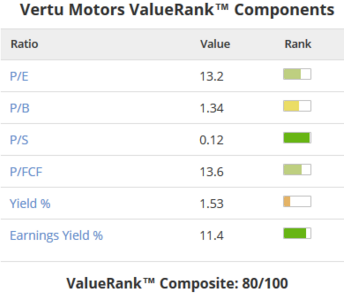
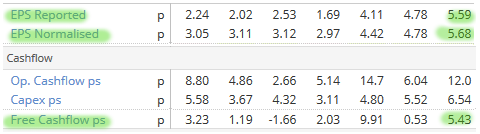
Vertu’s trailing P/E of 13.2 looks reasonable and is backed by a price/free cash flow ratio of 13.6. This shows that all of Vertu’s reported profit was converted into free cash flow last year:
Vertu’s low price-sales ratio of 0.12 is appropriate for a firm with such low profit margins. Although a dividend yield of 1.5% isn’t especially appealing, Vertu’s earnings yield (operating profit/enterprise value) of 11% suggests to me that the business is reasonably valued relative to its earning power.
Finally, I also like Vertu’s P/B of 1.34. I think this is fairly impressive after such a strong run of share price performance. The firm has net assets are 56p per share and tangible net assets of about 38p per share, thanks to a sizeable portfolio of freehold property and a lack of debt.
In the event of a downturn, this asset backing should provide some kind of support for Vertu -- although obviously the goal would be to sell out of such a stock before a major downcycle took hold.
From a value perspective I quite like Vertu, but what of its quality and momentum?
Quality
In the eyes of Stockopedia’s computers at least, quality is Vertu’s weak point. The company has a QualityRank of just 57 and does not score especially highly on any metric:
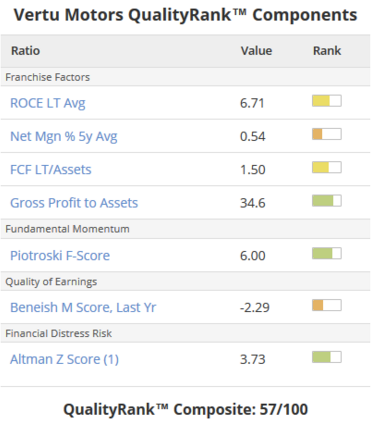
I’m not sure there are any major concerns here, however. Vertu’s Piotroski F-Score would be a highly respectable 8/9 if it wasn’t for a fractional fall in the firm’s current ratio and gross margin over the last twelve months. These declines are too low to be a concern, in my view.
The other general weakness relates to Vertu’s low level of profitability. The firm’s long-term average return on capital of just 6.7% isn’t inspiring, nor is its 5-year average net margin of 0.5%.
But to focus on these metrics risks missing the point, in my opinion. Vertu’s operating margin has risen from 0.6% in 2011 to 1.2% on a TTM basis. Over the same period, ROCE has risen from 4.9% to 12.7%.
This company is performing well at the moment, and could continue to do so.
Momentum may drive further gains
It seems late in the cycle to brand Vertu a turnaround. Despite this, the stock’s high value and momentum ranks and lower QualityRank suggest that Vertu does fit the profile of a turnaround.
Vertu’s MomentumRank of 97 is certainly an attraction. Both price and earnings momentum are strong. At around 75p, Vertu shares are only 2% below their 52-week high and have a 50-day moving average (dMA) more than double the 200 dMA. Both are signs of strong momentum.
On the earnings front, analysts seem bullish. Current year earnings per share forecasts have risen by 8.4% over the last three months, while next year’s forecasts have also been increased. This leaves the shares on a reasonable forecast P/E of around 12.
What’s next?
Vertu is one of the larger listed car dealers. Although its operating margin is lower than some of its peers, I like the Vertu’s net cash and solid asset backing. A track record of making acquisitions without gearing up the balance sheet also impresses me.
In my view, Vertu’s cash and property provide some defensive qualities in a very competitive sector.
However, with signs emerging that the housing market may be slowing, a corresponding slowdown in the new car market would not be entirely surprising.
Despite this risk, the odds that Vertu could deliver further gains seem good to me.
As always, this isn’t a recommendation. Investors should DYOR and share any views, especially bearish ones, in the comments below.
Disclaimer
This is not financial advice. Our content is intended to be used and must be used for information and education purposes only. Please read our disclaimer and terms and conditions to understand our obligations.

No comments yet
No one has commented here yet! Why not be the first one?