Stock in Focus: Has Hargreaves Services turned a corner?

Shares in coal production and processing firm Hargreaves Services have gained 23% since hitting an all-time low earlier this summer. The firm’s StockRank has also moved higher in recent weeks.
It’s a change in trend following a 50% decline seen over the last year, during which low coal prices and falling demand from UK power stations raised serious questions about the firm’s long-term future. Those problems still remain, but the market seems to have started to believe that the company may find a solution.

Has Hargreaves finally reached a turning point and become a contrarian buy?
Encouraging signs
Hargreaves’ management has certainly been making remarkable efforts to reposition the firm for a post-coal future. Early signs suggest to me that they could succeed.
One factor in shareholders’ favour is that Hargreaves’ chief executive, Gordon Banham, is the firm’s fifth-largest shareholder. Mr Banham’s 7.1% stake in the firm is currently worth just short of £8m. More importantly, Mr Banham’s dividend income of £682,000 last year was 54% more than his £443,000 salary. I believe the boss’s interests are well aligned with those of his shareholders.
What happens now?
The first stage of the group’s restructuring is now complete. Hargreaves has sold, downsized or optimised as many of its existing operations as possible. In the process it has eliminated most of its debt and built a £44m cash pile.
The next stage is to intensify efforts to develop the firm’s property assets, renewable energy opportunities and overseas coal consultancy business. Hargreaves is targeting opportunities in housebuilding, wind energy and hydroelectric power. The firm has also signed a deal to transport most of the biomass fuel used by Drax.
These developing operations will hopefully be funded by the run-off of Hargreaves’ coal business, which the firm believes will remain viable in some form until 2020.
What about the financials?
I was cautiously impressed by Hargreaves’ full-year results last month. Interestingly, so were Stockopedia’s computers. Over the last 30 days, Hargreaves’ StockRank has risen by 22 to 85, making it one of the biggest StockRank movers of the last month.
Hargreaves now has a ValueRank of 98 and a QualityRank of 72, suggesting it could be an interesting contrarian opportunity. Even the firm’s momentum is improving.
Strong value
Hargreaves scores highly on all key value metrics. The shares trade at a 20% discount to tangible book value and on a trailing price-to-free cash flow multiple of just 2.1.
At a share price of 340p, the firm’s business is valued at just 3.9 times trailing earnings and 8.0 times 2016 forecast earnings.
Of course, figures like this are often a sign of a business that’s in decline and is being valued accordingly. I’d certainly caution investors to remember that the trailing dividend yield of 8.7% is expected to fall to 6.4% in 2015/16, and to 5.4% the following year.

Dividends are in decline, but cover remains strong and the forecast yield is attractive.
What these figures do show, however, is that Hargreaves remains a profitable enterprise with a strong ability to generate cash.
Quality?
Hargreaves’ QualityRank has risen by 9 to 72 over the last month. What’s behind the change?
One factor in the firm’s favour is that its profits are uncomplicated and appear to give a reliable view of what’s really happening. The firm’s Beneish M-Score of -2.73 is well below the -1.78 threshold that indicates a high risk of earnings manipulation.
A second factor is that Hargreaves has a strong balance sheet. The firm’s Altman Z-Score of 4.21 indicates that the firm is in good financial health. The key factors here are that Hargreaves’ assets are still generating an operating profit and that it has plenty of liquid assets, such as cash and saleable inventories.
There are concerns, however. Operating margins have fallen from 7.9% in 2012 to 4.4% in 2014/15. Sales and profits are in decline, raising the risk that efficiencies of scale will be lost and profit margins squeezed by rising costs.
Hargreaves is now in a position where it is dependent on developing businesses to ensure its survival. As a result, my view is that the firm no longer enjoys any sort of defensive moat or competitive advantage. Trying to exit a dying business and shoulder your way into a new line of work is never easy.
Rising momentum
To overcome these obstacles, investors will need to rely on Hargreaves maintaining the focus shown during its restructuring and building a pipeline of future revenue.
Early signs suggest that following the firm’s latest results, momentum has started to improve.
As I mentioned, the shares have rallied by 23% from an all-time low of 280p. Hargreaves’ MomentumRank has risen from 16 to 38 over the last month.
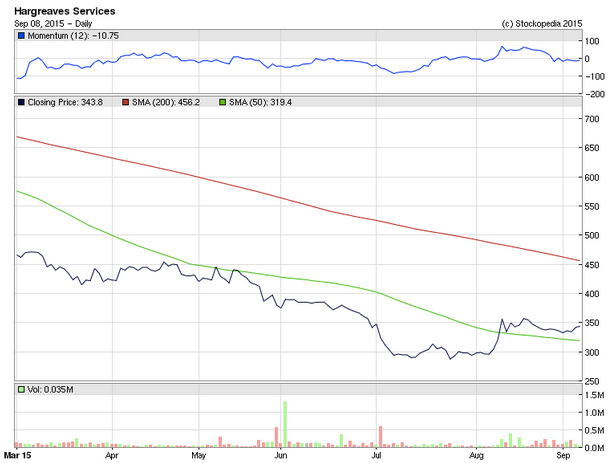
It’s still too soon for this to be reflected in the firm’s price momentum scores, which remain dire:
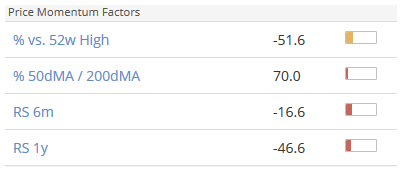
However, there are some signs of hope that earnings momentum is improving. Broker forecasts for next year’s earnings per share have risen by nearly 5% over the last month. This puts the shares on a 2016/17 forecast P/E of 8.4.
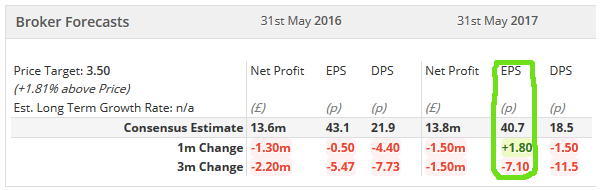
This may suggest that the market is coming to accept Hargreaves’ view that the coal market will survive for longer than expected.
Outlook
Over the last three years, Hargreaves has reduced net debt by around £80m, paid out £24m in dividends, and ended up with a cash balance of £44m. On a purely quantitative basis, Hargreaves arguably looks good value, has a strong balance sheet, and is cash generative.
I would not describe Hargreaves Services as a low-risk investment, but I do believe the firm’s financial performance and asset base have the potential to generate attractive returns for investors at the current valuation.
I am happy to remain a shareholder, but even more than usual, this is a DYOR share.
Disclosure: Roland owns shares of Hargreaves Services.
Disclaimer
This is not financial advice. Our content is intended to be used and must be used for information and education purposes only. Please read our disclaimer and terms and conditions to understand our obligations.

1 comment
That's a very good piece. So well done on putting it together. I would like to know a bit more about the company's land bank which might provide value if sold off to housebuilders/industrial site developers, or for use by say wind farm operators.
I'm sure the company is on the case.