Stock in Focus: I'm struggling to get a clear picture from Amino Technologies

On 7 October, internet television technology firm Amino Technologies was a high-flying share with a StockRank of 94.
Just 20 days later, Amino’s share price fell by 30% in one day after the firm warned that second-half sales would miss expectations, due to unsatisfactory “sales execution efforts”.
Amino provided no explanation for this mysterious and sudden loss of sales. Nor was the firm’s December trading update any help. Amino simply announced that its sales team had been restructured to address the problems experienced during the second half of 2015.

One possible clue is that Amino’s new sales team is being led by Steve McKay. Mr Mckay’s previous role was as chief executive of Entone, which Amino acquired last year. The Entone acquisition was announced in July and completed in August. Amino’s sales problems appear to have started immediately after this, as there was no hint of trouble in July’s interim results. Yet by October, the firm was forced to issue a profit warning.
I’m guessing, but I wonder if the rapid acquisition of Entone left Amino’s salesforce with a new range of products they struggled to sell. It’s clear from changes to broker forecasts that the Entone acquisition was expected to make a significant difference to 2016 earnings, but isn’t anymore:
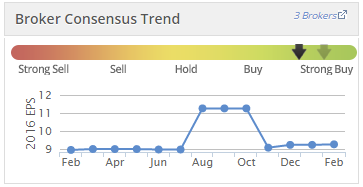
(I’m assuming that the revised earnings per share forecasts after the Entone deal made allowance for the £21m of new shares used to fund the deal.)
Amino published its full-year results last week. These seem to have contributed to a spectacular 48-point decline in Amino’s StockRank, which has fallen from 75 to just 27 over the last month.
As far as I can see, this makes Amino the biggest 30-day StockRank faller in Stockopedia’s universe of 2,729 UK stocks. Such a big decline seems worth a closer look, in my view.
Is this a stonking sell signal or a contrarian opportunity?
Uncertain value
A glance at Amino’s StockReport suggests that the stock’s one remaining value credential is a trailing yield of 4.8%. But it’s not immediately clear whether this is backed by earnings.
Based on the Thomson Reuters data used by Stockopedia, last year’s normalised earnings were just 4.95p per share. This gives a trailing P/E of 23 and fails to cover last year’s 5.5p dividend payout.
These normalised earnings (definition here) are usually a good match for a company’s own adjusted earnings, but not always. In this case Amino has provided two different adjusted figures. The headline “adjusted basic earnings per share” figure at the top of last year’s results release is 8.6p per share. However, in note 4 to the accounts, a “basic earnings per share excluding exceptional items” of 7.3p per share is provided.
I’m not really sure why two different adjusted figures are given, but I decided to use the lower figure of 7.3p. This gives a more reasonable trailing P/E of 15.8, if you accept the firm’s definition of exceptional costs.
Exceptional costs?
The acquisitions of Booxmedia Oy and Entone left Amino with total exceptional costs of £4,678k -- more than the group’s adjusted profits of £4,290k. Only a £744k duty rebate prevented Amino from reporting a statutory loss last year.
The question is whether Amino might have taken an overly generous view of what constitutes exceptional profits. This widespread practice is popular because it enables a company to adjust out items which might otherwise depress adjusted profits, on which most investors focus. (My recent article on GlaxoSmithKline triggered a discussion on this topic.)
Here’s the list of exceptional items from Amino’s 2015 results:
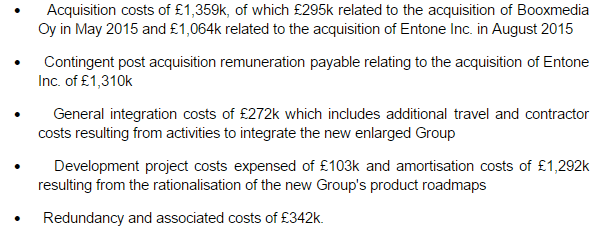
Would any of the £2.1m of general integration, redundancy, development and amortisation costs have occurred even without the Booxmedia and Entone acquisitions? We don’t know.
Should the £1.3m remuneration expense relating to the Entone deal have been expensed with all the other payroll relating to the newly-acquired workforce? It’s hard to say, without having access to more detailed information. Amino’s 2015 results indicate a possible total of £5.6m contingent post-acquisition remuneration for this deal. If this is to stretch over several years, then perhaps it should be treated as part of regular payroll expenses.
I should emphasize that I am not suggesting Amino has done anything wrong here. Clearly this treatment of expenses is legitimate and has been approved by Amino’s auditors.
Is earnings quality falling?
Even if we accept Amino’s 2015 adjusted operating profit figure of £4.1m, the firm’s operating margin fell from 11.4% to 10.0% last year. A 15% rise in revenue was not reflected in operating profits.
As you might expect, Amino’s QualityRank of 35 has very few bright spots and several causes for concern:
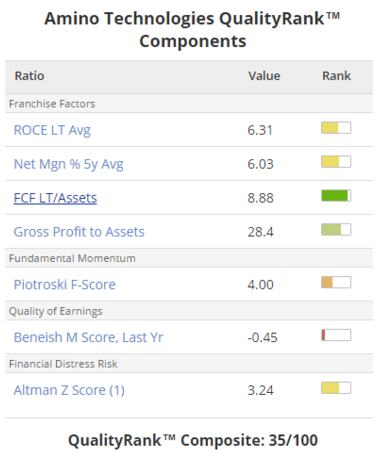
The Beneish M-Score highlights a particular risk -- a sharp rise in the number of days Amino customers take to pay their bills. This is easiest to understand using the receivable days ratio. In 2014, it took an average of 69 days for Amino’s customers to pay their bills. In 2015, this period rose to a snail-like 102 days, or more than three months.
Given this, it’s not surprising that Amino’s current ratio fell from 3.3 to just 1.2 last year. This decline caused one of the stock’s five fails in the F-Score test.
The one bright green item in the QualityRank breakdown was the long-term ratio of free cash flow to assets. This is a five-year average, covering a period during which Amino has generated good free cash flow and rising profit margins. What we don’t yet know is if the company will be able to regain that momentum once its acquisitions have bedded in.
Is momentum about to rise?
I’m concerned by what appears to be an underlying deterioration in profitability and balance sheet quality at Amino. Last year’s profit warning suggests to me that integrating two substantial acquisitions is not proving as simple as may have been hoped.
Despite this, analysts covering the firm are keeping the faith for 2016. Earnings are currently expected to rise to 9.27p per share, putting the stock on a forecast P/E of 12.6. The dividend is expected to rise by 7% to 5.9p this year, giving a potential yield of 5.1%.
These numbers suggest that the shares could be cheap if Amino can regain its previous form. However, the stock’s MomentumRank of 37 suggests that this may not happen for a while.
I’m unsure. I don’t fully understand Amino’s business. I’m prepared to believe that it has some longevity but will changes -- for example to software rather than hardware solutions -- alter the costs and profit margins of this business? I don’t know.
For all of these reasons, I plan to stay away from Amino for the time being. I’ll take a fresh look after the firm’s next set of results, which should provide a clearer picture of the group’s performance.
As always, these are my views only, not advice. Please DYOR and let me know what you think in the comments below.
Disclaimer
This is not financial advice. Our content is intended to be used and must be used for information and education purposes only. Please read our disclaimer and terms and conditions to understand our obligations.

6 comments
Good article Roland.
I sold out when the announced the last acquisition. I don't like acquisitions, as in my opinion companies invariably overpay and often don't know enough about what they are buying.
As an accountant i know that "due diligence" in most cases is nonsense, just asking a few questions etc - it's very easy to hide things! So not surprised by the sudden turn for the worse
On the linked subject of technology stocks and high stockopedia ranks another one has hit the buffers this morning - Alternative Networks (LON:AN.) This was a 2016 NAPS selection, following Ed's 2015 successful strategy, as one of the top two QVM ranked stocks in the Telecoms sector. Following a 'negative' trading update the share has fallen by over 30% this morning less than two months after a selection for the NAPs portfolio. It may be early days but is the current bearish market going to prove that the 2015 NAPs was 'more luck than quantitative judgement'?
Most people think in terms of "If I do A then B happens". That is a naively simplistic world view.
If the Entone expenses are really contingent (that is will not be paid if the thing they're contingent on doesn't happen, and that thing is not trivially easy to achieve), they should not be a payroll expense.
Hi cig,
I agree that that if they are truly contingent, then it may be acceptable to keep them off the payroll. However, from the outside, there's no way for us to know how difficult these contingent targets are.
After all, £1.3m of contingent remuneration was paid last year, within 3.5 months of the deal completing. I'm not sure if that is enough time to achieve a meaningful contingent target, especially given that Amino Technologies (LON:AMO) issued a profit warning during that period...
Regards, Roland
Good write-up. I sold this one immediately after the profit warning as I found the explanation given to be vague and troubling. I think your speculative explanation about the sales execution issue makes a lot of sense though I would say the fact that AMO have not been clearer about the issues giving rise to the profit warning + concerns about the long term viability of their products are big red flags.