Stock in Focus: Is Rio Tinto cheap at £100bn?

Mining giant Rio Tinto has become the fourth most valuable company in the FTSE 100 in recent weeks, as soaring iron ore prices have boosted the group’s profits. Although the shares are trading close to record highs, the stock still offers a forecast yield of nearly 8%.
Rio is a new arrival in my SIF stock-buying screen this week, so I plan to take a closer look. I also want to revisit my decision last week to sell Morgan Sindall Group days before the FTSE 250 firm published its results. This cost SIF several thousand (virtual) pounds.
Morgan Sindall: good process, bad result
Regular readers may remember that I opted to sell construction group Morgan Sindall from my SIF folio last week, a few days before the company’s annual results were due.
The results were good and included a strong outlook statement. Morgan Sindall shares promptly rose, meaning that I could have sold for around 12% more if I’d held on a week. I didn’t, because doing so would have broken my rules-based process.
Instead of following the process, I’d have been speculating and allowing my subjective judgement to influence my decision making. In this case, I’d have come out of it with a little extra cash. But it could have gone the other way.
As it happens, even after last week’s gains, Morgan Sindall still triggers my sell rules -- the share price still lags the wider market on a one-year view.
Even a good process will sometimes deliver a bad result. As a systematic investor, that’s something I just have to accept.
Rio Tinto (LON:RIO): More to come?
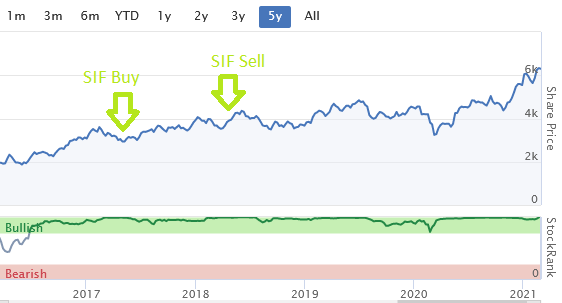
Rio Tinto has been a SIF portfolio stock once before. Back in May 2017 I added the shares to the portfolio at under £30, before selling at £40 for a quick 35% profit in February 2018.
I’d like to think that my new selling rules might have helped me keep hold of this stock for longer. Because if I had held on, my original Rio holding would have doubled by now.
I’d also have enjoyed some massive dividend payouts. In its recent 2020 results, the company declared a $6.5bn of dividends, bringing the total payout for last year to a record $9bn. That’s equivalent to a trailing yield of around 6.5%.
Rio Tinto is now back in my screen results with a StockRank of 99 and a market cap of £100bn.

Investors do not seem to have been deterred by Rio’s shameful destruction of a sacred Aboriginal site, or by ongoing problems with the giant Oyu Tolgoi copper project in Mongolia. I’m not surprised. Rio made 86% of its profits from iron ore last year. Demand for the red stuff appears to be the only thing that really matters right now.
The bull case rests on continued strong demand from China’s steel industry. Steel foundries gobbled up Rio’s high quality iron ore last year after the Chinese authorities flooded the economy with more than $5tn of stimulus payments.
The price of iron ore has doubled over the last year, to more than $170. Perhaps coincidentally, this is a level last seen 10 years ago, during a previous China-fuelled commodities boom.
Rio produced iron ore for $15.40 per tonne in 2020. With buyers at $170, this business is a licence to print money. But high prices for iron ore are now reported to be hitting the profitability of China’s steel foundries. With China now starting to taper its stimulus programme, there seems to be some risk that demand will soften.
The likelihood of another commodities supercycle is occupying investment commentators at the moment. A prolonged period where demand outpaces supply could support high prices for a while longer. I don’t know how likely that is, but I feel there are a few lessons we can draw from Rio’s latest numbers.
Let’s start with a look at the stock’s value score.
Value: keep cycling
Can Rio shares really offer good value at these levels? Or is this a classic late-cycle situation where the share price looks cheap because it’s being compared to peak earnings?
Rio Tinto’s ValueRank of 73 is the lowest of its three factor scores. It’s not a bad score, but I think there are some signs that the valuation is becoming quite full:

Why would a mining company trade at three times its net asset value? I think the clue to this lies in the other important metric that makes up the ValueRank score:

My screen specifies a minimum earnings yield of 8%. A double-digit earnings yield is generally cheap, in my view, unless profits are declining or abnormally high. As we’ll see, Rio Tinto is enjoying strong profitability at the moment. But I think there’s good reason to be cautious.
One additional value metric I find useful with cyclical stocks is the CAPE. That’s the cyclically-adjusted price/earnings ratio.
This classic value measure averages earnings over 10 years and compares them to the current price. For a stock with cyclical earnings, the CAPE can be a useful indicator of where the company is in the current cycle.
According to Stockopedia, Rio Tinto shares have a CAPE ratio of about 17 - they are trading at around 17 times 10-year average earnings.
To put this in context, my research suggests that this is Rio’s highest CAPE ratio in at least 10 years. Back in 2015, when the mining industry really crashed, Rio shares had a CAPE ratio of about five.
My view: Rio Tinto’s valuation suggests it’s getting close to the top of the cycle. But timing the top is impossible. This strong run could continue for a while yet.
Quality: super profit margins
Rio Tinto’s giant iron ore mines in the Pilbara region of Western Australia are cost advantaged, to use the industry jargon. They have lower costs than most others and are also geographically well located to supply China.
This has a very beneficial effect on Rio Tinto’s profitability, which is reflected in its QualityRank of 95.

An operating margin of 37% for supplying bulk loads of iron ore is remarkable. What’s even more remarkable is that broker forecasts suggest the group’s profits will rise by more than 40% this year, from $9.8bn to $15.9bn. Factoring in expected sale growth, I estimate this could imply an operating margin of around 45%.
My view: At this point, Rio’s balance sheet looks pretty bulletproof to me, with minimal net debt and strong cash generation. I don’t see anything to worry about on the quality front unless new CEO Jakob Stausholm is seduced by the idea of a big acquisition. Right now, I think that’s unlikely, given the challenges he already has on his plate.
Momentum: it all depends on China
Rio Tinto’s MomentumRank of 97 suggests an almost unblemished outlook. But broker forecasts suggest Rio’s profits will peak in 2021 before falling in 2022:

If so, that would support my view that we’re at the top of the cycle. This would also explain why the shares currently trade on just nine times forecast earnings, despite offering a cash-backed yield of more than 7%.

As always, we can break Rio’s momentum score down into two factors, giving us more insight into trading patterns and institutional views.
Earnings estimates: Broker forecasts have been upgraded repeatedly over the last year. I wouldn’t rule out the possibility that 2022 forecasts could edge close to 2021 numbers.

Price momentum: Buyers still seem happy to pile into Rio stock, perhaps tempted by FOMO and the high yield on offer. The stock’s technical momentum indicators all look fairly strong to me at the moment:

My view: Rio Tinto’s momentum looks strong to me at the moment. But if forecasts continue to show profits falling in 2022, I’d expect the stock’s MomentumRank to weaken over the year as 2022 forecasts take on more weight in the rankings.
My decision
FTSE 100 integrated coal, iron ore and steel group Evraz is already a SIF holding. So too is Russian gold miner Polymetal International. This means diversification considerations would prevent me adding Rio Tinto to SIF at the moment.
My decision not to buy Rio Tinto shares for SIF aligns with my rules. In this case it also reflects my personal view. I reckon there’s a strong likelihood miners are getting close to the top. The stock might still be a lucrative trade, but I wouldn’t add the shares to a long-term position at this level.
What do subscribers think? Am I too cautious given the likelihood of continued global stimulus? Or is the party nearly over?
Disclosure: At the time of publication, Roland owned shares of Evraz and Polymetal International.
Disclaimer
This is not financial advice. Our content is intended to be used and must be used for information and education purposes only. Please read our disclaimer and terms and conditions to understand our obligations.

16 comments
While I agree that current iron ore pricing looks toppy, I've still yet to see a fundamental argument other than "its the highest its been in a while" "matching previous top prices" "risen strongly in the last year". If you gave those reasons not to buy shares, you'd be ridiculed - they are neither good technical or fundamental analysis methods.
On fundamentals, here is where I stand:
Overall, with so many tailwinds to drive/sustain high commodity prices, I see Rio Tinto (LON:RIO) as being relatively safe for the next year at least, in which case investors will pile in for its 10% forecast dividend yield (and rising!). There is easily another 20-40% upside in the pricing over the next 6-12 months, which is nothing to sneeze at for a FTSE100 large cap.
(I Hold)
@RolandHEAD:
Pls post all the SIF rules. I spent 30 mins searching for the rules on the site. We need this to create such a portfolio.
Here is the screen: https://app.stockopedia.com/screens/buy-stock-in-focus-sif-113218?view=158149
you should be able to duplicate this into your own screen.
Fair and balanced assessment, thank you.
btw Rio went XD on its final and special dividend yesterday (March 4th) so if anyone reads this and is attracted by the dividend the next should be an interim payment made in mid-September to registered holders at around 6-9th August time. Last year this was just under 120 pence.
I bought Rio and BHP recently, the former probably for the first time in fifteen years. My thinking was very simple. I don't like commodity stocks in principle as they depend on a market price decided principally by demand factors. And there are ecological factors to consider - Rio's destruction in Oz was a real blemish on its name and the rewards for executives destroying first nation culture abominable. But being growth oriented in my portfolio it is clear that ratings in some areas of technology, for instance, have become highly demanding or in some instances absurd. I read two pieces (CS and JPM I think) suggesting that the strength in commodities may continue, partly influenced by government and consumer attitudes to electric cars. And that this just could be a supercycle in the making. So I decided the risk of being out was greater than the risk of being in, especially as current ratings - price earnings, dividend yield and RoCE - are so very attractive. It was a kind of hedge.
Hi Roland,
I read your Rio analysis with interest. Thanks for posting it. I have held in shares this company for a few years. The dividend return I get on my original investment is over 15% due to the share price rise so when I think about Rio it i
s with a smile on my face and thus I am perhaps rather defensive about Rio. However, I agree with your concerns about the risks to the mining share prices being close to a top. However, I wanted to get your feelings on the subject of price to book value. You made the point that at 3 times you felt this was waving a red flag. A couple of years ago the Price to book value was about 2 and the iron ore price was around $70 per tonne. Now the price of iron ore is more than double and the cost out of the ground is pretty stable at 16 dollars. It looks like an extra $70 per tonne profit is possible on every tonne Rio mine. Would that not be a good cause to raise the Price to book by a good margin?
Kind regards,
Peter
The question of Price: Book for resource companies is complicated by the fact that their principal asset (reserves in the ground) do not show up anywhere in the accounts, only the costs incurred in bringing the asset into production. There are no tons of iron ore or barrels of oil anywhere in the balance sheet so I would not be too concerned by the P/B of 3 when Rio have such huge reserves of ore.
Like danbjay I am very interested in their copper potential. I have held Rio in the past but sold a while back and it is the additional copper potential that would get me back in.
As someone who mainly invests in smaller companies, RIO has been one exception to my preference of not investing in Big Cap. For me the bigger story is the copper potential of RIO. Oyu Tolgoi is one of the largest known copper reserves in the world and despite the current problems, it is a project that will have to be made to work. We are at the start of an energy revolution which will require huge amounts of resources to transform the economy, especially copper. RIO has the balance sheet and the cashflow to invest in copper and keep paying dividends.
Hi Rowland,
Although you do not want to invest in Rio right now, eventually you wil be looking for incoming increasing dividend payments are important as yoyr SIP portfolio progresses with time.
Over the last ten years or so, from 2010 the income from dividends has increased by5X, from 55.05p to 288.63p now in 2021 with the strong possibility of another dividend payment this year. I do'nt think many people have got such a massive increase with their pension income each year.
Certainly the state pension is only earmarked a 2.5% increase this year, so REO tomorrow will be paying around 4.54 % ( 288.63/6375) to start with. So it is a thumbs up from me.
Good, balanced analysis of Rio Tinto (LON:RIO) Roland - thanks.
I hold so I'm balancing commodity super cycle, all time high, China's performance etc, etc, ...... but at the moment IMO the plusses outweigh the negatives (but this could change quickly).
Long term is a bit more difficult. What is obvious is $170+ for iron ore cannot last - its the most basic of basic raw materials and is everywhere. Other sources will come on stream in the medium to long term - aided possibly by Australia picking fights with China.
The super cycle is more about lack of past investment than future investment which will turn up just in time to experience falling commodity prices. One of the pluses about holding Rio Tinto (LON:RIO) is it has "last man standing" solidity due to its low cast base which has been built-up by huge capital investment as well as its location.
I keep a careful watch.
Phil
Between Feb 2018 and Jan 2020 RIO did Nothing. Then last March it dropped below your purchase price. Only in the Autumn did it start motoring. Your capital would have been tied up for 4 years and your conviction would have been severely tested. So your error was Not your sale in February 2018, it was not buying in Oct 2020. Maybe the SIFS system did not suggest it or was rejected because of overlap in sectors. That is where to put some attention.
Brilliant analysis Roland it's inspiring and really useful to read your write-ups.
I do believe this China-fuelled commodities boom will taper off this year and perhaps sooner than we think. Chinas leading companies have come off the boil for almost two straight weeks losing more than 10% of their value after an impressive run.
I am commodities and mining heavy at the moment and this is made me think about planning some changes to my portfolio.
In general I have no major problem being dispassionate about shares. Bitter experience tells me my buy or sell decisions will always seem wrong immediately after its done so I live with that. My problem at present is that whilst my strategy overall did work well over the past year in particular now it seems to be unhelpful and a;though overall the result isn't really damaging the weekly returns and performance against my main KPI, measured against ASX,, is drifting and I cant get any handle on the market. based on this and experience I really am beginning to think now might just be a good time to decide the party is over and I should take my illgotten gains and run. That flexibility is of corse ultimately is the only real advantage a mere amateur like me has In stare dealing.
I’m no expert but just a glance gave me the “trust your gut” feeling, this has had it’s day for now... it’ll come again though... I’ll just watch from the sidelines...
Even wondering if SLP has run it’s course and it’s time to head for the exit... only been in since early Dec and up 50%... is greed good as Gordon Gekko would say ?...
Good note Roland.
All too often investors wax lyrical about their winners; its refreshing to hear someone so candid about what could have been.
Formulating the correct sell discipline, for me, remains the holy grail; the quest continues.
I think your conclusion is sensible. I too bought and sold and wished I had held on. I did re-enter again with a small toe-hold reinvestment seduced by the super-cycle argument. However, my conviction is low and my confidence that I can make it to the exit door ahead of everyone else is even lower.