Stock in Focus: Is Sureserve turnaround the real deal?

The rally in global equities has also lifted the SIF folio to a new record high. I’ll look at the picture in more detail in my portfolio review at the end of the month, but for now I’m not sure if I should be pleased or worried.
The reason for this is that SIF’s recent surge higher has corresponded with a dearth of new stocks qualifying for my buying screen. That means fewer stocks than usual passing are my tests for affordable growth. This might be a coincidence. But it might also imply that the market is heading for a correction, or perhaps that the economic outlook is worsening.
A genuine turnaround?
Time will tell. In the meantime I want to take a fresh look at building services contractor Sureserve (LON:SUR). This £100m AIM-listed group owns operating businesses in sectors such as gas compliance, electrical contracting and lift maintenance. Customers include housing associations, schools and other public buildings.
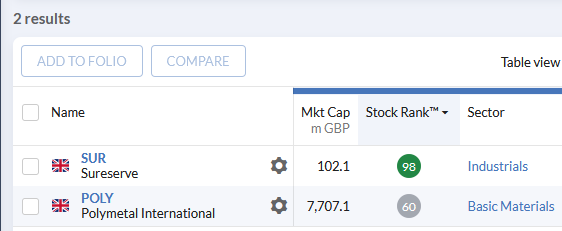
This stock has made regular appearances in my screen results recently and is one of only two qualifying stocks at the time of writing:
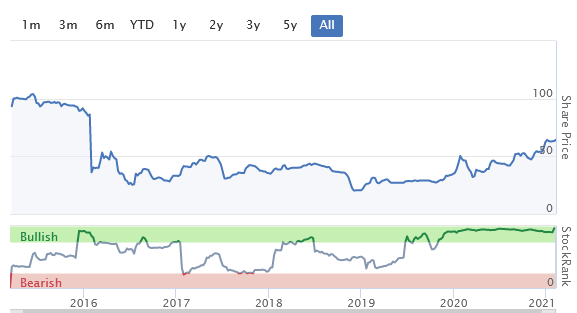
Sureserve Group was floated as Lakehouse plc in 2015. Soon after, various problems emerged and the stock crashed. Although the shares remain well below their IPO level, shareholders have enjoyed a gradual recovery over the last two years:
Funnily enough, when I added rival Bilby to SIF in 2018, I commented on Bilby’s outperformance against Lakehouse. You can probably guess what happened to Bilby after that - Bilby also suffered post-IPO problems, leaving me with no choice but to sell for a stonking loss.
Through bitter experience I have become biased against contracting companies of this kind. However, I don’t have a fixed rule on sectors to avoid and there are always exceptions. Indeed, SIF currently holds FTSE 250 engineering and construction group Morgan Sindall which I rate highly.
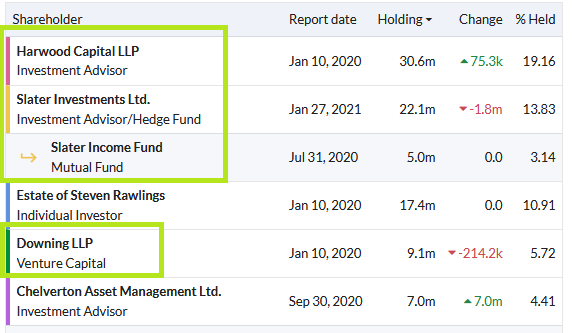
Sureserve’s turnaround has also attracted some small-cap specialist investors, suggesting that the current management team is viewed credibly by shareholders:
Given this, I’m happy to give Sureserve a fair review in case I might want to own the stock in the future.
Sureserve (LON:SUR)
Sureserve issued its preliminary results on 3 February for the year ending 30 September 2020. Not exactly a fast turnaround, but small companies are often slower to report.
The good news is that these (relatively) recent numbers have now been loaded into Stockopedia’s database. This means that my screening rules have a fresh set of data to work with. In theory, this should give us a more accurate view of recent trading and current momentum.
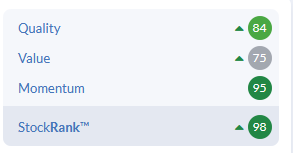
Stockopedia’s algorithms certainly appear to like the stock. Sureserve is currently rated as a Super Stock, with a StockRank of 98:
The shares also qualify for six of Stockopedia’s stock screens:

That all seems promising, so let’s take a look at Sureserve’s individual factor scores in more detail.
Value: Fair price
Sureserve’s ValueRank of 75 is actually the lowest of its three factor scores. But it’s a respectable total, all the same. A quick glance at the key ratios used in the ValueRank suggests to me that the valuation seems quite full and may already be pricing in some future growth:
Price/book ratio: 2.0
Trailing P/E: 16.5
Price/sales ratio: 0.5
Price/free cash flow: 4.9
Earnings yield: 9%
Dividend yield: 1.6%
Free cash flow: Sureserve’s price/free cash flow ratio of 4.9 is at odds with its trailing P/E ratio of 16.5. Looking at the accounts, it seems that operating profit of £8.6m was converted into £19.6m of net cash from operating activities last year.
The company says that cash flow can be lumpy:

A quick look at the accounts suggests to me that Sureserve may also be taking longer to pay its suppliers. This would also have the effect of boosting cash conversion. Trade payables rose by £6m to £42.8m last year, even though revenue and cost of sales both fell. My sums suggest the firm may now be taking more than 90 days to settle its bills, compared to around 75 days in 2019.
Managing working capital in this way is a legitimate technique, but I’d expect cash conversion to fall closer to 100% (or lower) during the current year.
Net debt/cash: In a similar vein, Sureserve says that although it ended the year with underlying net cash of £9.8m, it maintained an average net debt position of £6.4m during the year.
This doesn’t seem problematic to me, but it is a useful reminder that this kind of business can have lumpy cash flows. Mobilising and maintaining contracts often requires good levels of liquidity. In my view, it’s not safe to assume that net cash is surplus to requirements.
Quality: not too bad
I don’t expect contracting businesses like this to have high profit margins, but if they’re well managed I do hope for a double-digit return on capital employed. I’m pleased to say Sureserve scores well on this front, which may help explain why the stock has a QualityRank of 84 at the time of writing.
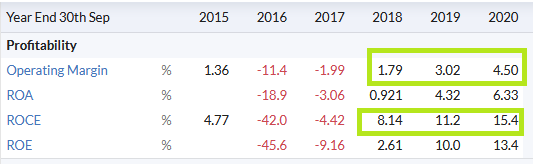
The stock also scores well on other quality measures thanks to strong cash conversion, improving margins and debt reduction.
On balance I can’t see anything to be too concerned with Sureserve’s quality metrics. The only point I think is worth reinforcing is the risk implied by a business model with high turnover, low margins and relatively few customers.
This combination means that a problem with one major contract or operating segment can derail an entire year’s results. We’ve seen this many times in recent years in the service and construction sectors.
Momentum: Flying high
At 95/100, Sureserve’s MomentumRank score leaves little room for improvement. It’s not too hard to see why.
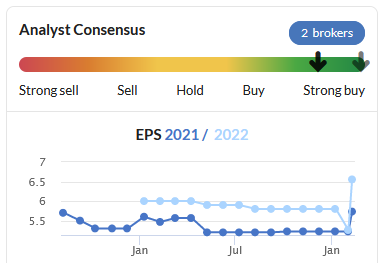
Earnings estimates: Earnings from continuing operations rose by 48% last year. Broker forecasts suggest another 40% gain in 2021. The outlook for 2022 is also positive and forecasts for both years have recently been upgraded:
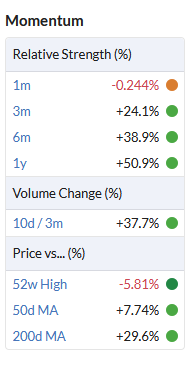
Price momentum: The stock’s technical performance has also been strong. Sureserve’s share price has risen by about 40% over the last year and has doubled from the lows seen in March 2020.
The stock’s momentum graphic shows a clean sweep of strong technical scores:
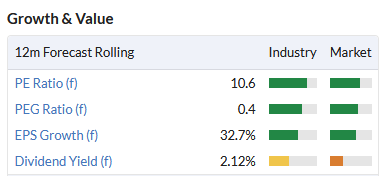
Looking ahead, Sureserve shares trade on a rolling forecast P/E of 11, with a 2% dividend yield:
My verdict
I won’t be adding Sureserve to SIF because the portfolio already holds housebuilder Countryside Properties and construction firm Morgan Sindall. Although these aren’t direct competitors, I don’t feel the need for any additional exposure to this sector.
As a potential investment, I can’t find anything particular to be concerned about with Sureserve. But I can’t really get too excited about the prospects for this business, either. This is a fairly competitive sector, and history tells us that problems are not uncommon.
With the shares trading on around 11 times forecast earnings and offering only a low yield, I think Sureserve looks fully valued at the moment.
I wouldn’t be inclined to chase Sureserve much higher - indeed, I note that fund managers Slater Investments and Downing have both recently trimmed their holdings.
Disclosure: At the time of publication, Roland owned shares in Countryside Properties, Morgan Sindall Group and Polymetal International.
Disclaimer
This is not financial advice. Our content is intended to be used and must be used for information and education purposes only. Please read our disclaimer and terms and conditions to understand our obligations.

1 comment
great article, and useful to see how you analyse using Stocko metrics.