Stock in Focus: Macfarlane could offer an attractive growth package

This week it’s time to put the systematic side of my stock selection process to the test. The next stock I’m going to add to the Stock in Focus portfolio is packaging manufacturer Macfarlane Group.
I’ve chosen this £80m small cap simply because it is the next-highest ranked stock in my stock screen that meets my diversification criteria. The company is actually a new arrival in my screen, as a result of some recent volatility in the firm’s share price.
A cautious AGM statement on 10 May advised investors that subdued market conditions were being offset by recent acquisitions. Despite full-year guidance remaining unchanged, Macfarlane shares fell 9% from 68p to 62p on 10 May. They’ve since started to recover. Assuming the firm does meet expectations this year, I think they could offer good value at current levels.

Stockopedia certainly likes Macfarlane, with a StockRank of 95. The stock also qualifies for six Guru Screens, including the Jim Slater Zulu Principle Screen. This popular screen has delivered annualised growth of 20.9% per year since 2012.
A smart approach to packaging?
Macfarlane is not an old-fashioned cardboard box manufacturer. The firm’s customer base includes major internet retailers, food and consumer goods manufacturers and electronic and defence firms. Macfarlane makes a range of modern packaging and labelling products tailored to the needs of these sectors.
A big part of the business is the group’s distribution service. Using a UK-wide network of distribution centres, Macfarlane can integrate with customers’ systems and ensure packaging is automatically ordered and delivered as needed.
Macfarlane’s net profits have risen from £3m to £5.5m since 2010 and the shares have triple-bagged over the last six years. To maintain this momentum, the firm has been pursuing a strategy of growth by acquisition. This can be risky, but Macfarlane appears to be executing well. The focus is on buying small companies which provide low-risk, incremental growth. This is a strategy that can deliver a surprisingly high mileage if done well.
Good value for a growth stock?
Macfarlane’s ValueRank of 66 is its weakest score, but it’s hardly bad. This high flyer may have the potential to become a super stock.
The shares trade on a trailing P/E of 14.7, with a trailing price to free cash flow ratio of 17.5. These seem reasonable to me, for a growth at a reasonable price (GARP) investment.
I’m also reassured by Macfarlane’s earnings yield of 8.3%. This suggests to me that Macfarlane’s equity valuation and debt levels are appropriate for its profitability. A low margin business such as this can still deliver attractive returns for shareholders, as long as the purchase price is right!
Strong free cash flow cover for the last four years suggests that the dividend is fairly safe, at least until the next major recession. Indeed, while Macfarlane’s business is obviously not one that will disappear during a downturn, I’d expect a fair degree of cyclicality. It’s worth noting that the dividend payout was cut in 2004 and 2009.
However, downside protection seems poor in the event of a sales slump. There’s very little asset backing for the shares, which have a book value of just 27p. When goodwill and intangibles are stripped out, this falls to -2.2p per share. This is probably a stock to ditch before the next big recession.
Balance sheet downside?
Macfarlane’s balance sheet looks fairly reasonable, but there are a couple of potential risk areas.
The first is the group’s net debt of £11.6m, or £12.8m if you include finance lease liabilities. This is less than 2.5 times 2015 net profit, so isn’t a problem if profits keep rising. However, this debt could become a more onerous liability in a major downturn, so needs to be monitored.
Note that while the bank borrowings are classed as a current liability on the latest balance sheet (i.e. due within one year), the firm’s borrowing facility was increased from £20-£25m in February and extended until June 2019.
The other potential issue is that Macfarlane had a pension deficit of £11.5m at the end of last year. While no additional payments were made in 2015, Macfarlane says that “The Group will consider a number of further actions to reduce the deficit in 2016.” This could reduce the amount of cash available for debt reduction and dividends.
Improving quality?
A useful trick for monitoring the effect of a company’s results and share price movements on its StockRank is to compare the current StockReport to an older version. You can see older versions of a company’s StockReport by clicking on the arrowhead next to the grey Print button at the top of each screen:
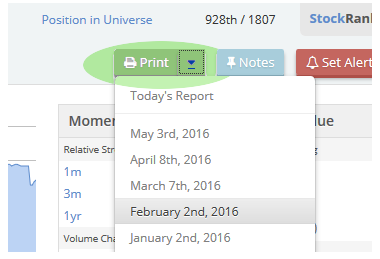
Comparing Macfarlane’s StockReport from 2 February with the current version suggests that the firm’s 2015 results triggered an increase in QualityRank from 60 to 77.
One of the main reasons for this increase is probably that last year’s results helped lift the firm’s Piotroski F-Score from 4 to 6. The F-Score is one of my favourite Stockopedia metrics and is also heavily weighted in the QualityRank calculation. Note that the current F-Score of 6 could quite easily be eight, were it not for marginal (and insignificant) declines in the firm’s current ratio and return on assets last year.
A narrow moat?
I’d imagine that a business like this could easily suffer from severe margin pressure if it wasn’t able to demonstrate to its customers that it was adding value to their businesses. On that basis I’m encouraged by the group’s operating margin, which has recovered from a low of 3.2% in 2011 to 4.6% in 2015.
Macfarlane’s scale means that it can integrate fully with the supply chains of larger customers, while innovative and modern packaging should ultimately reduce costs relating to packing, transport and damage in transit. I’m tempted to classify the firm’s competitive advantages as providing a narrow moat, although further research into major competitors would be needed to be sure about this.
A momentum opportunity?
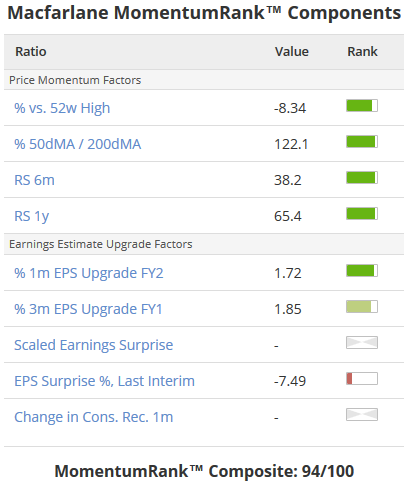
Despite the shares’ recent slide, Macfarlane’s MomentumRank has risen by 10 points to 94 over the last month.
One reason for this is that the firm’s house broker has increased earnings forecasts for both 2016 and 2017. This is presumably as a result of Macfarlane’s latest acquisitions, Colton Packaging and Edward McNeil.
Price momentum also remains attractive, as the sea of green in MacFarlane’s MomentumRank breakdown shows:
Final thoughts
I’m conscious of the cyclical nature of Macfarlane’s business and the risk posed by its pension deficit and rising debt. But the evidence suggests that the firm is executing and trading well at the moment. I’m happy to trust my semi-mechanical selection process and add this stock to the portfolio.
As always, I’ll review the state of play in six months, or sooner if something major happens. Until then, the shares are in.
If you’ve looked at Macfarlane recently, then I’d be very interested to know what you think as well.
Disclaimer
This is not financial advice. Our content is intended to be used and must be used for information and education purposes only. Please read our disclaimer and terms and conditions to understand our obligations.

6 comments
Thanks Roland for your response. The balance sheet does not seem that strong to me, quite a bit of debt and the significant pension deficit as highlighted by Paul. Its also low margin so not much room to cut margins. At the moment I don't find it that attractive. But anyway that's what makes a market and I will see how your selection does.
Deleted
Thanks for this article. I have also picked MACF up on a couple of my screens. I am interested in adding to my portfolio but feel at the current price there is not enough potential upside to justify purchase. If it drops a few more pence I might jump in.
Roland
Interesting piece, many thanks.
I bought MACF in Sep '15, Nov '15 and on the recent dip May '16. MACF came up on my screens and I was satisfied with most of the SP quants. I also spend a lot of time on their website and liked what was presented there.
One factor which has added to my confidence is that the share was priced at 16.28p 01/10/08, today it is 60.03p. If I calculate correctly that is 268.73% growth over 7 years, 8.5 months (92.5 months), which I calculate to be 34.86% annualised (excluding divs). I found this quite compelling and feel that it reflects good management over time, which I also picked up from trawling their website (whilst agreeing with herbie47 above, that a recession could dent this quite a lot). I have alerts on this to help de-risk my holding.
Thanks for doing your portfolio, I learn a lot from your write-ups.
Regards
Howard
Not a good start, down 8% today. The high debt, pension deficit and wide spread don't make it attractive to me. Also in a recession then packaging will be hit?
Herbie,
As I mentioned in the article a recession would undoubtedly hit sales and thus margins. But when you think about the type of packaging Macfarlane sells, it's now part of the fabric of life in western economies such as ours. This demand won't go away completely during a recession.
In my opinion, the challenge for investors is to satisfy ourselves that Macfarlane (LON:MACF) has a strong enough balance sheet to ride out the next recession. We can then choose between averaging down or selling when the next downturn arrives. Both approaches have their benefits, in my view.
Regards,
Roland