Stock in Focus: Should I add Fulcrum Utility Services to the portfolio?

Until now, all of the stocks which have qualified for my Stock in Focus screen and been added to the SIF portfolio have had high StockRanks. Of the twelve stocks currently in the portfolio, seven have a StockRank of 90 or above and only one has a StockRank below 70.
This isn’t because my screen chooses stocks with high ranks, at least not explicitly. What has happened is that the stocks which have satisfied my criteria have also generated high scores from Stockopedia’s ranking algorithms.
However, low-ranking stocks do occasionally qualify. One example is Fulcrum Utility Services Ltd. This AIM-listed small cap has a StockRank of 47, but has nevertheless made intermittent appearances in my screen.
This week I’m going to evaluate whether to add Fulcrum to the SIF portfolio.
A defensive addition?
I’ve discussed my chronic shortage of defensive stocks in previous weeks’ columns. My conclusion was that many genuinely defensive businesses are either overpriced or delivering very little growth at the moment. Hence why few have qualified for my screen.
As a utility sector stock, Fulcrum should help to address this imbalance. But does it?

Fulcrum isn’t really a utility. The company’s is an infrastructure provider whose business is to fill the gaps between electricity and gas distribution networks, and meter installations. For example, Fulcrum will connect up a new housing development or factory to the electricity and gas grids.
The group also has a gas transporter licence, which allows it to own and operate pipelines that deliver gas to customer premises. Such activity introduces a small element of utility-like recurring revenues to the group’s business. This could be attractive over the longer term, I feel.
However, it’s clear that the majority of Fulcrum’s income is linked to new-build projects. As such, I feel it compares more closely to companies such as Costain than to utilities.
Is it profitable?
Fulcrum floated on AIM in 2010 and proceeded to deliver a string of losses. However, management changes followed and things improved dramatically during the 2014/15 financial year, when Fulcrum moved into profit.
Although revenue has only grown modestly, the group now appears able to convert these revenues into decent profit margins and cash flow.
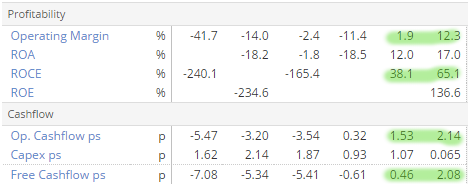
Fulcrum shares have doubled over the last year but remain modestly valued, on 12 times forecast earnings and with a 2.9% prospective yield. The balance sheet appears to be strong, with net cash of £8m and no debt.
Improving value?
Fulcrum’s ValueRank of 48 isn’t very exciting. But there don’t appear to be any real red flags here, either:
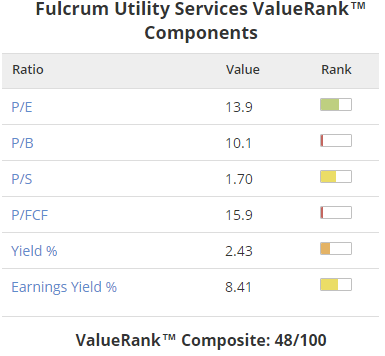
A trailing P/FCF of 15.9 and P/E of 13.9 are reasonable for a small-cap delivering strong earnings growth. The trailing yield of 2.4% is fine, and the earnings yield of 8.4% is above my threshold requirement of 8%.
On the other hand, the price/sales ratio of 1.7 is only acceptable if Fulcrum can maintain the 12% operating margin it reported last year. Similarly Fulcrum’s P/B of 10 is okay for a service business, but makes it clear that asset backing is minimal. Any downturn in new project awards or margins could leave the shareholders exposed to major downside.
Overall, I’d say that in value terms, the picture is broadly neutral.
Quality concerns
Fulcrum’s short history of profitability means that it doesn’t score well on any of Stockopedia’s 5-year average measures of quality, such as ROCE.
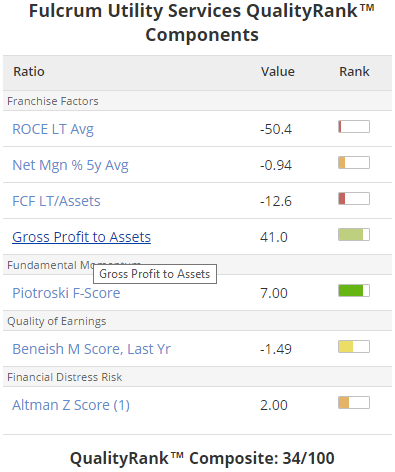
The group’s poor Beneish M Score and Altman Z Score also suggests possible risks. One reason for this is that Fulcrum has negative working capital of £8.8m.
Payables of £25.1m massively outweigh receivables of £6.7m and cash of £8.3m. The accounting notes to last year’s figures show that this is because the group’s current liabilities include £20.6m of accruals and deferred income.
Accruals fell by 12% to £6.8m last year, while deferred income rose from £12.1m to £13.7m, an increase of 13%. Although this is consistent with claims of tighter working capital management, these amounts are significant for a group with annual revenue of £34m and pre-tax profit of £4.7m.
Previous year’s accounts suggest that this level of accruals and deferred income is typical. However, I’d want to know more were I to invest.
Both accruals and deferred income imply future outflows of cash. If Fulcrum experiences a downturn in new orders at some point, then upfront payments on new contracts could dry up. The group might have to rely on its cash balance to fund these liabilities as they unwind.
In a similar vein, the Beneish M-Score highlights that receivables rose by 74% last year, while revenue only rose by 2.3%. A disproportionate increase in receivables can be a sign of aggressive revenue recognition or more generous credit terms for suppliers. There may be an innocent explanation, but on the basis of the figures alone, this isn’t clear.
Some good news
On a more positive note, Fulcrum’s costs did come down last year. Cost of sales fell by 10% despite a modest increase in revenue, while administrative expenses fell by 3.7%. Operating margin rose to 12% and the combined effect of these changes lifted pre-tax profit from £649k to £4.2m.
Fulcrum also has a strong Piotroski F-Score of 7. This useful measure of fundamental strength shows that the company is profitable and cash generative. It doesn’t flag up any serious concerns, in my view.
At least momentum is strong...
Fulcrum’s MomentumRank of 70 suggests that whatever other concerns may exist, the firm is expected to continue trading well in the near term and has investor support.
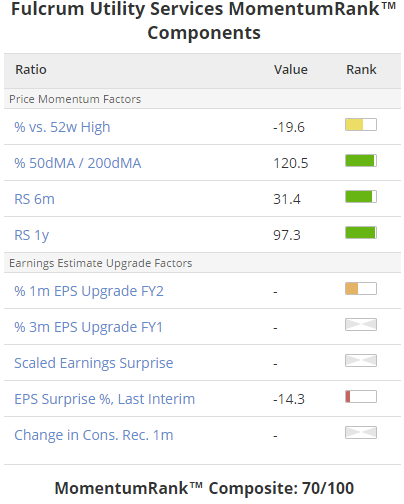
Price momentum factors are strong. The 50-day moving average is 120% of the 200-day average and the stock has strong relative strength.
The outlook for earnings is also relatively positive, with the caveat that Fulcrum is only covered by its house broker. Earnings per share are expected to rise by about 14% both this year and in 2017/18. At a price of 37p, this gives the shares a forecast P/E of 12, falling to 10.7 next year. This valuation also means that the stock meets my criteria for a PEG of less than 1.2.
Interestingly, Fulcrum qualifies for the Price Momentum guru screen. This has been a strong performer, with annualised gains of 14.9% since its inception.
Should I add Fulcrum to the portfolio?
I’ve flagged up potential quality concerns with Fulcrum, but I also believe there’s a good chance that these have an innocent explanation. Fulcrum may be a reasonably priced growth business.
However, the reality is that I wouldn’t be happy investing in this stock without understanding Fulcrum’s accounting policies in more detail. I also think the group’s dependency on construction activity means it lacks the defensive qualities I’m looking for.
Overall, this review of Fulcrum supports my view that while low StockRank companies can be attractive investments, the risks of an upset tend to be higher.
On balance, I won’t be adding Fulcrum to the SIF portfolio.
Disclaimer
This is not financial advice. Our content is intended to be used and must be used for information and education purposes only. Please read our disclaimer and terms and conditions to understand our obligations.

8 comments
Well I bought these at 8p and so am overjoyed with how they have done. A couple of points: I've noticed that Stockopedia really doesn't work on recovery stocks. The balance sheet is fine as they generally don't need much working capital given customers have to pay a 30% or so cash deposit on day 1. They are not really what you would call a construction company play. They are an infrastructure provider in the energy sector and are now moving into meter ownership to supplement the pipeline assets that they already own. The turnaround took many years, but the pivotal point was bringing their workforce back in house which has been a tremendous success. Oh and they are a market leader in the gas connections business, formerly being part of National Grid and Transco.
I see £FRCM SR is now 82 and the share price is 51p.
Just brought a small Fulcrum Utility Services (LON:FCRM) holding, because I like the Interim report Stockrank upgrades and its medium term growth potential. My buy notes today....
SR up +32 to 82, Q up +26 to 60 and QM up +25 to 87. Modest PER and PEG. Great return numbers. Broker target +20%. New Divi policy. 50% repeat customers. Miton Microcap Fund (Gervais Williams) No 1 holding. Confident growth outlook. As ever please DYOR - Ian
By the way agree with Somero , looks like great company . Pound dollar situation can only help
I wouldn't touch fulcrum with a barge pole having been in the construction industry
Andrew,
Interesting... Are you able to say more?
Regards, Roland
Found them inefficient , not sure if they sub contract but quality of work force questionable
Which companies would you consider touching with a bargepole?