Stock in Focus: Why I’m holding onto Next

There are no new stocks to add to the SIF portfolio this week. So I’m going to take a look at the numbers behind a stock that’s grabbed a lot of headlines recently. It’s one that also features in my own portfolio.
The market has become increasingly divided over the investment case for fashion retailer Next. Speaking personally, I bought shares during the first half of this year, at prices between £38 and £42.
As the year rolled on, this looked like a smart move. Next’s cash generation has remained robust, resulting in an expected yield on cost for me of about 8% this year. The firm’s profit guidance has also gradually firmed up, leaving the stock looking affordable on around 11 times earnings.
At the same time, costs appear to be under control and the group looked well positioned to take advantage of falling rents. My thinking was that performance wouldn’t have to improve by much in order to trigger a decent re-rating.
The jury’s out
I started to develop niggling doubts after the firm’s interim results were published. One reason for this was that it became more obvious that the group’s retail business may end up in a state of managed decline that could last years. Group profit and cash flow would remain positive, but might never increase.
My second concern was that I noticed an unexplained change in the information provided in firm’s financial reporting. Over the years, I’ve come to regard this as a useful warning flag. Such changes are usually the result of a considered decision by senior management.
For example, by changing the data that are reported, adverse trends can sometimes be disguised or presented in a more positive light.
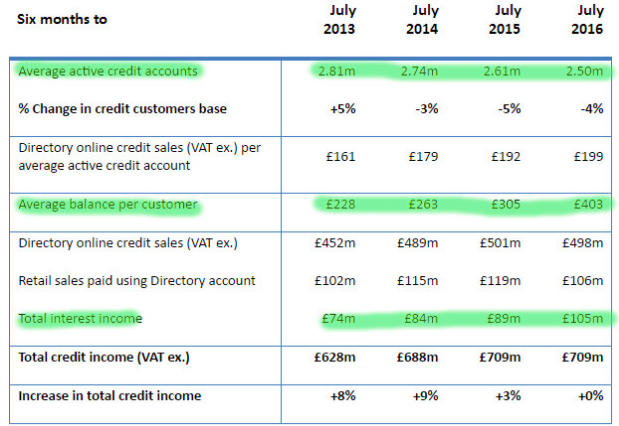
What I noticed with Next is that the firm appears to have stopped breaking out the financial details of its Directory credit operations.
I won’t discuss this at length, as I added a comment explaining what I’d found to Paul Scott’s coverage of the 1 Nov trading statement. But in short, the company used to include a breakdown of Directory financials, showing how much Directory profit was derived from interest payments, rather than sales. The last time this was included was in the 2016/17 interims, shown below:
I haven’t sold any Next shares yet. But I have to confess that my conviction is wavering.
The financial numbers still look good to me, but the company’s ability to eventually return to growth is a concern. If the current outlook is as good as it gets, then the shares might already be fully priced.
To try and shed some fresh light on this, I decided to take a closer look at how the stock is ranked by Stockopedia’s algorithms.
A super stock
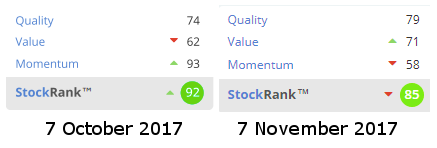
Next’s StockRank of Super Stock has remained intact following last week’s sell off. But the shares’ StockRank has taken a hit, falling from 92 at the start of October to 85 today.
What’s happened is essentially a swap. Value has improved, but momentum has fallen. Whether this appeals to you will depend on your investment style:
As someone with a preference for value and contrarian stocks, I’m reasonably comfortable with this. It’s interesting to note that Next also still qualifies for three Stockopedia screens, including the Richard Beddard Nifty Thrifty screen. This quality-value screen has delivered an annualised return of 18.4% since its inception.
You may be wondering whether Next qualifies for my own Stock in Focus screen. It doesn’t, essentially because both earnings and margins are falling at the moment. Rising earnings are a key requirement for SIF, which has more stringent demands for momentum than some of my personal stock picks.
Retail value?
Next’s ValueRank certainly contains some comforting ratios for value investors:
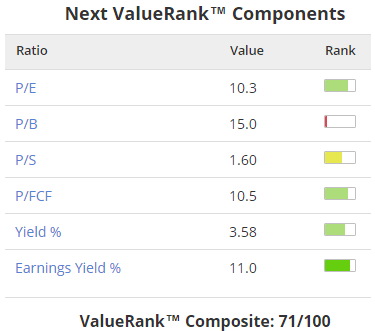
Regular readers will know that I particularly favour earnings yield (EBIT/EV) as a measure of value. This is because of the way it combines valuation and profitability in a single measure, while also neutralising the effect of different capital structures. In other words, the impact of debt on equity returns is factored in to the yield.
The minimum earnings yield required to pass my SIF screen is 8%. Next’s earnings yield of 11% is high by any standards, and is a useful reminder of just how profitable this business has been for many years.
This impressive yield is supported by the firm’s free cash flow and after-tax earnings. A trailing P/E of 10.3 and a price/free cash flow ratio of 10.5 are not only perfectly matched, but also imply an after-tax yield of 9.5%. That’s pretty good, in my view.
Falling profits hit Quality
Next’s rising ValueRank is complemented by a QualityRank of 79. As you can see, the firm scores very highly in terms of franchise factors. Essentially, these represent profitability and cash generation:
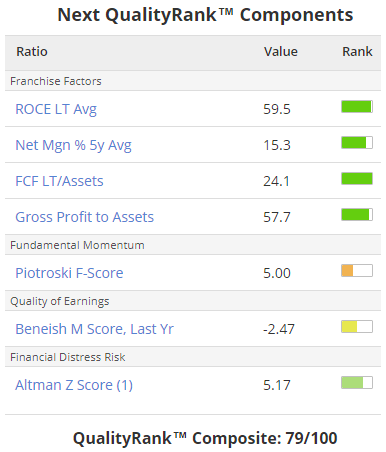
Where the company scores less well is on fundamental momentum, shown by a Piotroski F-Score of five out of nine. This is one of the reasons why Next doesn’t qualify for the SIF screen, which requires an F-Score of at least six.
There’s a good reason for this. The F-Score is designed to highlight good, improving businesses. Next may be good, but it’s not improving, at least not in the conventional sense of sustainable growth.
So do we need to be concerned? Next’s F-Score results aren’t as bad as they might seem. The main takeaway is a modest reduction in profitability. That’s something we already know about. The QualityRank doesn’t highlight any other particular concerns, so what we need to know is whether the outlook seems likely to improve at all.
Uncertain momentum
Next’s MomentumRank has dropped from 93 to 58 over the last month. That’s not very encouraging, but is it a reason to sell? I’m not sure.
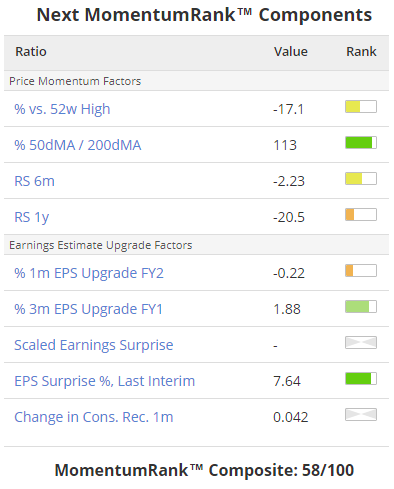
It’s a pretty mixed bag. Starting at the top, we can see that last week’s 10% slide has left the stock trading well below its 52 week high. But a second measure of price momentum, the ratio of the 50-day and 200-day moving averages, is still strongly positive.
It’s also worth noting that while six-month and 1-year relative strength are negative, the stock is now slightly oversold on the RSI index. Over the last year, the stock has performed strongly after falling to oversold levels (highlighted below):
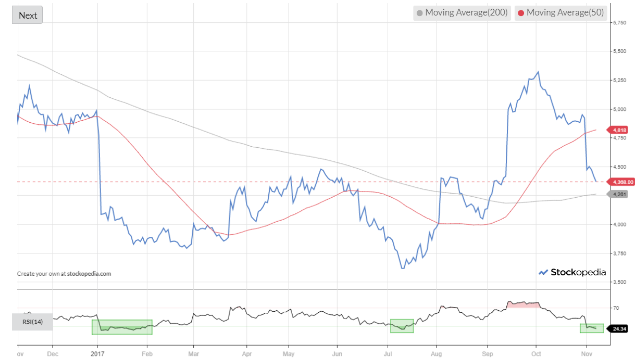
I think the price momentum picture is quite evenly balanced. The current period of weakness could easily be reversed.
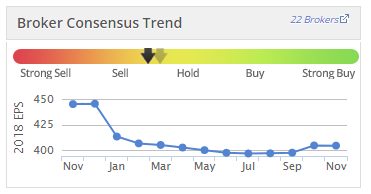
Earnings momentum is less clear. Although the last interim results were ahead of expectations, according to Stockopedia data, broker upgrades have been trimmed after last week. The consensus view is slightly stronger than it was three months ago, but well below the levels seen at the start of the year:
My decision
I’m going to hold onto my Next stock for the time, being on the basis of the group’s strong value and quality credentials. But I have to admit my conviction levels are lower than they were, so this one will remain under review.
Disclosure: Roland owns shares of Next.
Disclaimer
This is not financial advice. Our content is intended to be used and must be used for information and education purposes only. Please read our disclaimer and terms and conditions to understand our obligations.

3 comments
It is interesting that £NEXT have started buying their own shares again. Previously they have explained that they stopped doing this in 2017 to return cash to shareholders in uncertain times and also (further back in time) that buying their own shares makes sense when they expect to achieve a >8% return from doing so (since it is an almost certain gain for shareholders) vs investing and chasing growth.
From this I conclude they are more comfortable with the future, probably now that Directory is progressing well again. Directory including finance income is already the major profit earner and on current trends this will be significantly true in 2-3 years on just online sales alone. (I would expect net Retail space growth to slow and ultimately reverse but only slowly as they get to open more big stores at low rents as others vacate and they slowly close the tail of likely smaller stores; similarly mgt expect credit sales to drop as a share of Directory)
I therefore expect in time the market to re-rate Next up to reflect an established profitable business with a secondary supporting lines in retail stores & credit financing.
In the meantime, the 4% basic dividend is almost guaranteed and another 4% from special divis and/or buyback looks likely. I don't expect a huge return but am confident of say a relatively steady 10% TSR over a 3 year period. That's good enough for me so I remain a happy holder and will buy more if, as I expect and hope, it drops back to <4000p in the next 6 months on Brexit/consumer hardship fears.
All of the comments you have made about this stock, would suggest a strong sell.
It seems that you are going against all of your nomal logic and for some reason reluctant to sell, possible a big gamble. I think its watch this space tlme.
Regards
Melvyn
Hi Mervyn,
Thanks for your (perceptive!) comment. I have an uncomfortable feeling you are correct.
I may yet sell before the year is out. I haven't decided yet. The only reason I've held on to Next (LON:NXT) this far is because of management's track record of accurate and sometimes overcautious guidance.
The group's prodigious cash generation also attracts me, but as I've written elsewhere, if this is as good as it gets, then in my view the current valuation may be about right.
The jury is still out, for sure.
Regards,
Roland
Disclosure: At the time of writing this comment, I own shares of Next.