Stock in Focus: Will Games Workshop prove me wrong?

What did I learn from the 2015 success of rules-based portfolios such as Ed Croft’s original NAPS portfolio (+43%), grindertrader’s StockRanks portfolio (+38%) and gundroos’ rules-based portfolio (+31%)?
The big lesson was perhaps that to make more money, I may need to rely more heavily on decades of statistical evidence about what works in investing -- and what doesn’t.
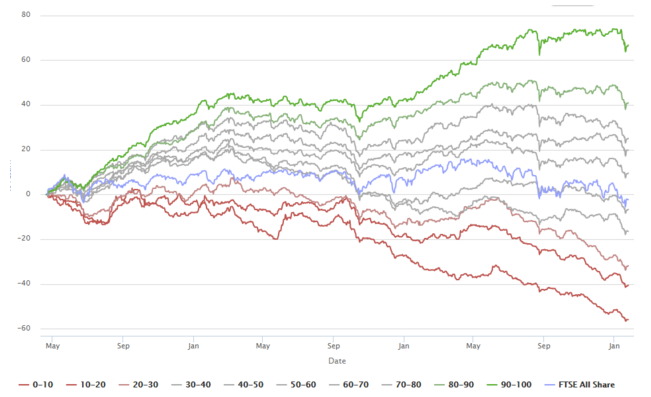
The same sets of rules may perform badly this year. But in its first 2.5 years, the results from the StockRanks system have backed academic evidence that stocks which demonstrate value, quality and momentum tend to outperform.
This chart shows the performance of the StockRanks since their launch in 2013:
A test of character
In this vein, I’ve decided to look at a company this week which boasts a StockRank of 98 but about which I have serious misgivings.
If you’re not familiar with this business, Games Workshop sells high quality, expensive miniature models to collectors. They then build and paint them, and in some cases use them to play complex war games such as Warhammer.
I was never interested as a teenager and from my detached viewpoint, I’m amazed this business has survived so far into the internet age. I cannot imagine how it can have a long-term future. Yet I may be wrong. I’m not a customer so I don’t understand the appeal. Specialist niche businesses can sometimes be successful investments, thanks to their loyal customer base and lack of competition.
Quit jumping to conclusions
With a StockRank of 98, Games Workshop was only a whisker away from being chosen as a consumer cyclical stock for Ed’s 2016 NAPS portfolio.
Games Workshop also qualifies for four of Stockopedia’s Guru Screens. Of Stockopedia’s universe of 2,717 UK stocks, only 21 qualify for more than four screens.
Games Workshop reported sales of £119m last year and a net profit of £12m. Free cash flow per share exceeded earnings per share and provided backing for a generous dividend. The group’s operating margin has averaged 13% over the last six years, and is fairly stable.
All of which suggests that perhaps I should focus on Games Workshop’s numbers, and stop trying to predict the future?
Is it good value?
Games Workshop’s ValueRank of 77 suggests few serious problems in the value department. The stock’s historic numbers seem to confirm this.
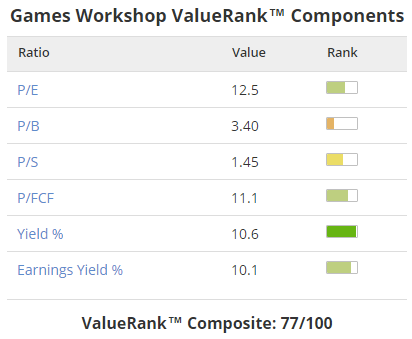
A trailing P/E of 12.5 and a price/free cash flow ratio of 11.1 seem acceptable, if not seriously cheap. Last year’s 56p total dividend gives a whopping trailing yield of 10.6%. While a lower payout is expected this year, this does suggest that Games Workshop’s management is committed to shareholder returns.
Games Workshop’s price/book ratio of 3.4 is relatively high, but a high P/B is not unusual in businesses whose main asset is intellectual property. Ultimately, I wouldn’t read too much into the firm’s book value, beyond its net tangible asset value of £39.2m. The value of Games Workshop’s intellectual property and inventories could fall dramatically in the event of a structural decline in sales.
Quality rules
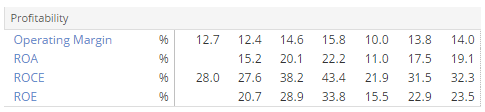
Games Workshop’s QualityRank of 99 suggests a state of near perfection! On paper this is a highly profitable and financially sound business:
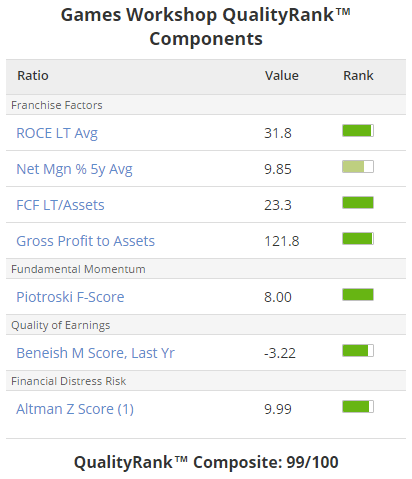
Although return on capital employed has fluctuated between 21.9% and 43.4% over the last six years, there doesn’t seem to be a particular pattern of decline -- it’s just variable:
A particular strength is free cash flow, which has exceeded earnings per share every year since at least 2010, based on Stockopedia’s data.
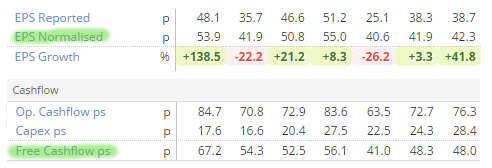
This really is outstanding and suggests to me that Games Workshop’s franchise remains quite strong.
This business appears to attract customers with a strong collecting habit. As the firm’s products can only be bought from Games Workshop’s global network of 4,000 shops and its website, customers are tied into future purchases.
To ensure customers remain keep buying, Games Workshop introduces a regular stream of new models. New designs are released “almost every week”, according to the firm’s website. This ensures that “no collection is ever complete” and caters to the apparently compulsive buying habits of some collectors.
Isn’t momentum slowing?
The market was not impressed with Games Workshop’s interim results in January. The shares fell by around 9% after the firm warned that pre-tax profit for the year to 29 May “is unlikely to exceed £16m”.
Broker coverage of Games Workshop is limited to the firm’s house broker, but this set of results appears to have triggered a 2.5p per share reduction in forecast earnings for the year:
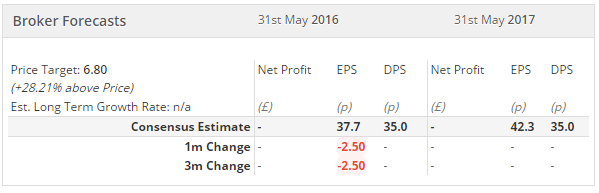
Last year’s adjusted earnings were higher, at 42.3p per share, but this year’s expected decline appears to be the result of foreign exchange differences rather than falling sales.
According to the interim results, operating profit on a constant currency basis rose by £0.1m to £5.6m during the first half. Currency effects meant that the reported operating profit fell by £0.8m to £4.7m, but at least this does suggest that underlying sales and margins are stable.
However, as Paul Scott flagged up in December, it’s clear that a lack of growth is the big risk here. Profits are expected to be around 25% lower than for the current year than at their recent peak in 2013.
The group’s management recognise that growth is a challenge and say that the firm’s strategy is focused on achieving long-term growth. Over the last few years, chief executive Kevin Rountree has led a ruthless charge to cut costs. This has resulted in the majority of the firm’s shops becoming one-person operations. This has apparently improved the profitability of the shops despite causing a drop in customer numbers.
If you read commentary on these changes elsewhere on Stockopedia and the internet, you’ll find many investors (and some customers) who are critical of the changes. There are also concerns that current sales and profits will be hard to maintain. A good example of the bear view is this comment from MrContrarian, on one of Paul Scott’s recent reports.
The verdict
Games Workshop is a quirky niche business which targets a very narrow but lucrative class of customers. My instincts suggest that the firm’s business will decline, but the weight of the evidence suggests it may outperform the market over time. A forecast 6.6% dividend yield is certainly tempting.
As a purely mechanical selection, as part of a diversified portfolio, Games Workshop appears to make sense. But that’s as far as I will go -- this is very much a case of DYOR, or perhaps I should say Define Your Own Rules for investing!
Disclaimer
This is not financial advice. Our content is intended to be used and must be used for information and education purposes only. Please read our disclaimer and terms and conditions to understand our obligations.

4 comments
They have a really nice thing going with their customer base at the moment. They are getting older.
So those kids who used to spend every weekend at the store but maybe spend £300 a year are now adults with their own cash and are spending £3000 per year.
The question is, are they engaging the next generation in the same way they engaged the last generation?
They have a fundamental issue with the product, it is too inaccessible for a generation with a short attention span. For those of you who don't know the product, they are base plastic figures, you have to paint them (weeks of work) and the game is complex but very fun.
Do they upset the big spenders to make it accessible (ie cut the painting out)? Will 3d printing hurt them? Are they engaging enough new players? Many unknowns.
They are in a Goldilocks zone at the moment. They need to figure out how to stay in that sweet spot. If you want a company that has been doing great work in this industry, look at Hasbro. They have every age range covered, and are mobilising the big spending adults with products via Wizards of the Coast.
The key question with GAW is whether hefty annual price increases are hiding an irreversible trend in falling volumes.
Maybe. But rather than just the numbers, I would suggest going back and reading management's statements in the Annual Reports. Tom Kirby explains the business very well and has been answering the question about competition from computer games for a couple of decades.
Some people think about "growth" but in my experience I have made far more money in profitable businesses that struggle to grow, than businesses that grow but at destructively low marginal returns on capital.
Hi Bruce,
Thanks for your comment, I think we agree, in a roundabout way!
The point I was hoping to make is that as investors, we may do ourselves a service if we ignore any subjective thoughts we have about a business and focus on proven statistical indicators, such as a solid balance sheet, excellent free cash flow and generous yield.
There is a temptation to ignore these strong buying signals because we don't believe in the story. I believe this habit may well erode investment returns, rather than improve them.
In the case of Games Workshop (LON:GAW), the forecast yield of 6.6% means that share price gains only need to be minimal to beat the long-term average annual total return from equities of 8-9%.
Hence I agree with you -- buying profitable stocks like this without worrying too much about a growth story can work well, even if it feels uncomfortable for some investors.
Regards,
Roland