Stock Pitch - Safestore (LON:SAFE)

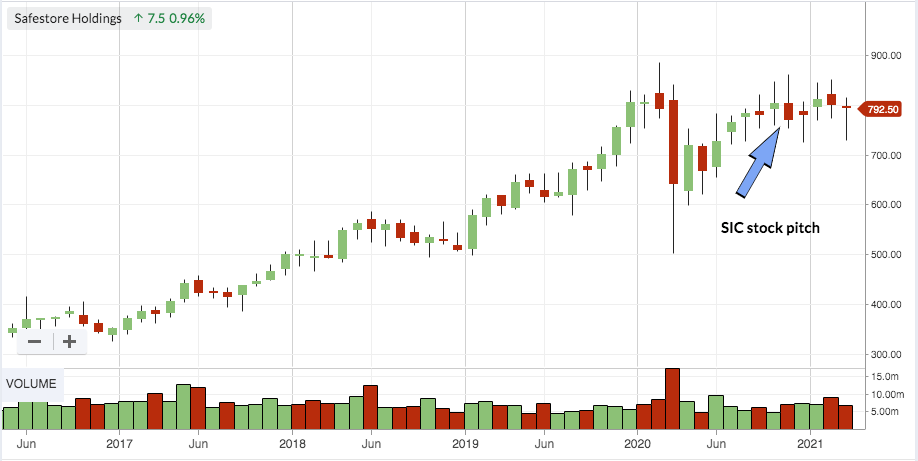
Safestore (LON:SAFE) was pitched to the Stockopedia Investment Club on 2 March 2021.
With a cautionary eye on the club's growing exposure to cyclical small-caps, Safestore was pitched as a mid-cap play that's perhaps not being given a fair shout by the market.
Safestore is a Real Estate Investment Trust with a portfolio of properties that it develops and rents out as multiple storage units to the public and businesses. Its share price had been strong before Covid, but it was hit hard by the crisis. With a brighter economic outlook on the horizon, could this be a moment to buy a stake in a group with a solid record of organic and acquisitive growth?
Summary
Bull points: Apparently good growth potential in fragmented markets, especially in the UK and France; a solid record of buying and developing properties profitably; growth potential without the small-cap/cyclical growth risk we're exposed to elsewhere in the portfolio; cash income.
Bear points: REITs are a rather specialist topic, which can make them hard to understand and value; the market doesn't get excited about stocks like this; Safestore has been affected by Covid restrictions.
Profile
Safestore is a self storage business. It acquires large buildings and rents out space in them to people and businesses that want to store things. Some properties are owned freehold, others are on long leases. Its asset value/ income is derived from the upward valuation of owned property as well as its rental income.
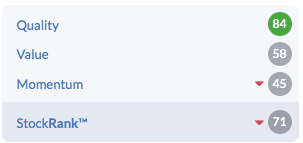
Safestore has a market cap of £1.72 billion, an enterprise value of £2.24 billion and is quoted on the FTSE 250 under Financials/ REITs*.* EMS is 3K. This is a Balanced, Mid Cap, Super Stock with a current StockRank of 71.
Safestore is a Real Estate Investment Trust - but what does that mean?
REITS are a tax-efficient structure for companies that make money as property rental businesses. It means they can benefit from exemptions from UK corporation tax on profits.
As part of this structure, REITs are compelled to pay 90% of tax-exempt income profits (not capital gains) out to shareholders as dividends. Often, this manifests in quite high yields from REITs. But SAFE only has a forecast yield of 2.5% because it's redirecting a lot of that income back into growth.
REITS like SAFE are often geared (with net debt increasing as the portfolio increases) to enhance returns. In FY20, SAFE had a loan-to-value ratio at 29% and interest cover ratio at 9.0x (31 October 2019: 8.9x). It had unused borrowings of £148 million and no borrowings to refinance before June 2023.
REITs are sometimes analysed using a 'cap' - which takes the operating income of a property and then divides it by the property valuation. So expect variations in some of these numbers over time that you might not usually see with a regular business.
- More on REITs here (external link)
Business & Model
The Safestore business is quite simple. It focuses on major and wealthier metropolitan areas/cities. More recently, it has been expanding abroad, both on its own and in partnership with the PE company, Carlyle. It also has a small ancillary business in selling things like insurance, boxes and tape and even has a deal with the hire company, Europcar.

Safestore is expanding its portfolio all the time. At 31st January 2021, it had:
- 159 stores (buildings it rents space in)
- 127 of the 159 were wholly owned (including 71 in London and Southeast England, with the rest in key UK cities)
- 28 wholly owned stores in and around Paris, France
- 4 stores in Barcelona, Spain
- 9 stores in the Netherlands and Belgium (as part of a JV with PE group Carlyle)
- A maximum lettable area of 6.871 million sq ft (excluding expansion pipeline stores and the Carlyle JV) of which 5.506 million sq ft was occupied
Main objectives:
- Optimise trading (by attempting to fill 1.4m square ft of un-let space)
- Ensure gearing stays cheap
- Expand in existing and new territories
Recent trading
In the year to 31 October 2020, Safestore's group revenue increased by 6.9% to £162.3 million, with underlying EBITDA up 7.3% to £93.9 million. The EBITDA combined with an increased gain on investment properties of £126.5m (up from £84.2m in 2019), resulted in statutory operating profit of £212.2m (FY2019: £163.7m) (operating profit 5-year CAGR of 9.6%).
There was a 5.8% increase in the final dividend to 12.7 pence, taking the total for the year to 18.6 pence.
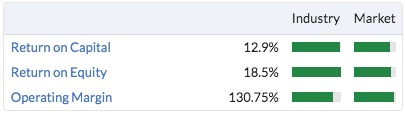
Note: Remembering the REIT status, operating profit increased by £48.5m to £212.2m principally as a result of an increase in the gain on investment properties of £42.3m to £126.5m (FY2019: £84.2m), as well as an increase of £6.4m or 7.3% in underlying EBITDA as a result of stronger trading performance.) As a result, the company's very high margins (see graphic) are flattered by the operating profit.
In its latest update, Safestore said that Q1 revenue was up 11.3% to £44.4 million. Like-for-like occupancy across the portfolio was up 6.9ppts at 80.6% (2020: 73.7%).
Frederic Vecchioli, chief executive, said: "Our priority, and largest opportunity, remains the significant upside from filling the 1.4m square feet of fully invested currently unlet space in our UK, Paris and Barcelona markets... The first quarter's trading performance has provided us with a strong base for the rest of the financial year and, if the current momentum continues, we would anticipate that the business delivers Adjusted Diluted EPRA Earnings per Share for 2020/21 towards the top of the range of analysts' forecasts."
History & Growth
Safestore was founded in the UK in 1998. It bought a French company - Une Pièce en Plus - in 2004, which was started by the current CEO, Frederic Vecchioli. It floated in 2007 and entered the FTSE 250 in 2015.
- It has got 75,000 personal and business customers
- Since 2015, revenues has grown at a CAGR of 9.1%
- Profitability has also been on a growth trend. 2019 saw a contraction - seems to be down to lower gains on the value of the property portfolio affecting operating income.
London and Paris are two conurbations (wealthy and densely populated) that work particularly well for Safestore. But the group is opening sites all over the place in the UK.
In addition to the UK / France business, it has a JV with Carlyle that includes stores in the Netherlands, Belgium and Spain. These are "interesting long-term growth opportunities" but the investment in the three businesses currently represents less than 2% of group assets.
Market & Competition
There appear to be two interesting factors that are influencing growth in this market:
- One is general growing awareness (in the UK and Europe) of the existence (and advantages of using) self-storage facilities. Self storage in the UK and France is way behind the kind of density of supply that you find in places like the US and Australia. To match the US supply density, the UK would need another 17,000 stores, compared to the ~1,400 that there are here.
Industry stats show that 52% of the UK population know little or nothing about self storage. The first time they ever look into it they'll likely do an online search for "self storage near me". That means this business needs to be extremely good at online search engine optimisation (SEO). As a result, SAFE has doubled-down on investment in internet marketing, and this has paid off during Covid.
Over the past year, online enquiries rose to 88% of enquiries in the UK, up from 83%. Approximately 60% of online enquiries originate from a mobile device (excluding tablets), compared to c.55% last year. So it's investing heavily here.
- The second is the economic cycle: most people and businesses need storage for different reasons at different times - and that's why this is quite a stable, dependable business. The need for self-storage is often driven by life events: births, marriages, bereavements, divorces or just moving house. Safestore reckons that house-moving accounts for 10-15% of its new lets.
This market is very fragmented. This SSA 2020 report says that 1,900 self storage facilities exist in the UK, including around 563 container-based operations. Safestore is the industry leader by number of stores with 126 wholly owned sites followed by:
- Big Yellow with 75 wholly owned stores (103 including Armadillo) (see StockRanks below)
- Access with 58 stores
- Lok’n Store with 34 stores (see StockRanks below)
- Shurgard with 31 stores
- Storage King with 28 stores
In aggregate, the top ten leading operators account for 23% of the UK store portfolio - so there is quite a lot of potential scope for consolidation here.
Valuation
As a REIT, Safestore's valuation is determined by the value of its estate and the income it makes from it. Because it has been growing reasonably quickly, earnings and net asset value of the portfolio are both important. Following its FY20 results, one broker indicated that the stock was currently valued ahead of its long-term average, but nonetheless the stock does trade at a discount to smaller rivals.
At 31 October 2020, the total value of Safestore's property portfolio was £1,557.5 million (excluding investment properties under construction of £14.0 million and net of lease liabilities of £76.9m). That was versus a market cap at the time of £1.76 billion. So on a NAV basis it was trading at a premium of around 11% to NAV.
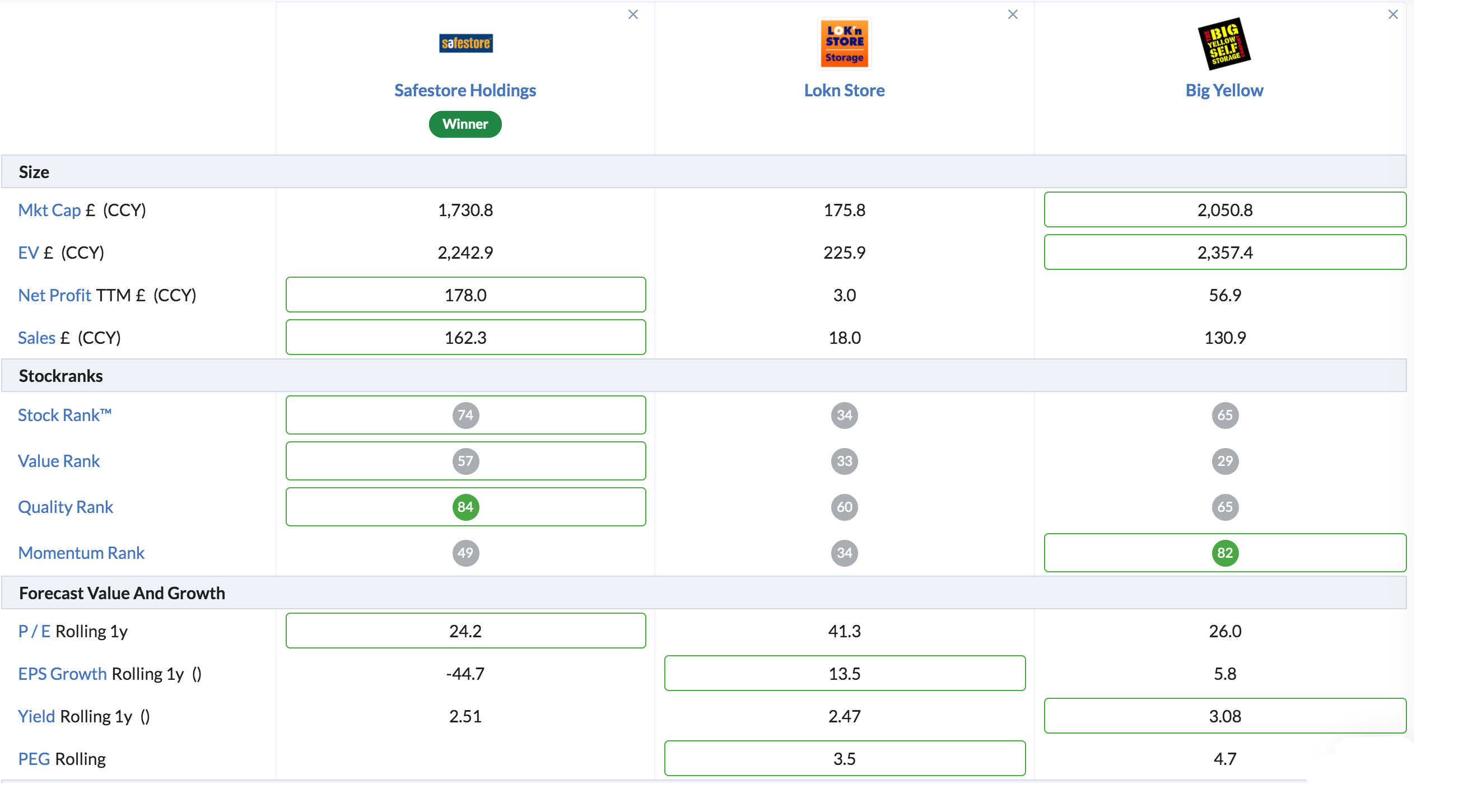
But Safestore's KPIs are all focused on earnings from its portfolio. On the earnings side, Safestore's forecast 12 month rolling PE ratio stands at 24.2x versus 26.0x for Big Yellow and 41.3x for Lok'n Store. It also has a superior (although relatively modest) Value Rank versus those two stocks.
Overall, Safestore scores best overall on a side-by-side comparison between the three stocks:
Summary
- Safestore offers strong growth potential in a fragmented market in UK and France (London and Paris especially)
- Driven by increasing consumer awareness, good handle on internet marketing and more 'life events' happening post-Covid
- Strong ambitions to keep growing and cement its leading position in the market
- Valuation is harder to assess than with a more normal (non-REIT) business
- It does have various debt facilities (revolving credit, bonds), although no need to refinance any of that before 2023
- Risk of unfamiliarity with REITs and how to properly value them
- Ongoing Covid risks could restrict its ability to let space
Sentiment
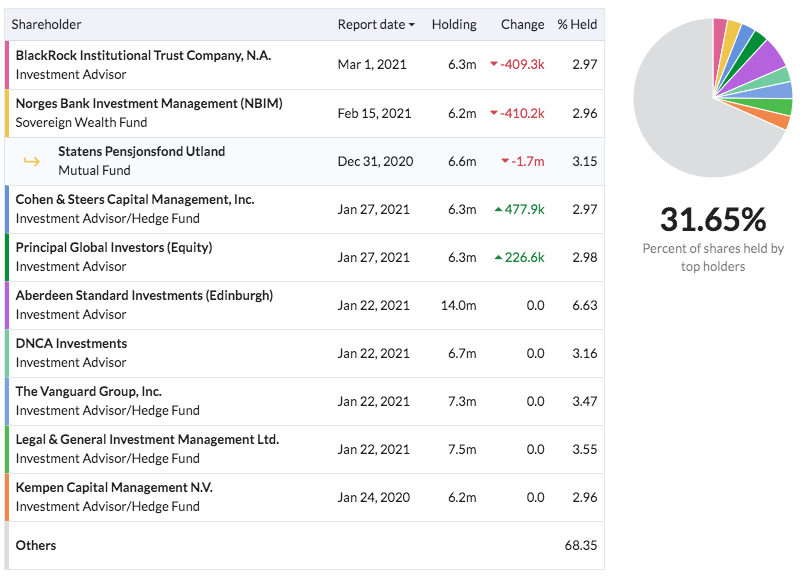
There has been a little bit of institutional selling in Q1 2021:
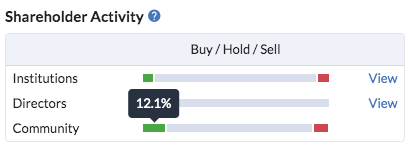
There is modest interest in the stock in the Stockopedia community:
Safestore beat broker expectations in its full year results (released 18 January), which triggered upgrades to the consensus earnings forecast.
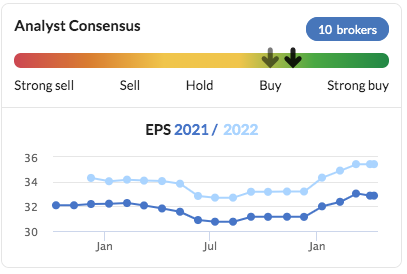
At the time, the broker Berenberg described the performance as "exceptional" given the conditions, and that the group had started 2021 "extremely strongly". It rated the stock a "hold" given ongoing Covid risks that might hamper growth and that it believed it was currently valued ahead of its long-term average.
Verdict
Safestore appears to be a well financed, stable mid-cap with an encouraging growth trajectory and promising ambitions. This could be a high quality compounder with a solid, simple business model that's benefiting from cheap borrowing and catering to growing demand that isn't cyclical. Whether it can offer the sort of strong upside or takeover potential we've experienced elsewhere in the portfolio remains to be seen. But as a counter-balance to some of the SIC's more speculative positions, it seems to be a solid option.
Overall, the SIC decided that Safestore would be a positive addition to the portfolio, so a stake was bought on 3 March.
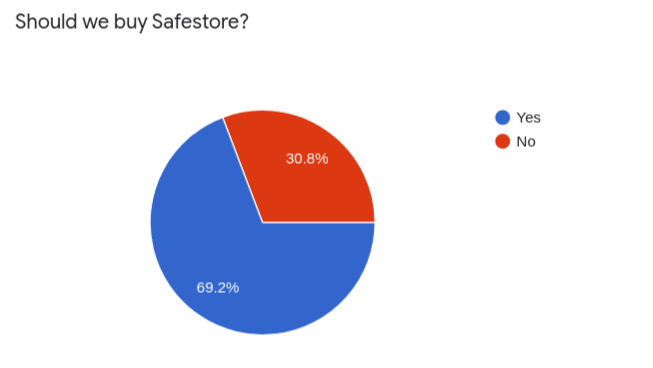
Does this this mid-cap self-storage group really offer meaningful upside for the SIC, or is there too much uncertainty in this sector?
Disclaimer
This is not financial advice. Our content is intended to be used and must be used for information and education purposes only. Please read our disclaimer and terms and conditions to understand our obligations.

8 comments
I’ve held this share for a number of years and it has been a good investment. The compelling factor for me is that modern housing is generally lacking in storage capacity. Homes often have no loft as such because rooms are already built into the roof. I can’t see the trend for pokey homes changing any time soon because the cost of new homes is such that people cannot afford homes with more space.
A TV programme called Storage Wars has been successful over the last few years and that has quite possibly publicised this as an option to people who never thought about it before.
I think that they were allowed to stay open during the first lockdown as being an essential service of sorts. But it is inevitable that the value of the property is potentially taking a hit in a downturn.
My one bugbear is that remuneration is way too high. The top people are paid as if they are running something much more complicated and much larger. I always make sure I vote against any remuneration related issues via the service provided by Interactive Investor.
Why is it that countries with the most space use the most storage?
I believe it boils down to affordability. I own $SAFE but for some of the reasons mentioned in the brilliant summary above, thanks Ben, but like most things, in the UK they just aren't good value for money.
Cheaper to throw/give away and replace than to store.
With lots of peeps moving out of pokey city flats into more spacious pads in the countryside I imagine demand for storage space will weaken in the short term.
Funny enough, nearly all of my chattels (except for my computers, headphones, road bike and a set of weights) are locked up in a Safestore at the moment whilst I'm homeless.
Its clean, its basic, its cheap, you don't get a light in your Dexter style kill room, but it solves your problems.
And they know how to get their monetisation out of their clients.
Does the group have a view on expected return %/exit price and/or timescale for this trade?
it was £7.88 on 3rd March
What was the price they bought in at?
Hi Fuzziebee,
The Club bought Safestore shares at 790.43p.