Strix: the Super Stock mid cap with a moat (and a 4% yield)

Strix (LON:KETL) might just be the best UK-based, world-leading niche designer and manufacturer you’ve never heard of.
This mid cap Industrials company is one of the key players in its core global market of kettle safety controls (which prevent kettles from overheating) and is busily expanding into all things related to water heating, temperature control, steam management and water filtration.
Strix continues to develop products and processes in additional large domestic appliance markets - two important examples being the launches of Aqua Optima water filters in 2003 and Tommee Tippee Perfect Prep in 2013.
The company is an important part of the domestic appliance value chain and is regularly consulted on matters by original equipment manufacturers (OEMs) and brand owners alike regarding areas where it is considered an expert.
Although operating and net profit growth have not been too exciting in recent years, the group has been busy investing in its products and operations. R&D spend has been going up and Strix sees a number of growth opportunities.

The group has committed to launching twelve new products across the appliance and water categories during 2020, as part of its “strategy for enhancing its core technologies to develop innovative and sustainable products”, and it is also looking for “strategically compelling acquisition opportunities” in this area.
Strix catches my eye for several reasons. It is a high quality operator and an established expert in the domestic appliance value chain, it has a dominant and entrenched market position backed up by patents and long term customer relationships, and it has a cash generative business model. Net debt is going down and dividends are going up. According to Stockopedia, Strix is a high QM, high VM Super Stock.
So, with its shares trading at just 12.2 times forecast earnings, is this our chance to get involved in a high quality, dividend paying UK manufacturer with an economic moat?
History and operations
Strix traces its roots as far back as 1951, when a man named Eric Taylor founded Castletown Thermostats. Taylor invented a revolutionary thermostat used during the 2nd World War to control heated flying suits worn by bomber crews at high altitude. This high-tech combat innovation then became, rather brilliantly, the foundation of the modern kettle control.

In 1981, Eric’s son, Dr John C Taylor, renamed the company “Strix” and built engineering and manufacturing facilities on the Isle of Man. Strix developed and patented key kettle safety control products, enabling it to gain market shares and establish itself as the leading global manufacturer in its field.
In 1989, Strix opened a Hong Kong office with a view to manufacturing in Asia, and in 2003 it opened its current manufacturing facility in Guangzhou, China. In 2005, AAC Capital acquired control of the group. Revenue growth increased and Strix produced its 1 billionth safety control in 2009. The group listed on AIM in August 2017. By November 2017 it had sold its 2 billionth control.
Operations
Strix has six operational sites: two in the Isle of Man, one in the UK, two in Hong Kong and one in Guangzhou, China. The latter is Strix’s largest manufacturing operation by some distance.
In the first quarter of 2019, Strix signed an Investment Agreement with the People’s Republic of China (PRC) government for a factory more than 2 times the size of its current premises, with 50 years right-of-use granted for the land.
The new facility will provide efficiency improvements, additional automation capability and an opportunity to in-source filtration products and processes. Capital expenditure for this new site will spike in FY20, but the efficiency improvements and increased automation it will unlock in future years will be important in driving future profitable growth.
Segments
Splitting out FY18 revenue shows just how important Strix’s core kettle products are to the company:
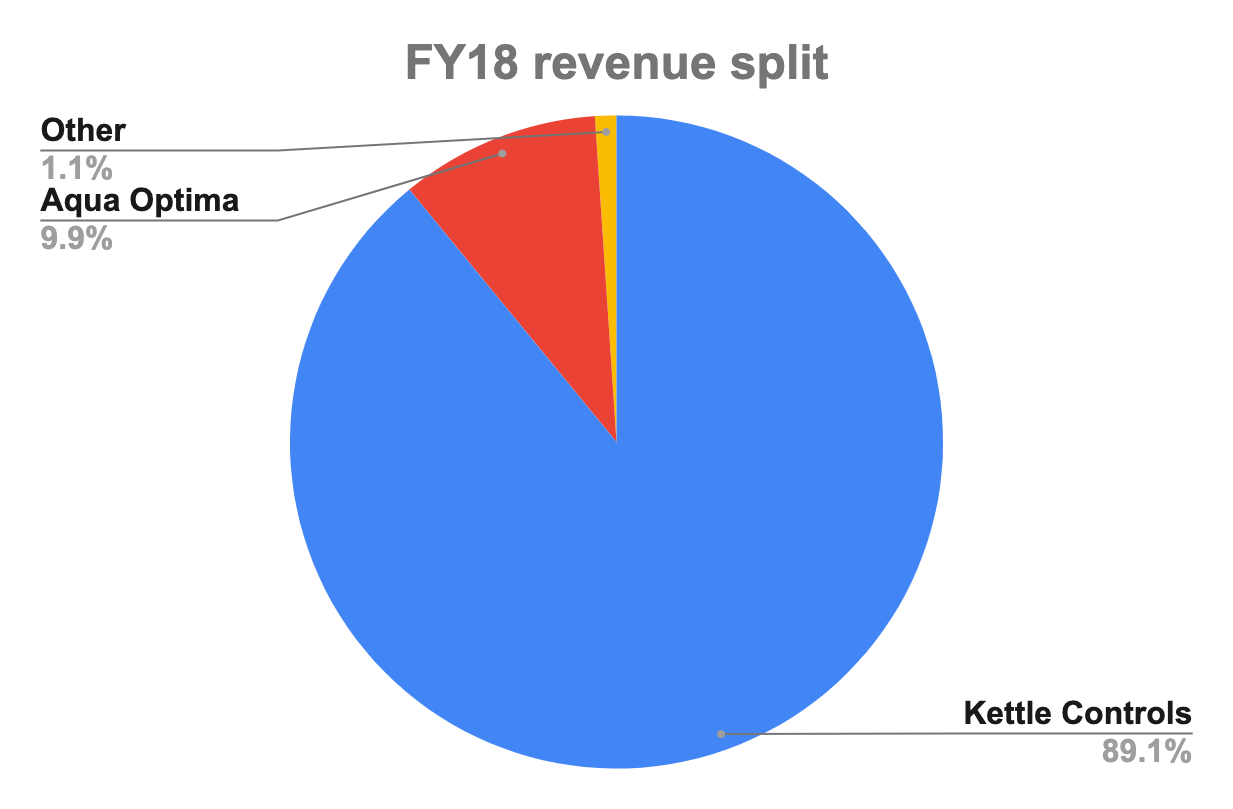
However, Strix sees opportunities across these segments. “Kettle Controls” can win share in Less Regulated Markets and the US. “Aqua Optima” is already growing quickly, and the recent purchase of HaloSource assets could step this up a level. Meanwhile, the group’s “Other” section is the beneficiary of millions of pounds per year in research and development spend - so hopefully we should see exciting new product development here in the mid to long term.
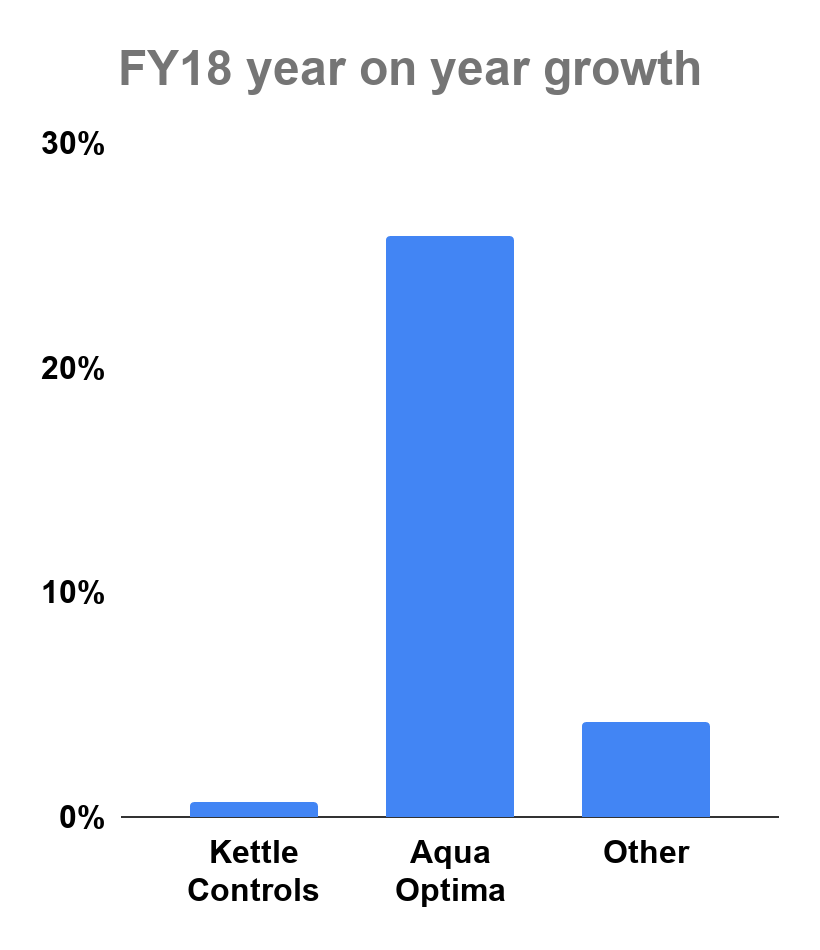
In the short term, the chart below suggests Aqua Optima / HaloSource is most likely to move the dial.
Kettle Control Product Development
FY18 Revenue: £83.514m
Year on year growth: 0.68%
Percentage of group revenue: 89.06%
Strix’s core kettle safety controls require precision engineering and a deep understanding of the properties of various materials. These high quality products are backed by intellectual property and patents that have been developed over more than three decades in the kettle market and which the group “rigorously” defends.
Strix’s flagship U9 series was launched in the first half of 2017 after extensive research and development. This next generation of the group’s core offering brought in many incremental performance improvements and confirms Strix’s “best-in-class” reputation with both OEMs and brand owners.
The U9 Series has been designed to provide enhanced economies of scale and with automated manufacturing and reduced tooling and inventory in mind. This is an important strategic point: the new control range will enable closer price competition with low cost competitors, which should allow Strix to increase volumes in Less Regulated Markets.
Aqua Optima
FY18 Revenue: £9.263m
Year on year growth: 25.91%
Percentage of group revenue: 9.88%
Aqua Optima is Strix’s evolving range of domestic water filtration products, including jugs, water filters and other related appliances. It is the fastest growing area of the group.
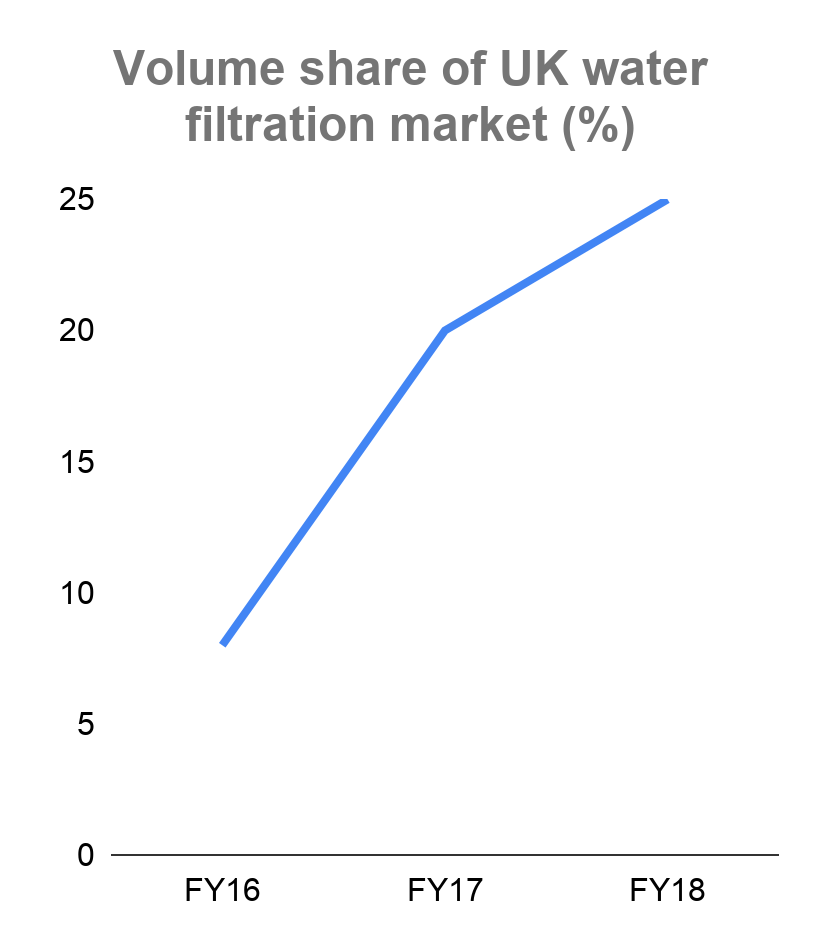
Strix’s expertise in water filtration is a good illustration of how the company’s research and development unlocks new products and markets. Originally, Strix commissioned an internal project to develop a superior filter kettle, but the resulting faster filter ended up inspiring a range of new products.
Aqua Optima has a long term contract to supply bespoke filters for the Tommee Tippee Perfect Prep baby formula appliance, which sterilises baby formula powder and prepares a bottle of the correct volume and temperature in under 2 minutes.
Over 600,000 Tommee Tippee Perfect Prep appliances and over 2 million filters have been sold since launch in 2013. Tommee Tippee Perfect Prep - a Strix designed concept - has substantial potential for international growth, including into China and Strix is working with the brand owner to realise this opportunity.
In March 2019, Strix acquired the Astrea product from HaloSource for $1.33m. This gives the group “access to world-class R&D knowledge and skills within the water filtration sector”, an increased presence in the promising US market and can also help in distributing water filtration products into China. The acquisition is expected to be earnings enhancing in the financial year to 31 December 2021.
The group’s FY19 pre-close trading update suggests this division is being reordered somewhat. Strix now talks of its “water category” which incorporates the Aqua Optima, Astrea and HaloPure brands. For the most recent financial year it expects to report c6% growth in this category “in the face of sustained market pressure”. Strix releases its annual report on 31 March - I’ll be interested to read a more detailed narrative of the year for this division.
Other products and technologies
FY18 Revenue: £0.992m
Year on year growth: 4.2%
Percentage of group revenue: 1.06%
“Other” is Strix’s portfolio of water, temperature and steam management technologies that have commercial potential.
It’s a bit of a mad scientist’s blue sky laboratory, but where the mad scientist is really into domestic appliances. Products include a patented steam boiler that reaches full temperature in seconds, an instant flow heater (for coffee machines and the like), and a patented “Turbo Toaster” that toasts bread in under 60 seconds.
The majority of Strix’s research and development is pumped into this department - and R&D has been going up both in absolute terms and as a percent of revenue in the past few years - so watch this space.
The emerging “Hot water on demand” category is particularly promising. This includes opportunities in coffee machines as well as innovative themes on water dispensing and kettle appliances utilising Strix’s Duality and Instant Flow technologies. Work done here can also translate into improvements for its larger Kettle Control and Water Filtration ranges.
Market and competition
The kettle value chain comprises component suppliers, OEMs, brands and retailers. Strix’s expertise is recognised in the fact that brands and retailers regularly seek its advice on product design and specification, including selection of an appropriate OEM.
This secures its market position and acts as a barrier to entry by ensuring that Strix’s specifications are embedded into the value chain.
The kettle control manufacturing market mainly comprises two different types of producer: high quality manufacturers who dominate supply in Regulated Markets, and low cost manufacturers who have a large share in Less Regulated Markets.
Regulated Markets:
Strix is a key supplier in Regulated Markets and has a market share of over 61 per cent.
Regulated Markets are those where high safety and intellectual property protection standards are in place, and are rigorously monitored and enforced. Think the UK, the USA and most of western Europe, as well as Japan, Australia and Turkey. In Regulated Markets Strix’s high quality products, intellectual property protection and effective market regulators limit competition from low quality players.
Less Regulated Markets:
Less Regulated Markets brands are less safety focussed and more price conscious. Here, Strix has a market share of approximately 18 per cent but the recent development and launch of new, lower cost products is designed to increase penetration and market share in these markets.
Strix has significant scale advantages over low cost producers, and has been working on leveraging its scale efficiencies and precision engineering capabilities to create a range of lower cost products that maintain high quality and safety standards. In doing so, the group is hopeful of capturing market share here.
China:
China is generally considered a Less Regulated Market, however consumer and brand preferences are rapidly shifting towards higher quality controls, which has seen Strix achieve a market share of around 50 per cent. The Chinese market remains price sensitive and unique, however.
It is also worth remembering that the vast majority of Strix’s customers - the OEMs - operate out of China. As such, Strix is potentially subject to the whims of the People’s Republic of China (PRC) government, and it notes “reliance on key customers” as its biggest risk.
Where is the growth
One glaring question concerning Strix is: given its status as a high quality, dividend paying Super Stock, why isn’t it growing?
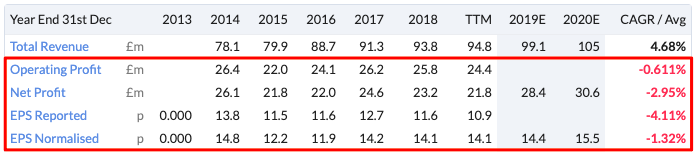
This is an important point. It is easy to get carried away with the obvious attractions of Strix but this lack of growth is staring us right in the face. Digging through the numbers we can see that, while operating profit has drifted, net cash generated from operations is in a more obvious uptrend.
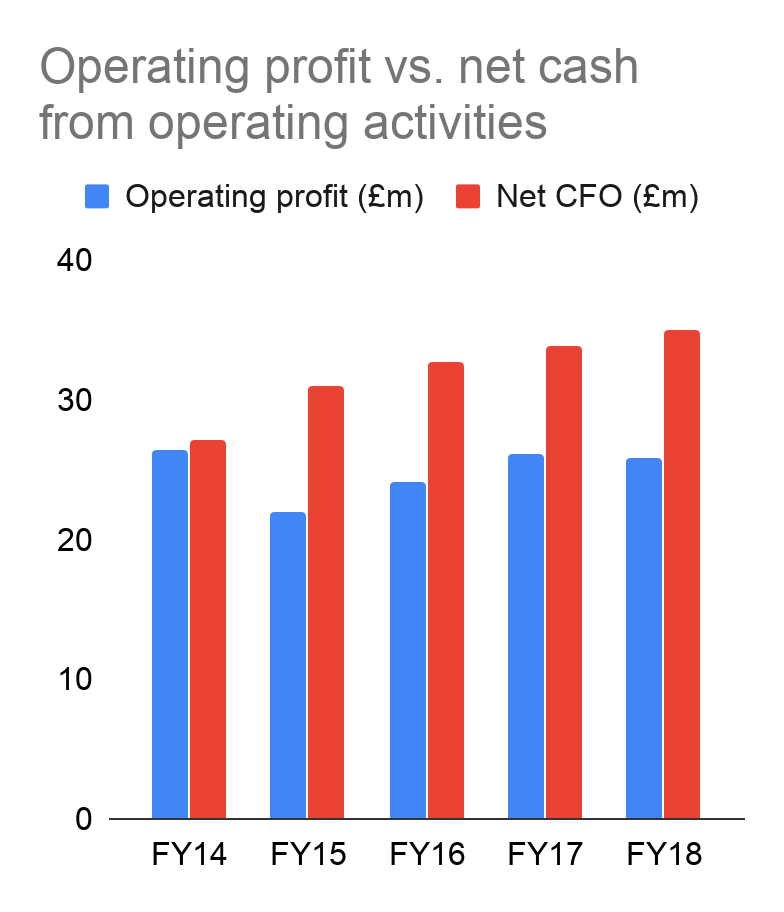
Meanwhile, Strix has kept busy since listing by reducing net debt and increasing its payments to shareholders.
Given Strix’s strong market position, R&D spend and catalogue of patents, I am willing to overlook stalling growth at the operating and net profit level for now. This should be monitored closely though. The group points to multiple growth opportunities it can and should take advantage of in the years ahead.
The group releases its annual report on 31 March 2020. It would be reassuring to see some progress on profits.
Risks
Strix’s strong competitive position and ability to take market share is helped by its catalogue of patents. The portfolio includes over 150 of them. These need to be defended and the company appears to be vigilant in this regard. What’s more, the group is cranking up R&D spend both in absolute and relative terms, which might lead to more patented designs in future.
On 1 April 2019, Strix appointed Marc Collinson as R&D Manager to lead the innovation function within Engineering in order to identify and develop technology for new, innovative products.
The Group has a number of key customer relationships. Strix management believe this is the biggest risk the company faces. The top ten customers contributed c.57% of the Group’s revenues in the financial year ended 31 December 2018 (2017: c.57%), with the largest customer making up c.18% (2017: c.19%) of the Group’s revenues. These figures have remained stable since Strix listed.
The Group currently manufactures the majority of its products at its main manufacturing facility in Guangzhou, China. If for any reason, including product mix changes, a capacity constraint is created, or should the operations at this site become disrupted, the Group’s ability to meet the demands of its customers could be affected.
Law and regulation applicable to the Group, particularly in the PRC, is complex. Inconsistent interpretations, implementation and enforcement of these laws and regulations is not uncommon. The distribution of the Group’s profits and dividends may be adversely affected if the Chinese Government imposes greater restriction on the ability of the RMB to be exchanged into foreign currencies.
Whilst the Group manages its input costs as far as possible, a significant change in the cost of certain raw materials, particularly silver and copper, if sustained for a prolonged period, could affect margins and profitability.
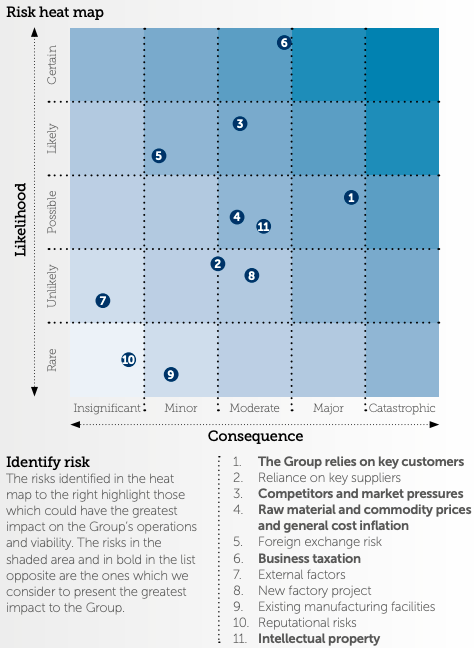
Strix ranks the risks it faces in this useful heat map (taken from the FY18 Annual Report):
Conclusion
Strix has obvious attractions. It is an innovative UK designer and manufacturer that dominates its niche. It is profitable and cash generative. It is a modestly valued mid cap dividend payer with scope for profitable growth. Every year, it invests millions of pounds into developing ingenious new domestic appliance innovations. What’s more, the Stockopedia algorithms love it.
The lack of growth in profits over the past five years is the fly in the ointment. Strix has a lot of exciting new products in the pipeline and multiple growth opportunities - I’d like to see if these are beginning to have any effect in the group’s upcoming FY19 annual report. The group has committed to twelve new product launches in 2020 and the new manufacturing facility should pave the way for growth in the years ahead.
In the meantime, it looks to me as though this is a reasonably safe, modestly valued, high quality company that pays a generous dividend to shareholders as they wait for growth initiatives to take effect.
Disclaimer
This is not financial advice. Our content is intended to be used and must be used for information and education purposes only. Please read our disclaimer and terms and conditions to understand our obligations.

34 comments
Strix is incorporated in the IoM and there it seems dividends can be paid if the company is deemed solvent.
I guess the negative reserves arose as a result of the company restructuring prior to its recent IPO.
Can someone please explain why the retained earnings figure is negative if they have been making profits. Dividends cannot be paid if -ve reserves.
Thank you for a really thorough article.
OK, I just saw the book value is negative. Must be a boat load of debt. So I infer all calculations with book value as input are simply denoted as n/a? Wouldn't negative book value contradict the idea of a "wide moat"?
David
No; the reasons for the debt are referenced in the comments above.
The debt hasn't arisen as a result of the company's operation, so I don't think you can read across that the debt subverts the notion of a moat here.
Interesting article, which I need to read again more thoroughly. Per references from Morning Star & other authors, one of the key metrics of a "wide moat" or "sustainable competitive advantage" is a high Return on Equity (e.g. over 17%). I notice that ROE is not available on the stock report page. This makes sense since the book value (denominator for ROE) is not provided. What is the reason for this lack of basic company data?
Return on Capital Employed, looks good however.
How do you derive a Value Rank which is supposed to include Price/Book Value?
Many thanks.
My only concern about Strix is the recent news of the rapidly spreading coronavirus in China, but i take note of the points raised in the above article.
Regards Edward
Very interesting article thanks. Taking a short term view, it's interesting that the share price has held up so well of late. Clearly, the operations in Guangzhou will be significantly impacted (HK to a lesser extent). My wife's family are originally from the two neighboring provinces Guanxi and Fujian and in both workers have had the New Year vacation period extended for at least two weeks, so I would be surprised if the facility in Guangzhou is not likewise impacted. I have heard the plan is for this to be increased, save as for core industries. Hopefully it'll all be resolved soon. No position.
“In March 2019, Strix acquired the Astrea product from HaloSource for $1.33m. This gives the group “access to world-class R&D knowledge and skills within the water filtration sector”, an increased presence in the promising US market and can also help in distributing water filtration products into China. The acquisition is expected to be earnings enhancing in the financial year to 31 December 2021.”
Halosource were a tiny failed company. One of the many failures of Woodford. It is highly unlikely that any of their technology was world class in any way. It is also highly unlikely that this provides significant increased presence or help in any market as Halosource were too small to provide that.
There's some information here on one of their products which suggests world class technology in filtration:
https://astreawater.com
Sorry SOF, but that’s their own publicity.
But let’s give them the benefit of the doubt and say it is better than other tech out there.
The fact remains that they didn’t sell enough of this when part of Halosource to keep Halosource afloat and so has little credibility in my view. I speak as someone who spent a long time working in industrial water technology.
Graham discussed this stock last week too. The point that stuck out for me in his analysis was regarding the extent of future life of the patents.
Does anyone have a view or any research in this area?
Was going to ask the same question
Great article, thanks. My Strix (LON:KETL) shares are up 42% and my largest holding. I hope I never have to sell them.
Very interesting, China's a bit of a worry at the moment though...Worth keeping an eye on I think
Excellent article Jack which concisely and accurately captures the strengths and weaknesses of £KETL.
I've been doing some analysis of my own here and it's clear that the PE owners ran the company as a total cash cow. So much cash was extracted that both R&D and maintenance capex were reduced below sustainable levels. At the point of IPO the PE company loaded as much debt as possible onto the company and ran off with that money too!
Despite this the business has made a good fist of paying down this debt and preparing for the future - principally by building a brand-new factory. This should reduce costs and make the business more profitable but it won't generate growth in and of itself. Instead new markets need to be accessed and perhaps water filtration will be the catalyst.
I do have a reasonable holding here and see Strix (LON:KETL) as a reasonably secure if unexciting investment. Probably more upside risk than downside hopefully.
Interesting, I suppose PE owners will be PE owners...
Thanks Damian, that's certainly the impression Strix (LON:KETL) I have come away with as well. I'd like to hear more from management when they release their annual report.
As other commenters have noted, a lot of its business does take place in China and there is even the Coronavirus to consider. If operations are ever severely disrupted, though, the company has a strong level of interest cover and should be able to ride out the storm.
From memory - the debt on the balance sheet was effectively a part of the sellers' consideration. On the plus side, the shares then floated at a lower price. Had the debt not been injected they would have sought a higher price at flotation.
I thought the important thing was that the debt was not there because of operational need.
political stability should be no 1 key in any investment making decision. Whilst the above is a well laid out and informative doc. The biggest red flag for me is the high dependency of the business ops. Being in China. I think this could be one factor holding back the growth of share price and note the momentum is on a downward track.
Thanks for write up. Would be interesting to have included a brief explanation of the fancy transaction(s) that happened on listing that led to a fundamental change (for the worse) in the balance sheet.
shipoffrogs also mentioned this... I'm sure I'll revisit Strix (LON:KETL) when its annual report comes out (at the end of March, I think) and I'll take another look at the admission doc then
Thanks. Seems like borrowed to buy back equity (with negative equity on balance sheet) - will also have a better look when I get a chance as is an interesting company.
What level of impact are we looking at from the coronavirus on this company, given it has facilities in guangdong?
Good article Jack - "The lack of growth in profits over the past five years is the fly in the ointment".
I asked them about this at Mello, and the company showed me their latest kettle which they hope will be a big success. Saves on energy costs, keeps some water hot at all times, and I wasn't allowed to take it home.
Maybe next time - if you don't ask you don't get...
The other aspect that Strix points out is that the use of kettles in certain markets (such as, surprisingly, the US and Italy) is low. Coffee and tea buffs prefer to make coffee and tea with water just below boiling point (depending on the type of tea or coffee) - and Strix machines can regulate the temperature to fit these requirements. A change of behaviour in these markets could offer tremendous growth.
To this I'd add boiling an egg - keep the temperature to no more than 80C and the yolk stays soft.
I'm a holder...
ST recommended strix a while back and convinced me with the growth prospects but the price never moved until 12 months later just after i sold. i find it a rather unspectacular share.
Great write up, thanks Jack.
I looked at this one and then bought after Tamzin posted this video:
https://www.piworld.co.uk/2019/04/17/navigating-the-markets-with-stephen-english-part-2-of-2/
for Strix start about 28 minutes in and yes, Jack, he agrees with you!
Oh great, thanks sharw - I'll check this out when I get a second.
Good analysis, Jack. Spot on. Many thanks. I think Strix (LON:KETL) could return a comfortable 15-20% per annum over the next 5 years including the dividend. It looks reasonably priced, as you say, possibly underpriced. Investor's Chronicle produced a strongly positive article on this company back in 2018, emphasising the value of the patents and the possibility of expanding into the USA where electric kettles are owned by only 7% of households, allegedly.
I bought a small batch of shares last week and will buy more if the price retraces to 170. It's unlikely this will be a multi bagger, but it's a good solid investment for growth and income.
Another great article on another interesting company.
Worth adding that: Profit after Tax is a whopping c30% of revenue, and the debt on the balance sheet was injected by the PE house when listing it, and has not arisen from operational reasons.
As you say - lack of growth is plain to see, but the share would look very cheap if that kicked in.
Thanks for those points - I'll go over the admission doc again at some point and take a closer look. Seems on the face of it like a strange move given that all Strix (LON:KETL) is doing now is paying it right back down again. No doubt the PE house knew what it was doing though...
Hold Strix (LON:KETL)
I get the feeling that post PE ownership, management is now enjoying the flexibility to invest and grow the business offering, as opposed to spending cash on debt.
Also, I would add that if you were to adjust out the R&D, which one would hope will result in future profits, then you would also have profit growth - i am comforted by growth in revenues and cash flow. Dare say if they were showing earnings growth at the same extent, it would not be as under the radar.